3rd & 4th October 2025: Wicked Madrid (Spain)

I am not a big fan of musicals – not because of the genre, but because in general the stories don’t seem to appeal to me. However, I like Wicked. Just before the first instalment of the movie duology was released, it was announced that the musical was getting a Spanish version. I was on the fence as to whether buy tickets or not, because I have often come across horrible translations into Spanish. After a lot of pondering, I decided to get an opening-day ticket, which I purchased in late November 2024. If in the end I backed up from attending, I could always give it to someone else, as it was sure to be a full house. Thus, I got a spot for Wicked: El Musical in Nuevo Teatro Alcalá in Madrid. However, once the film was released and I got to read the subtitles – I’m a visual person, I can’t ignore subtitles no matter how much I try – I became a bit more apprehensive.

In March 2025, I received an email advertising the option to get a VIP upgrade, Experiencia Premium Wicked, which included early entry, the booklet, a guided tour of the theatre, and what was de-facto dinner in the VIP lounge (which had its own private toilets). It was convenient, so I purchased it. Since I had originally bought the ticket on presale, some kind of discount was applied to it. I can’t be sure how much due to the anything-but-transparent Spanish ticket pricing. The nice seat on row 13 had a face value of 84.90 €, there was a fee of 6.79 € and a discount of 17.98 €, yielding to a final price of 74.71 € for the seat. The Premium upgrade was 29.90 €, value for money for the convenience only. Thus in total, I paid 104.61 €, without even being sure I was going to attend – I think my nibling was praying I would back out in the end and gave them the tickets…

I was not completely sure what to do with myself that day. I got a hotel because the 21:00 session would wrap up late, especially on opening day. The theatre Nuevo Teatro Alcalá was not in a convenient point to drive to. Trains would not be running any more when I reached any station, but the underground would. The only affordable but private room I found was 20 minutes away on said underground, but a big city would still have reasonably-full trains around midnight on a Friday in what is climatologically late-summer. The hotel was relatively close to the largest cemetery in Madrid, Cementerio de La Almudena, which reportedly holds some masterpieces of funerary architecture. I thought that it being October, it might be an appropriate visit, following a cultural itinerary provided.

On the day of, I set towards Madrid so I could reach the hotel a bit around check-in time, at 15:00. I dropped my luggage and set off towards the graveyard. Cementerio de La Almudena is the largest cemetery in Western Europe. It opened in 1884, though it was officially inaugurated in 1925. There were several architects involved in the design, but the current appearance is due to Francisco García Nava, who substituted previous styles with different Modernisme trends. Looking from above, the cemetery is designed as an adorned Greek cross, a design that eventually yielded to the creation of a secondary civil cemetery across the street.

I had wanted to visit for a while, but once there, I found Cementerio de La Almudena oppressive. Though there are green areas, it had nothing on the nature feeling northern Europe cemeteries give off. The niche walls felt overcrowded and cold, and the paved paths seemed designed just for vehicles and not people. I mean, the cemetery is big enough that it has its own bus stops inside, but there was something off about it. It was not a Victorian Garden, I guess. Since I was not enjoying myself, I decided to cut the visit short. I left after an hour, and headed towards the Central District.

La Almudena graveyard, with some neobyzantine decoration and traditional cross-decorated graves

When I reached my underground stop, I saw there was a matcha bar nearby, but upon reaching it, there was long a queue outside – it turns out that it belongs to a TikTok influencer – and I decided to just go to Starbucks instead. I had a vanilla drink sitting at a park, then headed out to one of the few buildings representative of Modernisme in Madrid, the manor Palacio de Longoria. It was running an exhibition on the history of Spanish comedy cinema. I am not a fan, but exhibitions are the only way to visit the manor. The building was designed by José Grases Riera and built in 1902. It features a central staircase with a colourful skylight which is always cordoned off, but it is incredibly beautiful.

Longoria Palace, a Modernisme building with a stunning skylight with a red stair in a sun and a blue stela. It is over a staircase with an intrincate railing.

My next stop was the national library Biblioteca Nacional de España for an exhibition I wanted to see in July, but it was not running. It turns out that the temperature control in the room had broken down, and the exhibits were removed for safety. The exhibition El papiro de Ezequiel. La historia del códice P967 (The Ezekiel Papyrus. History of Codex 967) displays part of the oldest surviving document preserved in the National Library of Spain, and discusses its history. The document is a Greek translation of some of the books of the Bible, copied on papyrus probably in the 3rd century CE. It was discovered in the necropolis of Meir (Egypt), probably in the 19th century, and sold by the page to different institutions and collectors around the world between 1930 and 1950. Its excellent conservation is probably due to it being sealed in a vase until it was dug up.

The Spanish National Library is depositary of several sheets, which were originally bought by private collector Pénélope Photiadès. Upone her death, her collection of around 350 papyri, now called Papyri Matritensis, was bequeathed to the cultural organisation Fundación Pastor de Estudios Clásicos. As for the rest of the original codex, 200 out of 236 pages are accounted for in different places around the world. The pages in deposit in Madrid contain the oldest version of Ezekiel’s prophecies

The Book of Ezequiel is part of the Hebrew Bible [Tanakh, תַּנַ״ךְ] and the Christian Old Testament. Ezequiel was an Israelite priest, considered one of the 46 prophets to Israel, who lived around the 600 BCE. His prophecies or visions revolve about the fall of Jerusalem and its eventual restoration. In-between, there are prophecies against other nations or rulers who had wronged the Israelites.

Regardless of the importance of their contents for the Abrahamic religions, it was really cool to see something that old. Especially considering that all those centuries ago, someone thought the writing was important enough to have it preserved and protected for the future. The exhibition is held in a round room, with photographies of all the known pages and their location. At the moment, there are five collections – Cologne, Princeton, Dublin, Madrid and Barcelona.

The exhibition displayed five sheets mounted over mirrors so both sides could be seen. Alongside, there are other translations of the Bible, and a small display on how to write on papyrus. The whole collection was displayed in a circular room, so it felt really immersive. It was really cool.

Ezequiel papyrus - two pieces of papyrus with ancient writing on it

The weather was nice and I still had time, so I headed out to the park Parque del Retiro. This large park in the centre of Madrid originates in a Royal possession in the 15th century, and it opened to the public in 1767 under the reign of Charles III (Carlos III). Today there are several buildings remaining, alongside the royal gardens, now the large green area. There are ponds, fountains, sculptures and extremely old trees – which end up being a potential hazard when it’s too hot, too cold or too windy. This yields to quite the controversy when the park closes during summer due to the risk of collapsing branches. Parque del Retiro is considered a historical garden and part of the Unesco Heritage Site Paseo del Prado and Buen Retiro, a landscape of Arts and Sciences.

I finally headed off towards the nearby theatre Nuevo Teatro Alcalá. I ended up joining a loose group of people waiting for the theatre to open, and I got shoved away by a group coming out from a taxi. Later, one of the ladies would claim that she was there before anyone else – everyone who had seen them pushing me knew she was lying, but obviously her group needed to go in first. Ironically, though they made it to the hall first, I ended up reaching the theatre and the VIP lounge way before them. The irony.

Teatro Nuevo Alcalá with the promo of Wicked for the musical.

Upon entrance to the hall, I received my VIP lanyard and booklet. I am not well-versed in Spanish musical theatre actors, but I’m told the cast is really popular. First, we were shown inside the hall, where we had an introduction to the building and the play. Wicked is the musical adaptation of the eponymous book by Gregory Maguire (1995). The novel is in turn based on the world created by L. Frank Baum, The Wonderful Wizard of Oz (1900). While the original book is aimed to children – I read somewhere that it was conceived as the first “US-based fairytale”, later adaptations would take a turn towards more mature audiences.

In The Wonderful Wizard of Oz, a normal child from Kansas, Dorothy (with her little dog too), ends up in the magical world of Oz after being flown away by a tornado. There she partners up with a Cowardly Lion, a Tin Woodman and a Brainless Scarecrow. Together they travel to meet the eponymous Wizard, who promises to help them if they kill the Wicked Witch of the West.

The book has been both praised and reviled throughout its history. While the original story gives no room to think that the Wicked Witch is anything but gratuitously evil, the very way the protagonist party is just sent to kill her may sound… strange. It did to me when I was young and read the story for the first time. Other versions just have the Wizard tell the party to bring him the Witch’s broom.

It might have also been like that for Maguire, whose novel focuses on the evil witch, whom he names Elphaba. In the novel, Elphaba is ostracised and radicalises as she grows up, which leads to her fall into evil. In the musical, she is not really evil, but the circumstances around her life and powerful people’s manipulations make her a scapegoat. She chooses her own path rather than either give in or become a victim.

The original musical features music and lyrics by Stephen Schwartz and book by Winnie Holzman. It first opened on Broadway (after a San Francisco try-out) in 2003 – and it has run since then, except during the Covid pandemics. In 2005, it went on tour in the US, staying on different cities for literally hundreds of performances. The London production opened in the Apollo Victoria Theatre in 2006 – I have seen that one twice, in 2018 and 2022. There have been two German productions (2007 – 2011 and 2021 – 2022). There have also been runs in Australia, New Zealand, Japan, South Korea and Brazil. Between 2013 and 2015, the first Spanish adaptation was staged in Mexico City, though I cannot be sure the translation is the same as the Mexican one. The Spain version is considered a “non-replica production” as the setting is different. For starters, there is no dragon hanging above the stage and no map of Oz on the curtain.

Wicked stage, surrounded by a circle of runes and a stylised Z in the middle

We did not hear any of this at the small explanation, but we learnt that they have 140 pairs of shoes. Then, we could go up the stage to get our picture taken with the giant Z on the curtain. I was amongst the first to get up there, so I also was lead to the VIP room quite early – remember the lady from before? I beat her every time, I did not even try, but it amused the hell out of me to realise it. To be honest, I had chosen the VIP experience not only because I’m a snob, but because it included what could be counted as dinner – cheese, ham and breadsticks with a drink before the play. And also the private bathroom, which was great. Ten minutes before curtain the waiters started telling us, along with taking orders for the drink during the break.

VIP package at Teatro Nuevo Alcalá - cheese, ham, breadsticks, soda, a commemorative grass, the program, and the menu.

I was at my seat at 20:55, and the theatre was not full yet. The play started a little late, and I was a bit apprehensive, to be honest, because as mentioned before Spain has a less than stellar record with translations, but adaptors David Serrano and Alejandro Serrano have done a general good job. Main singers included Cristina Picos as Elphaba; Cristina Llorente as Glinda (that must have been confusing during rehearsals); Guadalupe Lancho as Madame Morrible, Javier Ibarz as the Wizard and Xabier Nogales as Fiyero. The latter was, in my totally-non-expert opinion, the weakest performance. When trying to sing with both the witches, his voice was barely audible, and he just did not have the… charm nor the presence. There is more to Fiyero’s character than choosing a cute actor, I think. There is one line that defines Fiyero in Dancing through life, which hints that there is more to him than the deeply shallow character he plays. After babbling about being brainless and shallow, when the “Ozdust ballroom” is mentioned, he sings that in the end “dust is what we come to”.

The play was well carried by the main characters, despite a couple of wardrobe malfunctions with Glinda’s dress and Chistery’s wings. The translations of the songs and the jokes were mostly on point. An exception was “magic wands, are they pointless?” – that one either completely flew over the translators’ heads, or they tried to localise it – and failed. The lyrics were well-chosen, carrying as much parallel in form and meaning as the originals. Unfortunately, the song that suffered the most was Defying Gravity, which just… can’t be easily done. It was decent though. In general, I’d give the effort an 80%.

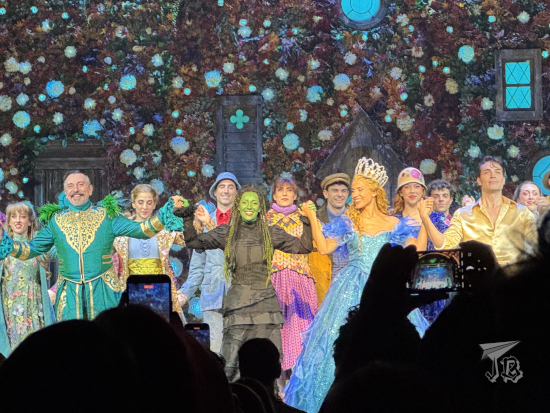
The main cast of the Spanish Wicked musical greeting after opening day

During the break, I returned to the VIP lounge to skip the bathroom lines, and have a snack (popcorn) and my second drink. I have to say that the VIP experience is much more value for money than the London one, even if it catered to way more people – maybe because it was opening day. After the event was over, I made it to the nearby underground station and… the trains were crowded. I’ve seen fewer people on the platforms on a random weekend morning. Maybe in the future, I can drive closer to Madrid and park somewhere with an underground station so I won’t need to book a hotel.

However, staying over had a few advantages. When I woke up in the morning, I headed towards a cosy café (as cosy as a franchise can be), Santa Gloria, to order a “glorious latte with vanilla” whipped cream and cinnamon, and a salmon-on-avocado toast, which was delicious. Afterwards, I took the underground to meet up with some family members (amongst them my very-disappointed nibling). Their house is actually quite near the Museo del Aire y del Espacio, Museum of Aeronautics and Astronautics and we headed there to spend the morning.

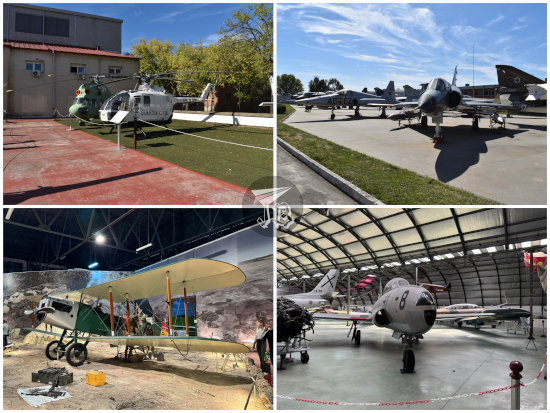
The Museum of Aeronautics and Astronautics is a space where the Spanish Air Force preserves historical aircraft. It is located in the neighbourhood of Cuatro Vientos (Four Winds), close to the military air base. Since it was established in 1975, the site has expanded its collection to 200 aircraft. There are seven hangars full of stuff and almost 70,000 square metres of exhibition. Along with all the actual preserved items, there are reproductions of important planes in history, models, engines, uniforms… I know next to nothing about the history of aeronautics, but it was really cool to see all the machinery and even go inside a couple of planes. There were even a few items from space exploration.

We were there from around 11:00 until closing time, 14:00, and it was barely enough to have a quick look at everything. There are guides who show you around, and it might be interesting to take a visit with one of them in the future.

Several aircraft at the Cuatro Vientos - helicopters and military planes, along with a historical biplane.

I had seen there was a big shopping centre nearby, but we got lost and then caught in a traffic jam, so we ended up having a very late lunch before everyone headed home for the day. Oh, but the mall had a Lego store where I could get stamps on my passport. When the salesperson asked me how many I wanted, he was somewhat surprised that I said I wanted all of them…

20th September 2025: The Mercury Mine in Almadén {Road Trip & Almadén, September 2025}

My lodging in Almadén included breakfast, so I had a coffee and a toast – better than dinner the previous night, but this time there was the hotel lady working the bar. Afterwards, I just grabbed my things and redid half of my tour from the previous night, and re-visit all the spots inscribed as World Heritage Heritage of Mercury. Almadén and Idrija.

The former mining school, the first one created in Spain, Antigua Escuela de Ingeniería de Minas was still closed – it is not open to visitors due to its poor conservation state. It is a Baroque building erected in the 1780s, with a sober façade and wooden interior with basements and semi-basements to deal with the steep street outside, the whole building designed around a master staircase.

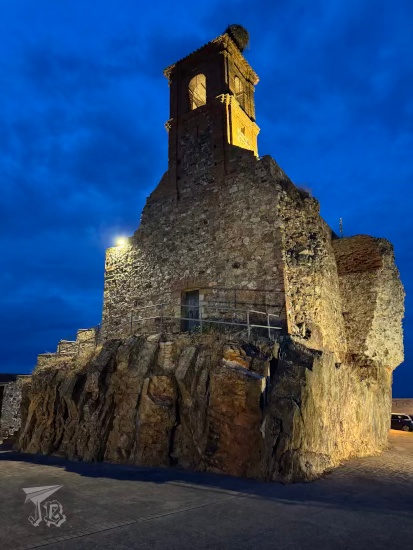
I climbed up towards the castle Castillo de Retamar. Historically, the Romans were the first to intensively exploit the mines, as they used cinnabar for pigments. Later, the Moors started distilling mercury, which they used for decoration. There are testimonies of fountains of mercury running in Al-Andalus – let’s face it, quicksilver is a fascinating thing. As the Moors wanted to protect their dominion over the mine – and the whole territory, including the water sources – they erected the castle in the 12th century. The building was later reinforced by the Order of Calatrava, but today there are only a few remains: the brick foundations of what could have been the keep, topped with a 14th-century bell tower.

I finally headed out towards the mining complex Parque Minero de Almadén. When the mine closed down in 2003, it had been the largest producer of mercury in the world throughout the current era – it is calculated that one third of the mercury used in the world comes from Almadén. The catch? Several of them, actually. First of all, mercury is toxic. Second, the exploitation of the mine was less than stellar – at a point in history, digging in the mine was a punishment for capital crimes, considered worse than being sent to row in the navy, with workers being little more than slaves. Third, the mine is surrounded by underground water reservoirs that percolated slowly into the tunnels, which reach 700 metres deep, threatening to inundate them. If breaking down rock was hard, so was carrying the mineral, along with bags of never-ending water, up and out. Since the mines closed, the water has flooded most of the 19 under-levels of the mine, rising up until the third one.

With the mine closed, life in Almadén dwindled down. The area opened to visitors in 2008. When the Unesco Heritage Declaration came in 2012, it breathed a bit of a new air into the town, turning it into a tourist destination, but lack of management makes it, in the end, barely worth a day’s visit. Visits to the mine are only guaranteed at the weekends, when the museum located in the university is closed down. Reservation of activities is confusing, and unless you’re a whole group there is no way to book a complete visit. I had booked the guided visit to the mine at 10:30 in the morning and a visit to the museums in the afternoon. I was not sure that I could do both before Spanish lunch time, but figured out I would be able to talk my way into the museums early if both things could be combined in one go. It was actually the cashier’s idea to have me do so, even better. One of the museums was closed and there was no warning about it anywhere but Google Maps, which feels a bit like cheating.

The main entrance to the mining complex Parque Minero de Almadén is locked down. There is a side building with an open door and a sign reading “we don’t have any information about tourist visits”, which leads to the Visitors’ Centre. That was confusing. As I came in, there was a large group who had not booked in advance because they were afraid they’d feel claustrophobic, and now they had no tickets. The cashier managed to fit them into the afternoon visit. I talked to him about my bookings and he told me to go to the museums after my mine visit, and to wander around while the rest of the group came together.

The lift that reaches inside the mine (modern lift in old encasing)

Of course, there was a family with young children absolutely in the wrong mind frame to get into a poorly-lit underground tunnel for a couple of hours. Fortunately, there were two groups organised and I made sure to insert myself into the child-free one. I didn’t want a repeat of the Cueva del Viento, where a bunch of information was lost due to kids being kids. And I understand that kids are kids but… for me it’s hard enough to focus on the information from a guide without the added distractions.

The visit into the mine only goes down to the first floor and an upper sub-gallery, after which you ride out in the “mining train”. Before starting, you need to get your helmet, and some lanterns are dealt out to each group to improve visibility in the tunnels. The rules are simple: distribute the lanterns throughout the group, keep light pointed at the floor. Apparently, those pointers are too hard to follow – my group had three lights together in the middle of the group, pointed upwards all the time. Good thing phones have torches now.

The descent to the mine is done through a modern-times lift installed in a former shaft Pozo de San Teodoro, down 50 metres to the gallery. It did not feel claustrophobic to me, and surprisingly, I was more impressed about knowing about the water creeping up than the rock above my head. The visit took about two hours and a half. Along the walk we saw areas that were worked on from the 17th to the 19th centuries, along some of the machinery that came into play in the 20th.

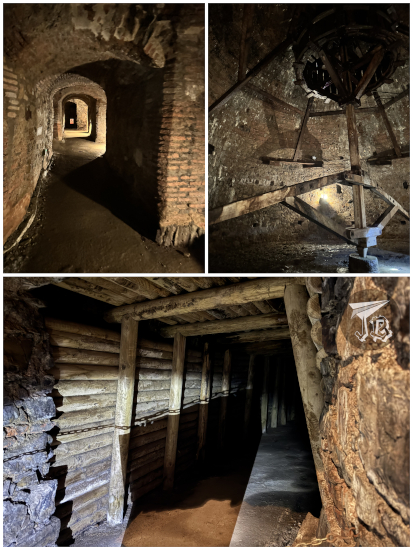
Inside the Almadén mine - corridors and mining galleries and a well to extract the water.

Inside the Almadén mine - corridors sustained by brick. In one of the pictures there is a bat flying but you can't see it.

Don’t get me wrong, back in the day mining those tunnels must have been beyond horrible. It is impossible to describe the history of mine without considering the harsh conditions the workers had to endure, especially the prisoners that were all but enslaved there for decades. The most intense exploitation of the mine happened during the age of the Spanish Empire and its expansion to America. Mercury became a key ingredient in the production of gold and silver in the New World.

Inside the Almadén mine - corridors sustained either by brick (newer) or wood (older).

Inside the Almadén mine - corridors and an image of the Virgin Mary.

Throughout the works in the mine, various exploitation strategies were used, digging both horizontally and in angles. We saw different methods and tools, from plain old pickaxes to modern hydraulic hammers, and the room where the mules would work to help extract the cinnabar. We were shown corridors held up by wooden beams – which were discontinued after in the mid 1750s there was a fire that lasted two years – and later brick ones. We saw shafts that had water at the bottom, and in the end we rode a little mining train to come up to street level. The visit ended with a brief lookout and explanation of the furnaces used to purify the mercury.

A piece of cinnabar embedded in the rock within the Almadén mine.

The mining train that used to transport cinnabar and now transports tourists out of the mine.

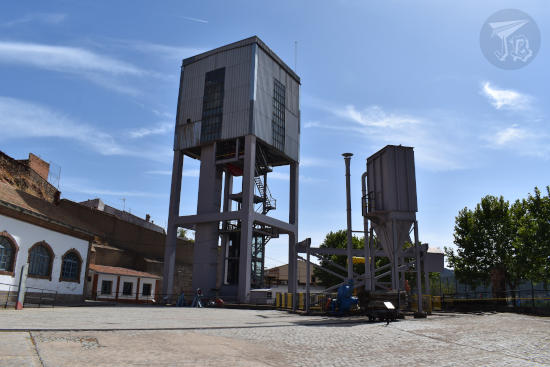
Rusted distilling equipement, metres high, where mercury was produced from cinnabar when the mine was in operation.

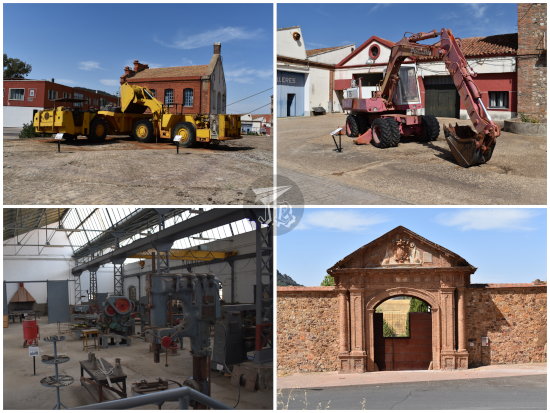
Afterwards, I had my visit to the museums. One of them has an explanation of the mining procedures, the same thing we had heard within the mine itself. The second held the former workshops, which displayed machinery to keep up with the maintenance of all the apparatuses used within the mine. I was the only person who had booked those tickets, so it was a quiet visit. I was also allowed to amble around the outer part of the mining park, seeing all the heavy-duty machines.

I left the mining park and tried to find the historical gates. The entrance to the mines has always been walled off – historically to protect the valuable resources it held. I could see the restored Puerta de Carlos IV. This gate would have taken me to the Mercury Museum, currently closed. There was another gate, but the overgrown vegetation made it impossible to do more than glimpse it.

Mining equipment and buildings on the outer part of the mine in Almadén, including an excavator, the mechanical shop and the classic door, in red brick.

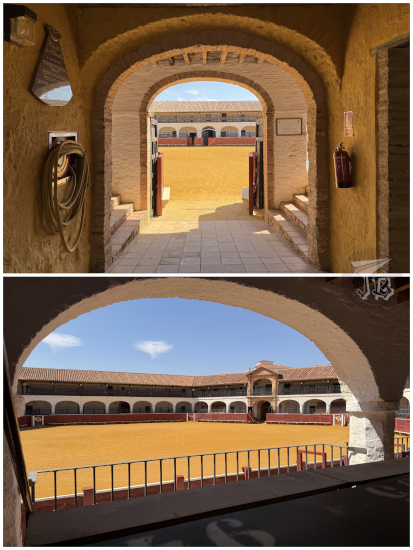
My next step was heading back downtown until I reached the bullfighting ring Plaza de Toros de Almadén. During thirty-month fire of the mine, which started in 1755, the miners had to work on anything, anywhere, to raise some money. One of their ways to get income was converting the communal garden into a bullfighting ring – at least that is one theory. Today, it is considered the second-oldest ring in the world, with the characteristic that the coso (the actual bullring) is not a circle but a hexagon. It is an important national monument and part of the Heritage Site.

Bullfighting ring in Almadén. The sand pit is hexagonal, which is its main characteristic.

In front of the entrance to the bullring stands the Monument to the Miner Monumento al Minero, which takes a new meaning after having visited the mine itself and heard about all the hardships and dangers within its galleries.

And then came the hard job to find a place to grab a bite. I wanted to try a typical dish from a restaurant with a typical name, but they had run out… For real. At least they let me have lunch at the bar… It made me decide to buy something from the local supermarket to have dinner later on. After lunch, I went back to the hotel to wait for 17:00, when the last monument would open.

This was the former hospital Real Hospital de Mineros de San Rafael. It was built between 1755 and 1775 – started during the fire – in order to treat miners who became ill or had an accident in the mine. The most common malady was hydrargyria – mercury poisoning – though of course there were physical accidents, especially loss of fingers after dynamite was introduced.

The visit has three parts of sorts. On the right there is a bit on the history of mining medicine and mercury poisoning. On the left, a very humble display of what is called “the archive” – documentation related to the mine and mining operations. Upstairs, a ward with some archaeological items and an exhibition about how the layman lived outside the mine, with a chilling panel explaining that the work in the mine was considered so dangerous that children would not be allowed to play when there was a relative in the galleries.

Mining hospital - a baroque building with some exhibits inside, amongst them cinnabar, mercury (sealed away) and a wagon

Afterwards, I moved towards the current university, which has been built around and over the former prison Real Cárcel de Forzados, but there was nothing to see from the outside, and the campus was closed as it was a weekend. However, I was on a small hill, so I decided to continue upwards and see if I could get a general view of the mining park. I ended up at a small forest-park, but did not get a great view.

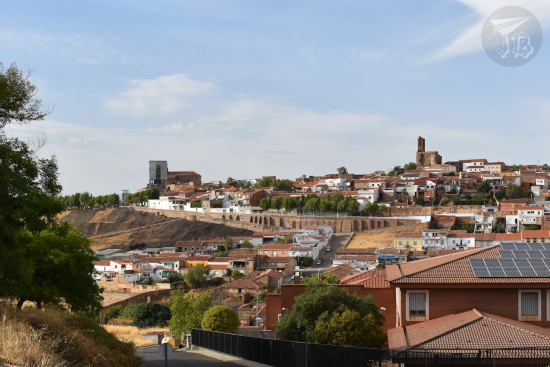
A general view of the town of Almadén. It shows that it is located on a hilltop. The main structures seen are the mining complex on the left (a grey mass on top of a black gorge) and the castle at the very top.

I headed downtown again and I headed towards a tobacco shop I had seen in a small side street. They had souvenirs in the window, so I hoped that they would sell some mercury. Technically, you cannot buy mercury in Europe – both the Mining Park and the Hospital staff had told me so – but this little shop had a little for sale. So yay me, now I officially own some Almadén mercury.

I found the side entrance to the church Iglesia de Santa María de la Estrella, but no other shops open – I wanted to buy some local cheese. Not even the supermarket had anything that I would not find in my local one. I did buy some dinner and snacks though, and a thermally insulated bag because mine is old and is not working that well any more. It helped keep dinner fresh until I reached the hotel and could use the small fridge there. Pity about the cheese though.

Baroque church in Almadén, showing the exterior in and the main altar.

I turned in afterwards to decide what I would do on my way back, and study the routes.

19th September 2025: A knot of roads {Road Trip & Almadén, September 2025}

I woke up early – way before the alarm clock went off, so I decided to hit the road. I first topped up the fuel tank at the cheap petrol station near my place. Afterwards, I drove off to the motorway and the morning rush hour. As I was caught in the traffic jam, there was a pretty rainbow in front of me – no pictures, though, for obvious reasons. Traffic dwindled a lot when I left the A2 behind and merged onto M50. From there, I took a couple of hours to reach my first stop, the village of Consuegra. On the mountaintop of the so-called Cerro Calderico, in the outskirts of this ten-thousand inhabitant, stand some the best examples of restored traditional windmills.

During the Middle Ages, the area in central Spain known as La Mancha proved a challenging place for watermills, the dominant technology at the time. The rain regimes cause irregular river flow, with a lot of the currents drying up in summer. As demand for flour grew, windmills were built near but outside towns, on high ground. They provided clean flour, cheap enough to be affordable, without being subjected to draught or flood seasons changing. The windmills lived its golden age from the second half of the 16th century until almost the 20th. Towards the end of the 1800s, most of the cereal crops were exchanged for vines in order to supply wine to France, leading to the decay and progressive abandonment of wind-milling. The Industrial Revolution and the appearance of fossil fuels and electricity finished off whatever little remained in the early 20th century.

However, besides their practical function, there was something else about the La Mancha windmills. They had gone viral centuries before the Internet was a thing. In the year 1605, Miguel de Cervantes – considered the greatest writer in the Spanish language – wrote his masterpiece El Ingenioso Hidalgo Don Quijote de la Mancha, worldwide known as “Don Quixote”. The novel is amongst the most translated literary works in the world, and tells the tragic story of a minor nobleman, the title character, who goes crazy from reading too many chivalric romances. He decides to leave his home and become an errant knight, having great adventures in his mind, which are more misadventures in real life. He is accompanied by a farmer-turned-squire, Sancho Panza.

During one of his delusions, Don Quixote fights giants with long arms – which the reader knows, from Sancho’s warnings, that are in reality windmills. Of course, the madman is “defeated” by the blades, which shatter his spear on impact. It is one of the most famous passages of the book, even if it is barely a page or two in the eighth chapter. Throughout the novel, which starts “in a village of La Mancha, the name of which I have no desire to call to mind”, several locations are explicitly mentioned, others are implied, and some have completely imaginary names. Experts have placed this fictional encounter with windmills either in Consuegra or Campo de Criptana – which was not on my route.

Thirteen windmills were built in the 19th century on the Cerro Calderico, and twelve have been restored and turned into tourist attractions – one even works. They stand in a row alongside the ridge and next to the local castle Castillo de la Muela (or Castillo de Consuegra). After all, both castles and windmills need the higher ground to be effective, in a way. The castle already existed in the 13th century, with roots in a 10th century previous fortress.

I parked at the foot of the hill and walked up to see the castle and the windmills. The castle was closed as it was a local holiday, and the fortress is managed by the town hall. I stayed around for an hour or so, walking from one end of the hill to the other. I had a snack as I snooped around, then I moved on.

Consuegra - a line of windmills with a castle in the background

My next stop was the National Park Parque Nacional de las Tablas de Daimiel, a weird place. I call it weird because despite its status as a protected area, it has been on the brink of collapse for the last century or so. The wetlands have been drying out for decades.

The area is the literal last of its kind in Spain, a kind of wetland generated when rivers break their banks in their middle course on flat terrain. In the middle of the de facto Spanish Inner Plateau desert, it is formed by the rivers Guadiana (fresh water) and its tributary, the Cigüela (brackish water), and fed by a number of underwater aquifers. These have been exploited for farming, which seems to be the cause for the dessication. So out of what it should be, there is only one medium-sized pond, Laguna de Navaseca (usually referred to the “permanent pond” Laguna Permanente), where a number of birds, fish and amphibians live either seasonally or all year round. The area was designated a national park in 1973. Later, it received other protections, especially regarding the bird population.

I parked in the allocated space and had a sandwich before I went in. The visitors’ centre was manned by a very disgruntled employee who explained the dessication to me as if I were personally responsible for it. I really felt like apologising. The truth is that the first place I visited was the pier, which has not seen water for at least a decade. I could do two of the three walking routes, but in the end I only did one and a half, as the second I tried was way hot and dry and I gave it up three-quarters in, as there was no water any more.

In the end, I stayed around the main pond Laguna de Navaseca, where wooden walkways have been built. I felt horribly guilty whenever the wood cracked under my feet and I scared the ducks away, but the local guides could be heard from across the whole pond. On the banks, there are bushes of common reed (Phragmites) and rushes (Juncus). The only tree in the area is the tamarix (Tamarix gallica), small and brime-resistant.

In the pond – and flying over it – I found a flock of greater flamingoes (Phoenicopterus roseus) – which are for some reason not listed anywhere that explains the park. I also saw herons, ducks, geese and I swear ibises – the latter are not mentioned either, but my bird identification book suggest a glossy ibis (Plegadis falcinellus). I was hoping that autumn had modulated the temperatures a bit, but it was extremely hot. It was also… stupidly dry for wetlands… That is why I gave up on the second route halfway.

Doñana National Park - view of the main pond, surrounded by low bushes

Doñana National Park - view of the main pond with flying flamingoes

An ibis waddling for food

A flock of flamingoes flying

I went back to the car and drove to a small parking lot at the entrance of the park which allows you to see the watermill. It was closed, and again dry, but it was an interesting structure.

I continued on the road towards the archaeological site Yacimiento Visitable de Calatrava la Vieja in Carrión de Calatrava, which has a very nice and shaded parking area, where I had my second sandwich as I was there 30 minutes before schedule – read: they had not opened yet.

The archaeological site is considered one of the most important of Moorish origin in Spain – a city and a castle from that period, erected on older remains, probably Iberian. Back during the Arab vs Christian wars in Spain, the fortress was right in the middle on the way between Toledo and Córdoba, along with other important commercial routes, so it became a key defence point. It is known that the castle already existed before the 8th century, on the Guadiana riverbank. When it fell to the Christians around 1150, it became the first line of defence, and it was entrusted first to the Knights Templar and then to the Cistercians. It became the birthplace of the first Spanish military order, the Order of Calatrava Órden de Calatrava.

Calatrava castle from the outside - a ruined fortress with a roundish shape, built in clay-coloured rock, with no vegetation whatsoever around it

The castle was built on a plateau, defended by the river itself and the walling structure, which included at least 44 flanking towers. There were four fortified corridors (corachas) that protected access to the water. The entrances to the inner fortress had several turns to make them easier to protect. Between the inner core and the walls stood the medina, the Islamic city, and the alcázar rose as a sort of triangular keep, accessed through a triumphal arch. The inner castle itself is the best-preserved area, having even rebuilt furnaces to make clay. During the Templar times, part of the alcázar was repurposed into a budding church which was never finished. On one of the inside walls there are carved drawings of vessels.

Calatrava castle, collage: The inside of a room with a Templar cape as sole decoration, the inside of a pottery oven, a view of the mdina arched entrance and two inner archways.

As I climbed the walls, clouds had started gathering and the wind had picked up. I decided to get going, trying to outdrive the storm. At first I thought I had been lucky, but about 20 minutes away from Almadén, the skies opened and there was a torrential downpour. I was lucky enough to find a parking spot where I hoped, down the corner from the hotel, and I have an umbrella in the car. A few minutes after parking, the storm stopped though, albeit the rain did nothing to cool down the evening. I checked in, and the hotel lady gave me a map with all the spots that have been inscribed as World Heritage Heritage of Mercury. Almadén and Idrija.

Mercury (chemical symbol Hg) is a native metallic element, the only one which is liquid under normal temperature and pressure conditions. In nature, it is usually found as cinnabar (mercury sulphide, HgS), a bright scarlet mineral. Its formation is linked to volcanic activity and alkaline hot springs (the area of Ciudad Real comprises the extinct volcanic field called Campo de Calatrava, which I drove through, but found no way to stop anywhere to explore). Liquid mercury, also called quicksilver, is extracted from cinnabar by heating it, as sulphur evaporates with heat.

Mercury is toxic to the nervous system, dissolves gold and silver, and has long been associated with “mystical” powers and sites – the first emperor of China was buried in a tomb with rivers of mercury, there is mercury under one of the Teotihuacan pyramids in Mexico, and in the end it carries the name of the Roman God of Messengers and Travellers. It has fascinated humans throughout history.

The name of the five-thousand-inhabitant town, Almadén, comes from the Arabic Al-maʻdin [المعدن], which means “The Mine”. The site was already exploited in times of the Romans – the extracted bright-red cinnabar was used to create vermilion paint for the walls of Pompeii and Complutum. When I was a child, my history book had some information on Almadén, and the accompanying photograph showed someone who had thrown a cannonball into a mercury pool, but the cannonball was floating on it. I have wanted to see the mine since then, even knowing that there was no way I would ever see that one pool any more, due to the legislations that have deemed mercury as “too toxic for anything”.

I went to have a look around town. It was dusk and everything was closed – not that many things would open the next day anyway. I did a small circular walking tour which included the main church Iglesia de Santa María de la Estrella, and down the main street the central square with the town hall Ayuntamiento de Almadén and the church Iglesia de San Juan. I continued on and found the the old mining school Antigua Escuela de Ingeniería de Minas. To the side of the street stands the former castle point Castillo de Retamar, where only a turret remains. Up a little, I reached the third church, Iglesia de San Sebastian and the ruins of the manor house Casa de la Superintendencia.

Almadén Castle - a derelict tower in brick, with a stork nest on top

I undid my path and headed to the other side of town. In a secondary square there is a monument to miners Monumento al Minero, and across the street the bullfighting ring Plaza de Toros de Almadén. My final stop was the former hospital Real Hospital de Mineros de San Rafael. I had dinner at the hotel restaurant, which honestly was a little disappointing.

Almadén: monument to the miner at night; a huge sculpture in metal that represents miners. Two of them have picks and are breaking a rock, two others are pushing a wagon. The miners have helmets with actual lights.

I headed back to the room to have a shower and some rest, and get ready for the following day – and try to digest dinner.

23rd May 2025: Valletta {Malta, May 2025}

Around 5:00, I was woken up by a group of guys singing, and I thought they were outside, drunk and going back to their hotel. It turns out that Saint Julian’s | San Ġiljan is a party area. I had absolutely no idea – I would like to chalk that up to the improvisation again, but to be honest the concept of a “party town” is one that had not even crossed my mind till then. I did not sleep much afterwards, so a bit after 7:30, when breakfast opened, I headed there, then I took the bus towards the capital, Valletta.

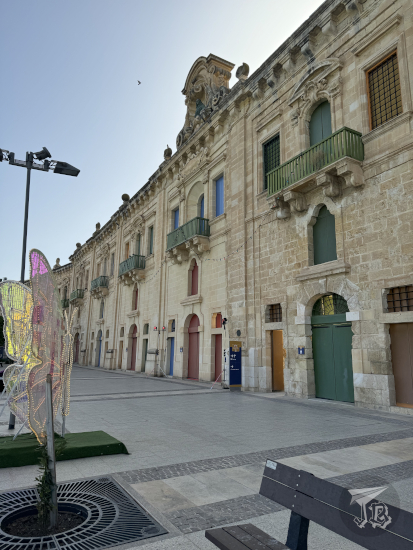
My first stop was a compulsory one – the City Gate | Bieb il-Belt which I had to cross to walk into the city. The capital of Malta was declared a Unesco World Heritage in 1980 under the name City of Valletta because with 320 monuments in 55 hectares, it is one of the most concentrated historic areas in the world. The city was erected by the Knights Hospitaller around a watch tower that was demolished to create a large defensive fort. After said fort fell during the Great Siege of 1565, the Grand Master of the Knights Hospitaller Jean de Valette decided to build a grand fortified city with plans by Francesco Laparelli. Neither Valette nor Laparelli saw the city complete, which happened in the 1570s, when it became the capital. The Gate is the entrance to the fortification itself, separating Valletta from the city of Floriana. Protected by its the walls, Valletta thrived and though 17th the century it became filled with manors and palaces, some of which have now been repurposed as hotels or museums.

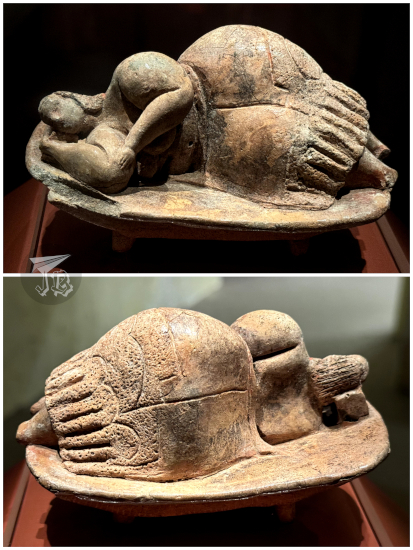
One of such buildings is the National Museum of Archaeology, which hosts artefacts from the Neolithic (around 5900 BCE) to the Phoenician period (circa the 6th century CE). On the ground floor they have all the items that have been removed from the Neolithic temples for protection, including some of the carvings from Ħal Tarxien Prehistoric Complex. A tiny clay figuring called The Sleeping Lady captured my attention. It was a lovely detailed little representation from the so called Temple Period of Maltese history (4000 – 2500 BCE), which was recovered from the Ħal Saflieni Hypogeum. There are also headless bodies and bodiless heads found at other temples.

Archaeological Museum Valletta: pieces taken from the Temples in order to protect them: carved rocks, statues (most of them of bodies without heads), trilithons...

Archaeological Museum Valletta: Sleeping lady. A small figurine of a woman sleeping made in clay

I proceeded upstairs, where there is a small exhibit on “cart ruts”, a network of tracks in the rock. The analysis seems to show that they were made by carts with wooden wheels eroding the limestone. However, there are no… traces of whatever pulled on them – no tracks, no trails, nothing but the wheels. There is another room displaying Phoenician civilisation, and one showing some amphorae from a shipwreck off Xlendi Bay in the island of Gozo, at a depth of 110 m. The ship sank in 700 BC, it was discovered in 2007 and it was finally excavated between 2018 and 2021.

The final room I saw hosts a few skulls from the Ħal Saflieni Hypogeum. I might have to return to Malta just to finish exploring all the prehistoric sites – aside from that, there is sea, the food is delicious and when you open the tap, the water is warm. I felt right at home, really. Anyway, some of these skulls are described as “elongated” and for a while there was even a conspiracy theory about them being alien… They are not. The elongation was not artificially created, like in some Mesoamerican cultures. They belonged to a few individuals who had… long heads. Which is a bit anticlimactic, but only a few remains have been recovered from the calculated thousands, so there is very little that can be inferred from whomever was interred in the burial chamber.

Archaeological Museum Valletta: Phoenician pottery, skulls from the Hypogeum, anforae from the shipwreck

There was actually a last-last area, a ball room from the Baroque palace, but that was under construction and I could barely have a bit of a look. Afterwards, I walked towards the St. John’s Co-Cathedral | Kon-Katidral ta’ San Ġwan. The Catholic co-cathedral shares responsibilities with the one in Mdina, and was built between 1573 and 1578 in a Mannerist style. The interior was redecorated in the 17th century in a very Baroque style and lots – and I mean lots – of gold and golden decoration. Downstairs, there is a crypt where some Grand Masters of the Knights Hospitaller are buried. On the main floor, the nave is surrounded by nine chapels, eight of which are dedicated to the different chapters of the Order and their patron Saint, and the last one is dedicated to and one to the Virgin Mary. .

Though you can get tickets online, there is no chance to buy same-day tickets but on site. I queued for a while, maybe 20 minutes or so, before I was scanned for… guns and explosives… then I was allowed in. There were small restoration works being carried out. Not a Baroque person in general, but I have to admit it was impressive. I declined climbing to the dome because the fun views are from across the harbour, not from inside the city itself.

The co-cathedral holds two pieces of art by Caravaggio – The Beheading of Saint John the Baptist and Saint Jerome Writing, both in the chiaroscuro style – with high contrasts of light and dark. Michelangelo Merisi da Caravaggio (1571 – 1610) was one of the maximum representatives of chiaroscuro, with usually violent and gruesome topics, usually disguised as hagiography.

Baroque interior of the cathedral, with dark walls decorated with frescoes and golden wood

After I exited the cathedral, I headed down a small alley opposite for something that is not a monument but… made me happy anyway. Malta has Costa Coffee – something which, unlike the plugs, I had thought of checking beforehand. I actually had a shop near my hotel. Had I known that, I might have skipped booking breakfast. What I did worked really well though, so no big deal. I managed to balance breakfast and dinner, which made my moving around more convenient, not needing to find a place for lunch. Of course, a medium vanilla latte from Costa does not count…

My next stop was the Grand Master’s Palace | Il-Palazz tal-Granmastru. It was the first building erected by the Knights Hospitaller around 1574, and it is considered the seed of both Valletta and the country of Malta itself. The building was first the residence of the eponymous Grand Master of the Knights of Malta until the 18th century, then the residence of British Governors, the Seat of the Parliament, and it currently houses the Office of the President of Malta. That explains why the security is tight enough you’re not even allowed a bottle of water in.

The building was designed by Gerolamo Cassar. The exterior is Mannerist, severe and simple, but the interior is richly decorated with paintings and frescoes. Some of the rooms have coffered ceilings and tapestries on the walls. There is a huge armoury, organised chronologically, and a throne room, which felt a bit out of place for a republic. The building has two courtyards – the so-called Prince Alfred’s Courtyard has a clock tower which is claimed to date from the 1530s. Oh, and apparently, it’s haunted? I did not feel anything out of the ordinary, not even a temperature drop. That would have been handy.

Grand Master's Palace - clock tower, throne room and corridors decorated with frescoes

After the Palace, I walked down Valletta’s narrow streets and until I reached St Paul’s Pro-Cathedral | Il-Pro-Katridral ta’ San Pawl, the Anglican “temporary” cathedral, established in 1839 – and still in use. It is a Neoclassical building with a very characteristic steeple and an organ imported from England.

Interior of the cathedral, with corinth columns and a small altar.

I then took a walk towards what is called Lower Valletta, at sea level. I walked around Elmo Bay and reached Fort Saint Elmo | Forti Sant’Iermu. The origin of the star-shaped fort was defence against the Ottoman Empire (which would eventually yield to Türkiye), and it is a large structure in limestone. It was key in the 1565 Great Siege of Malta and the Maltese victory. However, the interior is a War Museum, and I did not quite feel like that. Instead, I walked around and went down to the beach to enjoy the waves and the views of Fort Ricasoli | Forti Rikażli across the bay.

Fort St Elmo - a sea-side fortification made in golden limestone

Later, I found the Lower Barrakka Gardens | Il-Barrakka t’Isfel, a green terraced with trees, monuments and fountains, along with a nice view. I was heading upwards again, towards Upper Valletta.

Lower Barrrakka Park: Mediterranean plants, a temple-like building and a pond.

I thought I ought to get some food as I passed by the Valletta Food Market | Is-Suq Tal-Belt, but I did not find anything I fancied. I bought a soda in a small market in the basement, where I was charged 10 cents for the “reusable cap” (fair) and 10 extra cents for buying a chilled drink (LOL). The soda gave me calories and hydration enough to continue on, so I found the Upper Barrakka Gardens | Il-Barrakka ta’ Fuq. Aside from a nice mixture of architecture and nature, the gardens are linked to the Saluting Battery | Batterija tas-Salut, which stands under the terraced area of the gardens as part of the St. Peter & Paul Bastion. It was constructed in the 16th century for ceremonial gun salutes. Today it hosts cannon replicas that are fired at 12:00 and 16:00. I was there for the Evening Salute, with the firm plan to watch from above.

Then a nice gentleman in a nifty uniform said something akin to “for just 3 € be the closest to a firing cannon you can be in Europe” and there went all my restraint. I mean it was only 3 € and being the closest to a firing cannon you can be in Europe. Yes, I’m easily distracted. Yes, I paid the 3 €.

Entry included a brief explanation, including what a “smooth-bore breech loading 32-pounder gun” is: basically, a cannon designed in the 1880s with a smooth barrel, which can be loaded from the breech end of the barrel and… can fire shells weighing 55 pounds (24.95 kg). They were made modifying guns that could only shoot 32-pound shells though. The soldier-actor explained about cannons, how to load them, what the process was and the security protocols. Oh, and that the weapons were anything but accurate in real life. That was cooler than I thought it would be, so I was happy I had decided to get the ticket.

Saluting Battery: cannons and still of the shooting

 
When the demonstration was over, I left the gardens. I walked past the Tower Port and The Lascaris War Rooms, another war museum, on my way to the Herbert Ganado Gardens and the Kalkara Steps. Doing this, I temporarily left Valletta and stepped into Floriana, then walked back into Valletta until I found The Valletta Waterfront, a group harbour warehouses from the 1700s which have been converted into restaurants, bars and souvenir shops. Since it was that silly time when the restaurants have closed after lunch time and are not yet open for dinner, it was almost empty, so it was nice to see all the buildings.

Valletta Waterfront: a line of neoclassical warehouses and buildings turned into shops and eateries

I had two options then – one was walking back towards the city centre to see two churches that I had missed, or head back to Saint Julian’s | San Ġiljan. Since I was quite closer to the bus station than to any of the churches (Shrine of Our Lady of Mount Carmel | Bażilika Santwarju tal-Madonna tal-Karmnu and The Collegiate Matrix Parish church of Saint Paul | Il-Knisja Kolleġġjata Arċipretali u Matriċi ta’ San Pawl), I decided to return.

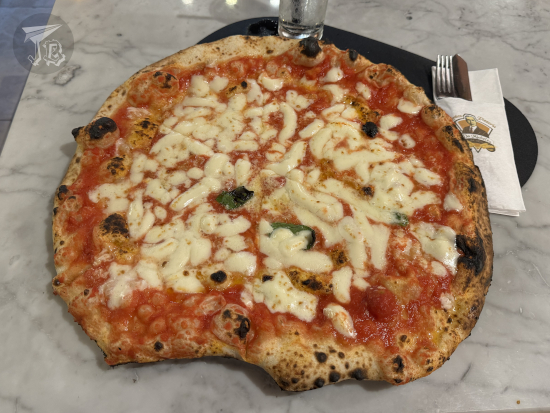
Once in Saint Julian’s | San Ġiljan, I had the largest pizza I’ve ever had the pleasure or disgrace to be served. I mean, good thing that I ordered a plain Margherita (in all honesty, it was the house special with extra cheese) because I would not have been able to eat anything with toppings, even after having basically skipped lunch. I somehow made space for ice-cream afterwards…

Huge Margheritta pizza

22nd May 2025: Blue Grotto, Tarxien & Saint Julian’s / Sliema {Malta, May 2025}

My flight departed at 9:55 from Madrid-Barajas, which is actually a very bad time for a flight, as you have to drive to the airport through the daily rush-hour traffic jam. However, for a change, I was given a lift there instead of driving myself – my car failed a few days before and I was not feeling too trusting. The inbound plane was delayed, and we ended up landing at Malta International Airport around an hour late.

It turns out that Malta has done a smart thing – the airport is also a coach hub, and there was a bus which went directly where I wanted to go first 20 minutes afterwards – that was lucky because the bus only comes every hour. It did not take long to reach the Blue Grotto | Taħt il-Ħnejja in the village of Qrendi | Il-Qrendi.

I got off in an aptly-named bus stopped called Grotto, next to which stands Xutu Tower | Torri Xutu. The history of Malta cannot really be understood without mentioning the Order of Knights of the Hospital of Saint John of Jerusalem, the Knights Hospitaller, today also known as the Sovereign Order of Malta. This Catholic military order was founded during the Crusades in the 12th century and the knights were established in Malta between 1530 and 1798, acquiring the name. They fortified the island and created the city and defences of Valletta, so-named after Grand Master La Valette. The knights built hospitals – along with medicine schools – and turned Valletta into a centre of art and culture with a university, a school of navigation, and a school of mathematics. Through the centuries, the order transitioned from a warring and defensive army to an organisation centred in humanitarian, medial and social assistance.

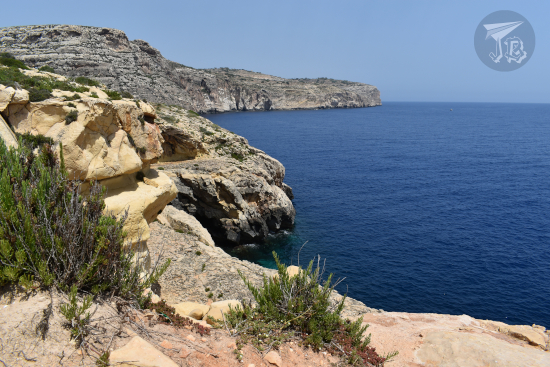
Xutu Tower | Torri Xutu was one of the towers built during the operation to fortify the coastline of Malta, probably around 1650. It is a two-story tower with a square ground plan and vaulted ceilings inside, setting the example of the towers that would be built afterwards. As many buildings in the island, the tower was erected using limestone, and restored in 2014 using the same type of material. It also yields to impressive sights – even without climbing it – of the ocean and the islet of Filfla, uninhabited and turned a bird sanctuary.

Qrendi cliffs, made if whiteish - grey rock, over a calm dark-blue ocean

I bought a ten-euro ticket to sail to the Blue Grotto | Taħt il-Ħnejja from the Blue Grotto Boat Service. This is just a way to amalgamate all the captains and boats who do trips to the caves, I think, and not a bad one. It is a quick trip that does not even take half an hour and charters you to snoop the different caves, created by the erosion of sea water and waves against the cliffs. Each has its name: Blue Window Cave, Circle Cave, Calscave, Honeymoon Cave, Cat’s Cave, Reflection Cave and the main archway which gives the name to the whole area, the Blue Grotto. The water is very clear and since the sun was out, there were extremely beautiful reflections. I stuck my hand in the ocean a few times when I was not taking pictures.

Blue Grotto: Sea level caves with bright blue water

Afterwards, I decided to stop for food. I was not really hungry, but I wanted to tackle the walk to the viewpoint, which was 15 minutes. I thought it would be more efficient to have a late lunch first. There were a couple of restaurants and I chose Step in Malta. It had a terrace, was less than half full, and most importantly: offered calamari fritti. When I researched Maltese food, I read about this dish – fried squid with garlic and parsley mayonnaise, and I really wanted to try them. I think I broke the poor waiter’s brain when I told him I did not need the menu and ordered directly. They were delicious.

Calamari fritti: a plate of breaded and fried squid

I then did the short walk to the Blue Grotto Viewpoint – and though I won’t be mentioning it much, just assume I just used a lot of sun lotion all the time. It did not take as long as I expected, even if the shortcut was closed down. It yield to pretty views, but not as impressive as expected.

Blue Grotto viewpoint, showing the cliffs from above

I was about to go back towards the original spot to wait for the 201 bus again, when a Valletta-bound bus stopped by. I hopped onto that one to use the Wi-Fi and replan the rest of my evening. An idea had been to head towards Valletta indeed, but instead I decided to try my luck to reach my first Megalithic temple in Tarxien | Ħal Tarxien. The Blue Grotto is actually quite near another archaeological complex, but that one was covered by the tour I had booked on Saturday.

The trip to Tarxien turned out to be a great idea. When I arrived, I was surprised by the sheer amount of Christian images that were in the streets. That weekend the Catholics celebrated the Feast of the Annunciation. Malta is officially a Catholic country with over 80% of the population adhering to the religion, so while it was slightly surprising to see so much decoration, it is not shocking. I wanted to get to the Ħal Tarxien Prehistoric Complex | Il-kumpless Preistoriku ta’ Ħal Tarxien because it had a closing time.

A street crossing in Tarxien, with a movable Catholic altar brought out. The houses on the corners have flags with religious motives, and the altar is guarded by angels carved in wood

The Megalithic Temples of Malta are considered amongst the oldest free-standing structures in the world. They were erected between 4100 and 2500 BCE (making them older than Stonehenge, whose rocks were placed between 2600 and 2400 BCE), though the remaining structures probably date from the 3600 – 2200 BCE. In 1980, the UNESCO created the Heritage protection for one of the temples, and in 1992, the Site expanded to six temples / structures in total.

The Ħal Tarxien Prehistoric Complex | Il-kumpless Preistoriku ta’ Ħal Tarxien has been dated between 3000 – 2500 BCE, and it is considered the greatest example of the Temple Period (4100 – 2500 BCE). It was first excavated by Maltese archaeologist Themistocles Zammit around 1913 following complaints of a local farmer that he kept hitting stone while ploughing. The main excavation and restoration took place between 1915 and 1920, and some of the most delicate structures were moved to the Malta Museum of Archaeology to protect them from weathering. The site is covered by a protective tent that makes it look a bit alien, and being alone made it even more magical.

The temple is built in limestone, showcasing three constructions which are independent but attached to one another. The rooms are round, and there is evidence that they had a roofing. There are several chambers, and in some of them there are spiral decorations and domestic animals carved into the rock. There is even a small hearth where fire could be lit. I spent about an hour there, nearing closing time, which meant I was almost alone. I was extremely happy to be there.

Hal Tarxien temples - ruins of Neolithic temples with round rooms and trilithon entrances, from outside

Hal Tarxien temples - ruins of Neolithic temples with round rooms and trilithon entrances, from inside, showing spiral decorations and areas that have been restored, such as a hearth

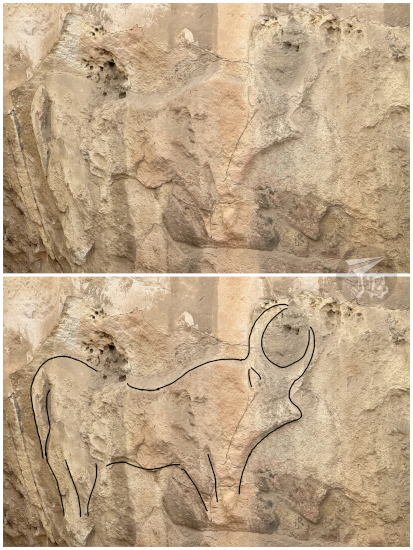
Relief of a bull on a limestone wall

I could not visit the related Hypogeum of Ħal-Saflieni because tickets are released – and sold – months in advance, and this whole trip was planned in a couple of weeks. But I could explore around.

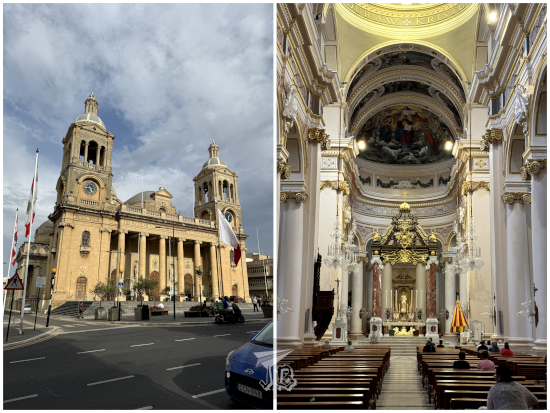
Due to the festivities, some of the bus stops were out of order, so I followed the bust route until I found one that was in use. At some point there I crossed my first “invisible frontier” between the village of Tarxien and Paola. Still in Tarxien, I stopped to look at the Catholic sculptures, and in Paola, I came across the Minor Basilica of Christ the King | Il-Bażilika ta’ Kristu Re. The church was erected at the beginning of the 20th century and, compared to the buildings around it, it feels huge – over 80 metres long, 40 metres wide and 60 metres high. It was full, which I found strange for a weekday at 18:00, but then I thought it might be part of the Feast of the Annunciation programme.

Minor Basilica of Christ the King: a Neoclassical basilica with two towers on the outside, and a sober interior design

I took a bus again and after a few changes I reached my hotel in the town of Saint Julian’s | San Ġiljan. Though I was driven through a few towns, it felt like a huge stride of buildings one after the other, with no real break. It was weird, that the whole area is just one big urban sprawl. I found changing buses easier than I expected, even not knowing the layout of the area. I got to my stop, Ballutta and checked into my hotel.

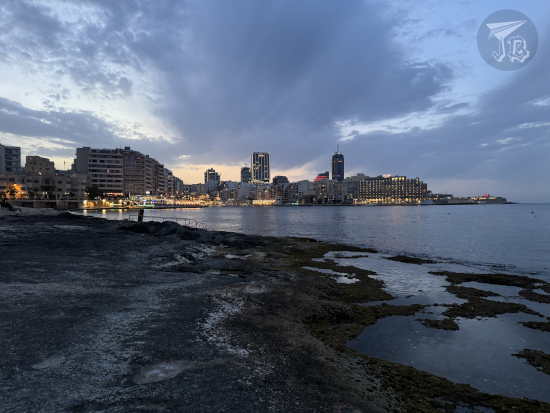
Aaand at that point I realised that there was a consequence of “British colonisation” that had not even crossed my mind – Malta has Type G plugs. So on my supermarket run I had to add an adaptor (despite having a few at home) to my bottled water and sandwich shopping list. I dropped the groceries at the room and then I went off to explore the coastline. That way, I inadvertently crossed to Sliema. I walked along Ballutta Bay and Exiles Bay, two of the three lobes that make up the larger St Julian’s Bay. I was a bit surprised when all the beaches were made of rock and limestone, which made them great to walk on. I had a lovely walk – except at one point, when I slipped and realised that my totally-sensible-for-airport shoes were not the best choice for limestone beaches. Eventually, I went back to the hotel to eat my supermarket-bought dinner.

Balluta Bay at dusk. The ocean is calm, and the buildings at the other side of the water have started turning on their lights

13th May 2025: Three free niche exhibitions (Madrid, Spain)

I planned a little escapade to Madrid. There was nothing really special going on, it was just going to be a sunny day with no rain forecast and I could go to a museum and have lunch. When I say nothing special was going on, I mean there were a couple of exhibits I wanted to see, but it would have been just as easy to visit them the previous or following day. I just timed it for the best weather forecast of the week.

I had a small work-related thing early in the morning so I ended up leaving the house half an hour later than I would have liked. The trains were around 10 minutes late and the underground was packed, but none of that is news. I reached my first stop, the Museum for the Blind Museo Tiflológico de la ONCE, around 11:30. This museum hosts models or miniatures of famous monuments in Spain and around the world, designed to be seen with one’s hands. That way, people with low or no vision can get an idea of how they are. It is part of the ONCE inclusion program for the blind, and I think it is a brilliant idea.

ONCE stands for Spanish National Organisation of the Blind in the local language, Organización Nacional de Ciegos Españoles. Its history and works are a bit convoluted, but keeping it short, the Organisation was established in 1938 with the goal of providing equal opportunities for the blind and people with visual impairments. One of its main income sources is the lottery known as El Cupón de la ONCE.

While the museum itself is free to enter and very relaxed, when you arrive at the building you have to fill out a questionnaire, for statistical purposes, I guess. I did find it a bit off putting that I was outright asked why I wanted to see the exhibition. Because I’m curious, all right?

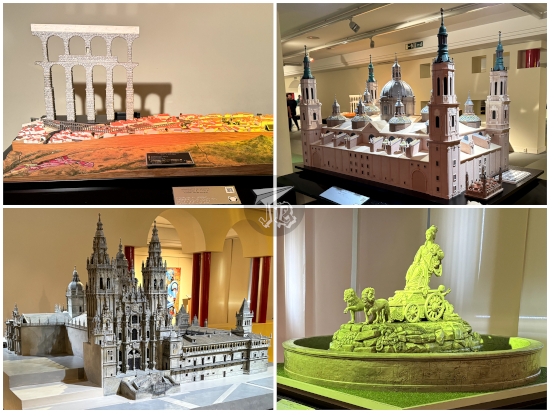
The museum has three distinct sections – one with the reproductions of the monuments, one with works by low vision, blind, or artists with other disabilities, and a historical area. In turn, the monuments are divided in national (Spanish) and international landmarks. The models are faithful to their smallest detail, and just like the Eiffel Tower is made out of metal, the Taj Mahal is made out of marble! Some of the monuments were reproduced in different scales, such as the Alhambra in Granada or the Aqueduct in Segovia. This should give an idea of both scale and detail. However, I don’t think I would ever be able to imagine something like that without being able to see it.

There were lots of sculptures by artists with disabilities, with a disturbing amount of naked ladies, but whatever. I also saw paintings and a homage to Braille that was sort of abstract but was really cool. The historical section hosted a number of items to learn and write Braille through the years, general studying tools such a 3D map of Spain, and a few historical runs of the lottery ran by ONCE. In general, it was a fascinating visit.

Museum for the Blind - national monuments

Museum for the Blind - international monuments

I did some shopping afterwards, and while the sales lady was really nice, she worked rather leisurely- That, and all the pedestrian lights being red on the fifteen-minute walk, put me seven minutes behind for my lunch reservation – and I swear, they phoned me. I was reaching the door of Comic Planet at 13:07 and they were already calling to check I was coming. People wonder why I’m paranoid about reservation times with them… They decided to change my table to “a more private one” to keep me away from a family with toddlers, and I had no problem.

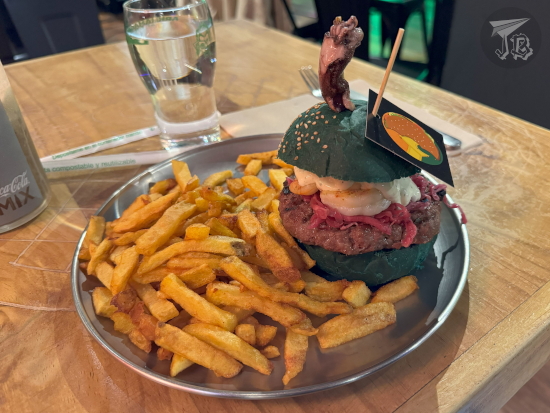
I got to try the last item that I wanted to try from their menu – the Aquaman Burger, which had caused me some morbid fascination when I first read about it– Beef and king prawns? Garlic and pickles mayonnaise? It could be… either really good or really bad, I thought, and I really wanted to check it out. It was all right, I guess. There was much less of a flavour contrast than I expected, so it was most of a normal burger with a bit of an edge. And the edge was that the buns were blue. I also ordered a Vanilla Coke just because I could, and the waiter was nice enough to offer me tap water when I asked for some too. Cool.

Comic Planet Aquaman Burger

After lunch, I took the underground towards Fundación Telefónica which is running an exhibition called “Echoes of the ocean”, Ecos del Océano. I liked the idea better when I did not know that half of it was done using AI. It was – or tried to be – an exhibit centred around cetacean vocalisations. The first room was a mindfulness thingy in which a lady told you to become one with the ocean and then called you fat – “your body enlarges. You’re huge. You’re a humpback whale”. It made me laugh as it broke all the concentration thing. I also cackled when the voice told me that I went “deeeeep” as a sperm whale and met leopard seals there.

Then there were several huge screens with computer-generated graphs that imitated a sea prairie, dolphins and whales. That was the part that was made using AI, and it could have been a CGI or an actual video just as easily. The important part was that the images on the screen moved along the sounds of actual cetacean vocalisations. A room at the end hosted two actual underwater microphones, and headphones to listen to recordings of different creatures – sperm whales, seals, humpback whales – and ice sliding (this is important because for a long time, the sound of ice on the ocean was unidentified and it yielded to a lot of wild explanations / conspirancy theories).

Echoes of the Ocean screens

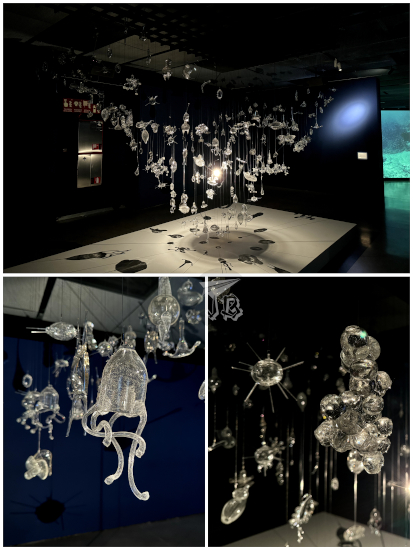
On the way out, there was a sculpture with glass reproductions of different microorganisms that love in the ocean: diatoms, anabaena, coccolithophores, dinoflagellates… Yes, this was totally me geeking out and identifying all the tiny little critters. The final room had to do with some photograph and schematics of a particular blue whale that had been tracked by the organisers.

Echoes of the Ocean plankton

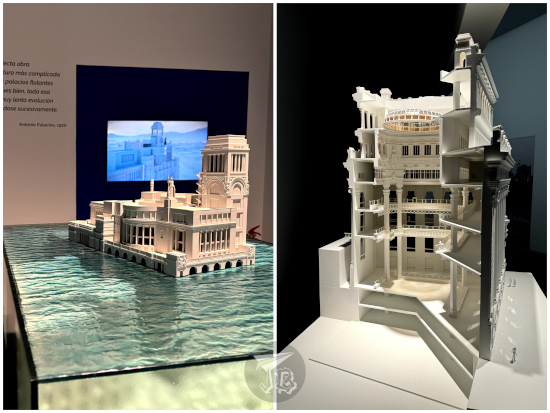
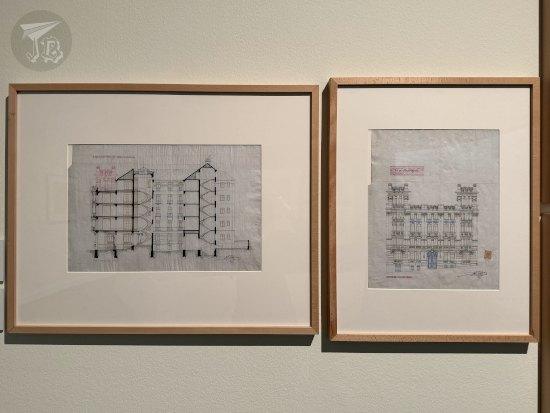
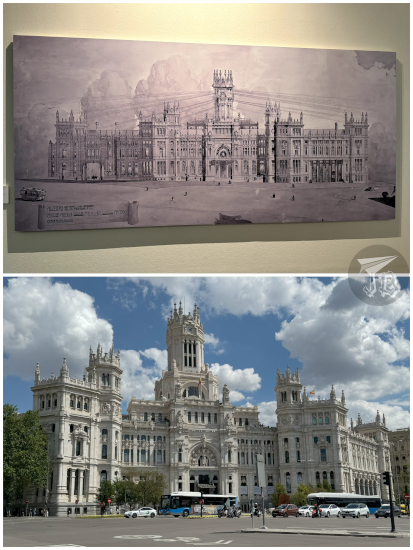
I left the building and headed towards Palacio de Cibeles, which this time, was running an exhibit on its own architect Antonio Palacios. The exhibition is aptly named “An architect’s dream: Madrid as a metropolis” Madrid metrópoli. El sueño de Antonio Palacios. It uses photographs, designs, and models to present the works Palacios projected for Madrid – the ones that were built, the ones that were not, and the ones that have disappeared. It was an interesting collection, and the visit was free! Of course, I wandered the building a little before heading to the train station.

Antonio Palacios exhibit - models of buildings

Antonio Palacios exhibit - framed façade designs

Antonio Palacios exhibit - façade design and photograph of the actual Palacio de Comunicaciones building

On the way, there was a classic book fair Feria del Libro Antiguo y de Ocasión, but everything was way too expensive for me. I guess that in general it was a very budget-friendly day – three free exhibitions – if you do not count tiny shopping spree in-between, and it was around 20 €.

31st March 2025: More Modernisme and the way back {FFVII Barcelona 2025}

For our final day in Barcelona, I had planned some more architectural visits. I had adjusted my planning considering the underground issues the previous day, but it turned out, it had been a Sunday-only thing. We had breakfast and on check-out, the manager asked how the stay had been. To his merit, when we told him about the issue with the air-conditioning, he apologised and offered us free breakfast in compensation. After we declined – timed entry visit – he advised us to write a complaint letter for a discount next time. I didn’t think it was necessary.

Since the station we had to change at was open, there was no issue with the underground, so we were half an hour early. I had booked a locker for the luggage in the centre of town, as the hotel is very convenient for attending a concert at CCIB, but quite far from… everything else, really. The locker system was convenient: you book online and get a code which opens both the place and your assigned locker. I found it more trustworthy than leaving the bags in a random shop which “looks after luggage”. However, about a month later, there was a complete outage in Spain, which made me second-guess the convenience of these things, as I heard about a lady who could not go home because her luggage was inside one of those lockers. We’ll see whether I dare use them again.

We were to continue on my Modernisme route, visiting one of the works of Antoni Gaudí (1852 – 1926), considered the peak representative of the style – to the point that some of his works have been declared Unesco Heritage by themselves as Works of Antoni Gaudí. Gaudí originally found inspiration in orientalism and Neo-Gothic, but as he became more and more established, he turned to nature forms – seeds, branches, bones, catenary shapes… The UNESCO work we wanted to see was Casa Milà, a building commissioned to Gaudí by lawyer Pere Milà in 1906. The building itself was erected between 1906 and 1910, and it was nicknamed “The Quarry” La Pedrera. It is an eight-floor apartment building with a self-supporting façade, electricity, running and hot water. The building was designed around a central patio, and it has a very particular roof-terrace. Some people claim that Casa Milà does not even fit into the Modernisme category, but it should be classified as “organic naturalism”, or even “expressionism” all by itself.

La Pedrera, exterior

I found the building… underwhelming. We had a combined ticket for Sant Pau and Casa Milà at 39 €, but the normal ticket price for the building is 40 €, and this is only for one of the floors with a “recreated apartment”, the attic, and the terrace. At least you get to see the patio as you have to walk past it so you reach the tiny lift in which they cram you to take you to the 7th floor. The experience felt… like… not enough. I was for sure expecting something more.

La Pedrera, Interior

Do not get me wrong, the house is extremely cool, but you get to see really little in comparison to how big the place is. So even if it is pretty, it feels crowded and small, with way too many gift shops crammed in. The terrace is fun, with chimneys that look like ancient warriors – some people say they represent chess pieces, others that they hide religious undertones – Gaudí was very spiritual. Reportedly, they also inspired the stormtroopers’ helmets in Star Wars.

La Pedrera, terrace

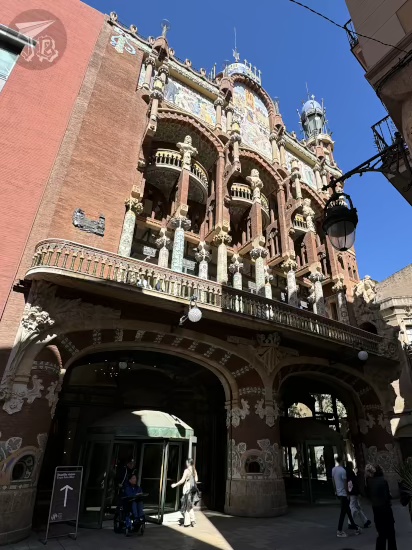
Afterwards, we walked to the music hall Palau de la Música Catalana part of the Unesco Heritage Site Palau de la Música Catalana and Hospital de Sant Pau, Barcelona. The so-called Palace of Music was designed by Lluís Domènech i Montaner a couple of years after projecting the hospital.

Palau de la Música Catalana

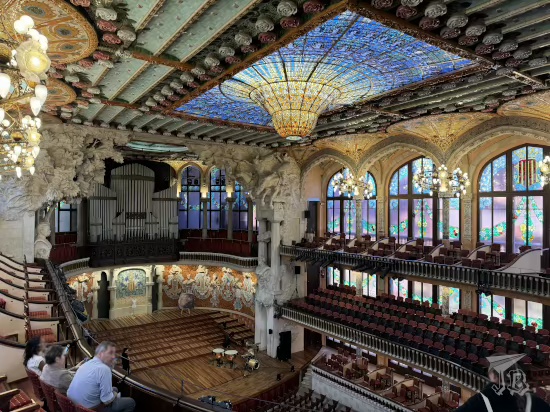
Everything that Casa Milá came short, the Palace passed with full marks. The building has an original entrance designed by Domènech, in dark brick with extensive decoration. The interior is laced with tiles and glass, and tinted-glass windows. The concert hall is amazing. At first, we could not access it, because there was an educative concert for children going on, but we were later allowed to sit at the paradise. There is a huge skylight / lamp in coloured glass, pegasus statues. The concert was incredible too, with four to six musicians playing classical music and… running around the stage too. Lady trotting up the stairs while playing the cello, you have my admiration. I loved everything about the palace, to be honest, except the creaky chairs.

Palau Música Catalana

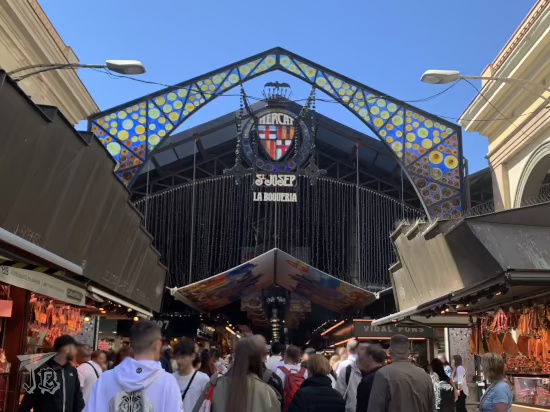
Once we were done in the Palau, we walked to the market Mercat de Sant Josep (St. Joseph’s market), known as La Boquería (The Butcher’s). It used to be a regular marketplace, but now it has turned a touristic attraction. The main entrance is also part of the Modernisme route, designed by architect Antoni de Falguera, who also created the inner metal cover. Though I had half a mind about eating there, the prices were ridiculous, so we ended up at an Asian place a couple of streets down. On the way, I had been excited about the “Barcelona Aqueduct”, but it turns out it’s a modern construction with old ashlars, nothing historical in it at all.

Market La Boquería

After lunch, we had about an hour to kill, and we decided to try our luck in the hobby-shops area. The Norma Comics shop was open, and we spent a while looking at the books there. Then, we headed back to pick up our luggage and commute to the station.

We had to change trains, and there was an announcement that any passengers with a connection shorter than 30 minutes would be escorted to their train. Of course, that’s only PA, and you’re on your own – I asked a worker, who tried to divert us to the suburban trains, not our connection. From that conversation, I think that we were supposed to go out of the system and get our tickets scanned again, but we found our train before that. There was no one else to consult with, so I decided that we would get on it. My sibling was mortified, but we were not doing anything wrong. If anyone checked on us, we had a valid ticket. They had not lived up to their part of the agreement anyway – and I would have told them exactly that, had anyone even thought of scolding us.

But we made it, as I predicted nobody gave us any grief, and the drive from the train station was uneventful. All in all, it was an intense weekend – though I feel I could have squeezed in a monument or two more had we skipped the sit-down meals, but my sibling can’t handle that. All in all, I think everything worked out rather well.

30th March 2025: Sant Pau, Verne & a chocobo {FFVII Barcelona 2025}

The Barcelona hotel charged 20 € per day and person or breakfast, and I was not willing to pay for that, and so I told my sibling. They had no option but to accept since they had decided to delegate all planning and credit-card’ing on me. Instead of booking with breakfast, I brought cold latte bottles and snacks – good for taking headache medicine, which I did. After a quick breakfast, we set off. As we left, I asked at reception if they could do something about the air conditioning.

We headed towards the underground. It should have been an easy twenty-five-minute commute, but one of the stations was half-closed. We had to go outside and walk towards the other entrance to change lines, which was strange and consumed a ridiculous amount of time. We had to be at the ticket booth of our booked visit ten minutes before the allotted time, and we barely made it – though they did not seem to care. When I was looking at tickets, I found a combined ticket that saved us 10 € for two iconic buildings in town that I had not visited before. That however implied exchanging vouchers for tickets, thus the extra time.

We reached the former hospital of Saint Paul Sant Pau Recinte Modernista ten minutes after I had anticipated, right at the time we had to be there. Sant Pau is a huge hospital complex erected between 1901 and 1930 by architect Lluís Domènech i Montaner (1849 – 1923). Domènech favoured Modernisme, and is considered one of the most influential architects in shaping it. He designed buildings which balanced functionality and decoration, with lots of mosaics and polychrome. Though the precinct had been a hospital since the Middle Ages, it was completely redeveloped for the early 20th century project. Today, it is half of the Unesco Heritage Site Palau de la Música Catalana and Hospital de Sant Pau, Barcelona.

Hospital San Pau from the street

The hospital is considered one of the most important, and largest, complexes in the local Modernisme style. The complex was designed with 26 buildings, 12 of them pavilions for patients, separated by sexes and kind of disease. The pavilions were connected by underground tunnels, leaving space for gardens and open spaces between structures. It was originally conceived to be self-sufficient, closed off to protect the rest of the city.

Hospital San Pau, outside

The buildings are erected in brick, and decorated with ceramics both inside and outside, some of them forming complex mosaics on the roofs and ceilings. After a new hospital was built next to the original one in 2009, the complex was recovered as a museum in 2014. We could visit the pavilions, the tunnels, and the administrative building. The whole enclosure is magnificent, and incredibly large. It took over two hours to see everything we were allowed to visit and I loved every second of it. Well, except the pavilion with political propaganda.

Hospital San Pau, interior

Afterwards, we headed out towards a fun restaurant I had found online – Verne Barcelona, decorated simulating Captain Nemo’s Nautilus from the novel Twenty Thousand Leagues Under the Sea by French writer Jules Verne. We shared a cone of tempura vegetables and I ordered a “Submarine” – a sandwich made from toasted brioche bread – called Turtle, with battered squid, sauce and salsa (I just don’t understand how they are supposed to resemble a submarine…).

Verne Barcelona

We headed back towards the hotel, stopping at a Starbucks for a coffee – a matcha in my case – because I helped my sibling dress up for the concert. We had been carrying the cosplay after all, of course they were going to wear it!

We were in Barcelona to attend the Final Fantasy VII Rebirth Orchestra World Tour, to be held in the CCIB – Centre de Convencions Internacional de Barcelona. Final Fantasy is an expanded video game anthology which set off in 1987. Since then, it has spawned 16 main games and countless spin-offs, media, plushies, and remakes. One of the most famous games is the seventh instalment, Final Fantasy VII, released in 1997. The game is set in a cyberpunk dystopia where energy is obtained by draining the Planet’s life-force. Gameplay follows the adventures of a party which opposes the system, embodied by the electric company Shinra, while at the same time trying to stop the main antagonist – mad soldier Sephiroth – from destroying the Planet itself.

Since 2015, Final Fantasy VII has been under redevelopment into a trilogy using modern graphics. The first game was Final Fantasy VII Remake, released in 2020, whose music had its very own World Tour in 2021. The second instalment, Final Fantasy VII Rebirth came out in 2024, and its music event – Final Fantasy VII Rebirth Orchestra World Tour – began almost immediately, ending precisely with our concert.

We were at the queue already when doors opened, but not early enough, so we needed to line again for the merchandise booth, almost an hour. It was in that queue where something amazing happened. When we attended the previous concert Final Fantasy Distant Worlds 35th Anniversary – Coral –, we were stuck at the merchandise queue for about an hour too and by the time we reached the front, they had ran out of most of the items. That included what I wanted the most – the chocobo plushies. Chocobo are a recurring species in the Final Fantasy franchise, large birds that can be ridden in-game, and in real life be sewn into cutesy toys.

It turned out that in 2023 the last chocobo plush had been bought by the guy who was sitting behind me. I might have made some jokes about stealing it and running away, and he promised to get me one for the next concert. I of course filed that under “one encounter silliness” and forgot all about it.

Well, he did not.

In that queue, two years later, he found me, and he gave me a chocobo plush. He actually found my sibling, who was easier to identify due to the cosplay. I was absolutely flabbergasted. Gobsmacked. Never in a million years would I have expected something like that to happen. Just… figure that everything that went on afterwards was coloured by a feeling of puzzlement and amazement at this stranger’s kindness over a silly plush I wasn’t able to buy two years before.

Chocobo!

We got to the front of the line over an hour later, almost at the time of start. I only wanted a programme, and we were seated around 20:50. I am good at choosing seats, by the way. We were dead centre at a great distance from the stage.

Setlist:
  First part:
  1. The Unknown Journey Continues
  2. FFVII Rebirth Opening
  3. Main Theme of FFVII – Battle Edit
  4. A New Journey Begins: Grasslands / Junon / Mt. Corel
  5. Crossing the Planet: Corel Desert / Gongaga / Nibel
  6. Queen’s Blood
  7. Stamp – Rebirth Medley
  8. Rufus’s Welcoming Ceremony – A New Leader
  9. Costa del Sol – Fun in the Sun
  10. Custom Valkyrie
  11. End of the World Medley
  12. Cosmo Canyon – Sanctum of Planetology
  13. Bare Your Soul
  14. Welcome to the Gold Saucer
  Second part:
  15. Loveless Symphonic Suite – Gift of the Goddess
  16. No Promises to Keep – Loveless Ver.
  17. Galian Beast
  18. J-E-N-O-V-A Lifeclinger
  19. Sephiroth Reborn Symphony
  Encore:
  20. One-Winged Angel – Rebirth Medley
  21. Aerith’s Theme – Return to the Planet Medley

Final Fantasy VII Rebirth orchestra playing

The orchestra was directed by Eric Roth. It was all right, I enjoyed it. However, I don’t think it was as powerful as the first one I saw, but that one was the first post-Covid event so it was emotional in other ways. Then again, I am not a gamer. I just watch gameplays on the Internet… I was a bit disappointed by the arrangement of One-Winged Angel, it felt… too elegant. What I love about the song is the pure chaos it represents, after all.

In attendance was composer Masashi Hamauzu [浜渦 正志 | Hamauzu Masashi]. He started working for Square Enix in 1996 under Nobuo Umematsu, the main composer of Final Fantasy VII music. Hamauzu’s first direct work related to the saga was the Chocobo’s Mysterious Dungeon soundtrack in 1997. He was in charge music for the Final Fantasy VII spin-off Dirge of Cerberus and alongside Mitsuto Suzuki, he has worked in both Final Fantasy VII Remake and Final Fantasy VII Rebirth.

After the concert, we joined the VIP queue for pictures and autographs. Though I had brought the CD from the time before – when I did not get the pamphlet – I was equipped this time. And I even managed the Spanish – English – Japanese cacophony without messing up either of them. That’s a first for me, I think. I got my programme autographed on the setlist page, and then my sibling and myself headed back to the hotel. For 179 €, I keep thinking the VIPs should at least get their own merch queue, or an item to get signed. I guess there are lots of people to get paid…

Eric Roth and Masashi Hamauzu signing autographs

Something that surprises me a lot about this area of Barcelona is that not even the McDonald’s at the shopping centre is open after 23:00, so I always make sure we buy something to snack after the concerts. The room was at least not freezing, though not particularly welcoming either. I had a hot shower, and that finally got rid of my headache, just in time for bed…

15th & 16th March 2025: Canterbury (England, UK) for “The Shark Is Broken”

I’ve travelled for – or with the excuse of – concerts (take your pick) and documentaries (at least thrice, even twice for the same one), but this was my first time travelling for a theatre play. Don’t get me wrong, I like theatre – I’ve even squeezed Wicked into a London trip a couple of times – but it had never been a main driving force. Until I stumbled upon the information that The Shark is Broken was heading towards the UK and Ireland. There were no shows in London, and my connection to everywhere else – including Dublin – was not good, especially due to work schedules. However, there was one date which was, if not convenient, at least doableCanterbury, in the county of Kent. Unfortunately, neither the Gods of Trains nor the Gods of Buses were as willing to smile upon me as the Gods of Air Travel.

Once I secured a ticket for the play (£55.00, dead centre of the stalls), a hotel in Canterbury, and the plane ride, I checked out what to see in town. This was back in December 2024. I also booked my parking spot at the airport, and since it was so long out, I could reserve Terminal Parking for just a couple of quids more than long-distance parking. That’s an extra 20 minute snooze! However, as I’d been hearing about train disruptions in England, I decided to wait a little before buying the Stansted-London and London-Canterbury trains. And sure enough, when a couple of weeks before the trip I went to check on the trains, the Stansted Express was indeed not running. There were ticket sales, at normal prices, but the trip would be by bus – taking as long as a bus usually takes. Thus, I decided to buy a coach trip at coach prices instead. That added a couple of hours of travel / waiting to the whole journey. Then, I went on to the South Western Rail website, which claimed that purchasing tickets would be easy. My definition of easy is… different, but, I was able to secure tickets. I was supposed to download the app to use them – but the app cannot be downloaded outside the UK. Fortunately, I was able to download a copy of the tickets from the confirmation email and use those.

When the day came, I left home a bit after 3:00 for my 5:45 flight. It was extremely cold, but at least it was not raining. I had some time at the airport before take-off, but of course everything was closed. It felt a bit weird, knowing it was the last time I could fly to the UK “for free”, considering that all countries are implementing the stupid Visa fees everywhere. We landed in London’s Stansted Airport on time, so I made it to the 08:10 coach I had booked – despite the utter chaos that Stansted coach station has become. The nice 40 minutes by train to London Liverpool turned into an over-two-hour coach obstacle course through London’s construction work.

Since I had been forced to buy a bus ticket, I got a direct one to King’s Cross – St Pancras International, where my train to Canterbury was due to depart. I had calculated for a safe train at 10:40, and I reached the stop around 10:05, which gave me enough time to find the nearest Costa Coffee before I went to Platform 13 to board my train. I chose the carriage poorly, as I ended up in the midst of a boisterous hiking group, but the trip was less than an hour, and I reached Canterbury West at 11:34. This was a bit over an hour later than what I had originally hoped for, due to the train-bus adjustment. Looking back, maybe it had not been necessary to buy that ticket in advance.

The city of Canterbury is a Unesco World Heritage Site in the county of Kent, in the south-east of England. The area has been inhabited since the Lower Palaeolithic, through the Iron Age, and Roman times on. The town saw the first Christian conversions in the British Isles, and the foundations of the cathedral were set in 596. Canterbury survived the Viking raids around the year 1000, but it fell into William the Conqueror’s hands in 1066.

In 1170, Archbishop Thomas Becket was murdered in the cathedral, an event which triggered massive pilgrimages from all the Christian countries. Between 1387 and 1400, author Geoffrey Chaucer wrote The Canterbury Tales, one of the key works in English literature, a fictional compendium of stories told by pilgrims towards the cathedral. During the early Middle Ages, Canterbury became one of the most populated towns in England, until the Black Death decimated its people. In the 16th century, there was an influx of French protestants (Huguenots) who fled mainland Europe to resettle, revitalising the economy and introducing the silk-weaving industry that flourished for over a century.

After the 17th century, things changed. Canterbury became an agricultural hub spot, so the Industrial Revolution only affected it with the construction of railways. The historical centre was damaged during WWII bombings, after which the historical area was pedestrianised and a ring road built around it. Today, Canterbury lives off tourism, retail, and higher education, with a large floating population of university students.

And it was cold that weekend. A climate topsy-turvy seemed to have exchanged the Spanish winter anticyclone and the British rains, so it was storming in Spain and crispy in Britain those days. But at least, it was not raining, which allowed for freedom and seeing a lot of things. Upon leaving the station, my first contact with Medieval Canterbury were the Westgate Towers Museum & Viewpoint, the largest Medieval gateway surviving in the UK. It was erected around 1380 to substitute the Roman ones. Even before that, there were other hits like “the oldest brewer in Britain.”

Westgate tower, former gate to the Medieval city

I reached the pedestrian St. Peter Street, which merges into High Street, the town’s spine. My first real stop was the Cathedral and Metropolitical Church of Christ, Canterbury (Canterbury Cathedral for short). The cathedral is the seat of the Archbishop of Canterbury, the symbolic leader of the Anglican church, and the spiritual leader of the Church of England – whose official residence is actually in London though, for some reason. I wanted to get to the cathedral first just in case it closed at any time for a service, and so I did not pay much attention to the main street for the time being.

The cathedral precinct is accessed by the Christchurch Gate, completed around 1520 in the Tudor Gothic style. It features restored colours on the decoration, restored between 2018 and 2022. In the square in front of it stands the Canterbury War Memorial, to honour the victims of WWI, which was damaged during WWII, along with most the historic area, due to bombings.

The cathedral was established in the year 597 after the arrival of St Augustine to Kent. During its first period of existence, it was a Roman Catholic place of worship. The building burnt down and was completely re-erected towards the end of the 11th century, and a lot of construction and reconstruction went on until the end of the 16th century – around the time of the English Reformation, when the Catholic monasteries were disbanded and the cathedral turned Anglican. Most of it has remained in the 12th-century Gothic style, except the crypt, which is Romanesque. The west front – under conservation work – hosts statues of people who are considered influential in the life of the cathedral and the church of England, from Augustine of Canterbury to Kings and Queens including Elisabeth II. During the Roman Catholic period there was a Benedictine Abby attached to the cathedral. Today, only the cloister and the ruins of the infirmary remain from that time.

I bought my ticket and headed to the entrance of the cathedral. There was a trail, and I decided to follow it. That led me to see the West façade, with the statue of the Saints, Kings and Queens, and then down a corridor towards the cloister, which might have been the most beautiful one I’ve ever seen, with gothic arches and family crests painted on them. After the cloister, I found the herb garden and the water tower, and I got to see the ruins of the infirmary.

I went down to the crypt, and then up to the cathedral. The building already looks big from the outside, but the inside feels huge, with columns and pointed arches soaring up to the ceiling, and paned glass windows letting the light in. I first toured the quire (choir), where the Shrine to Thomas Becket used to be. Thomas Becket (Saint Thomas of Canterbury) was King Henry II’s friend and chancellor when he was appointed Archbishop of Canterbury in 1162. He clashed with the King regarding the rights of the crown and the church, and even if the Pope tried to mediate, in the end Becket was murdered in the atrium of the cathedral in December 1170, which propelled him to martyrdom first and sainthood a couple of years later. His body was hidden for decades until he was buried in a shrine under the quire in 1220. The shrine became a pilgrimage destination in the Middle Ages known as The Pilgrims’ Way, from either Winchester or Southwark Cathedral in London. During the Reformation, in 1538, King Henry VIII ordered the destruction of the shrine and Becket’s remains. Today, there is a candle burning where that shrine stood, and the Pilgrimage is still encouraged by the cathedral.
Canterbury cathedral - exterior

Canterbury cathedral - interior

I saw the place of the murder, called the martyrdom, on the way to the main nave, where a concert was being rehearsed. It sounded beautiful, but I could not stay forever, because there were many more things to see in town. Outside the cathedral itself there is a memorial garden and the six-metre sculpture War Horse (named Joey), in honour of all the animals that have died in war.

I had to move on, as it was windy and cold out in the open, and I still had more places to visit. I went on towards the Canterbury Roman Museum. The British are always extremely proud of their Roman ruins, though sometimes these are just a few objects. This time, however, the museum lives up to its hype. Even if the artefacts are not that impressive, it hosts the only in-situ Roman pavement mosaic in the UK. Unfortunately, nobody thought about building an overpass viewing platform…

Roman mosaic on the ground

I then headed back towards the main artery of the historical area, High Street and the local museum, The Beaney House of Art & Knowledge, which also doubles as Tourist Information Centre. I broke the worker’s brain when I asked for advice considering that I’d already seen the cathedral and the Roman Museum. What I actually wanted was an estimate of how long the trail around town would take, and confirmation of opening times. I was not too successful as they gave me some schedules which were not accurate. Anyway, I snooped around the place.

The Beaney House of Art & Knowledge was designed by A.H. Campbell in 1897 in the Tudor Revival style. It is named after James George Beaney, a Canterbury-born medical doctor who left money to the city to create a cultural hub. Today, the house hosts the Tourist Information Centre, an art gallery, an auction gallery, the local library, and a museum with collections about different aspects of the town’s history, including a lot of worldwide items that seemed brought by aristocrat’s Grand Tour.

The Beaney House of Art & Knowledge

I decided to do the walking trail around the town then. Now that I was not bee-lining any more, I could take in the statues, houses and buildings in High Street. The statues include Aphra Behn and Geoffrey Chaucer. Behn was a 17th century writer, one of the first English women to earn her living from her art, and possibly even a spy in the colonies and Antwerp. Along the street, I located my hotel, the Great Stour Canal, the theatre and the restaurant where I wanted to have lunch. I exited the centre through the Westgate Towers again, and ended up in the Westgate Gardens. I had started exploring, but then I got dizzy, and my legs shook a little. I had been on the go for almost 12 hours, on four hours of sleep, so it was time for a break. Thus, I backtracked to the Old Weavers Restaurant. I have to admit that I almost got sidetracked to have an authentic afternoon tea, but I had come across this place during my planning, and I was glad I went.

It is true that British food has a horrible reputation around the world. But honestly, it is not that bad – it’s just not such an important social event as it could be for example in Italy or Greece. Furthermore, there is a theory that most “traditional” recipes diluted away with industrialisation, when people worked too much to bother with cooking – the Industrial Revolution was something so new, nobody really knew how to deal with so many changes. Then, WWII food rationing and post war pre-made foods prevented a whole generation from learning how to cook. And thus, Chicken Tika Masala became the staple of English cuisine. In reality, however, this is not accurate. The British gave us scones, bangers n’ mash, roasts and pies, all of which are delicious.

Pies were what grabbed my attention from the Old Weavers Restaurant menu. The eatery is located next to the canal, in a house which dates from the 1500s, with foundations from the 1200s, and the original interior structure. The building was originally a weaving centre in the 16th century by the Huguenot refugees, which then became a weaving school – hence the name. When the school closed, the restaurant was established. moreover, almost all the “nice” restaurants in the area were offering a 15% discount with theatre tickets too.

The place was warm and a hot meal was a nice break to have. I was seated at a small table on the ground floor and ordered a Chicken, ham & leek pie in a hot skilled with a puff pastry lid, and a side of chips. I like British pies. Conversely, the first recipe of British pie on record was also written by Chaucer in 1381.

Pie and chips

Since I was quite literally outside my hotel, I decided to check in so I could drop my backpack and relieve the weight on my shoulders. I was not carrying much at all, but the hours were getting heavier, I guess. The hotel turned out to be an old refurbished house, with narrow stairs, and my room was on the upper floor. It turned out to be tiny, and weirdly distributed – I had to open the bathroom door in order to take off my coat. But it had a working bathroom, a radiator, and it was warm, so I was all right with it. The price was cheaper than anything I would have found in London and it would save me a lot of stress when I left the theatre. While taking the train back to London was doable, it’s not like I felt like one hour on the train, and then a commute in the Tube in the middle of the night.

I left again, and tried to pick up where I had stopped before lunch – this was my mistake. I should have done my walk clockwise, but I thought I had a bit of time. I had not counted on admission ending up an hour beforehand – but it was all right, and my plan ended at a local supermarket to buy snacks, dinner, and something I wanted to bring back with me. Thus, I went to the Westgate Gardens again, and I took a bit of time with the buildings and the ruins there.
Canterbury - Marlow theatre and Medieval buildings

Canterbury is located on the River Stour, usually known as Great Stour to distinguish it from its tributaries. There are at least three main waterways through town, and even businesses that give boat rides to tourists. The Westgate Gardens are built along the Stour. They host The Guildhall (town hall) and Tower House, a narrow Victorian house built around a bastion of the city walls. I strolled along the riverside, mindful of the mallards and the seagulls who owned the place, until I crossed the Rheims Way Underpass – Canterbury really likes its underpasses, and they’re all right when you get used to them – full of graffiti and contemporary art (graffiti). I eventually veered back towards town, towards an area called Tannery Field and I came across the Canterbury Bull Sculpture, by local artist Steven Portchmouth, an artwork which honours the agricultural and industrial history of the area.

Canterbury Great Stout & Westgate park

I found St. Mildred’s church, an 11th-century stone church with a small graveyard, and totally missed Canterbury Castle for a minute there. I knew it was closed, but it turned out it was completely covered in scaffolding. The castle dates back to 1066, when Canterbury surrendered go William the Conqueror, who proceeded to commission a motte-and-bailey structure, with the motte being what remains today, though underneath the protective scaffolding.

A few minutes away, I got distracted by something which had not been in my plans – Dane John Gardens. Dane John was not a person as I originally thought – the name comes from the corruption of the Norman word for “fortified mound”, donjon, and there is actually a theory that the mound that still stands in the middle of the park is a former defensive motte, though during the Roman times it might have also been a burial mound, on top of which stands the Simmons Memorial – Simmons was the local alderman who built the gardens between 1970 and 1803. The park ends at the reconstructed Roman wall, with rebuilt defensive towers, and it hosts small attractions like fountains, a giant sundial, a Band Stand…

I went along the Canterbury City Walls until I reached ground level again – and then I went underground to cross the wide roads. When I emerged, I finally made my way to St. Augustine’s Abbey. The abbey was originally dedicated to other saints, but it was repurposed after St. Augustine, who had established the cathedral, died. It was a Benedictine monastery from the year 598 on, until the English Reformation forced its dissolution in 1538. Afterwards, it became a royal residence, which was then rented out to noble families. Most of it was eventually dismantled to build new houses, until it was bought in 1844 by a religious Member of Parliament who established a missionary college. During the 20th century, the abbey ruins and the college were separated for classrooms and boarding houses. The British Government took charge of the ruins in 1940, and the abbey is part of the Unesco Heritage Site.
Dane John Gardens and Medieval walls of Canterbury

It was a little past 16:00, and I assume the ticket booth had just closed, though opening times were listed until 17:00 and there were people – a dogs – inside. I first saw the Fyndon Gate, the original gate to the abbey, built in the early 1300s, with two octagonal towers on the side, and a chamber above the entrance arch, which has an overlooking arcade. Though I could not enter the abbey, I was able see to the main ruins through a convenient lookout to the side of the locked-down area.

St Augustine Abbey Canterbury

I saw a signpost regarding the pilgrims’ route that lead me to both Rome and St. Martin’s church. Rome was a little far away to be back on time for the theatre, so I decided to settle for the church, which had been the plan all along anyway, as it was the third key point in the Unesco Heritage Site. The church recognised as the “oldest parish church in use” in the English-speaking world. It was used by Queen Bertha of Kent as her private chapel even before St. Augustine arrived from Rome in 597. Though her husband, Æthelberht of Kent, was originally a Pagan, he allowed her to continue practising her Christian Faith and he himself eventually converted. The building was erected reusing a lot of Roman bricks and tiles, along later stone. It has a small graveyard where many notable families have been laid to rest. The sun was setting, and the wind had calmed down, so it was nice. I did have a moment of slight worry when I glimpsed someone and I heard a bang – I thought maybe they had closed the gate and I would have to jump over the wall. Luckily, it was not.
Canterbury St Martin chuch

I headed back towards the centre. In front of the abbey’s Fyndon Gate I found the statues of King Æthelberht and Queen Bertha of Kent. King Æthelberht was eventually considered a saint for his role spreading Christianity among Anglo-Saxons, but his main contributions were more earthly. He created the earliest written Law code in any Germanic Language, and minted the first coins which circulated in Kent.

Still heading downtown, I walked by St. Paul’s church without the Walls, which could’ve been built in Roman times as a cemetery chapel. A bit further along, there was the St. Thomas of Canterbury Roman Catholic Church, the only Catholic church in town, built in the late 1800s in the Gothic Revival Style. Adjacent to the church stands the tower Tower of St. Mary Magdalene, which belonged to Medieval parish that was demolished to build St. Thomas. There is a memorial inside the tower, protected by glass.

Back in the High Street, most shops were closed or closing down, and I did not come across any bookshops, where I would have purchased a copy of Chaucer’s The Canterbury Tales just to have a copy from the town. What I did find was a Sainsbury’s Local supermarket. There, I bought a sandwich for a late supper after the theatre, some Cadbury Eggs, and a can of Bisto Gravy granules. Cadbury Eggs are a confection made of chocolate with a yellow-and-white sugary filling. Gravy is a cooking sauce I can’t recreate to save my life so I enjoy having the ready-to-make at hand, it’s just small granules that you dissolve in boiling water to create the sauce. Neither – I reasoned – should be a problem at the airport.

I went back to the hotel to have an hour or so of rest before I headed out to the theatre. Marlowe Theatre was obviously named after one of the most famous Canterbury locals: Christopher Marlowe, the 16th century playwright, poet, translator, alleged spy and reportedly atheist, whose work is reported to have influenced Shakespeare himself. His plays were extremely successful, and they include The Tragedy of Dido, Queen of Carthage, The Tragedy of Jew of Malta, and the first dramatised version of the Faust legend, The Tragical History of the Life and Death of Doctor Faustus. The Marlowe Memorial, depicting The Muse of Poetry (either Calliope or Erato, one guesses).

There have been at least three “Marlowe Theatres” in Canterbury. The current one was rebuilt from a previous one between 2009 and 2011, as a stainless steel and aluminium building with a colonnade, and at night it glows electric blue, pink and purple. It is not a pretty building on the outside, but the inside is all right. It seats 1,200 spectators, it has a bar and a tiny merchandise stall.

Canterbury cathedral and Marlowe Theatre at night

Before I went into the theatre, where I bought the programme, I headed towards the cathedral to take a few pictures the building at night. On the way back, I must have taken a wrong turn somewhere, because I was disoriented for a minute before I found the bluish glow of the theatre. Back in December, when I booked the tickets, I also got “ticket protection” (insurance, basically), but I was ecstatic that I did not need a refund. I had managed to get there, and I could finally enter the theatre. I did not feel even a bit tired, even if I had been on the go for over 16 hours.

The Shark is Broken is a ninety-five-minute play written by Ian Shaw and Joseph Nixon, based on actor’s Robert Shaw’s diary of filming the 1975 film Jaws, directed by a young Steven Spielberg in 1975. It follows three very different men who try to hunt down (fish down?) a great white shark which has found the perfect feeding ground off Amity Island, a small beach community in Long Island. Jaws is often credited as the first summertime blockbuster, and it went on to win three Academy Awards – Best Original Score for John William’s music, Best Film Editing and Best Sound.

Canterbury Marlowe Theatre - The Shark is Broken

It is a commonplace piece of trivia that working on Jaws was a nightmare for everyone involved, as the mechanical sharks used for filming kept breaking down, which caused delays and going over budget again and again and again. Main actors Roy Scheider (Chief Brody), Robert Shaw (Quint) and Richard Dreyfuss (Hooper) were stuck on the little ship set for days on end while the film crew worked on “Bruce”, the shark. On top of authoring the script, Shaw plays his father. Dan Fredenburgh plays Roy Scheider, and Ashley Margolis plays Richard Dreyfuss. The stage play was originally directed by Guy Masterson in its Broadway run, and Martha Geelan is acting touring director.

The play is a number of connected, sequential scenes depicting different conversations over several days, showing the rising tensions amongst the actors. There are plenty of rather uncensored references to Robert Shaw’s rampant alcoholism, which his son, Ian Shaw, has not tried to hide or dilute. The set is just the ship, and only the three actors are on stage, you only ‘hear’ about the shark off-scene.

Was it a comedy? No. Was it funny at points? Extremely. Did I enjoy it? Immensely. I’ve read reviews saying that it is not worth it unless you are a huge Jaws, which I am. It includes known trivia, obscure facts and several hilarious meta references, including “It’s a thriller, do you think people will be talking about it in 50 years?”, which delivered on the 50th anniversary of the film is hilarious. Another one, referring to how Spielberg bailed on the last day of filming fearing the crowd would dunk him in revenge for all the inconveniences, and his upcoming career, is “Sharks? Aliens? What’s next, dinosaurs?” The scenes were chronological towards the end of filming, until the last one. Another known piece of trivia is that Robert Shaw was extremely drunk trying to do one of his scenes, the so-called “Indianapolis Speech” – and he screwed it up every time until he sobered up and delivered it in one go. The speech is referred to a few times throughout the play, and the very last scene is its re-enactment. It was glorious.

The Marlow Theatre was just a minute away from my hotel, and I could use the back door to get back in. I climbed up to the room and took a shower to warm up. Unfortunately, the bathroom had one of those fixed nozzles and the shower screen was… way too short for it. I might have caused a teeny-tiny flooding – good thing that I had extra towels to contain it. Afterwards, I had my sandwich, and a Cadbury Egg, even if it should have been too late for chocolate. Predator was running on TV, so I watched that while I charged the phone. Finally, I set my alarm and went to sleep, thinking that maybe being able to be on the go for twenty-something hours straight is my superpower.

My train back to London was at 7:24 – I had to miss my breakfast at the hotel, which started at 7:30, but that’s life. Fortunately, there was a kettle with some instant coffee and creamers in the room, along with biscuits. I woke up around 6:15, got ready, and hurried to Canterbury West station not because I was late, but because it was extremely cold. The train was on time and I was back in London St Pancras International just before 8:20. The train ride was uneventful, and once there I crossed over to Kings’ Cross Station to get breakfast from Costa Coffee. Since I was there, I peered over at Harry Potter’s Platform 9⅓, and I discovered that they actually take out the cart when the “attraction” is closed. I knew they charged for pictures, but I did not know that the cart was detachable. Which… I guess makes sense… considering that people would take free pictures with it if it was there. I just thought there would be a screen or something…

Anyway, not my thing. I headed out to explore St Pancras International Station. The original station was constructed in the Gothic Revival style (or Victorian gothic) in the 19th century, opening in 1868. The exterior was made out of dark red bricks, while the interior displays a complex roof in wrought iron and glass. The overall station layout was commissioned to engineers William Henry Barlow and Rowland Mason Ordish, and the adjacent hotel was designed by architect George Gilbert Scott. It is a magnificent building only slightly defiled by the contemporary expansion tracks. St Pancras was all but abandoned around 1960 until the 1990s, with extensive reconstruction, renovation and restoration in the 2000s. In 2007, it became the “international” station as it became terminus for the Eurostar train which covers the route between London and Paris in 2h 16 mins.
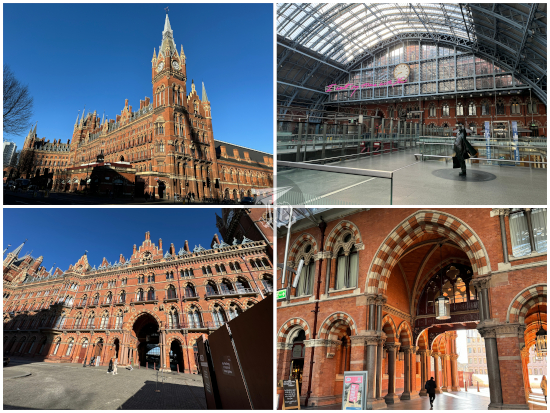
St Pancras international train station

I had to sit down for a few minutes because I made a wrong movement and my back cramped, but it passed soon. I was able to do a little bit of shopping in the station. A lifetime ago, I bought an umbrella in a franchise called Boots, and they had the same style and brand in the shop at the station. Considering that said umbrella served me well between 2012 and 2024, I had decided to buy another one if I ever saw it. I also got a book, because books in the UK are comparatively very cheap.

I found the coach stop, where I had to be at 15 minutes in advance. It was cold and windy, and it felt long. Apparently, the bus before had not come either, so there were a lot of people waiting. However, my ticket and seat were guaranteed. The only problem was, again, that the traffic was horrible due to construction. We took 43 minutes to cover something that should have been done in 10. Despite it all, the coach arrived at London Stansted Airport on time and without issues.

I went straight to security. Stansted is implementing new security protocols, which is great if you don’t get stopped. I got through two times ago, but last time my keyring created a problem – I have since changed that. This time around, the security lady was opening playing-card boxes to check for chemicals (not even kidding) and had to swipe my gravy granules for drugs, or explosives or who-knows-what. When I said “I didn’t even realise that could be a problem” her – rather sheepish – answer was “it isn’t.” Then… why did it get flagged? I’ll never understand airport security.

After 20 minutes waiting at security, I had some sushi at the airport, and bought a Playmobil Royal Guard, because they have always drawn my attention, and I thought that today was the day. Then, it was just waiting. My plane back was at 14:10, landing before 18:00, because I needed to get to a hard week of work on Monday. Part of me wishes I could have stayed until a later flight, but I needed to be reasonable. I did not get emergency exit seats either flight, so there was no issue with the cabin crew. However, when I tried to get my car out of the parking lot, the plate-recognition system would not work, so I had go down all the way back to find a person to talk to – good thing, then, that my plane had not arrived at 23:00.

The truth is, everything would have been more efficient had the Stansted Express been running, but at least I waited to book tickets so I could make the most out of the commuting issues. I did not pay train prices for coach transit, and I did not have to wait much between transportation choices. Furthermore, I could fill the time I had with things to do – and stuff to buy. And the most important thing, I saw The Shark is Broken, along with getting to know a new city.
22nd October 2024: Antwerp & Starset’s Immersion {Belgium October 2024}

The weather was clear but crisp in Antwerp [Anvers | Antwerpen] when I left the hotel to grab a coffee at a small supermarket at the station. I walked right up to the Cathedral of Our Lady Onze-Lieve-Vrouwekathedraal. The interior was spacious, with a feeling of light and openness, with pointed arches. One of the key features of the cathedral is the art it houses, particularly the four paintings by Peter Paul Rubens (1577 – 1640), the most important Flemish Baroque artist, known for his nude characters, whether mythological or biblical. There are four of his works in the cathedral – The Elevation of the Cross, The Descent from the Cross, The Assumption of the Virgin Mary and The Resurrection of Christ. The cathedral boasts that it contains more “masterpieces”, both classical and contemporary, but they pale in comparison.

The cathedral is 123 metres long, and its tower is 123 metres high, giving it a special proportionality – which would have been even more spectacular if the second tower had ever been completed. The nave has a “secret” skylight that can only be seen if you are standing right underneath – this is supposed to represent the presence of God. The building is considered late Brabant Gothic, with some Baroque decorations. The stained glass windows are mainly Neo-Gothic, since the originals were destroyed. Underneath the nave there is a Medieval crypt.

Antwerp Cathedral interior

Art in Antwerp Cathedral

Afterwards, I headed out for the Plantin-Moretus Museum Plantin-Moretusmuseum, a Unesco Heritage Site. It is a museum on the history of book printing, especially from the 16th century printers Christophe Plantin (founder) and Jan Moretus (heir and son-in-law), located in their former house and workshop. The collection includes original printing presses and typesetter letters, drawings and paintings by Rubens, and hundreds (thousands?) of books printed throughout the centuries, and even some manuscript codexes. There were Bibles, atlases, medicine books… It was absolutely fantastic – though taking pictures was hard due to the lightning (so forgive the strange angles).

Plantin-Moretus Museum

Plantin-Moretus Museum books

I was feeling a bit woozy, probably because I had not eaten anything solid in 24 hours. Thus, I found a supermarket and bought a few items to have lunch, dinner, and breakfast the following day. I was heading back to the hotel, but I became distracted as I walked by the Stadsfeestzaal. Now a shopping centre, it used to be an exhibition hall, built at the end of the 19th century. It burnt down in 2000, and in 2007, it reopened after restoration as a shopping centre… which was celebrating Hallowe’en.

Antwerp festival hall

I ate a sort of pizza bread, warm from the supermarket, on the way, and some sushi when I got to the hotel. It was an unorthodox combination, but it made me feel fine again. I saved a salad for later, and I got some rest and got ready for Starset’s concert Immersion: The Final Chapter. I reached the venue Trix Zaal around 16:20, and I was… second in the VIP queue. The VIP passes were issued around 18:30, with a staff member taking our names and checking IDs. Doors opened at 19:00 and the curtain literally fell at 20:15.

Starset Inmersion poster

I once had to describe Starset and I did it as “weird”. Not in a bad way. They have a futuristic image, with an emphasis on a future rather terrifying technocratic dystopia. The concerts carry out a narrative – the New East is a sort of mental empire that controls everything through a device implanted in your mind. Their music videos are independent though. Their music style is hard rock or alternative metal, I’d say.

When I first saw them in Japan, they were officially four members: Dustin Bates (lead vocals, keyboards, soundboard, guitar), Ron DeChant (bass, keyboards, backing vocals), Brock Richards (guitars, backing vocals) and Adam Gilbert (drums, percussion) – those were the ones I met for the sainkai. They are currently touring with Zuzana Engererova (cello), Siobhán Richards (violin, keyboards), and Cory Juba (guitar, synth). I am very happy to report that the touring members are – at least for the two concerts I’ve attended in Belgium are present for photographs and meet and greets.

I enjoy Starset concerts a lot, I kind of feel the music. Besides, there are a bunch of songs that hit my soul really hard. Out of this concert’s setlist, I particularly love Carnivore and TokSik. However, Trials, Monster and My Demons are the ones that touch me really deep.

The stage was set with a bunch of rotors between the musicians and the audience, and there was a lot of neon and smoke to help with the visuals. The concert took about two hours, with a break in between to take down the rotors (in a matter of minutes). The “final chapter” the tour title refers to turns out to close down the futuristic plot and kickstart a present one with… time travel. And it makes total sense!

Setlist:
  1. Unbecoming
  2. Carnivore
  3. Manifest
  4. Perfect Machine
  5. Frequency
  6. Trials
  7. It Has Begun
  8. Waiting on the Sky to Change (Downplay cover)
  9. Devolution
  10. Infected
  11. Telekinetic
  12. Brave New World
  13. Faultline
  14. Monster
  15. Degenerate
  16. Echo
  17. Die For You
  18. Halo
  19. My Demons
  20. TokSik

Starset concert snapshot

Starset concert snapshot

Starset concert snapshot

Starset concert snapshot

Starset concert snapshot

During the concert, the person who had been first at the VIP queue had a bucket with a glow in the dark message asking for guitar picks. They caught an extra one and gave it to me afterwards! I was extremely grateful! After the encore, VIP pass holders could stay behind to take the official photograph and get some items signed.

I had brought a printed copy from my photograph from the VIP event at the previous concert. Whilst last year the VIP experience was a pre-concert acoustic, this time around it was afterwards, and it consisted on “hanging out with the band”. I had heard about it before, but I could not imagine how that went. First, we lined up for the official photograph. They built up a backdrop for the. After the picture was taken you got a signed poster and the QR to download it, and off you went back to the floor. I was talking to the people I had queued with when I suddenly looked up and saw Cory within the crowd. How can these guys be so tall and at the same time so sneaky? Because I swear, Dustin is 2.5 times me and I never saw him coming.

I asked each member to find themselves in the photograph and they signed it for me. Some asked when it was from, and I explain the one from the previous year. Though technically they could sign two things, I forewent the CD I had because the photograph was easier to hold on its own. I praised Zuzana on the girl-power vibe she and Siobhán had going on for the tour and she was happy “someone noticed”. Trust me, it is very noticeable. It was extremely weird and fun to be chatting with all the members like that. I am not sure it makes sense, but I am a bit intimidated by the interactions with Japanese stars – I would blame it in Japanese being my third language, but both Miyavi and Yoshiki are fluent in English. I could blame it on all rules being broken after the stint on the floor of the Royal Albert Hall, I guess. Or maybe it is just different with American artists, since I had the same feeling with Misha Collins – “approachable and human”.

Though the manager had said “no selfies”, towards the end, when he was the last around and a bunch of people had left already, Dustin (vocals) took a few with the fans who remained. I was one of the lucky ones. Then we ran into Andy (drums) at the bar and we were chatting for a while longer. We also took a selfie, yay us.

Afterwards, I undid the way towards the hotel. I walked because it was actually shorter than taking public transport. It was after 23:00, and the streets were mainly deserted as it was cold, but I had no incidents. I had to walk fast to keep myself warm, so that helped reduce the time out. I was also glad I had bought myself dinner, as I thus I did not have to look for a fast food place open at the time and I could head directly into the shower.

All in all, the whole experience was fantastic and I had a blast, or two. Thank you, Starset, for such an awesome event, and all the nice fans who had zero issues with switching to English whenever I was around, and especially to the person who gave me the pick.

21st October 2024: Bruges & Antwerp {Belgium October 2024}

It was raining in Bruges [Bruges | Brugge] when I woke up, but it was supposed to stop by the time the monuments started opening. I asked reception to take care of my bag and I left around 9:30. I thought I would retrace my steps from the previous day, but when I got to the Church of Our Lady, it was not open yet, thus I took a small detour and explored its surroundings. I walked around the area taking in the scenery, and crossed Boniface Bridge Bonifaciusbrug, one of the iconic bridges overlooking traditional wooden and brick houses which face the canal. In front of the church stands the hospital-turned-museum Apotheek Sint-Janshospitaal. It was closed because it was a Monday, but the building was pretty.

Bonifacebridge

The Church of Our Lady Onze-Lieve-Vrouwekerk opened at 10:00 and I wanted to at least see the free area. The church is famous for having a statue by Michelangelo, but that was in the museum area, which I did not visit. The church also displayed original frescos and a small Via Crucis.

Church of our Lady Bruges

I then walked towards the city centre and Saint Salvator’s Cathedral Sint-Salvatorskathedraal. The cathedral is made mainly out of brick, along with tuff and limestone. The oldest bricks date from the 14th century, made outside the city and brought via the waterways. It was not originally built as a cathedral, but took over the role when the actual one one was destroyed in the 18th century. Instead of rebuilding it, the city made Saint Salvator the next cathedral in the 19th century. Unfortunately, shortly afterwards, there was a fire and the roof collapsed. English architect Robert Chantrell was in charge of the restoration, and he chose to build the neo-Romanesque tower that looks something like a Lego set. Later, a peak was added to the tower which makes it even more… Lego-like.

Saint Salvator Cathedral Bruges

The cathedral has an organ originally built in the 18th century, and has been expanded thrice since then. The altar is surrounded by Flemish tapestries. Underneath the nave, there is a crypt where you can see the oldest bricks and a number of 14th century tombs, decorated with paintings in the fresco technique. They feature angels, Jesus, the Virgin Mary and Saint John. There is a small building adjacent to the cathedral with a closed off cloister which holds the treasure, full of works of art.

Saint Salvator Cathedral 14th century tombs

Afterwards, I headed off back towards Market Square Grote Markt. It was raining on and off, so I decided that maybe I could check out the Belfry of Bruges Belfort van Brugge – it turns out that the museum is… climbing the belfry. The belfry was originally built in 1240, though it burnt down and it was rebuilt forty years later. It has an octagonal end cap which was added in the late 1480s. After a few built and destroyed wooden spires, a stone neo-Gothic parapet was added in 1822. The tower is 83 meters high (366 steps, yes, I counted, I got 364) and contains a carillon with 23 bells (27 tons, no, I did not weigh them), and a total of 47 bells. Believe it or not, I was up there when the carillon stroke noon. That was awfully cool. There were also great views of the city.

Bruges Belfry

Bruges from the Belfry

There was a clearing in the clouds and very low chance of rain for the next hour or so, and thus I decided to find one of the official providers of boat tours on the canals. These are sanctioned by the town hall and all of them have the same price and the same route, so any one would do. The one I found first was De Meulemeester Boat Tours Rondvaarten De Meulemeester. The tour departed and arrived from Dock no. 5 (Wollestraat 34). We sailed to Jan van Eyckplein (Jan van Eyck Square) and the edge of the Lake of Love Minnewater. On the way we did not only see the most important monuments facing the water, we also came across Bruges’ famous swans. In the 15th century, keeping swans was a symbol of status, and they were added to the city as part of its image as a flourishing trade point. Today they’re still maintained by the city, which has actually taken them off from the canals for quarantines before. There were quite a few tours going on at the same time, and the boat captains seemed to know each other – or at least have enough familiarity for some banter.

The canals of Bruges

After the boat ride, I found the Gothic Bruges city hall Stadhuis van Brugge, one of the oldest city halls in the historical region. It was built in a late Gothic style between 1376 and 1421, but it has been modified and renewed a few times – and since at this time I had decided that Bruges was a city to come back on a non-Monday, I decided to leave it for the next time, hoping that Antwerp would have better weather – a bit less cold at least.

Next to the town hall stands the Basilica of the Holy Blood Basiliek van het Heilig Bloed, which is supposed to hold a Relic of the Blood of Jesus Christ. I only visited the Romanesque chapel underneath, because I had just seen two huge groups of people go in.

It was then around 13:45, and I had decided to take the 14:25 train to Antwerp to try and make it to the last entry to Chocolate Nation. At the station, however, I decided to get a Belgian waffle with dark chocolate and strawberries. The waffle shop was out of strawberries, so I got a berry mix instead. That killed all my appetite, to be honest, but it was delightful. I even got a little Belgian flag on it – and good thing that I did not order whipped cream, because it was so filling that I was not able to eat anything else throughout the whole day. I regret nothing.

Belgian waffle

The train was on time and off I went to Antwerp [Anvers | Antwerpen]. I reached the stunning Antwerpen-Centraal railway station Gare d’Anvers-Central | Station Antwerpen-Centraal. The weather was not much nicer than in Bruges though, and it was still raining. I dropped my luggage off at the hotel, and went back to the station to take some pictures – I like hotels near travel hubs. Afterwards, I headed off to Chinatown / Van Wesenbekestraat, but the only interesting thing there was the pagoda gate.

Antwerp Central station

I headed towards the historical centre and stopped by the Cathedral Cathedral of Our Lady Onze-Lieve-Vrouwekathedraal, which belongs to the Unesco World Heritage Site Belfries of Belgium and France. It is credited to architects Jan Appelmans and his son Pieter Appelmans. Both of them are honoured in a metal monument within the wall of the cathedral, which was erected in the Gothic style. The cathedral was never completed to its original concept, and only one of the two projected towers was ever finished. The church was damaged in several scuffles with time – as recently as WWI – and it was completely restored between 1965 and 1993. It had already closed, but I was counting on that.

Antwerp cathedral by day

I continued off to Main Square Grote Markt, which was almost empty due to the weather. There stands the Antwerp City Hall Stadhuis Antwerpen, a few guild houses, and Brabo Fountain Brabofontein, which represents a legend – a giant who cut off the hands of boatmen received the same fate by hero Silvius Brabo.

Antwerp Grote Markt by day

Then, I continued off towards the edge of river Scheldt, on whose banks Het Steen, a Medieval fortress dating back to the early 13th century. It is what one could call the Antwerp Castle from Wagner’s’ operas, and it was built as a way to control the river. It is currently used as a visitor centre.

Het Steen

It was getting dark already and none of the monuments were lit, so I decided to get back, as it was raining rather hard. The second I saw reached the station though, the illumination was turned on. I decided to go to the hotel and wait the rain out, as it was supposed to clear out in about an hour. It did, so I retraced all my steps back towards the Cathedral of Our Lady Onze-Lieve-Vrouwekathedraal and the Main Square Grote Markt. I even reachedHet Steen, but it was not lit.

Antwerp cathedral by night

Antwerp Grote Markt by night

Though it was cold, it had fortunately stopped raining for the time being, and I could take my walk leisurely. I turned in for the day afterwards.

20th October 2024: Heroes Comic Con & Art Nouveau in Brussels and the Medieval Centre of Bruges {Belgium October 2024}

Just before going to bed to grab a couple of hours’ sleep on the 19th, I did a last check that I had everything ready, and I realised that my parking reservation at the airport had not been processed. It is a good thing that being an Aena member, the price had not gone up outrageously from when I had done it the first time a few months back. I have no idea why it did not work the first time, but I am glad I caught it before I left, because non-reserved parking is three times as much.

I did sleep for a few hours and the alarm clock went off around 3:00 for my 6:20 flight. The drive was uneventful, I found an awesome parking spot, and I had the bus just for myself after a minute of waiting. Security was fast, and it was weird to be in the Schengen side of the terminal for a Ryanair flight. I got on the plane and got some sleep. We landed in Brussels [Bruxelles (French) | Brussel (Dutch)], Belgium [Belgique | België] early, but deplaning took a while. Once outside, I followed the signs for the train and there was one there already. I settled until I got to Brussels Central station, where I bought a coffee, a drink, and a sandwich. I then walked towards the underground station – the coffee was gone even before I was there.

I knew I was in the correct underground line when I started seeing cosplayers and kiddos with superhero merchandise along with their resigned parents. My backpack was not heavy, but I was glad to have a seat both on the train and the underground. I reached the area of Brussels Expo a few minutes before the convention Heroes Comic Con opened for general admission. There was a queue, but instead of getting in line, I walked up to the nearby Atomium.

The Atomium was built as the centrepiece of the Brussels Expo’58. It is credited to architects André Polak and Jean Polak from a project by civil engineer André Waterkeyn. It was designed as a homage to scientific advance, especially nuclear physics, and thus resembles an atom or a molecule. It is 102 metres high, and it comprises nine spheres with a diameter of 18 metres each, joined by tubes and escalators. The Atomium was not designed to survive the Expo it was built for, though. In the mid 2000s, it had to be renovated, and a lot of the original aluminium was replaced by stainless steel.

Brussels Atomium

I contemplated going up the building. However, when I looked at the time, I realised that if I went in, I would be able to get into the first of Misha Collin’s photo shoots. When I decided to buy the tickets, I only bought one picture in the afternoon, because I was not sure what time I would make it to the convention, considering the plane, the train and the underground. But I was there on time so I used my phone to buy an extra ticket for the photo shoot in which Collins would be wearing the outfit from Supernatural’s character Castiel. This also gave me the chance to get the photograph signed during the time between photo shoots. Furthermore, I was still within budget – because I had decided to indulge myself with the money I had originally set aside for a balloon ride in Cappadocia.

I walked into Brussels Expo. The exhibit was huge, but I had a map downloaded on the phone. I was a bit confused when doing my original research, because it turns out that there were actually three conventions going on at the same time – Heroes Comic Con, Made In Asia and Gameforce. However, once there, it was easy to get around. Heroes Comic Con is “a big feast dedicated to pop culture”, so basically a one-size-fits-all big merchandise fair with graphic artists, cosplayers, the whole nine yards, nothing too different from Paris Fan Festival. Heroes Comic Con’s biggest selling point, however, was having invited a number of popular actors – along Misha Collins (real name Dmitri Tippens Krushnic, for the record), other guests were Bob Morley, Eliza Taylor, Ian Somerhalder and Paul Wesley. Some of them… rang a bell. I might even have seen a few of them somewhere – I must have, because I did watch the newer Star Trek. However, I find it great that they had a large following and there were queues for them.

I followed my map towards the photo booths, where they checked my ticket and gave me a bright-coloured chip – they give you a chip per ticket, as you can have two people in one photograph. I was on my own, so no problems there. I actually got two photographs out of the first shoot – so I’ve got three though I paid for two, yay me. I had brought a customised jacket with a pair of angel wings, and the goal was to have them in the photographs, so I would be facing Misha but looking over my shoulder. The first photograph did work out too well, so Misha called me back for a re-shoot. He was very friendly, and much more approachable than my usual Japanese artists. Either that or I was less strung up. The pictures were printed on-site, so I took mine to the autographs area to wait. I had bought an official book beforehand – the lightest thing I had found, to be honest – in case I could not get a photograph signed, but since I this had worked out so well, I had our recent picture – and in the character outfit – to be signed.

Since I had been towards the end of the photograph queue, I did not have to wait long for Misha to come. A staff took my name on a post-it note and attached it to the photograph. When it was your turn, you paid for the autograph (I decided not to get a selfie, because I still had another photograph bought), and I told him about the pure chance I was there. He was “glad I could make it”. As I said, nice and approachable.

By the time I was out of the autograph area it was around 11:40. I decided to wander around. I gravitated towards Made in Asia, and was very strong reminding myself I wanted to keep my luggage light and not pay for any extra. Thus, I managed not to buy anything despite finding a bunch of Saint Seiya merchandise – which I now regret, but that’s FOMO speaking. I had a chuckle or two out of young people complaining about the official good stuff being “too expensive” when I found the shops cheaper than the stands I see in the Spanish counterparts.

Brussels Hero Comic Con

I returned to the photo booth for the second photograph, and I thanked Misha for the chance – I look silly in the picture, but that’s okay. It was great. There was a Q&A with Collins an hour or so later, but I decided to forego that and leave the convention. If I stayed, I would have no time to do anything in Brussels that day. I also wanted to keep on the move because else my body would remember how little slept it had gotten, and I would crash. Thus, I bought an online Art Nouveau pass, and I left the convention.

Brussels’ Art Nouveau Pass is 20 € and it covers entry to three museums, historical places, or exhibitions in a long list, all of them related to – obviously – Art Nouveau. The pass can be value for money even if you only visit two of the “big ones”. Since the pass is valid for nine months, I might be able to use it for a third time in the near future. The original idea was to buy one from the beginning and hit the Comic Museum, the Horta Museum and the Solvay House – things I had not had the time to visit the previous time because in the end I spent a lot of time walking to different spots (read: the Natural History Museum). However, the Solvay House was under renovation, and the Horta Museum was a bit out of the way, so I ended up being flexible

I rode back to Central Station and walked out towards the Cathedral of St. Michael and St. Gudula Cathédrale des Saints Michel et Gudule | Kathedraal van Sint-Michiel en Sint-Goedele, which was beautiful in the flurry of autumn leaves. It was cold, so I hastened towards the Comics Art Museum Musée de la Bande Dessinée | Stripmuseum (Belgian Comic Strip Center). The museum is located in the former textile store Magasins Waucquez, an early 1900s commercial building designed by architect Victor Horta. Horta is considered one of the founders Art Nouveau, with his use of curved forms and use of steel, skylights and open floor plans with abundant decoration.

Brussels cathedral

After the department store closed in the 1970s, the building was listed as a historical site, and it was bought by the Belgian Government to be used in the promotion of comic strips. The museum itself was founded in 1984 as a non-profit, and it opened in 1989. It runs a new permanent exhibition on the history of comics in Belgium and Europe (free from the American Comics Code Authority and censorship – I mention this because I had tickets for a Marvel exhibition the following month, and the CCA had a lot of impact in the development of American comics). The person at reception told me to watch out for a very first-print Tintin which had been recently added to the exhibit. There are items and print issues related to most of the great Belgian comic artists – there were a lot of things I had never even heard about. I found a big lack of Morris’ Lucky Luke though.

Comics Art Museum Brussels

Comics Art Museum Brussels

Something I had decided to do in this trip was trying the typical foods, so once out of the museum I headed towards the central square Grand-Place | Grote Markt and Manneken Pis, which was not wearing any costume this time around, even if Brussels is still under a lot of construction (when I saw it in 2023, it was wearing a reflective jacket). I remembered that there were a lot of places that sold local street food – I don’t tend to be much of a foodie, especially with street food or fish. I figured out that Belgium could be a safe place to experiment without risking an upset stomach.

Brussels Grand Place

Manekken Pis

Thus I got some frites, Belgian fries, at a chain called La Friterie. I had seen a few of the establishments with queues outside, so when this one was almost empty, I jumped at the chance. Belgian fries are sourced from local potatoes and cooked in two goes, traditionally in beef fat. I got them with just salt, and they were really good. And warm. That was a great point.

Belgian Frites

It was around 17:00 by this time, and things had started to close down. I headed off towards the station to take a train to Bruges [Bruges | Brugge], in the north west area of West Flanders. The historic city centre is a Unesco World Heritage Site – Historic Centre of Brugge – and it is criss-crossed with canals. The area has been inhabited since Prehistory, but its importance peaked during the Middle Ages, between the 12th and 15th centuries. It became a commercial hub due to its strategic location between Flanders and France, though it later opened to other countries, like the Portuguese. The first stock exchange in the world probably opened there in 1309.

The Medieval architecture and brick Gothic constructions are exceptionally well preserved, including the pattern of streets intertwined with waterways. I was curious about northern Europe canals, which was one of the reasons why I chose the city. The other one was that it is a city to walk and see from the outside, which was great for a Monday morning. Unless it’s raining and about 7 ºC colder than cool – I had prepared for 13 – 17 ºC and drizzle, and got 9 – 13 ºC and rain. Whoops.
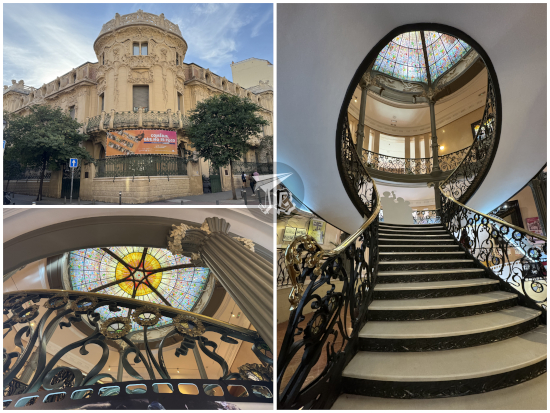
I bought some snacks at the station and went down to the platform. The train was late. I knew it was late, and I knew when it was expected, because the board told me. It was refreshing, considering the uncertainty around Madrid’s trains this last couple of years. I had booked a hotel close to the railway station, and I got there around 19:00. It was quite a basic place, with a toilet, and a shower closed off, and a washbasin column in the middle to separate the wet area from the bed area. Functional, and all right. The heating worked and they spoke English, so all good.

I did not rest for long. I ate the snacks, grabbed my umbrella and an extra layer of clothing, and headed out. It was dark outside already, and I hoped to get to see the city centre lit up for the night. My first stop was the Church of Our Lady Onze-Lieve-Vrouwekerk. Mostly built between the 13th and the 15th centuries, it is one of the highest Gothic brick structures in the world.

Our Lady, Bruges

Then I headed towards Saint Salvator’s Cathedral Sint-Salvatorskathedraal, a curious mixture of neo-Romanesque and neo-Gothic, with a bell tower that looks more like a defence tower than anything religious. This tower, however, was the result of a 19th-century modification of the original tower. Of course, both churches were closed at this time, but they would open the next morning.

Bruges cathedral

I continued towards the Market Square Grote Markt, featuring the Gothic Provincial Court Provinciaal Hof, the Historium, and the Belfry of Bruges Belfort van Brugge. The Medieval bell tower is doubly World Heritage – it belongs to the Historical Centre Unesco site, but it is also key in the Unesco Belfries of Belgium and France serial property. And while it is not part of the Manual bell ringing intangible Cultural Heritage, Bruges takes a lot of pride in its carillon and its bell ringing. At the centre of the square stands the statue of Pieter de Coninck and Jan Breydel Pieter de Coninck en Jan Breydel, who participated in the Flemish resistance against the French King in 1302.

Bruges Grotemarkt

I also wanted to explore a large park I had seen on my way. It turned out to be two of them, Poertorenpark and Minnewaterpark – which later I found means “Lake of Love Park” – before it was too late in the evening. There I found the Gunpowder Tower Poertoren – built between 1398 and 1401 by Jan Van Oudenaarde, and used as gunpowder store for almost five centuries. Beyond it, the Lake of Love itself Minnewater, the Lovers’ Bridge Minnewaterbrug, “very romantic” stone bridge. I noticed the part about it being stone. It also yielded to a beautiful night view.

Bruges Love Lake park at night

I did not want to stay out too late. Thus, I crossed the Barge bridge Bargebrug to get back to the busy street area. Bargebrug is a modern construction, barely 20 years old, in bold red curves. On the other side there was a “reception area” in the same style, apparently a sort of bus station, and then there was the main road. Afterwards, I just headed back to the hotel and turned in for the day. I watched some TV, but to be honest, I had woken up before 3:00 am, so I zonked out rather quickly.

Bruges Love Lake park at night

10th October 2024: The Trojan Horse & Bursa {Türkiye, October 2024}

We had to leave by 5:30 to go see the Trojan Horse. The reason why I had chosen this particular circuit was because it included “Troy”. The only thing I got to see of Troy was the Truva Heykeli Trojan Statue, – the horse which was used by Warner’s Bros to film the movie Troy in 2004. Not a damn ruin, not a damn rock, let alone be near the archaeological site. Damn it, did I choose the circuit badly or what? I do wonder what people thought of us taking structures of the stupid thing at 6:40 in the morning. As we drove north, we saw the Galipoli Peninsula, place of a huge battle between the Ottoman Empire and New Zealand and Australia regiments belonging as part of the British troups.

Çanakkale Trojan horse

We continued towards the city of Bursa, the first capital of the Ottoman Empire, and another of the World Heritage Sites – Bursa and Cumalıkızık: the Birth of the Ottoman Empire. It started off as a settlement around 5,200 BCE, which evolved into a Greek city. Under the Byzantine reign, it was a city known for its garrisons and its silk manufacturing centre. It is considered the origin of the Ottoman Empire, and throughout the period, it flourished through its local silk production. Following the foundation of modern Türkiye, it became an industrial city.
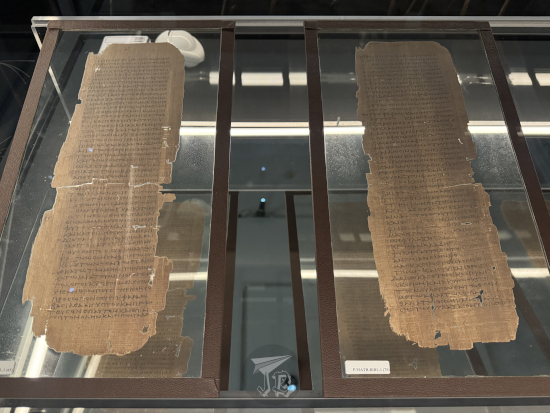
Our first stop was the Grand Mosque of Bursa Bursa Ulu Cami. Its first stone was set in 1399 an important building in the early Ottoman architecture as it found its own style. It is a rectangular building with a fountain from the 19th century at the centre – originally this area was open but it is now closed with glass, forming a skylight. It has two minarets. The interior is mostly white, but at the same time, quite decorated with calligraphy, medallions and vegetal themes.

Interior of the Great Mosque Bursa

Then we drove to the Green Mosque Yeşil Camii complex. It was commissioned in 1412 by Sultan Mehmed I Çelebi, who is buried in the adjacent Green Tomb Yeşil Türbe – along with his children and their caretakers. Both the mosque and the mausoleum have beautiful decoration in blue-green tiles with gold inserts, which create the motifs and calligraphic inscriptions.

Mihrab of the Green Mosque Bursa

Bursa Green Tomb

Next to the mosque stands a building which calls itself a Silk House, but is just a huge souvenir shop, nothing even close to the actual Silk Bazaar. Afterwards, we went for lunch, lentil soup and a traditional Bursa kebap İskender kebap, making this another sort-of actual Turkish meal. It uses meat cooked on a vertical rotisserie (döner kebap) on pita bread, with tomato sauce, yoghurt and sheep’s milk butter – which was poured at the table. Dessert was a honey pastry.
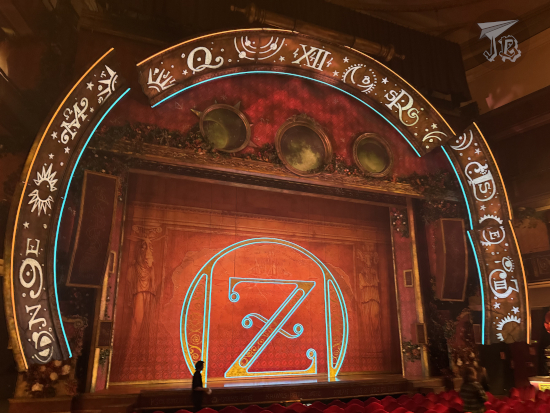
İskender kebap

Then we continued off back to Istanbul | İstanbul. We got there around 16:00 and I was considering maybe heading out to a church-turned-mosque to see some of the most important museums but… at that point it felt more like a self-imposed obligation that something I really wanted to do because I would enjoy it? It was more of a feeling of “you should do it because you are not going to come back to this country”. But the truth was that I really did not want to do it. I was disappointed in the whole trip experience, and in a way, I did not… I don’t know… care anymore? No balloon over Cappadocia, not enough time for Pamukkale travertines, no Troy. Whatever.
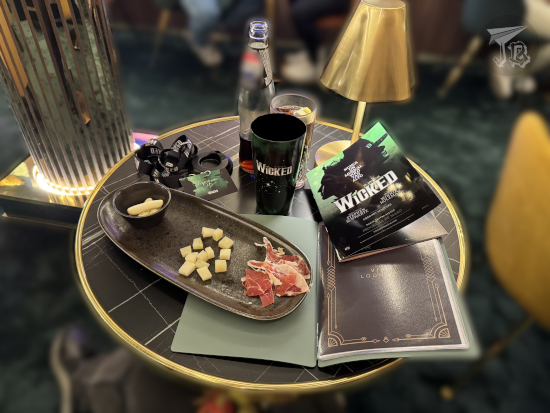
The nice group from the trip invited me to hang out with them for a walk. Together, we walked to the Grand Bazaar Kapalı Çarşı. Then we continued towards Sultanahmet Square Sultanahmet Meydanı, from where we crossed Gülhane Park Gülhane Parkı until we reached the coastline İBB Sarayburnu Parkı, the point in which the Golden Horn and Bosphorous Strait come together. On our way back, we stopped around Sultanahmet Square Sultanahmet Meydanı to take some pictures.

Gülhane Park at night

Bosphorous at night

Sultanahmed square at night

Finally, I headed back to my hotel – Hotel Bi·setun, the same as the first two nights – to order dinner, have a shower and get ready for the return trip.

9th October 2024: The Asclepieion & the beach {Türkiye, October 2024}

We left around 8:00 towards Pergamon Ancient City Pergamon Antik Kenti, another of Türkiye’s World Heritage sites – Pergamon and its Multi-Layered Cultural Landscape, still in the city of Izmir | İzmir (in Türkiye, “city” and “province” are interchangeable, apparently). The origin of the city dates back to the 8th century BCE – though there were legends about a mythological foundation by the son of Heracles. Pergamon flourished and became the capital of its own kingdom, until it eventually fell in Roman’s hands. The most important archaeological area is the acropolis – though the Great Altar, which is currently located in the Pergamon Museum of Berlin, in Germany. I had had a tired / silly moment the night before and packed the camera battery charger with the battery still in it, and I almost had a heart attack when the camera would not work. Fortunately, it made a lot of sense after I opened the battery receptacle.

We did not get to go to the Upper or Lower Acropolis, but we could see the theatre, one of the steepest theatres in the world – built in the 3rd century BCE with capacity for about 10,000 people. We stayed down at the foot of the acropolis, in the Sanctuary of Asclepius Asclepieion [Ἀσκληπιεῖον] – a healing temple dedicated to the demigod Asclepius, the demigod who learnt the art of medicine from the centaur Chiron and became the first doctor in “history”.

The Asclepieion worked with a holistic approach to patient care, giving thought to tranquillity, water, and activities such an art and theatre performances. The theatre is one of the best-preserved structures in the Asclepieion of Pergamon, though there are many others – such as 70 metre long cryptoporticus a tunnel that connected the baths, sacred pools – with a healthy population of frogs and tortoises – and fountains. I also found a lizard chilling out – or baking out, considering the temperature (remember, I had packed for… autumn, not for almost 30 ºC at noon every day…). Some famous ruins include

Pergamon Asclepieion ruins

Pergamon Asclepieion tortoises and lizard

Pergamon Asclepieion theatre

I wandered around for as long as I could, but again here was no time to explore everything – though this time I came pretty close. We left at around 12:30. This was the only visit we had on the day, as we were directly driven to the hotel in Çanakkale. On the way, we saw the Red Basilica Kızıl Avlu just before leaving Izmir, and glimpsed the island of Lesbos from the bus.

Iris Hotel was in the middle of a residential area – to the point that the bus barely passed through some of the streets. There was nothing interesting around to see in kilometres, so to… compensate, I guess, the hotel had a small mini zoo of deer and fowl.

Sunset at Çanakkale beach

Behind the hotel there was a private beach with a stunning sunset, but nothing around to explore or do. Çanakkale is located to the west of Türkiye, at the end of the Dardanelles Çanakkale Boğazı, the natural straight that joins the Aegean Sea with the Sea of Marmara, just south of Istanbul. The sea was warm, but I only got in up to my knees. At night, I watched a monster movie in Turkish. That… was an experience.

8th October 2024: Ephesus {Türkiye, October 2024}

It is not paranoia if they are really after you. And I am paranoid enough not to set a foot onto a bus before I make sure my suitcase is on board with me. So, guess who had to wrangle their suitcase down the stairs, since the hotel staff did not do it? Yep, I did. At least down is easier than up. Anyway, we were our merry way by 9:00, and continued until noon, when we were ushered into a “typical fur-working centre” which was… I don’t know how describe it, to be honest. But neither typical nor traditional are words I would use.

First, we were taken into a room with a catwalk and given notepaper to write down the numbers of items we liked. For about an hour, four or five models showed off anything but typical leather items, a lot of them reversible. Then, we stepped into the shop. I touched some of the items – they were extremely thin and weightless, which was weird. The prices were extremely high, too, even taking into account “the 70% discount because we were special”. I am happy to report I was at no point approached by any salesperson – again, maybe I do not look targetable to Turkish people?

Lunch was okay, it had some nice dips and a soup, then another sad-meat main dish – albeit with your very own pita bread! Dessert was the only one I liked – a churros family treat called tulumba.

Lunch at Ephesus

Afterwards, we continued onto our way to Ephesus, which belongs to the current settlement of Izmir | İzmir, and is an archaeological site considered World Heritage. Coincidently, it was more than warm. It was scorching. We were there for two hours and a half, from 14:30 to 17:00. Again, leaving way before closing time to reach the hotel around 17:30, and yet this was the archaeological site where we spent the longest!

Ephesus was a city in ancient Greece – which back then included several areas of what is now Türkiye. Ephesus was founded around the 10th century BCE, and it became home to one of the Wonders of the Ancient World, the Temple of Artemis, which was built around 550 BCE. It was controlled by the Romans between 129 BCE and 395 CE, and during this period, it became an important site in Christianity starting the year 50 CE or so – with the apostle Paul of Tarsus living there, and reportedly being home of “the seven churches of the Apocalypse”. The city suffered attacks from the Goths, and was damaged by earthquakes before being finally abandoned in the 15th century.

Some of the ruins in Ephesus, including Trajan's fountain and the entrance to the therms

Though the temple of Artemis was off-site and it has been destroyed, many monuments from different periods still stand or have been restored. There are two theatres, a small odeon, and a larger one – with the large one being probably the greatest in the ancient world, seating 25,00 people. There were two agoras, one for commercial meetings and the other one for business. During the Roman times, the Gate of August was built to honour the Emperor.

Since the temple is long gone, the most important building remaining is the Library of Celsus, rebuilt from the pieces left. Tiberius Julius Celsus Polemaeanus was one of the Ancient Greek governors of Roman Asia, who paid for the library himself around the year 125 CE, and is actually buried underneath. The library once held up to 12,000 scrolls in 180 square metres.

Celsus library Ephesus

Ephesus theatre

The guide kept hurrying us up, saying that he had a surprise for us – which turned out to be an immersive show about the history of the city, and after that we had to leave. The film was okay, but I would have much preferred to have more time to wander and see the real thing. The only item that was real – I hope, though it was probably a copy – was the final statue of Artemis.

Statue of Artemis Ephesus

We left afterwards. We did not get to stop by the place where the temple used to stand. We did not see one of the most famous sites outside the city either – the so-called house of the Virgin Mary because, according to the guide, “it was a recycled myth”, it was probably the house of Artemis’ priestesses. Which in my view made it even more interesting, but oh well…

Ephesus Hitit Hotel had an outdoor swimming pool that I dipped into, but it was too cold to stay for a long time. I also tried to go out of the hotel to find something to see, but the street did not seem safe. To the point that our bus driver actually saw me going out and came to ask me if I was all right…

7th October 2024: Pamukkale {Türkiye, October 2024}

Upset as I was, it took a long time to fall asleep, and I nearly had a heart attack when the hotel’s automatic wake-up call made the landline ring at 4:20 – half an hour before my alarm clock was set. We left around 5:40, and it was cold at that time, though it would get really hot during the day. Around sunrise, we reached our first destination – a caravanserai (kervansaray in Turkish, کاروانسرای, kārvānsarāy], in original Persian). Between the 2nd century BCE and the 15th century CE, Europe and China were communicated through the Silk Road, a network of trade routes frequented by caravans. Caravanserai were roadside inns built alongside those trade routes. They were fortified inns which protected the traders from bandits and weather, providing food and water. In Turkish, they are also called han.

Öresin Han (also called Tepesi Delik Han, “the han with a hole on the roof”) is a restored caravanserai / han. It was built in 1188, according to a plate that was recovered during restoration. The works lasted between 2007 and 2010, saving the building from literal ruins (and the aforementioned hole on the roof). Nowadays, it is a shop and inn for tourists. It has thick walls and a vaulted interior to withstand the weather and possible attacks.

Cansaverai

We continued on the road for hours until an early lunch at noon, then drove to the World Heritage Site Hierapolis-Pamukkale, a combination of historical site and geothermal activity. First and foremost, there is the travertine formation. Travertine is a sedimentary rock made out of calcium carbonate which precipitates from fresh water – basically, the material stalactites are made of. Sometimes, in thermal areas, they deposit in cascade form with lakes and waterfalls.

The Pamukkale travertine formation Pamukkale travertenlerinde is a terrace formation around 2,700 metres long, 600 metres wide and 160 metres high. The local thermal water oozes onto the surface at a temperature between 35 and 100 ºC and saturated with calcium carbonate. At the surface, carbon dioxide degasses and the calcium carbonate precipitates into a gel that will crystallise into travertine. Unfortunately, the waterfalls have been mostly drained now to feed pools at the hotels.

Even from the Classical era, the travertines have attracted visitors to the point that a thermal spa was founded around the 2nd century BCE, which eventually became the town of Hierapolis. In the year 133 BCE, Hierapolis was incorporated into the Roman Empire.

We had some time to wander around the place, but way too short to actually see even a quarter of what was on display, which was frustrating – but this would again happen at every archaeological site. Along one of the nice ladies from my group, I saw the Roman baths, then basilica, now museum, which contains the smaller items unearthed – sculptures, friezes, sarcophagi. We then climbed up to the Temple of Apollo Apolion and the Temple of Pluto Ploutonion – which are closed off as the cave underneath them emits asphyxiant carbon dioxide due to the geothermal processes.

Hierapolis museum

Hierapolis theatre

There is also a swimming pool on site, and after hiking up to the theatre it might have even been inviting, if not for the fact that you could actually step onto an area of the travertines to experience them first-hand. I of course took the chance, and was surprised at how… non smelly it was, used to sulphur thermal waters in Japan.

Pamukkale travertines

Travertines Pamukkale

I did not understand why we had to leave so early, because then we just ended up at another hotel with nothing around – thinking back, I have reached the conclusion that the guide was overworked, and he kept a schedule of going to sleep early and getting up early too, that is why we were at all the hotels at 18:00 at the latest; not an excuse, but an explanation. We were at Colossae Thermal & Spa Hotel around that time. The hotel did not have a lift, and most of our rooms were on the first floor. The hotel staff brought the luggage up, and we were reassured it would be taken down again the following morning. I… had a feeling it would not.

In accordance to the thermal and spring water reputation of the region, the hotel had a thermal centre. It comprised a swimming pool, a warm pool and a jacuzzi inside. Outside, there was an actual thermal water / mud pool – which was great for relaxing, but at 33 ºC, I could not stay for long (and I tried not to feel guilty as I knew the water is deviated from the travertines). By this time in the trip, too, I had inserted myself into a group of nice people, and made acquaintances with a nice couple, which was good because it’s always useful to have someone telling you that you’re about to get into the shower with your glasses on…

6th October 2024: Cappadocia {Türkiye, October 2024}

I had made a thing out of two coffees for breakfast, and today was no exception. The whole group was now in the hotel so we were ready to go see the sights. The bus had barely hit the road when our guide gave us a huge grin and decalred “I’m the first Turkish face you meet during this trip. Trust me. We’re going on the balloon is too expensive, so we’re not gonna do it here. We’re going to do it somewhere else”.

I was crushed at these words. Had he said this the previous day, I would have arranged to go onto the balloon on my own – today. Now, with a 5:00 departure time the following day, it was impossible. I don’t have words to write how I felt – devastated, cheated, furious. The option to ride a balloon in Cappadocia was in the documentation, and I had budgeted for it. And this guy had plain and simply… robbed me from it, because he did not want to wake up early after picking the other half of the group from the airport. Looking back, I should have tried to do it myself, hiring the flight on the hotel for today – and knowing that does not make it any better, because I could not do this one activity, which was important for me, not because of the weather or any actual problem. Just because the guide did not want to do his job. I did try to get him to reconsider, but he was like “no can do”.

Thus, I reached the conclusion that the travel agency, Oxin Travel and the guide himself sucked. Through the day (and the rest of the trip), I would build evidence on this – such as hearing explanations that did not make sense, or just contradicted what was written on the panels. I’m surprised it did not cross my mind to leave the trip at that time, because I was seething and heartbroken. In the past, I have tried to leave unsavoury experiences out of JBinnacle, but this would not be an honest trip report without all the emotions that coursed through me during that day – and to be honest, this was just the beginning of the problems. I wrote an email to the distributor that very same day, told the guide, and have complained formally to my travel agent. I have no hope for any solution, but at least I made it known that I was not happy with the services provided. And this trip was not cheap, at all.

I had to try to get over the disappointment in order to at least see what I could of the region. It was hard, I felt a cloud over my head ruining the mood. I almost did not care about anything else, but I knew I had to make do with what I had, or let my whole trip be ruined. Thus, I tried to get myself into the right mindframe to enjoy the World Heritage Site Göreme National Park and the Rock Sites of Cappadocia as much as I could.

Around 9:00, we reached Christian Keşlik Monastery Keşlik Manastırı outside the town of Ürgüp, which is a cave monastery. Human history in Cappadocia is tied to its geology. Tuff is easy to carve, and a lot of civilisations have made their dwellings into the earth instead of on it. First, it was the cavemen, and much, much later the Christians. The first buildings from the monastery date back from the 3rd century CE. Between the 1st and the end of the 4th centuries CE, Christianity spread through the Roman Empire, coming into conflict with the established religion, which deified the Emperor. As Christianity forbade idolatry, their refusal to adore the Emperor as a god made them a target of persecution, accused of treason. In some Roma cities, the Christians took to the catacombs. In Cappadocia, they dug cave monasteries.

Within the tuff structures, ancient Christians created all the items that one would find in a regular monastery – a church, two actually, St. Michael and St. Stephen, a refectory, a winery, dwellings, a baptistery created from a sacred spring… The monks could perform their rituals and protect themselves from any possible attack. It was a functioning Orthodox church well into the 20th century.

The most important cave-building in the rock is the Church of Saint Michael. Its ceilings are decorated with black backgrounds and colourful figures, although many were damaged by iconoclast movements. There were also tomb-like structures where the monks meditated. Underneath the church, there is a baptistery, and next to it the refectory, with a long table and seats carved out of rock. Outside, you can wander around the dwellings, halfway between caves and houses, which served as rooms for the monks.

Keslik Monastery Church of St Michael

Keslik Monastery - chambers inside the rock and panoramic

Afterwards, we headed out to the Underground City of Mazi Mazı Yeraltı Şehri, known in the past as Mataza. There are between 150 and 200 known “underground cities” in Cappadocia. They were initially carved between the 8th and 7th century BCE by the tribes which dwelt in the area. Turf is easy to carve and there is no water in the soil, which made it easy for the tribes to dig “caves” under their houses. These caves became “rooms” which ended up connected to one another through tunnels. As time passed, the cities became more and more complex, with decoy tunnels and booby-traps that the locals could use to hide, safeguard their resources, and protect themselves from raids.

The cities were layered, and the levels were used for different activities – upper floors were for stables, underneath which stood the wineries and ovens… They had wells and ventilation systems that could not be tampered with by the enemies, and even a communication system to talk to people who were in other rooms. Mazi itself had eight stories, four different concealed entrances, and rounded rocks that could be used to close off the corridors. About 6,000 people could survive in its tunnels for up to a month. We did not have much time to explore as we had to move as a group, but it looked really cool.

Mazi subterranean city

We went back onto the bus to head to Guvercinlik Vadisi, Pigeon valley – so called because the geological formations were excavated into dovecotes, since pigeons were used for food and their droppings as fertiliser. As we had 20 minutes there, I could hike down into the valley for a bit and even step into one of the dovecotes. Since it has become a tourist spot, locals have decorated trees with Turkish amulets – evil eye charms – to create photo spots they can request a tip if you get your picture taken there.

Cappadocia Guvercinlik valley

Back on the bus, the guide “graciously” and “secretly” stopped at Üçhisar, a town which has turned a lot of its fairy chimneys into hotels and cafeterias. It is dominated by Üçhisar Kalesi, Üçhisar “castle”, the only natural castle in the world, built in a tuff hill.

Natural castle of Uchisar Cappadocia

Then we were taken for lunch, a rather nondescript buffet which ran out cacik (Turkish tzatziki) way too fast, and afterwards to a “jewellery atelier”. The rocks they showed us were pretty, but the jewellery was rather tacky – and their star product? A pendant made of the local semi-precious stone sultanite inside a balloon, so we were not amused. I was not the only one angry about the whole debacle.

During the bus ride the guide had pitched several optional activities, and I decided to take a so-called jeep safari, run by locals, which takes you in a kind of luxury jeep up and close with the geology of the area. I got that one because it was external and better than nothing, but I did not sign up for the “traditional Turkish night of alcohol and dancing” – I don’t drink alcohol and I was not in the mood for dancing.

The jeep safari drivers picked us up from the jewellery shop around 16:00, whilst the rest of the group went back to the hotel. I felt so cheated – six hours in Cappadocia to go back to the hotel at 16:00 is disgraceful. But then again, I was not in my best disposition. Good that I still had the chance to drive right into the heart of the valleys, at least.

It was a pity that the drivers spoke zero English or Spanish, because it made it impossible to determine where exactly he was taking us. However, we got close to the rock-houses, saw the valleys, the castle, and finally, finally, finally got close to a fairy chimney! We even caught a glimpse of one of the volcanoes responsible for the landscape. It was hard having to go back to the hotel at sunset, but I had a lot of fun – I shared the car with a couple, and the poor lady was terrified by the driver’s antics. I was honestly more worried about the times on the road than the bouncing through the trails.

Cavemen dwellings in Cappadocia

Cappadocia volcanic valley

Cappadocia volcanic valley

Cappadocia Fairy Chimmneys

However, back in Suhan Cappadocia Hotel & Spa before 18:00 made the sadness hit – and no internet in the rooms did not help for any kind of distraction. I tried to walk around the village to try to see something, but I did not find a way, and it was getting dark. I packed for the next day as we were leaving the area. After dinner, I wrote to the travel agents’ in Spain to complain, with zero hope for a solution as it was a Sunday, but I wanted it out of my system. I spent a really bad night, and it was stupidly short because I could not fall asleep…

4th October 2024: Istanbul, day 2 – Bosphorus Istanbul (plus, again) {Türkiye, October 2024}

It was warm in Istanbul | İstanbul when the sounds of the town woke me up. Since I was up early, I decided to find the Bozdoğan Kemeri (Aqueduct of the Grey Falcon), part of the Aqueduct of Valens Valens Su Kemeri. It was built using brick and stone in the 4th century in order to bring water to Constantinople. Construction started under the reign of Constantine II and finished during the reign of Valens, and the structure was in use under the Ottoman period. The Bozdoğan Kemeri bridge is 971 metres long, and its maximum height is around 30 metres. Today, it stands over a busy road, with cars running underneath.

I went back to the hotel for pick-up, which today happened on time. I had signed up to the other day trip offered to me at the airport Estambul Bósforo (55 €). My hopes were not too high, but at least I met with the nice ladies from the day before. This time around, the group was bigger, so everything was a bit more chaotic. Our first stop was Süleymaniye Mosque Süleymaniye Camii, an Ottoman imperial mosque commissioned by Suleiman the Magnificent to his imperial architect Mimar Sinan around 1550. The mosque has four minarets with a total of ten balconies. The interior is decorated with medallions, writings, geometrical decorations, and beautiful stained-glass windows. Outside, there is a cemetery with the mausoleum of Sultan Suleiman and his wife Roxelana.

Süleymaniye Mosque

After the mosque complex, the bus headed out towards the Asian side of Istanbul for a panoramic viewpoint up Çamlica Hill Çamlıca Tepesi, which implied getting stuck in traffic for a long time again and driving past a lot of interesting buildings – visiting any of those would have been a better use of our time.

View of Istanbul from Çamlica Hill

We went back to the bus for the boat ride, which despite being advertised as a Bosphorus trip, was only up and down the Golden Horn Altın Boynuz for about an hour. At first, I tried to pay attention to the guide as he explained things, but I got bored pretty quickly. This was not a good sign, considering this one guide was the one who was to take me onto the tour around the country…

Bosphoros boat ride

For lunch, we had been asked to choose either bream or chicken. I had ordered the chicken because I had a feeling I could not trust a random restaurant in Istanbul… I was right. The bream turned out to be sea bass. Again, food was nothing remarkable. Then, we walked towards the New Mosque Yeni Cami, which was the next visit, but we did not get to go into that one for reasons that escape me. Instead, we were taken into the Spice Bazaar or Egyptian Bazaar Mısır Çarşısı, for a demonstration inside a particular shop. I do wonder how many and how much commissions go into decisions like that.

New Mosque Istanbul

Egyptian bazaar Istanbul

This was the end of the day trip, around 17:00, since the guide had once again stated that “your hotels are close, no need for the bus”. I said goodbye to the nice ladies, and headed out towards the Grand Bazaar Kapalı Çarşı, described as a “network of indoor souks and market streets”. It is actually one of the oldest and largest covered markets in the world, and it has thousands of shops – literally. It dates back from 1455, just after the Fall of Constantinople into the hands of the Ottomans. It was an interesting structure, but I only found trinkets and souvenirs, and it was packed with people.

Grand Bazaar

Thus, after crossing out the Grand Bazaar from the list, I headed towards the university İstanbul Üniversitesi, my reference for the metro stop Veznecıler. From there, I could take a train towards Taksim Square Taksim Meydanı, the gateway to Independence Avenue İstiklal Caddesi, on the other side of the Golden Horn but still in the European side. The area is a tourist hub with shops, fast food places, and ice cream vendors who play around before they serve you the ice cream cones. One of the highlights of the avenue is the “nostalgic tramway” İstanbul nostaljik tramvayı, a revival or heritage tramline with tiny cars, built from memories and photographies. It is not a novelty thing for tourists, but an actual working system that goes up and down the avenue, line T2. I was happy to be able to see it, the car was packed – mostly by tourists though…

Taksim square

At the end of İstiklal Caddesi, stands Galata Tower Galata Kulesi, a former watchtower, now a museum with an observation deck. The origin of the tower dates back from 1204 though the original tower was destroyed and rebuilt in the Romanesque style in 1350. At that point, it was the highest building in the city. At the moment, it is almost 63 metres high, with nine floors, and a renewed roof.
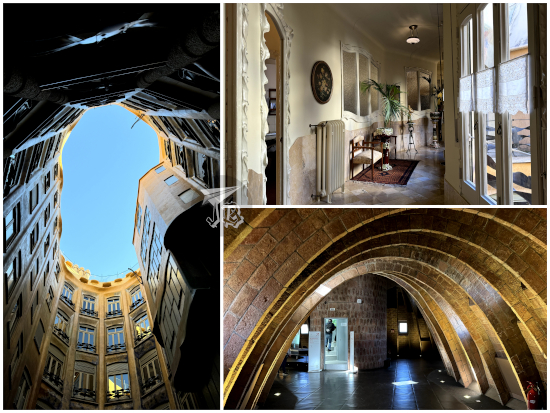
Nostalgic tram and Galata Tower

Afterwards, I caught the underground at the nearest stop – though I was a little bit tempted by the nostalgic tram – and I headed back to the hotel. I settled the bill for the water bottles I had bought and went up to my room, where I decided to order the same dinner as the evening before – kebap and yoghurt. I then had a shower and packed, because pick-up was at 6:00 the next morning. Good thing that I had found a vending machine in the underground system that sold canned coffee, even if it was “almond flavoured”.

3rd October 2024: Istanbul, day 1 – Classical Istanbul (plus) {Türkiye, October 2024}

I spent the day in Istanbul | İstanbul, probably the most important city in Türkiye, and certainly the largest, but not the capital. It was founded as Byzantium in the 7th century BCE, straddling the Bosphorus Strait, which is considered the boundary between Europe and Asia. In 330 CE, Roman Emperor Constantine renamed the city into Constantinople after himself, and made it the capital of his domains. The so-called Fall of Constantinople in 1453 started the Ottoman Caliphate – sometimes called the Ottoman Empire. The empire survived until it joined World War I and was subsequently defeated – Istanbul was the capital during most of that time, until the Turkish Independence War, when Mustafa Kemal Atatürk made Ankara the capital.

Istanbul is probably the only city in the world which stands between two continents, separated by the Bosphorus strait and the Golden Horn – an estuary flowing into the strait. To the west of the Bosphorus is Europe, and to the east Asia. The European area south of the Golden Horn is called the historic peninsula.

Istanbul has claimed its rightful place in history as a key step of the Silk Road and the spread of Christianity during Roman times. The historic peninsula is a Unesco Heritage Site, the Historic Areas of Istanbul, which the day trip I had hired, called “Classical Istanbul” Estambul Clásica (50 €) was supposed to cover.

I woke up around 7:00 and went down for breakfast. Coffee was… unexpectedly dull, considering the fame of Turkish coffee – and I had two cups to kickstart my brain. The scrambled eggs were particularly good, but the bread so-so. At 8:20, ten minutes before pick-up time, I was ready and waiting at reception. At 9:10 I wrote to the person who had picked me up from the airport, who had told me to text her with any question, and at 9:15 they showed up – there was apparently “a lot of traffic”, and we were stuck in it for a while. I spent the time checking out the ruins of Constantinople’s ancient walls Bizans Surları, which are also part of the Unesco Heritage Site.

The group comprised around 30 people, and the bus headed towards an area called Pierre Loti Tepesi, Pierre Loti Hill, and reached there around 10:00. This is a viewpoint above the Golden Horn Altın Boynuz, with a viewing terrace, a café and the Eyüp Cemetery Eyüp Mezarlığı. We were told we’d visit the cemetery later, and were given twenty minutes to take in the views. Afterwards, we hiked (considering the speed, “marched”) down the hill through the cemetery, and saw several tombstones from the Ottoman period, but there was no visit whatsoever.

Istambul from Pierre Loti hill

We hopped back onto the bus to drive towards the quarter called Fener, which we were told was “movie neighbourhood”. We were going to visit the Venerable Patriarchal Church of Saint George, the Orthodox cathedral of Istanbul Aziz George Katedrali, which closed down as we arrived for “an unknown length of time” because the Patriarch was coming out. Instead of letting us amble through the neighbourhood before the church, the guide insisted on us waiting for about 20 minutes before we all came into the church, and he gave a couple of explanations, and gave us free time to check out the church and the neighbourhood.

The church of St George was one of the few places with “real” security. We got through a lot of places with metal detectors and such with guards who would not even care, but the ones that did were ridiculously strict in contrast. The truth is that with the rise of Turkish nationalism, a lot of the church’s flock were deported, so the church and Patriarch are mostly symbolic and a pilgrimage point, and it has even been attacked by terrorists at times. The church itself used to be the centre of the quarter, which was historically the Greek quarter, even after the Ottoman Turks had taken over former Constantinople. Though the church existed previously, it became the seat of the Ecumenical Patriarchate of Constantinople since the early 1600s. It has been damaged and rebuilt several times, the latest as recently as 1991. It has three naves and aisles, with a rich iconostasis (decorated screen that separates the altar from the nave) in golden wood.

Church of St George Istanbul

After the cathedral, I wandered the quarter of Fener on my own for as long as was given us as free time. I found a colourful set of stairs Renkli Merdivenler, which led to nowhere but area pretty. The whole area was a hill, and I climbed up to try to catch a view of a very interesting building – the private school Phanar Roman Orthodox Lyceum Özel Fener Rum Lisesi. The building was designed in an eclectic style by Greek architect Konstantinos Dimadis, and built around 1882, though the school itself dates back from 1597. I also saw a film crew on a break in one of the streets.

Roman Orthodox Lyceum

Once we were called back to the bus, we headed out for lunch. The entrées looked good, actually Turkish, including hummus, rolled paçanga böreği, dolma (stuffed vine leaves), cacik (Turkish tzatziki). The main was rather unremarkable, and something that I could have easily had in either Jordan or Egypt – a sad-looking plate with eight fries, two slices of cucumber, one slice of tomato, a mouthful of rice, and some chicken and lamb. Dessert were the ubiquitous Turkish delights, which are extremely sweet and I’m not a big fan of. Looking back, however, this was one of the most Turkish meals I ended up having, besides kebaps. During lunch, I made acquaintances with some nice ladies who promised to make sure I was not left behind – which has been a bit of a worry of mine when I’m in a guided tour since my last day in Egypt.

Turkish meal

Around 14:00 we walked towards the area known as Sultanahmet Square Sultanahmet Meydanı, the neuralgic centre of historic Istanbul. There, the first stop of the afternoon was Sultanahmet Camii, the Sultan Ahmed Mosque colloquially known as the Blue Mosque. It was built between 1609 and 1617, during the Ottoman era. Designed by architect Sedefkar Mehmed Agha, it was the last great mosque built in the Classical Ottoman style, and combines Byzantine details and Islamic architecture. It has a central dome (43 metres high) with four semi domes and six minarets. The interior is decorated with tiles and mostly blue decoration, hence the name – though honestly I mostly felt it was… golden. The mosque has windows which originally had coloured glass, and are now modern, and it has chandeliers hung from the ceiling, with some of the lamps being ostrich eggs, a typical feature in Turkish mosques. One of the minarets was being restored.

Blue mosque

The mosque stands next to the square, which is long and narrow – it is actually built on the former Hippodrome of Constantinople Hipodrom, the centre of the city during the Byzantine period. Upon the founding of Constantinople, both Constantine and his successor Theodosius the Great brought works of art into the area. Today, there stands the Serpent Column Yılanlı Sütun, an ancient bronze column representing a hydra, whose heads are now missing (part of one is now in the nearby Archaeology Museum). Another monument of the square is the Egyptian Obelisk of Theodosius Dikilitaş, originally erected for Pharaoh Thutmose III (1479 – 1425 BCE, 18th century) in Karnak. It stands on a Roman pedestal from the time it was transported to Constantinople around the year 390 CE. The final construction in the square is the German Fountain Alman Çeşmesi (The Kaiser Wilhelm Fountain), a neo-Byzantine fountain that was constructed to commemorate the visit of German Emperor Wilhem II to Istanbul. It has eight sides, with marble columns and an inside covered with golden mosaics.

Monuments at Istanbul hyppodrome

The official day trip ended there – though they were supposed to take us to the Grand Bazaar. However, the extended tour (25 € extra) included visiting the Orthodox church-turned-mosque-turned-museum-turned-mosque Ayasofya-i Kebir Cami-i Şerifi Hagia Sophia Grand Mosque. The current structure was commissioned by the Byzantine Emperor Justinian I to be the Christian cathedral of Constantinople as the Church of God’s Holy Wisdom, designed by Greek geometers Isidore of Miletus and Anthemius of Tralles. At the time it was built, it was the largest interior open space in the world.

It has a central dome with rises 55.6 metres from the ground and a diameter of around 31 metres. After the fall of Constantinople in 1453 it was converted into a mosque. In 1935, the new Turkish Republic turned it into a museum, but in 2020 the controversial decision to turn it back into mosque was made. With the first transformation into a mosque, minarets were erected and the Byzantine mosaics on the ceilings were covered or destroyed. They were recovered for the museum period, and now they are hidden away. While originally the mosque was going to be “open for all”, now the ground floor, covered with a carpet, is only for praying Muslims, and tourists have to pay to access the second floor and see the Christian mosaics. From the second floor, you can see the mosaics, and are close to the domes, which allows you to see the questionable state of conservation. The dome is fantastic, and there are mosaics of the archangels there. On the way out, there is another mosaic depicting the Virgin Mary with the child, and Constantine and Justinian giving them presents – Istanbul itself and Hagia Sophia. The walls however, are in dire need of restorations.

Hagia Sophia Istanbul

The day trip ended after an introduction to the building, and I wandered around for a while, seeing everything I was allowed to before I stepped out. At that point it was 16:50. I had the option of walking, as recommended, to the Grand Bazaar, but I decided that I had better things to do. I rushed towards the palace-turned-museum Topkapı Palace Topkapı Sarayı. Construction of the complex was ordered just after the fall of Constantinople by Sultan Mehmed the Conqueror overlooking the Golden Horn. Closed-off by walls, it has several buildings and palaces, some of which hold exhibitions. The palace closes at 18:30, and the ticket booths at 17:00. I was able to buy a ticket at 16:57 because I am very motivated, and I even saw most of the key areas of the palace in those 90 minutes. Though the recommended visit time is four to five hours, at least I felt accomplished – I wished I had prepared better for it, but I thought that I was standing next to the palace, and even if it was expensive I could return the next day if I felt I wanted to see more.

The first courtyard is free for everyone to see, and that is where the ticket booths are. I hurried towards the second courtyard, where I was able to see the Ottoman Empire Imperial Council, the Treasury, the Arms collection, the Gate of Felicity, the Chamber of the Sacred Relics, the Harem, the Baghdad kiosk, the Grand Kiosk, and even the panoramic view of Marmara Sea, among other smaller buildings – and of course, the feral cats. I did miss the porcelain and miniature collection, but I felt rather accomplished for the 90 minutes I had.

Topkapi palace Istanbul

Topkapi palace

I left the palace among the last visitors, as they closed the gates behind us. I had two options now – head back to the hotel and try to see the Grand Bazaar, or explore around for a while. To be fair, the area looked rather full and with a bunch of tourists looking more like a target than myself. That happened a lot during this trip, fortunately. I was not considered “targetable”.

Most visitable monuments had closed or were about to at this point. However, I knew that the Basilica Cistern would reopen an hour later, so I decided to wander around and try to get to the promenade along Kennedy street Kennedy Caddesi, which allowed me for nice views of Bosphorus Strait İstanbul Boğazı, the Golden Horn Altın Boynuz and Galata Bridge Galata Köprüsü.

Golden Horn at night

I went back towards the city centre through Gülhane Park Gülhane Parkı. At this point it was dark, so the fountains were on, and they looked very fun, all lit up.

I reached the queue to enter the Basilica Cistern Yerebatan Sarnıcı (Subterranean Palace). The ancient cistern has a normal opening schedule, and an evening schedule, which is a bit more expensive, with live music. But it worked for me. The cistern was built in the 6th century with the goal of providing water to the Great Palace of Constantinople, which stood where the Blue Mosque is now. It is an underground chamber with 336 columns that are up to 9 metres high, and it can hold up to 80,000 cubic metres of water. The columns seem to be recycled from ruined buildings, and at least one of them is carved with an upside-down Medusa face on the base. Today there is very little water, and there are modern art installations, and there are cool changing lights that give it a very interesting look and feel.

Basilica Cistern Istanbul

By the time I left, I kind of regretted having signed up for the second day trip, because I had been rather more efficient on my own, but again, I had not done much planning for the city. I went back to the hotel and I ordered food using the online room service. This time I decided on a kebap chicken wrap and a Turkish yoghurt, which was delicious. I had a shower and went off to bed.
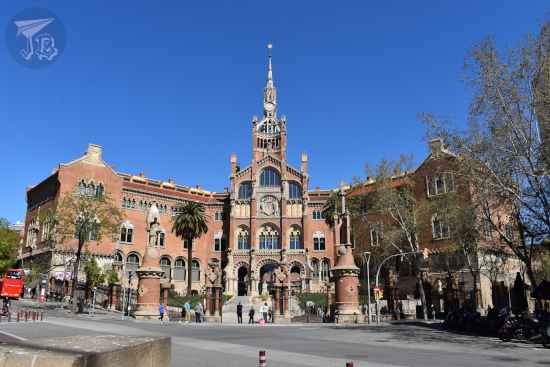
Kebap and yoghurt

15th June 2024: The Old Naval College, and a mishap {London, England, June 2024}

I am getting weirdly used to 5:00 wake-up calls. I drove to the airport and arrived at the long-stay parking lot just before 6:00, with the exact time to catch the bus at the nearest stop. I might be getting too comfortable with timings – either that, or the flights have started taking off a bit later, because I remember having to leave by 3:45 for the first Ryanair flight a few years back. Anyway, security was nice and smooth, but passport control was maddeningly slow – the shiny brand-new machines the airport has spent a fortune on were not working, and there were only two agents, and three flights leaving around the same time.

We left on time and landed on time too, and since works at London Stansted have been finished, I was fast out of immigration. I considered going to the hotel first thing in the morning in order to make sure the credit card went through – and have time to find an exchange office if it did not. When I was able to buy my usual breakfast in the Costa at the arrival area without an issue, I decided I should be all right. Thus, I just headed off towards the centre, reached Liverpool Street station, and transferred to the TfL system. I got a bit confused at the DLR. London’s railway is divided in the Underground, the Overground and the Docklands Light Railway or DLR, which are mostly automatic trains which involve more transfers than I had expected. I needed to backtrack a station or two before I got to my final destination, the area know as Isle of Dogs in the borough of Tower Hamlets. I’ve recently found out that there is a footpath under River Thames which connects the Isle of Dogs with Greenwich. The footpath, the Greenwich foot tunnel, was built from 1899 onwards, and it opened in 1902. You can literally walk from one bank of the Thames to the other in just a few minutes!

Old Royal Naval College from across River Thames

The tunnel was damaged during World War II, and there is a section which is held together by an inner steel lining. The whole tunnel is lit and either painted or tiled in white, so it does not give off any kind of claustrophobic feeling. Something cool that happened to me was that I could actually feel the water running above me, similarly to how I feel when I’m standing on a bridge and look at the river underneath. That was unexpected. Though there are lifts – the original ones were installed in 1904, but there are new ones from 2012 – I took the stairs.

Greenwich foot tunnel

I stepped out of the tunnel and into Greenwich, next to the Cutty Sark. I have already visited the museum inside the ship. This time around, I was going to try to see the Old Royal Naval College, which has been closed whenever I’ve tried to see it – they film rather often there. This time it was actually open to visitors.

The Old Royal Naval College, today part of the Maritime Greenwich UNESCO World Heritage Site, was originally designed as a veteran home and hospital. The current iteration of the building was designed by Christopher Wren – also responsible for St Paul’s Cathedral. The complex has two complexes or courts, Queen Mary Court on the left from the river, King William Court on the right. William III (reigned 1689 – 1702) and Mary II (reigned 1689 – 1694) were offered the throne as joint monarchs when their predecessor James VII and II was declared unfit because he became a Catholic. The building served as hospital and hospice until 1869; later, in 1873 it became a training academy for the Royal Nay until 1998.

I first went into the Chapel of St Peter & St Paul in Queen Mary Court. It was reconstructed after a fire by James ‘Athenian’ Stuart in the neoclassical style. It has one nave, and a wood ceiling decorated with naval themes. The altar piece was painted by Benjamin West. I found the chapel quite beautiful, it gave off a warm feeling. The security personnel were also very nice.

Old Royal Naval College chapel

Then, I headed off to King William Court, to the pièce de résistance of the building. The Painted Hall is a huge ward decorated with Baroque paintings by Sir James Thornhill. The ceiling and walls are painted to honour the kings and queens who gave their patronage to the “Royal Hospital for Seamen at Greenwich”, depicting them surrounded by mythological and allegoric figures. The art was impressive, and the volunteer who explained it was a former teacher who made the whole tour really informative. While I usually avoid guided visits as much as I can, I found the painting too complex to interpret on my own.

Old Royal Naval College - Painted hall

I backtracked through the Greenwich foot tunnel and took the Underground towards the Victoria & Albert Museum. Last time I was over they were running an exhibition I wanted to see… only this time around they had moved to another of their sites. I shrugged it off and decided to have a scone instead – any scone. I mention this because the couple before me wanted two particular scones from the basket. Afterwards, I went to see a gallery within the museum which I missed in 2023, which turned out to have bronze sculptures by French artist Auguste Rodin, considered the initiator of modern sculpture.

Snapshots at the V&A museum

After that, I hopped back onto the Underground and headed off towards the Royal Academy of Arts, located in Burlington House. I was… surprised, to say the least, about the current display in the courtyard, but I was there to see oldest surviving red telephone box – Sir Giles Gilbert-Scott’s original prototype “K2” kiosk, made in wood in 1924.

Burlington house

I then snooped around three of the high-class shopping centres along the Oxford Street area, all of them out of my price range, of course – Burlington Arcade, Piccadilly Arcade and Quadrant Arcade. I walked past Piccadilly Circus and Leicester Square, and headed off to Forbidden Planet to check out if they by any chance had a copy of a comic I’ve been looking for (Alligator Loki, if you ever find it, give me a shout?). I did not find the comic but I did see some stuff by Stjepan Šejić in the wild.

High-end London shopping arcades

Finally, I headed off towards the hotel / venue area, I found the venue – just outside the station. I bought some snacks for dinner and breakfast, then headed off to get to my hotel. The credit card thankfully went through and I got my room. I spent the rest of the evening watching films and snacking on salt and vinegar crisps. Truth be told, the weather was not that nice, but most of the rain happened when I was inside the buildings in the Old Royal Navy College. It’s been a long time since I was in London and there was not a heat wave, so I am not going to complain.