18th July 2025: In the University of Saragossa {Dinosaur Eggs Loarre & Zaragoza, July 2025}

I woke up and for the first time in days I put on “person clothes” (for the city) instead of “scarecrow clothes” (for hiking & working in the field). Before setting off on the trip, I went to the sales to buy some jeans that would work for sitting on rock or walking through thistles and dry grass, and while they are not particularly nice, they are comfortable and resistant. Saragossa / Zaragoza was still waking up as I headed for breakfast to a bakery close to the hotel, Pannitelli Original Bakery, which I had chosen for two reasons. One, they opened at 7:30, which gave me plenty of time to walk to the university afterwards and two, they had waffles, I had seen them online. I wanted waffles, and a big coffee. I had both (and some orange juice, just because I could).

It turned out that not driving to the university Universidad de Zaragoza had been a great idea. Though it had been my first thought (dump the car there, then walk to my accommodation), I was lucky that in the end I was able to reserve my parking spot with the hotel. It happens that access to campus is restricted to working staff. Students can drive into the parking lot ten times in the school year. And on top of that, there was a farmers’ market for some reason.

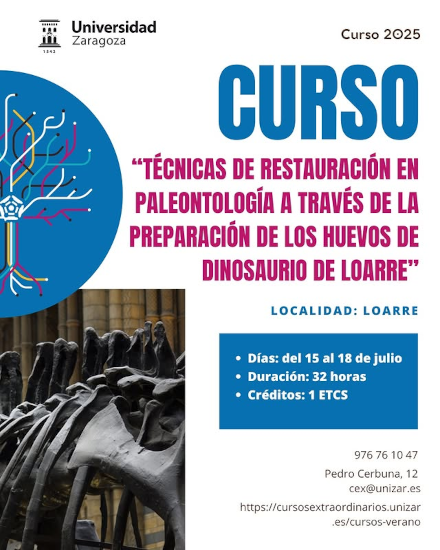
Having 20 minutes to walk, I was the first one there, and I sat down in the rock garden of the Earth Sciences building to wait for everyone else for the last day of the course Técnicas de restauración en paleontología a través de la preparación de los huevos de dinosaurio de Loarre: Palaeontological Restoration Techniques through the preparation of Loarre dinosaur eggs. By 9:00, when class was to start, I was the only one besides the teachers who had managed to arrive. Everyone else had either got lost, left Loarre late, or was taking forever trying to park. So yay me being lucky for once (and for the 20 € which the hotel parking cost for the whole stay).

The first chunk of the morning was a tour through the Rock and Hard Material Preparations, 3D Printing and Scanning Service (Servicio de preparación de rocas y materiales duros, impresión y escaneado en 3D) in the university. They have two main lines of work. One is to make thin translucent sections out of specimens so they can be studied under the microscope, and the other is digitalising and making 3D models and copies of items so they can be lent or studied through a computer. The inner works of the department were explained by Raquel Moya Costa, who not only described in detail all her complex machinery, she also gave each of us a 3D printed T-Rex charm from the Dino Run Game!

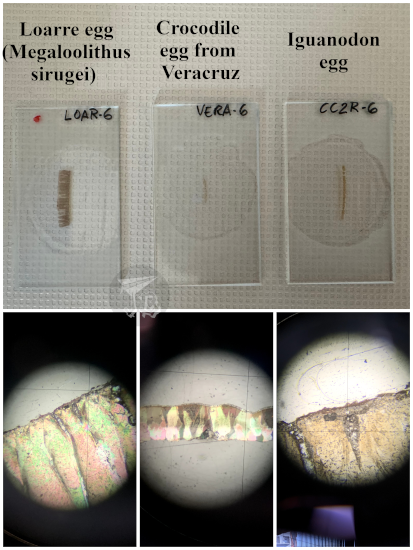
We then moved onto the Petrology lab to look at thin sections on the transmitted-light microscopes – preparations of a sauropod eggshell, a crocodilian eggshell and an iguanodon eggshell. There were other preparations we could snoop around if we promised not to take pictures and publish them. We also got to play with the 3D copy of one of the first eggs recovered from Loarre. Much less heavy than the real thing, for sure.

Microscope used in geological studies

Microscope preparations and how they look under the microscope. There are three egg specimens: one from Loarre (sauropod), a crocodile and an iguanodon, The crocodile is the thinnest, and the sauropod is the brightest and more complex

Then a bit of chaos ensued as we got distracted by the shiny exhibits of the Palaeontology department, and a couple of post-docs offered to show us their lab and what they were working on. Having finished all the activities of the course, the coordinators had organised an extra visit to the Natural Science Museum Museo de Ciencias Naturales de la Universidad de Zaragoza (which might have actually been my fault as I asked how come that would not happen, considering that most of the region’s fossils are officially deposited there). A few people left first, but some of us got delayed looking at the lab specimens, and then we had to hurry to the museum…

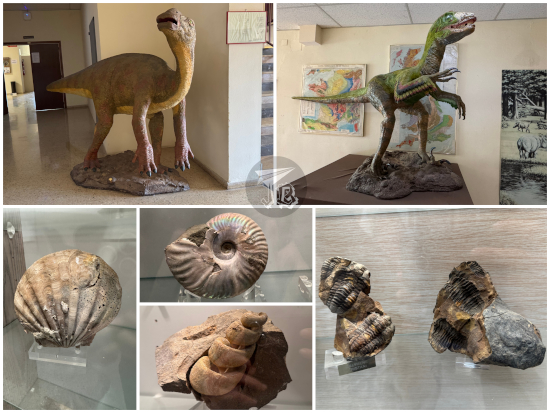
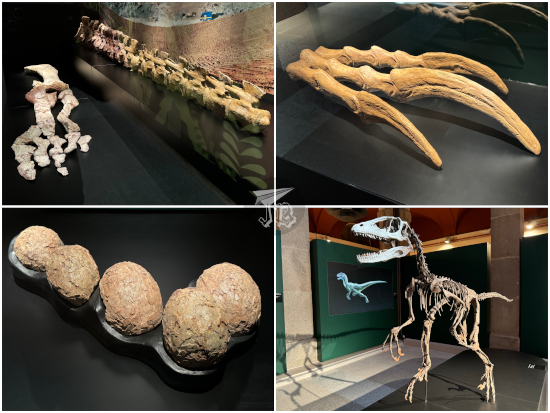
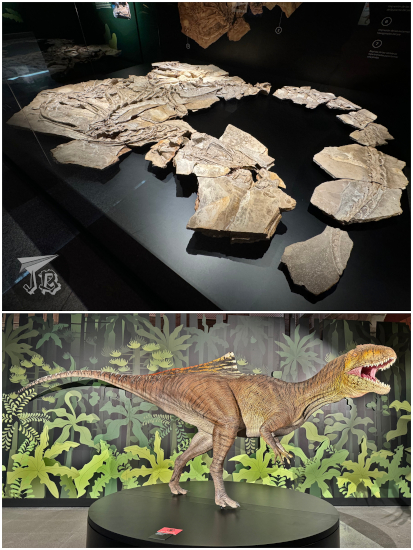
Zaragoza Natural Science Museum: Exhibits in the Geological science building. Replicas of dinosaurs and invertebrate fossils

Once we were at the site of the Museo de Ciencias Naturales, we were taken on an express visit of the palaeontology ward by Ester Díaz Berenguer, curator of the collections. The museum is located in one of the historical buildings of the Zaragoza campus. Designed by Ricardo Magdalena in 1886, it was erected with academicist criteria, in brick, with large windows and striking symmetry. It opened in 1893, and during the 20th century, it served as Faculty of Medicine. When the university moved to the newer campus, the building was refurbished as cultural spot and seat of the government body. The basement was turned into the exhibition site of the Science Museum, which has three main areas – palaeontology, natural science, and mineralogy.

The palaeontology ward of the museum comprises nine rooms. The first one is an introduction to the science and the concept of fossilisation, and the following ones run through the Earth’s history, from the Precambrian to the Quaternary. The Precambrian is the earliest “calculated” period in geological time, and spanned from 4567 to 539 million years ago (give or take). Though we cannot pinpoint when life actually originated, it was already there when this “supereon” gave way to the Cambrian. During the Ediacara Period, at the end of the last Eon of the Precambrian, the Proterozoic, the earliest complex multicellular organisms that we know about thrived in a state that has been called “The Garden of Ediacara”. The word “garden” tries to evoke the idea of the “Garden of Eden” as there was no active predation and life just… existed.

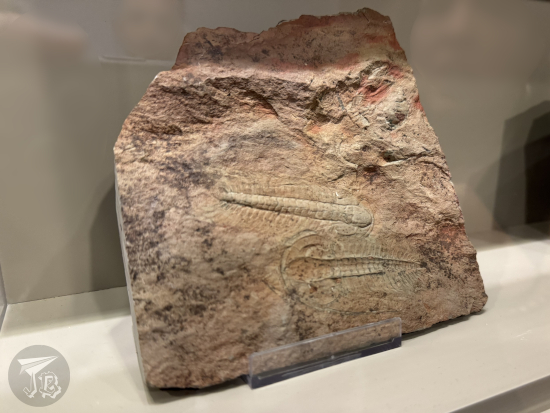
The next rooms focus on the “Cambrian Explosion”, a term used to refer to the point in geological time when living things took over the planet. At first, this brand-new life was comprised of ocean-dwelling invertebrates. In the room there are impressive trilobites from the Murero Palaeontological Site, which I had actually planned to drive through on my way back. But not only animals appeared, so did plants – organisms which produced a new toxic gas that would change the planet forever: oxygen. To the side of this area there is a curtained room, the “aquarium”.

Zaragoza Natural Science Museum: Two trilobites from the same species showing slightly different shapes, thought to be a male and a female

Here you can see the cranium of Carolowilhelmina geognostica, a fish which lived around 392 million years ago, during the Devonian period. It was a placoderm, a group whose main characteristics were being covered in armoured plates, and having developed an actual jaw and true teeth. The specimen is not just the holotype, it is the only known fossil of the animal. The cranium alone measures almost 45 cm, and by its shape, palaeontologist speculate that the animal was probably a predator of invertebrates. A first fragment of the fossil was found in Southern Aragón in 1971 by palaeontologist Peter Carls. Carls kept returning to the site to search for the rest of it every summer, until in 1986 he unearthed the rest of the skull, which was finally extracted in 1993.

Zaragoza Natural Science Museum: skull of an ancient armoured fish

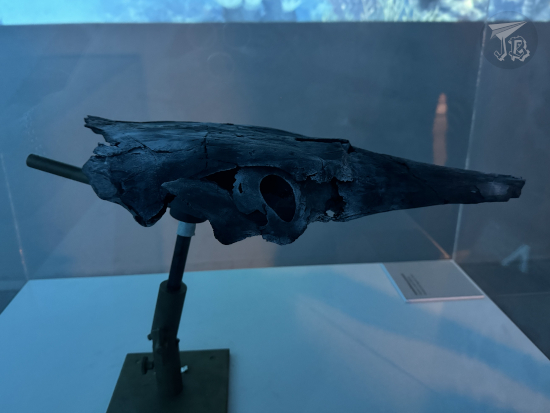
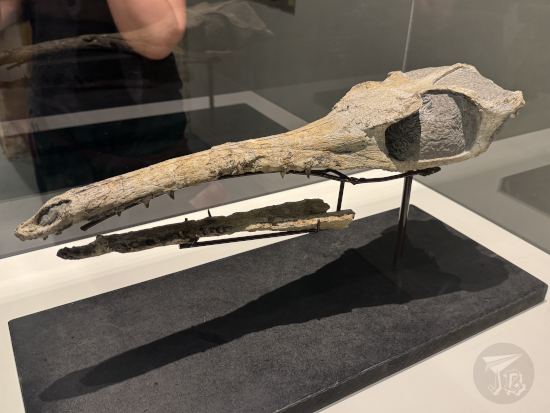
The following room is devoted to the Mesozoic, and it hosts another of the museum treasures, the skull of the holotype and only specimen of Maledictosuchus riclaensis, the “Cursed Crocodile from Ricla”. This crocodilian lived in saltwater around 163 million years ago, during the Middle Jurassic. It had flippers instead of legs, and probably ate fish. The fossil was found during the construction of the high-speed railway between Madrid and Barcelona in 1994. It earned the name of “cursed crocodile” because despite the fact that it was the oldest crocodilian found in Spain, exceptionally preserved on top of that, it took 20 years until someone could tackle its study and description. The “curse-breaking” researcher was Jara Parrilla Bel, one of the post-docs who shown us her lab work at the university.

Zaragoza Natural Science Museum: Skull of an ancient crocodile

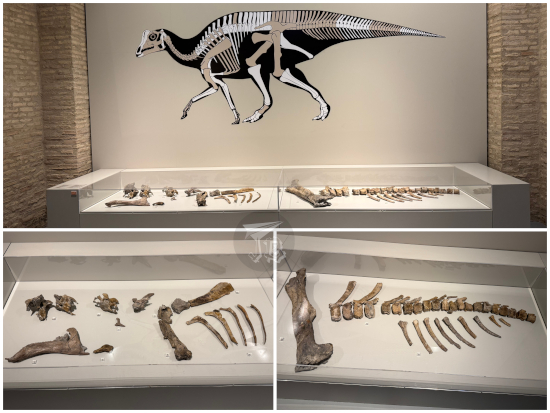
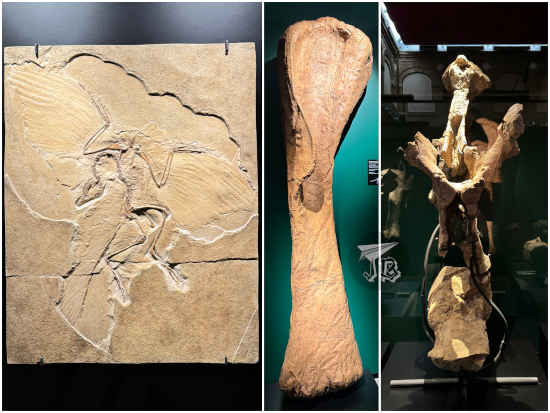
Of course, the “stars” of any palaeontological exhibit are dinosaurs. The museum hosts several iconic pieces, amongst them replica of the feet of the first dinosaur ever described by researchers belonging to the local university Universidad de Zaragoza, Tastavinsaurus sanzi (a titanosaur), a whole specimen of the Mongolian Psittacosaurus (a small ceratopsian), and a good part of an Arenysaurus ardevoli, a hadrosaur which lived in the Pyrenees area around 66 million years ago, during the early Maastrichtian; the rest of the specimen is located in Arén, where it was located, and which is one of the museum’s satellite centres, just like Loarre’s museum-lab. In the same room there were trunks of fossilised wood that could be touched, and a skull of the extinct crocodile Allodaposuchus subjuniperus.

Zaragoza Natural Science Museum: Skeleton of a small Mongolian dinosaur

Zaragoza Natural Science Museum: some bones from a hadrosaur, including the tale, hind hip and some ribs

After a small room with an audiovisual representing the impact of the meteorite and the K-Pg mass extinction (which we skipped due to time constraints), there was an exhibit of the spread of mammals. The specimen of honour in this exhibit is the ancient sirenian Sobrarbesiren cardieli (holotype, and the topic of our guide’s thesis). This species lived during the Eocene, around 45 million years ago. Sirenians (manatees and dugongs) are a type of marine mammals whose closest relatives are elephants – and not other ocean-dwelling mammals. After life spread through land, a number of mammals went back to water, and it looks like this species is a snapshot on the readaptation process: it was already completely aquatic, but it still had four functional limbs. Its hind legs had started reducing and its tail was getting flat. It was a strict herbivore, eating sea grass, but less efficiently than current sirenians.

Zaragoza Natural Science Museum: Skull of an ancient sirenian.

There was also an impressive aquatic turtle of the genus Chelonia, several remains of Gomphotherium angustidens, an elephantimorph, and smaller pieces including crabs, sea urchins, gastropods and even insects. Several of these specimens are holotypes, too.

The final area was almost contemporary considering when we had started. It hosted remains of cave bears (Ursus spelaeus, 40,000 years ago), the skull of an aurochs (Bos primigenius, a species that actually lived until the 1600s), evidence ancient hyena nests, micro-invertebrate bones, mammoth defences… These animals coexisted with human beings, whose skulls comprise the ending room before moving onto the “nature collections” which we did not visit because a) the course had after all to do with palaeontology and b) it was closing time – quite literally, museum security was turning off lights behind us since the museum shut down at 14:00.

Zaragoza Natural Science Museum: Skull of an ancient bull, curved mammoth defence, a pile of bones from a hyena nest and several human-ancestor skulls

We had a mini closure “ceremony” in the hall of the building – coordinators Miguel Moreno Azanza and Lope Ezquerro Ruiz thanked us for attending, we clapped and thanked them back. Then we all went off to have a drink, a snack and a chat. A bit after 16:00, when most students had already left and the professors had been joined by university staff, I took my leave.

Palaeontological Restoration Techniques through the preparation of Loarre dinosaur eggs

Hopping from shadow to shadow to avoid the sun and the heat as much as I could, I headed downtown. On my way I made an exception regarding the walking in the shade when I found the only remaining gate of the original Medieval Wall, today called Puerta del Carmen. Calling it “original” is a bit of a stretch though. While it is in the same place as the first gate, it actually dates from the early 1790s, and it follows Neoclassical patterns.

I also stopped at Starbucks for a Vanilla Frappuccino – I’m on a bit of a matcha remorse trip due to the alleged shortage, so I’ve reverted to my old drink of choice. With a temperature of around 38 ºC, I reached the most important square in town, Plaza de Nuestra Señora del Pilar, where the namesake basilica is. I kid you not, what was running through my head was “I’ve got a 0.5 zoom on my phone now, I’ll be able to take a nice picture of the whole building with its towers…”. Only to find said towers covered in scaffolding. I was able to take the picture, but it could have been nicer. I entered the Cathedral-Basilica of Our Lady of the Pillar Catedral-Basílica de Nuestra Señora del Pilar, a Baroque / Neomudejar catholic temple which is considered the first-ever church dedicated to the Virgin Mary. I sat at the chapel for a little bit, but when I was ready to have a walk around the church, there was a call for mass, so I did not do it out of respect.

Chapel of Our Lady of the Pillar, a baroque chapel for the workshop of a small figurine of the Virgin Mary carrying a child and standing on a pillar

Instead, I strolled to the former exchange building Lonja de Zaragoza, which has been turned into a free exhibition centre. The building is Renaissance with a touch of Neomudejar, and it is considered the most important civil architecture construction erected in the whole area of Aragón during the 16th century.

I had read that there was an exhibition on Asian culture called Tesoros. Colecciones de arte asiático del Museo de Zaragoza – Treasures: Asian art collections from the Zaragoza Museum. At the moment, the Zaragoza Museum is closed and has loaned a few of its artifacts to be displayed elsewhere. This one exhibition displays items that were originally part of personal collections and were donated to the museum. The Colección Federico Torralba, comprises religious items and art pieces from China and items from Japan. The Colección Víctor Pasamar Gracia and Colección Miguel Ángel Gutierrez Pascual have woodblock prints – landscapes, noh [能], kabuki [歌舞伎], even modern ones. The. Finally, the Colección Kotoge displays lacquered tea bowls (chawan [茶碗]). There are also modern calligraphies, paintings, and the compulsory samurai armour. The regional government has undertaken buying artefacts to engross the Asian collections. Though they looked a bit out of place in the historical building, the items were fantastic – and you could even make your very own “woodblock print” at the end.

Zaragoza exchange ceiling, decorated with architectural flower-like patterns

Though the exhibition was the reason I had wanted to go downtown, after I left the (nicely air-conditioned) Lonja, I still had some time to do stuff. I wandered back into the cathedral for a bit – between the 17:00 mass and the 18:00 mass, and left before the second one started.

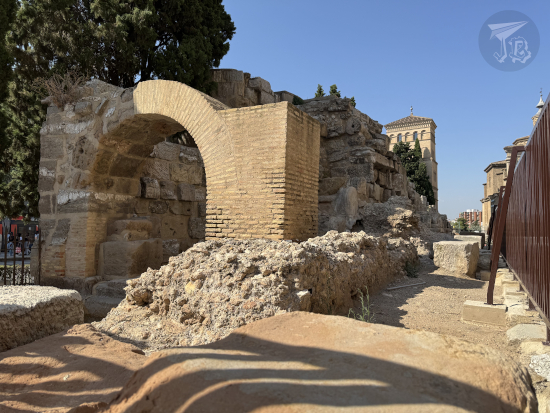
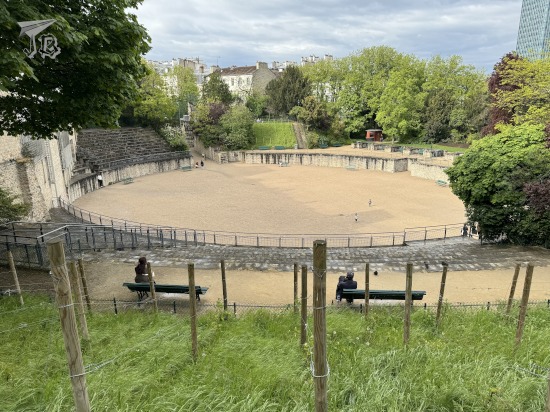
I continued towards the Roman Walls Murallas Romanas de Zaragoza, which sadly have had to be fenced off because people have no respect (I vividly remember a mum letting her toddlers to climb all over them one time I visited). At the end of that square stands the marketplace Mercado Central de Zaragoza, a wrought iron architecture building designed in 1895 by Félix Navarro Pérez. Being a Friday evening, in the middle of summer, many of the stands were closed, so it was not crowded.

Zaragoza Roman ruins

Iron and glass architecture market

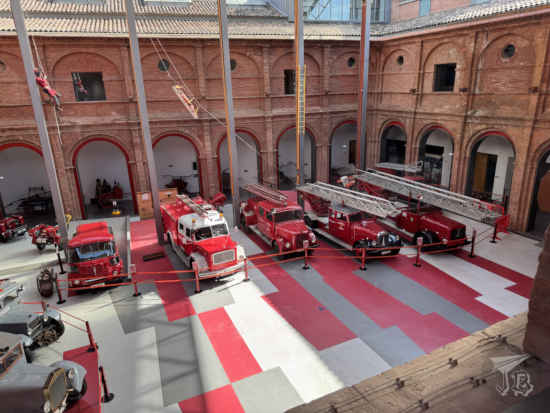
I continued towards the Fire and Fireforce Museum Museo del Fuego y de los Bomberos, where a nice gentleman wanted to give me a guided visit which I declined. Honestly, I just wanted to look at the old fire trucks (and actually, support any initiative by firefighters if it helps fund firefighting). It is a little quaint museum located in part of a former convent, the other half is an actual fire station. The exhibition covers documentation of historical Zaragoza fires, firefighting equipment, a collection of helmets, miniatures, and quite an impressive collection of vehicles used to fight fire. There were two immersive rooms, one which showed damage to a house and another about forest fires. I really enjoyed it, though I only had a quick visit – they closed in an hour, and I was the only guest along a family.

Firefighting museum: collection of vintage vehicles in a brick cloister

On my way back towards the hotel I walked by CaixaForum Zaragoza, where they were running the Patagonian dinosaurs Dinosaurios de la Patagonia. Seeing the Patagotitan on the balcony made me want to go in, but I had already seen it, and I knew I was just on a palaeontology high.

Patagotitan installation on a balcony

I headed back to the hotel – crossing a couple of quite unsavoury neighbourhoods – and bought some fast food dinner again. It was stupidly early, but after eating I could have a shower and relax on the bed while I studied the route for the following day. Furthermore, it was so hot I really needed that shower, and I knew I would not be going anywhere after taking it. Thus, I showered and plopped down to watch the Natural Science Museum’s YouTube Channel after I had learnt how to get out of the city.

22nd February 2025: Architecture in Madrid, and folklore in Guadalajara (Spain)

By now, reaching Madrid by train without anything remarkable to comment on is actually remarkable all by itself – there were actually no problems for once. I had booked a spot for a visit at noon, but since I don’t trust the rail service, I hopped on a train to be at Atocha Station around 10:00, and for once I was there right on time, maybe even a minute early!

As I walked up the street Paseo del Prado, I passed by the exhibition centre CaixaForum, where the Patagotitan still stands. Since it was still winter, the trees on both sides had little to no leaves, and I could see it from the opposite side. I of course said hi.

Patagotitan skeleton

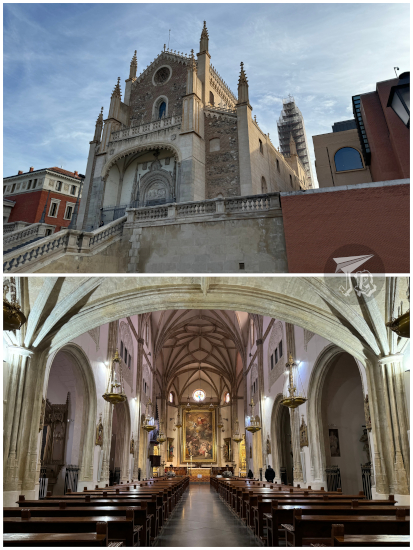
My first stop was the church Iglesia de San Jerónimo el Real, dedicated to St. Jerome, a late Gothic – early Renaissance building erected between 1502 and 1505. It belonged to a monkhood whose original monastery stood near the river. The stagnant waters caused illnesses among the brethren, who asked the Catholic Monarchs for a new location. The church for the new community was created from brick and masonry, and towers were added in the 17th century. The interior is decorated with two gothic altars to the sides, but no main altarpiece, as the original one has been lost to time. Instead, there is a painting by Rafael Tegeo La última comunión de San Jerónimo – Saint Jerome’s last communion – created in 1829.

Monastery Monasterio de Jerónimos

Afterwards, I headed towards the National Museum of Anthropology Museo Nacional de Antropología, a small museum dedicated to the diversity of cultures in the world, particularly the Americas, Philippines, Africa and the “Far East”, focusing on traditions, culture and religion. It is covered by my national museum card.

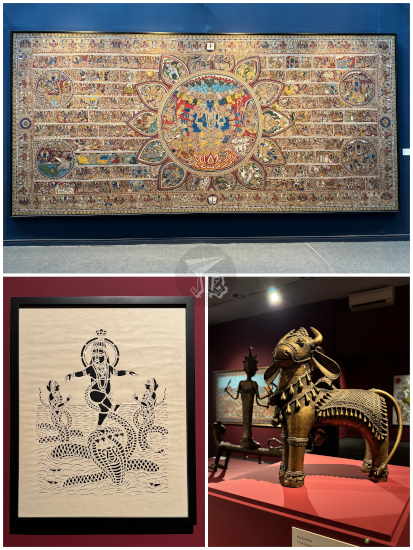
At the moment, the museum is running a temporal exhibit on art based on myths, legends, and sacred texts from India, Caminos místicos. Tradiciones vivas del arte de la India – Mystic Paths. Living Traditions of art from India. I was curious about it, but not expecting how much I liked it in the end. The pieces of the exhibit were mostly based on Hinduism (Sanātana Dharma, सनातन धर्म), the oldest religion in the world. According to Hindu tradition, the Supreme Being Brahma exists as themself, but also as the manifestation of the deities Brahma the Creator, Vishnu the Sustainer and Shiva the Destroyer, all of who at the same time have different avatars (avatāra, अवतार) or incarnations. One of the core principles of Hinduism is the concept of cosmic cause-and-effect justice, karma [कर्म]. Another is reincarnation (saṃsāra, संसार), an eternal cycle of life and death until the individual is liberated from it through self realisation or illumination. The religion is based on values like righteousness, truth, love, peace, and ethical conduct, and it is quite open to other beliefs and ethics.

Religious Indian Art pieces

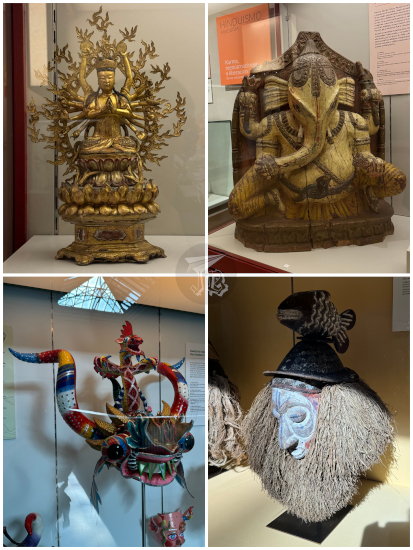
The Museum of Anthropology’s permanent exhibition has a lot of items from the Philippines on the ground floor, probably due to how long(1565–1898) the islands were a Spanish colony. There are clothes, tobacco items, ritual objects, and a small sample of how the local culture was throughout the 1800s. To the back, there is a room dedicated to the religions of Asia and the Middle East – Hinduism, Buddhism and Islam. The first floor is dedicated to Africa, combining a number of traditional exhibits with modern photographs of the traditional people’s way of life – baskets, pottery, leather and wooden objects, ritual masks… The second floor holds items from the Americas, especially from South America. Some of them include a Mexican Día de los Muertos (Day of the Dead) altar, Andean Carnival masks, Sioux-Lakota clothes, Inuit coats…

Religious icons and traditional masks

I remember visiting the museum when I was a child, and then feeling disappointed in it when I returned as an adult. This time around, I found the permanent and temporal exhibitions quite interesting, so it’s a good thing I headed there. It also helped make time until noon, when my next visit was due, to the only Ministry that can be visited – albeit not freely, by appointment and paying a fee – as it is a historical building.

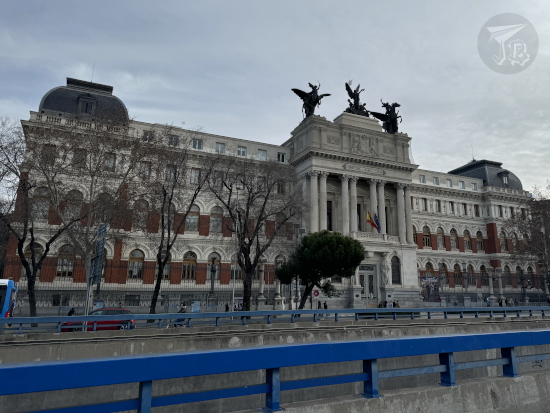
The current Agriculture Ministry is housed in the historical building known as Palacio de Fomento – Palace of Development. Its plans were originally drawn by architect Mariano  Belmás y Estrada, aiming for an Arts and Craftwork School. Later, Eduardo Saavedra y Moragas took over to turn the design into a university. Finally, the project ended in the hands of architect Ricardo Velázquez Bosco, who erected the building between 1893 and 1897 to house the then Ministry of Development.

The Palace is an impressive construction. The original design had three floors, which have now been turned into five. From the outside, the building looks white and orange-brown, but a more focused look reveals decorative tiles by Daniel Zuloaga, who also collaborated with Velázquez Bosco in the ETSIME. The entrance is flanked by two caryatids and roof above there is a sculpture group – Glory and Pegasi La Gloria y los Pegasos, a bronze copy of an original marble by Agustín Querol.

Palacio de Fomento, outside

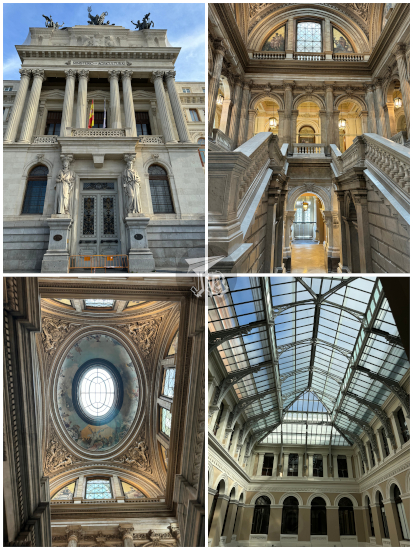
Once you enter, you find yourself in a huge majestic hall, where we had to check in, since the building is a working Ministry. The email said to be there at 11:45 to go through security. I got there at 11:40 and went in at 11:44. They took my name (they did not care about the ticket) and they put my stuff in the X-ray machine. I had to go through the metal detector and when I asked whether I had to remove my belt, I was just told to put my hand over the buckle… So much for security, I thought, because I did not beep. Then I realised that I must look quite non-threatening as quite a few people were thoroughly searched as they set off the machine.

Beyond the hall where we were checked in, there is an imperial staircase in marble, and a vaulted frescoed ceiling. From there, we visited some offices and meeting rooms, and the portrait gallery – from which the ministers who held office during the Franco dictatorship had been removed. Finally, we visited one of the side inner courtyards, covered in a skylight with some ironwork.

Palacio de Fomento, inside

After the visit was over, the security guards saw us out and locked the doors. I walked around the building, because I had honestly never realised it was square. As the place was next to the Retiro Park, I had been considering looking for some archaeological spot they had opened. However, there were more ideas – Guadalajara was having the Botarga parade, and it was the fair weekend in Tendilla, though, a phone call informed me that traffic was horrid and that it was not a good idea to head there so late in the afternoon.

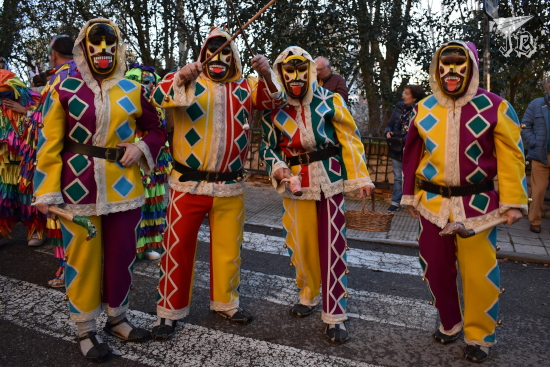
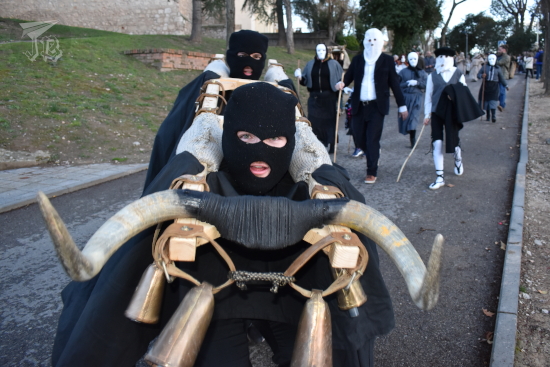
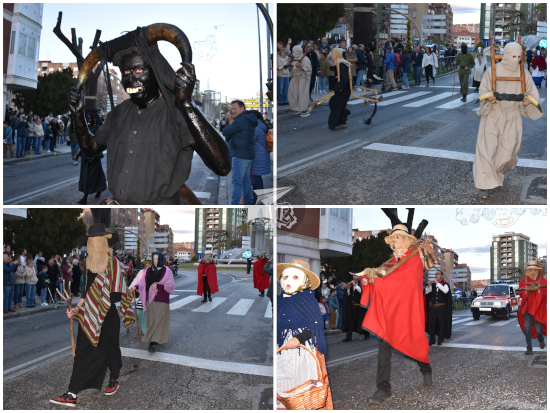
Eventually, I decided on the Parade. I bought some sandwiches and headed for the train. Though I got rained upon, it cleared up, and at 18:00 I was in Guadalajara to have a look at the traditional Parade of Carnival characters Desfile de Botargas – “creatures” from the whole area which meet up in the capital the Saturday before carnival, despite each character having its own schedule wherever it is rooted. The parade was a bit late, so I could talk the local botarga group – El Manda (the Order-giver), Los Mandaneros (the Order-receivers), and the Botarguilla (Little Botarga) – into posing for me. I watched and took pictures from two spots, but the parade moved really fast because they only had thirty minutes to do the route – last year they took well over an hour for that. I decided I did not want to run for it that much… I have to remember to find myself a vantage point next year, instead of trying to get the beginning of the parade…

Guadalajara Botargas

Heifferette from Riba de Saelices

Botarga Parade 2025

I got “attacked” a few times, and ended up with soot all over my face, but at least I avoided the guy painting people with mustard… The botargas seemed to zoom in on children and cameras, and so did the devils Diablos (from Luzón) and the heiferettes Vaquillas and Vaquillones (Villares de Jadraque, Robledillo de Mohernando, Luzaga, Riba de Saelices). It was fun. One of these days I might have to try to follow the botargas in their own villages…

31st December 2024: A clumsy morning yielded to an unbelievable evening {Vienna, Silvesterkonzert 2024}

When we walked out of the rooms to go down and have breakfast, my parent’s alarmed face made me worried. They informed my sibling and myself that “it had snowed”. That was spooky for a second – until I ran to the window and saw that the “snow” was just a very thin layer of scattered white powder. It was safe to go out, even with my senior parents. We had breakfast and we got ready to go out.

Snow in Vienna

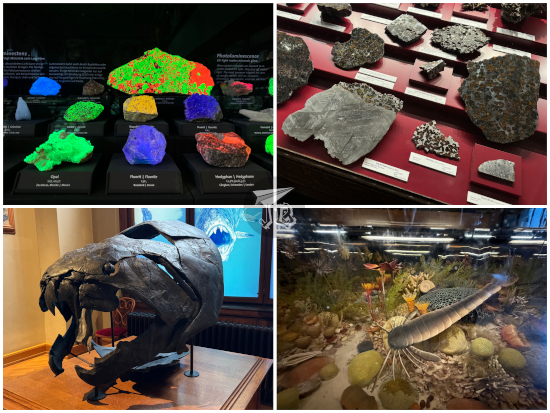
At some point, my family “caught” that I like Natural History museums, so they really, really thought I wanted to go to Vienna’s Natural History Museum – Naturhistorisches Museum Wien, and just wouldn’t listen to “No need, I’ve been there already, Their reasoning is that I had mentioned it before, which I actually had, to inform them that the Venus von Willendorf was there. That is where we ended up, and I was happy to oblige – the museum has rocks, meteorites, fossils and dinosaur animatronics. All right up my alley.

The museum’s oldest collection 250 years. In 1750, the Holy Roman Emperor Francis I bought what at the time was the largest collection of natural history objects at the time – around 30,000 objects. That same decade, the Emperor founded the Schönbrunn Zoo and the botanical garden, and he ordered the first scientific exhibition to be held. Upon his death, the collections were donated to the state, and the first museum according to the Enlightenment principles was founded – and soon expanded.

The museum building was also commissioned by the Emperor. It was designed by architects Gottfried Semper and Carl Hasenauer, with an identical exterior to the nearby Museum of Fine Arts. Works began in 1871, and the institution officially opened in 1889. Though it was indeed originally designed as a museum, it feels more like a repurposed palace, with decorated ceilings and monumental staircases. It has 39 halls with almost 9,000 square metres of exhibits, still keeping the 19th century outline. We just did halls 1 to 13: mineralogy, petrography, meteorites, palaeontology and prehistory galleries, including the Venus von Willendorf. The 11-centimetre figurine was made in limestone around back to 30,000 years ago. It is a nude woman of large proportions, and even if she does not have a face, she is mostly anatomically correct and has plaited hair.

My family was fascinated by the collections, and I guess I felt a teeny bit smug about that – considering how much fun they poke at me because natural history museums are very high on my priorities when I visit a new place (see: my first time in Brussels).

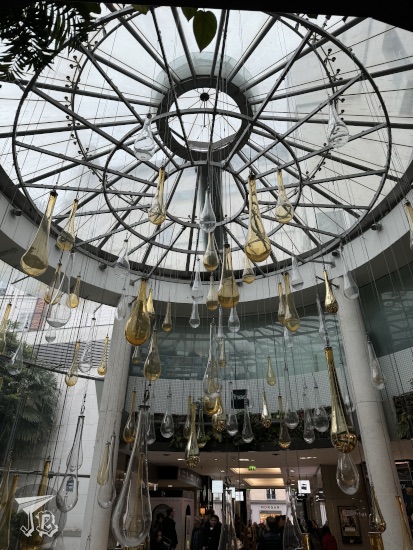
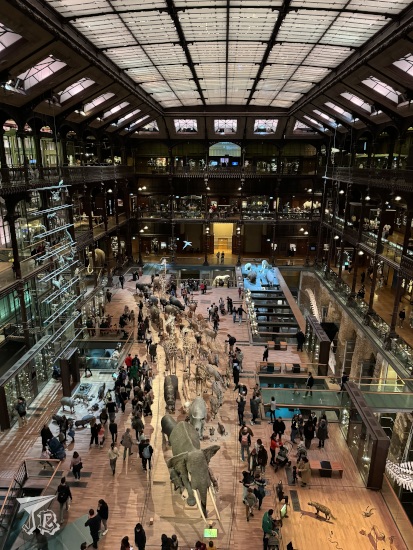
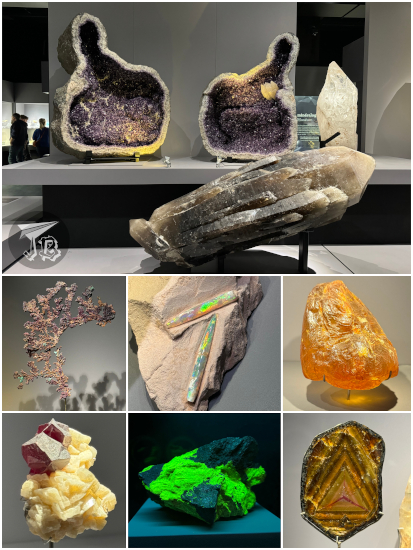
Natural History Museum Vienna

Natural History Museum Vienna

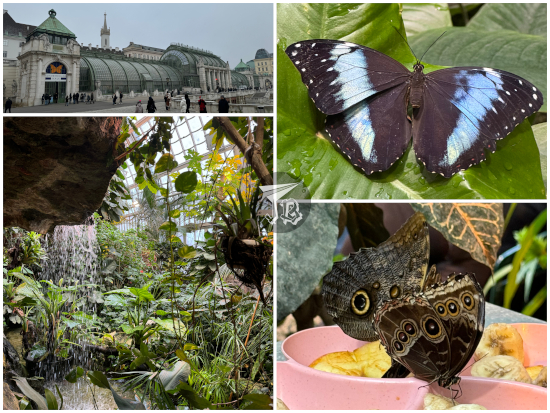
We left the museum after a couple of hours, around noon. We did not stay at the Silvestermarket at the square, but headed out towards the Imperial Butterfly House Schmetterlinghaus. It comprises half of an Art Nouveau greenhouse turned tropical botanical garden and butterfly zoo of sorts. I really love the iron-and-glass architecture of the building – and I would have loved to have had lunch in the brasserie that fills the other half of the greenhouse. The building was designed by architect Friedrich Ohmann and erected in 1901 as part of the Hofburg Palace and is, next to the Burggarten palace.

Most of the butterflies we saw, if not all, were forest giant owls Caligo eurilochus, very large butterflies originating from the Americas – they can live from Mexico to the Amazon basin. They have marks like big eyes in its back wings (hence the commmon name), and the inner wings are blue. They are pretty, and they seem to like fruit, as they gathered around the feeders to snack on it. The sad part is that they only live around 24 days.

Schmetterlinghaus

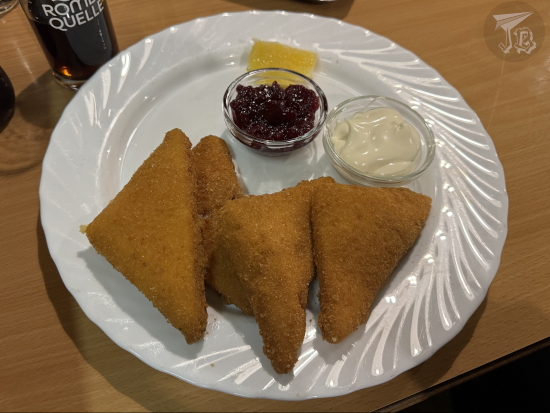
We then headed to the restaurant Centimeter, near the Rathouse (town hall) to have lunch. It is a place that has a lot of things measured – you can order sausages by the metre. I was somehow was not feeling hungry, so I decided to get Gebackener Emmentaler mit Sauce Tartare und Preiselbeeren, breaded and baked Emmental cheese with tartare sauce and cranberries. After lunch, we expected the Silvestermarket next to the Rathaus to be open, as it was one of the places to be for New Year’s Eve. We were wrong! That was a bummer, because in hindsight we could have cancelled the reservation and just stayed at the market in front of the Natural History Museum. That was a bummer, but at least we were warm.

Gebackener Emmentaler

We headed back towards the hotel, and we stopped by the supermarket next door to buy something for dinner. I grabbed myself some pre-emptive sushi, because I was pretty sure that my family was not going to find what they wanted – basically stuff like they would get at home. After half an hour of going back and forth, they decided to settle down with sandwiches and more sushi. We also picked up some chocolate thingies that would end up being more coconut than anything else. Not that I have anything against coconut, but I do not appreciate it replacing chocolate unannounced.

We took the groceries to the hotel, and had a bit of downtime before got ready for the main event. During that time, I went on the online airline webpage to make sure that the travel agent at El Corte Inglés had checked us in. The check-in was done, but someone had made a typo on my parent’s email address so we had not received the boarding passes. I retrieved them and downloaded onto my phone to distribute later.

A bit past 18:00, we left for the Wiener Musikverein, the Viennese Music Association, home to the Vienna Philharmonic Wiener Philharmoniker, where we would attend the 2024 Silvesterkonzert. It was a bit strange to head to such an event using the underground, but that was the most efficient means of transport, to be honest. We ran into the Spanish lady and her husband again – and that was great because that way we could take pictures of each other without having to get a stranger to do so.
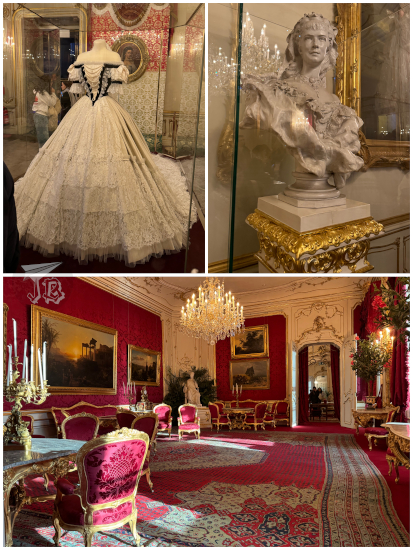
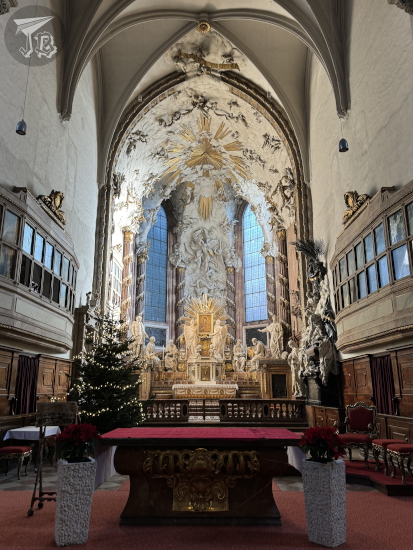
Vienna Musikverein

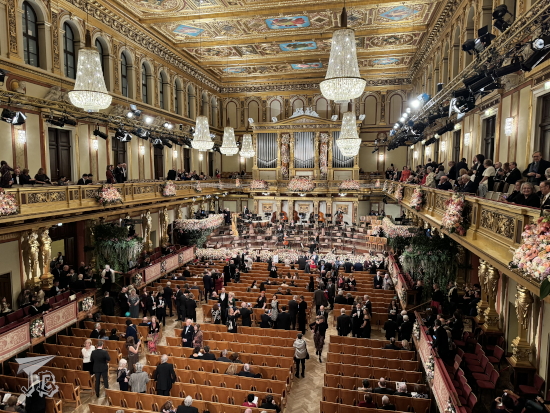
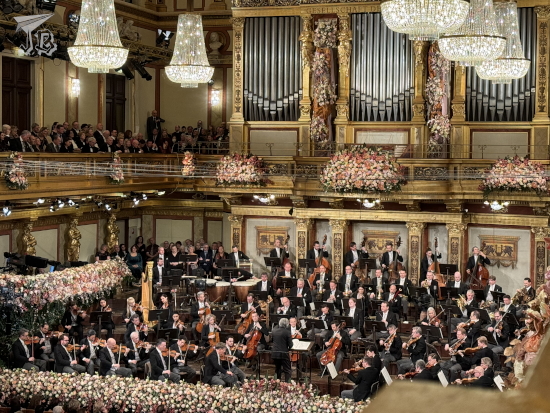
The Musikverein was designed to resemble an Ancient Greek Temple in a Neoclassical style, following plans by architect Theophil Hansen. The building was inaugurated in 1870, and it has a small decorated entrance, very underwhelming staircases, a small chamber music hall, and the main music hall, the Großer Musikvereinssaal or Golden Hall. Walking in there was… surreal. It’s a hall I’d seen so often on TV, and it actually felt… I don’t know, a bit… pale. Less bright than on the screen. Maybe it was that the flowers were white and pink, so they did not pop. And it’s not like I know anything about flowers, anyway. I was just happy they were artificial enough not to trigger my allergies, it would have been awkward to sneeze all throughout the concert…

Vienna Musikverein Golden Hall

Though the “New Year Concert” is the one that everyone knows, there are actually three concerts with the same set list – the Preview Voraufführung on the 30th, the Silvesterconcert Silvesterkonzert on the 31st, and the New Year’s Concert Neujahrskonzert on the 1st. I honestly would have thought that it would be full of wealthy people and they would be all cool as cucumbers, but it turns out, a whole bunch of us were just excited noobs taking pictures of every and anything. My family’s seats were on the second floor balcony. I just couldn’t believe everything that was going around around me, nor where I was. I bought the programme, because I really wanted something physical from the soirée, aside from the ticket.

The Vienna Philharmonic was founded in 1842. It is formed by the best musicians from the Vienna State Opera. It is actually run by the musicians themselves. Every year, a conductor is chosen to direct the concerts, and for the 2025, it was Italian Riccardo Muti. Maestro Muti was born in Naples in 1941, and studied in the Classical Lyceum. He proceeded to move onto studying Piano, then Composition and Conducting. He began his career in 1968 as the music director of the opera festival Maggio Musical Fiorentino. He conducted the New Year’s Concert in Vienna in 1993, 1997, 2000, 2004 and 2018 before this year. In 2011, the Philharmonic awarded him Honorary Membership. He is also a bit of a troll.

The concert had two parts, including the encore:

First part:
  1. Johann Strauß I. Freiheits-Marsch, op. 226 – Freedom March
  2. Josef Strauß Dorfschwalben aus Österreich. Walzer, op. 164 – Village Swallows from Austria, waltz
  3. Johann Strauß II. Demolirer-Polka. Polka française, op. 269 – Demolition Men’s Polka, French Polka
  4. Johann Strauß II. Lagunen-Walzer, op. 411 – Of friends, Waltz
  5. Eduard Strauß Luftig und duftig. Polka schnell, op. 206 – Airy and fragrant, fast Polka

Second part:
  6. Johann Strauß II. Ouvertüre zur Operette “Der Zigeunerbaron” – Overture to the operetta “The Gypsy Baron”
  7. Johann Strauß II. Accelerationen. Walzer, op. 234 – The Acceleration, Waltz
  8. Josef Hellmesberger (Sohn) Fidele Brüder. Marsch aus der Operette “Das Veilchenmädl” – Fidel brothers. March from the operetta “The violet girl”
  9. Constanze Geiger Ferdinandus-Walzer, op. 10 [Arr. W. Dörner] Ferdinandus, Waltz
  10. Johann Strauß II. Entweder – oder! Polka schnell, op. 403 – Either … or! Fast Polka
  11. Josef Strauß Transactionen. Walzer, op. 184 – Transaction, Waltz
  12. Johann Strauß II. Annen-Polka, op. 117 – Polka Ana
  13. Johann Strauß II. Tritsch-Tratsch. Polka schnell, op. 214 – Chit-chat, fast Polka
  14. Johann Strauß II. Wein, Weib und Gesang. Walzer, op. 333 – Wine, Woman, and Song

Encore:
  15. Johann Strauß II. Die Bajadere, Polka schnell, Op. 351 – The Bajadere, fast Polka
  16. Neujahrsgruß (New Year’s Address)
  17. Johann Strauß II. An der schönen blauen Donau, Walzer, Op. 314 – The Blue Danube
  18. Johann Strauß I. Radetzky-Marsch, Op. 228 – Radetzky March

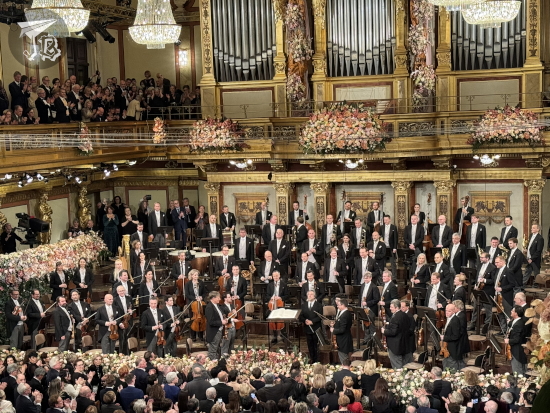
Vienna Silvesterkonzert 2024

Honestly, what can I say? It’s nothing and everything like what you watch on TV. The music was fantastic, but somehow it felt like the conductor did not do much, the orchestra did whatever they wanted, not in a bad way. They knew exactly what to do and just did it. I know next to nothing regarding classical music, but they made it feel absolutely effortless. I am not sure how much work they do on their own and how much they do with the conductor, but I can tell had Riccardo Muti a blast. At some point, when he was coming in and out, he knocked over some of the viola or bassoon’s music sheets all over – he was very apologetic about it. Also, although neither photographs or videos are not permitted (mine are totally… sneaky, you see), one of the ladies in the first row was shamelessly filming, and he winked and waved at her. Furthermore, he would just… jump during some of the polkas, which is a feat considering the man is 83 years old.

The concert always ends with Strauß’s Radetzky-Marsch, and the public is invited to clap along. Muti completely had the concertgoers in his pocket, controlling them (us) with a finger and a look. It was amazing to watch. All in all, he was absolutely… not careless but carefree. It was great to see, somewhat magical in a way.

Vienna Silvesterkonzert 2024

The concert felt much much shorter than the two and a half hours it lasted. We went down to the first floor for pictures during the intermission, and we were not the only ones. However, I think we kind of… snuck past the intern or something, not sure we were supposed to be allowed on that floor. People were having champagne but I only cared about seeing everything. I might be a bit… weird. I make no apologies. I really loved the experience. They say it is a once-in-a-lifetime experience, but to be honest, I would just try the lottery every year from now on. I mean, I now have the right clothing for it…

After the concert, we went back to the hotel where we had our dinner. To be completely fair, there was a part of me that would have totally wanted to go out to watch fireworks and Vienna’s way to celebrate the New Year – and then be an absolute wuss, freeze my butt off and need to come back to the hotel. But the grass is always greener on the other side of the fence, and since I did not get to see it… It must have been the most interesting thing ever! It’s okay though, because I got to see the concert, and it was already my once in a lifetime most interesting thing ever… But it took me hours to get to sleep, so maybe I could have explored some, because in the end I’m greedy and I want it all.

30th December 2024: A planned and packed day {Vienna, Silvesterkonzert 2024}

It was a crisp morning in Vienna when we got up. We went down for breakfast and it was not particularly well stocked. The coffee was… weak, so I decided to mix a cappuccino and a black coffee to get me the energy I needed for the day. I tried some local cake, but I did not enjoy it, so I decided to stick to bread and croissants. Thankfully, I did run into the lady from the day before, and her husband, during breakfast, and told her about our plans – that way at least someone in the group would know not to wait for us and we would not delay anyone. Apparently, we were not the only ones who had made their own plans either, as the excursion had been marketed as “optional” and yet it seemed to be “a given”. Even better, we came across the driver from the day before (despite him saying he had nothing to do with the trip), and we could tell him that we were not coming, either. As we stepped out, it was freezing – literally below zero – but sunny during the whole day.

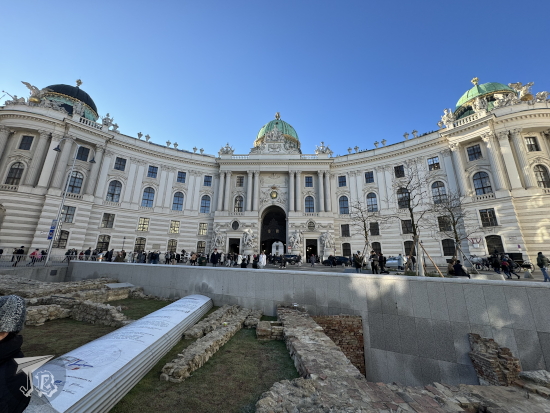
We took the underground at Zieglergasse and headed towards the city centre. I asked my parent to use their phone for GPS and maps in order to keep my battery for as long as I could so I could be taking pictures throughout the day, so they would be guiding. Our first stop was the Hofburg – the former imperial palace – and the Sisi Museum. Empress Elisabeth of Austria (1837 – 1898) was the wife of Emperor Franz Josef I of Austria. She married the Emperor when she was just 16 years old, and was stifled by court life. She spent most of her time travelling and avoiding royal duties. Her perceived eccentricity – today we would call it depression – and assassination in 1898 helped create an image of a romantic heroine in the media that has reached today, especially through actor Romy Shenider’s portrayal in the 1950s.

Hofburg

The museum tells about her life by showing objects, portraits and reproductions of her clothes. Then, you step into the former imperial apartments, which have been refurbished with furniture from the 19th century to make them look real. The audioguide was… corny to say the least, and I kind of skipped most of it because I got bored.

Sisi Museum and Royal Apartments Vienna

I proposed the church of Saint Michael first, and then the National Library. However, my parent had been intrigued by the church that stood at the exit of the underground. Thus, we headed there. The Wiener Minoritenkirche, Friars Minor Conventual Church, is officially the Italian National Church of Mary of the Snows Italienische Nationalkirche Maria Schnee. The church was erected between 1276 and 1350, and it was one of the first gothic churches in Vienna, following a French pattern. There were many subsequent reforms, including rebuilding the bell tower and the spire again and again – today the bell tower is flat and the spire is gone. The interior altar is Neogothic, by Ferdinand Hohenberg. Since it was still around Christmas time there were Nativities and Christmas trees.

Wiener Minoritenkirche

Afterwards, we headed towards St. Michael’s Church Pfarre St. Michael. It started as a late Romanesque or early Gothic building, maybe in 1221. The following two centuries saw Gothic annexes added. The crypt was built in the 16th century. The organ was built in 1714. The Rococo high altar was sculpted by Karl Georg Merville, and it represents the Fall of the Angels after the War in Heaven, when Lucifer was banished; underneath, there is a Byzantine Virgin Mary from the Cretan school. The outer façade was rebuilt in a classicist style in 1791. Construction officially finished in 1792. The crypt is accessible in a guided tour, but considering it has about 4,000 bodies, some of them mummified and on display, I think I’m happy we did not take it.

Michaelkirche Vienna

I proposed going to the Library again, because it was cold and there would be toilets there. My parent took over guiding with their phone, and my sibling and I got distracted as we passed by the Stallburg, where we caught a glimpse of the Lipizzan horses chilling out.

Instead of reaching the Library, my parent decided that we wanted to see the Augustinian church Augustinerkirche, a mix of 14th century Gothic and 18th century Neogothic. The original church was engulfed by the Hofburg as it expanded, and in 1634 it became the official imperial church. May Habsburg weddings were officiated there, and a chapel to the side, called the Herzgruft (Heart Crypt), contains the hearts of the members of the dynasty, from Ferdinand IV in 1654 to Archduke Franz Karl in 1878.

Augustinerkirche

I did not get to go to the Library, but we walked past the Hotel Astoria, which opened in 1912. it was built in the a late Art nouveau style known as fin de siècle (end-of-century). At the time it opened, the hotel was the latest, with electricity, bathrooms and all!

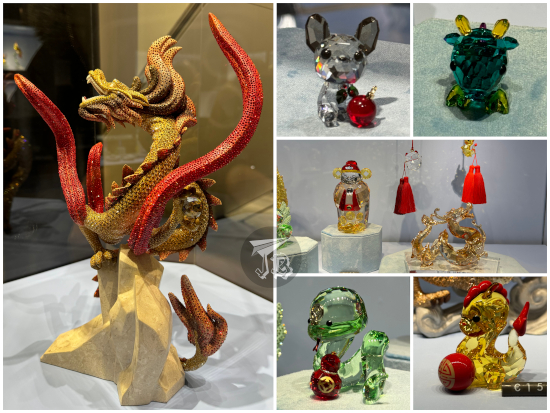
We reached the pedestrian / shopping street Kärntner Straße, the neuralgic centre for Vienna shopping. There we… met the card-not-working lady and her husband again, in what would become a funny number of encounters. We also saw the Swarovski shop. We entered it because we thought it would be warm – and hey, it had a toilet, which was handy, considering we had left the hotel over four hours before. Swarovski is an Austrian glass producer, known for its crystal glass, used in jewellery, decoration, watches, accessories. The company was founded in the late 19th century with the idea of “making a diamond for everyone”. Since then, it has produced thousands of items – from Christmas decorations to sculptures to collectible tiny figurines to whole dresses for the Vienna Opera. The place was halfway between a shop and a museum – and we might have spent a bit more than we had planned there, especially considering we were not planning to spend anything.

Swarovski flagshop Vienna

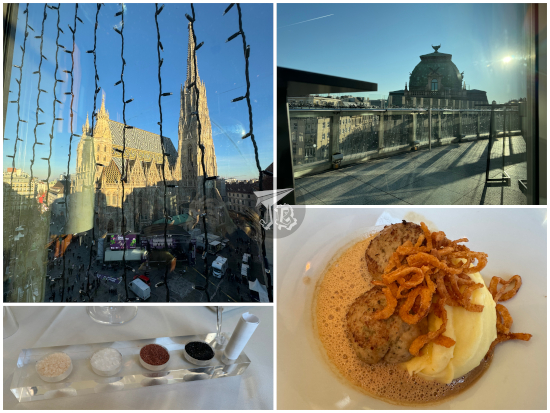
We reached DO & CO Restaurant Stephansplatz, located on the top floor of the post modernist structure Haas House, constructed in 1990. Most of the building is a hotel now. The restaurant has a fun view of the cathedral Domkirche St. Stephan. My parent and I discovered the restaurant because the opening scene of Austrian TV series Kommissar Rex, which ran between 1994 and 2004. It follows the story of German Shepherd Rex, a police dog which is “transferred” to the homicide department after his original handler dies… at the DO & CO terrace. It is such a naïve series, I just love it. Think The A-Team ingenuity with an adorable GSD saving the day every time and stealing sausage rolls as a self-reward. In a later series, Rex would move to Italy, and there is currently a Canadian reboot too…

There were no doggies in DO & CO, but both service and food were superb. They had butter and bread, and small receptacles with different types of salt, and a note on how they should be used. For lunch, I ordered kalbsbutterschnitzel – delicious minced veal butter patties with cream, accompanied with mashed potatoes, fried onion rings and a small leaf salad. For dessert, I had an ice latte that I should not have had, but I saw it pass by and I was smitten. We snuck a number of pictures from the restaurant, too.

DO & CO Vienna

After lunch, we went into St Stephan’s cathedral Domkirche St. Stephan. The building is a mixture of Romanesque and Gothic, and it was initiated around 1137 and completed 1578, and as many as four construction stages can be seen – the first Romanesque towers, the later Romanesque church, the Gothic Choir, and the outer, newest additions. The roof is tiled with as many as 230,000 pieces, one side shows the mosaic of a double-headed eagle, and the other the coat of arms of the city and the country. The bell tower has twelve bells, and the interior hosts as many as 18 altars (plus the ones in chapels). The cathedral was built in limestone, so it looks darker than other churches its size (107 metres long, 70 metres wide and 137 metres high).

The high altar was built in marble by Tobias Pock in the 1640s in the Baroque style. It depicts the stoning of Saint Stephen, church patron and the first Christian martyr. He was stoned to death by the Israelites after a rather inflammatory speech in front of the Sanhedrin, defending Christ’s teaching versus the traditional Jewish ones. According to the Bible, this would have happened a couple of years after Jesus’ death, and before the Roman persecution.

St Stephan’s cathedral

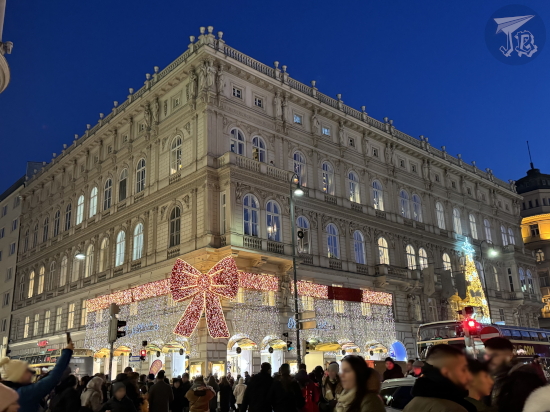
My parents were tired and they decided to head off towards the hotel, while my sibling and myself stayed behind. We wandered around Stephansplatz, Rotenturmstraße, and Kärntner Straße, checking out the Christmas lights and decoration until we reached the Popp & Kretschmer fashion store. They are a luxury women’s clothes firm, which draw tourist crowds during Christmastime to see their huge bow decoration, which makes the whole building look like a present. They call it the Vienna Bow.

Christmas decoration - Vienna Bow

We also looked at the Vienna State Opera Wiener Staatsoper, which was prepared to celebrate the new year, with a neon display saying (in English) “Hello 2025”. It was stupidly cold though, so we might have stayed in an underpass for a few minutes longer than necessary.

Afterwards, we headed towards the Sacher Hotel. The five-star hotel was founded in 1876 by the son of a famous confectioner. When the founder died, his wife, Anna Sacher, became manager. She turned the hotel into one of the most refined in the world, catering exclusively to the aristocracy. This management lead the hotel to bankruptcy, and she had to sell the business to new owners, who restored it to its former glory. The hotel serves “the original Sacher-torte”, a chocolate cake coated with dark chocolate icing, and a thin layer of apricot jam in the middle, served with unsweetened whipped cream. It was reportedly invented by the father of the founder, and the recipe is kept a secret. There are other versions of Sacher-torte, but the hotel is the only one with legal standing to call theirs original.

We had a 17:30 reservation at Café Sacher, in the hotel. Sacher Hotel actually has two cafés. The more modern one faces Kärntner Straße and is called Café Bel Étage. It had a long queue – Christmas is peak season in Vienna, as we were quickly learning – but I had been informed that reservations accessed through a particular door. However, that was not where our reservation was – I swear, I did not see the different name anywhere. The historic Café Sacher had an even longer line, and no special door. I dared ask the doorman at the hotel how to get there, and he gave me a huge grin and said “skip the line, go through the exit”. Boy, that was… awkward. Very, very awkward. I though the people just outside would lynch us!

Staff came to check on us, and since our reservation at the Café Sacher was valid – I made the reservation in July, literally as soon as the spots open – we were shown into one of the small salons. The café has a perfect offer – Sacher Sweet Treat: a perfect slice of original Sacher-torte with whipped cream, a non-alcoholic hot beverage and a bottle of Römerquelle mineral water for 22.5 € (31.5 € with a glass of the in-house champagne, Original Sacher Cuvée). I ordered mine with sencha senpai, Japanese green tea. I enjoyed the cake more than I had thought I would, and the tea was great. The staff was incredibly nice, too. They must have been used to silly tourists.

Sacher & Sachertorte

We left the Café Sacher and headed towards the Spanish Riding School Spanische Hofreitschule. For my sibling, this was a core-memory event, so they insisted we got really, really good seats for the Gala Performance Galavorführung at 19:00, on the parterreloge – the box at ground level. The Gala performance is the longest exhibition the Riding School has, and it lasts 90 minutes, with a break. The horses were gorgeous, and the riders looked very cold, but everything felt strangely… cold. I think I liked the exhibit in Jerez Riding School better.

The Spanish Riding School, considered the oldest horsemanship school in the world, was established during the Habsburg Monarchy in 1565. It is dedicated to the breed and training of Lipizzan horses. Lipizzaners are a breed of riding horses developed during the Habsburg empire. It derives from Arab, Bavarian, Spanish and Neapolitan breeds. They were selectively bred so most of them are grey with white coats – albeit there is always a bay stallion in the Spanish Riding School. The breed itself might be traced to eight stallions in the late 1700s, and it was developed in Slovenia. The horses are considered so precious that they were evacuated during WWI, and “rescued” by the US army during WWII. “Lipizzan horse breeding traditions” has been considered Unesco Intangible Cultural Heritage since 2022.

Once bred, foaled and fledged, the Lippizaners are trained. This is done at the Spanish Riding school. The traditional horse training methods used by the school can be traced back to Ancient Greece, and like many other things, they re-flourished during the Renaissance period in the 16th century. The goal of Classical training was to prepare horses for warfare as part of the calvary. Horses train for six year after they turn four.

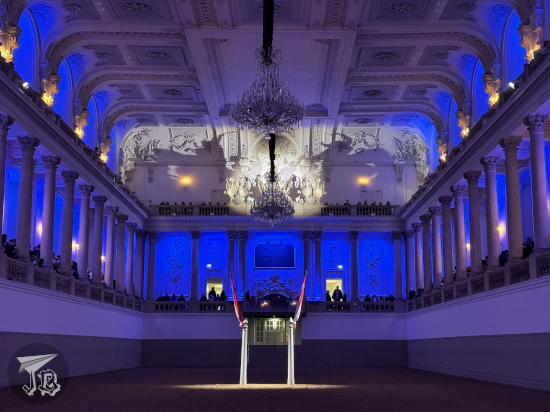
In Vienna, the Lippizaners are housed at the Stallburg, which is technically part of the Hofburg Palace. It is a Renaissance building from around 1560, originally conceived as a residence but that was later converted into the Imperial Stables. The Winter Arena was built in 1735, and has remained unchanged since then – including the chandeliers. The arena is presided by a painted portrait of Emperor Charles VI.

Vienna Riding School - winter Arena

There was something weird in the atmosphere that made it not feel all that… fun. Before every performance, a lady walked to the centre of the arena to introduce the exercises movements in German and English. The performance was pretty though. I tried to sneak a picture or two, but I was unsuccessful – and a bit worried they would kick me out if the venue. There were a total of six different numbers, and the show, including the introductions, was organised as follows:

  1. Alle Gänge und Touren der Hohen Schule – “All Steps and Movements of the High School”: four riders and stallions in individual choreographers, including the one dark stallion in the stable, with classical movements.
  2. Am Langen Zügel “Schools on the Ground: On the Long Rein” – the riders guide the horse from the ground, they are not on top of the horse, with movements such as piaffe and pirouette.
  3. Pas de Deux “Step by Two” – two riders-horses pairs work in tandem, mirroring each other.
  4. Arbeit an der Hand und Schule über der Erde “Working Hand and Airs Above the Ground” – with three main movements: levade, capriole and courbette. Four horses work with their riders on the ground, and two of them with the riders on the saddle, but without stirrups. When horses perform well, they get a sugar treat from the rider.
  5. Am Zügel “Schools on the Ground: Curb Reins” – only one horse and his rider, who only holds two out the four reins in their left hand, and they hold the riding crop upright in their right hand, a commemoration of the military heritage of the horse riding tradition.
  6. Schulquadrille “School Quadrille” (or Das Ballett der weißen Hengste “Ballet of the Eight White Stallions”) – eight horse-rider pairs have to coordinate with each other for a choreography, ending in the Radetzky-Marsch.

When the exhibition came to an end, we tried to go to the toilets. You had to scan your tickets and pay 50 cents. Really. Two hundred quid for the tickets and they charged fifty cents for the toilets, which were filthy on top? A total rip-off.

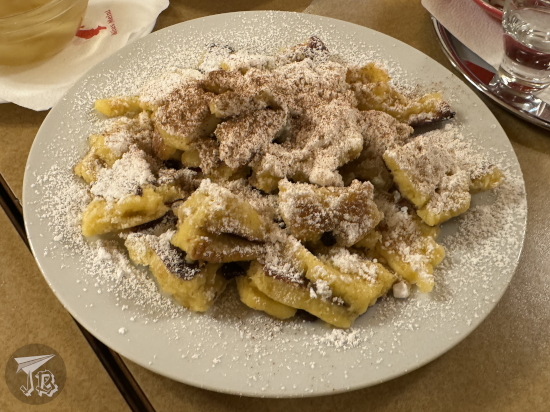
I got my sibling to the hotel, and then I left again to meet up with my friend D****e and her father Fr***, who were also in Vienna for a few days. They were even staying in a hotel close to ours, so it seemed that we had planned it in advance. We spent a couple of hours in a small eatery – Gschamster Diener – where they introduced me to kaiserschmarrn, fluffy shredded pancakes with raisins, powdered sugar and cinnamon.

Kaiserschmarrn

I eventually had to go back to the hotel and my room. There, I spent an hour trying to find a place to book lunch for the following day. After deciding not to plan anything on the 31st, my parents had a change of mind and suddenly I found myself tasked with planning and finding a place for lunch. Most restaurants were either closed or booked off. I was not a happy camper, but in the end I managed to find something… somewhat decent. My sibling suggested the Natural History Museum, the Butterfly House and the Library before lunch. I was absolutely sure that was impossible to cram three things in the morning. We would not even do the entire Natural History Museum, but at least we would be somewhere warm. I resigned myself not to see the Library, had a shower and went to bed.

29th December 2024: Arrival, Karlskirche & Prater {Vienna, Silvesterkonzert 2024}

With our plane boarding at 8:10, we aimed to be at the airport around 6:30, which was a successful endeavour. We had our boarding passes but we needed to drop off some luggage. As we needed formal wear, neither of us could just make do with a simple backpack or trolley. We had decided to bring a carry on each, and two large suitcases – one per room – for coats, jackets, dresses and so on. The travel agency had checked us in the day before, and we had separate seats, but that was not important since it is just a short trip early in the morning.

Once in the terminal, it turned out that Iberia did not have a drop-off counter as my parent was expecting, so we had to queue with the people who needed to check in, including non-Schengen and intercontinental travellers. We decided that two of us would line while the other two could sit down and wait for us. We stepped into the cordoned area, and suddenly… one of the attendants directed half of the queue out and into another area of check-in counters. All in all, it took us around 35 minutes to drop the luggage off. Not efficient, Iberia. Not efficient.

Luggage successfully checked in, we went past security, found our gate, and sat down for breakfast. We went to the gate early, and queued to be the first in our group because… I’m not even sure why, but it was too early in the morning to fight. I napped about half of the journey, and also took pictures of the landscape from above. Once we left Spain behind, the mountaintops were covered in snow, and the valleys in fog. This was a clue of how cold it would be when we landed in Vienna. We had a maximum temperature of around +3ºC throughout the trip.

From the plane window Flight Madrid - Vienna

We disembarked and made our way to baggage claim, where our suitcases were among the first few to come up, which is always a great feeling. Afterwards, we went out and found the people responsible for picking us up – the representatives from Blaguss DMC, the local agency which manages Viajes El Corte Inglés and Tourmundial in Austria and Hungary. First, they handed us our our hotel voucher, schedule, and tickets!! Upon opening the envelope to check that everything was correct, we found out schedule with a Vienna tour the following day that my parents swear they had never heard about – the truth is that it appears in the documentation as optional. The driver in charge of taking us to the hotel was… a character. My biggest regret though is that I did not run for a Costa Coffee while we were waiting for the other travellers to come out, but I only saw the sign when he had started moving.

We arrived at the hotel Elaya Hotel Vienna City West around 13:00. It was a four-star hotel that felt like it had dropped at least one and a half, and it was not any of the ones listed in the original documentation. There was neither a bar nor a restaurant, and the staff was not exactly friendly. I know it’s not nice to work during the holidays, but come on. I don’t think requesting two keys for a two-people room was that outrageous. At first, neither card worked to open my door, but after trying three times each card, both sides, I managed to get it open. And more importantly, though the warm option of the air-conditioning did not work, I figured out how to turn on the radiators.

The hotel room was… sad. It had a little terrace overlooking the interior yard, and two windows – the blinds were unmoveable on one and broken on the other. We unpacked, got freshened up, and went back down to find a place to grab a bite to eat. I approached reception to ask for a recommendation, and there was a Spanish lady trying to get the check-in attendant to help her with her card – she seemed to have the same problem I had had. She had no English at all, so I tried to help her out. The attendant just huffed and left to check the room herself, and I guess she managed to get the card working. When she came back, I asked for any restaurants around, and she pointed us up the street. We found a Greek place seemed okay, and that is where we ended up – at restaurant Mythos, which had very friendly staff, and decent food.

Afterwards, I would have gone towards the city centre. However, my parents needed a break and wanted to move as a group. Thus, I stayed in the room – we did not leave the hotel until 16:30, and by that time it was already getting dark. We walked to the underground stop Pilgramgasse. It was supposed to be just ten minutes away, but was a bit longer, I think we took a wrong turn.

The Pilgramgasse station dates back to the original 1899 Valley line, before electricity and all. The entrance was cast in iron, and it looked very cool. There, we bought seventy-two-hour tickets, which are awesome because you only have to validate them once, and then you can use all the transportation options in the city for 72 hours. The price of the pass was 17.10 €, so not that expensive – one trip is 2.20 €, so aside from the convenience, it is value for money if you plan more than seven trips. Though we did take more than that, the best thing is just being able to waltz down to the platforms without having to validate each time. It was also great that the frequency of the underground service was 8 minutes at the longest, and that was on Sunday evening!

We used the underground to find our stop next to Musikverein Wien (Vienna Music Society), where the concert would take place on the 31st. This was to gauge the time to get to the station and the underground system. Once we familiarised ourselves with the transport though, we realised that there was a better route. It included a change, but the station was much closer to the hotel, and the total time was around the same if you accounted for walking times. The Musikverein stands next to Karlsplatz, so once there we just had to cross the street to find ourselves in front of the church Rektoratskirche St. Karl Borromäus or Karlskirche, dedicated to Saint Charles Borromeo.

The cathedral was originally designed in 1713 by Johann Bernhard Fischer von Erlach. When he died, his son took over directing construction and altered some of the plans. Though the building is Baroque, it displays a mixture of elements – the dome, a Greek temple portico façade, monumental columns based on Rome’s Trajan Columns… The altarpiece was erected by Ferdinand Maximilian Brokoff after the elder Fischer’s design. It portrays the Assumption of Saint Charles Borromeo, the nominal saint, into Heaven. There were Christmas trees on both sides of the altar, which I found strange – I had always thought that the Christian church was not a fan of them.

Karlskirche Vienna

The dome is frescoed with a scene featuring Charles Borromeo, the Virgin Mary, and the Cardinal Virtues, by Johann Michael Rottmayr. Hanging from it, there was a modern art installation by artist Cerith Wyn Evans called Forms through folds (ascending)…. This sculpture is part of the Karlskirche Contemporary Arts Program, started in 2018. That was… weird, and really out of place amongst the Baroque frescoes.

We climbed to the upper levels. The first floor hosts a choir model and the organ, built between 1739 and 1847. Technically you can also access the treasury, but it was locked away. We continued up and stepped into the terrace, which yields to a bit… underwhelming… panoramic view of Karlsplatz and the city. Vienna is a great city, but the Karlskirche is not really looking at the scenery from above.

We should have tried the Vienna Museum next to the church then, but instead took the underground to the classical amusement park Prater, where we had dinner reservations a couple of hours later. Originally a hunting ground, Prater was the area where the 1873 World Exhibition was held. Some of the current buildings were erected at that time. In 1897, the first rides, attractions and puppet theatres were established – including the Ferris wheel Wiener Riesenrad, which is the current symbol of the park. Prater was severely damaged throughout World War II, due to bombings, trenches and fire, but it was eventually reconstructed using records from local artists who had drawn or photographed the area in all its glory. Nowadays, it is considered an actual park, which just happens to have rides on it, and part of it is protected as “green land”. The actual amusement park is called Wurstelprater. There are tons of attractions, rides, snack stalls, and there were even some musical activities going on.

Viena: Prater

But of course, it was Vienna, in a late December evening. It was late and cold. And dinner reservation was hours away. We almost decided to give it up and go back to the hotel, but we found somewhere to have a drink and warm up instead. Finally, we made our way to the Rollercoaster Restaurant, the place where we had – thankfully – reserved in November. It was packed. There were around 50 people waiting to come in, and most of them did not have a booking, and were turned away – there was even a group of people checking every 15 minutes if there was an opening. We took ten minutes to get to the front of the mob to finally get our table, but we were sat around 20:15. I was so happy I had pushed for the reservation! It made me further convinced that anything in the city centre or near a tourist spot might need a reservation, which in turn made me worried about the 31st “winging it” decision.

The Rollercoaster Restaurant works with a system of rails that hang from the ceiling and connect the kitchen to the different tables. The food is prepared by human chefs and distributed by two huge robotic arms. Once placed on the rails, it rolls and slides and gets to the right table – much like suitcases inside an airport distribution system. We were also on time for one of the robot shows, where they turn off all the lights and play music while the robot arms “dance”, and it was surreally fun. One of my parents was horrified, because they are more on the traditional side of things, but the rest of us had a lot of fun! The food was all right, too. I ordered baked schnitzel fingers served with potato salad, Gebackene Schnitzel mit Erdäpfelsalat, and we shared some baked Emmental with cranberry sauce Gebackener Emmentaler mit Preiselbeeren. I kind of wanted some apple strudel, but my portion was good enough, so I decided not to get any.

Vienna Rollercoaster Restaurant

We left around 21:30, and headed back to the hotel using the underground system. This time, we came out at a stop much closer to the hotel, Zieglergasse, which was neither pretty nor classical, but nearby and functional. Afterwards, there was just a shower and bed. I could not sleep right away though, because my mind was latching onto the group trip the following day. My parent had decided that we would just not show up – we had tried to warn the representative, but the driver said it was not his responsibility. I kept thinking that if we were not there, everyone else would wait for us and that was not a nice thing to do. It did not feel right. Maybe I’d meet the lady with the key problem, I thought, and warn her that we would not be tagging along. Hopefully.

Yes, I know. I worry too much.

12th September 2024: Cádiz {Escapade to Cádiz, September 2024}

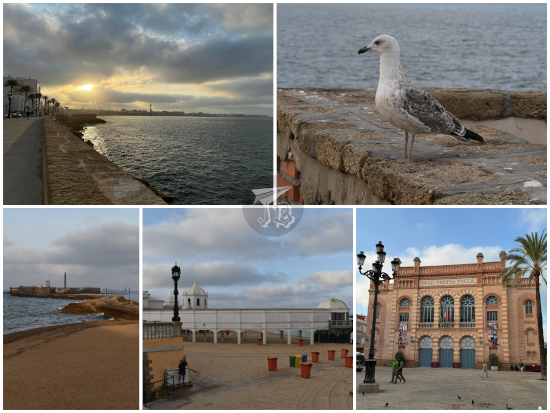
My paperwork-related appointment was at 9:30 in Cádiz itself, and I got up around 7:30. I left the hotel, but unfortunately the café where I had expected to have breakfast was closed. Thus, I instead headed out towards the promenade Paseo del Vendaval to see the ocean again. I turned to my right, in the opposite direction from the previous night, and I walked towards the central beach in town – Playa de la Caleta, a mostly-rocky area with tidal ponds and a long bridge called Puente del Hierro which leads to an old castle Castillo de San Esteban. I chased a few birds on the way for photographs. They were not at all cooperative.

I reached the former bathhouse Balneario de Nuestra Señora de la Palma y del Real, built in 1926 from an original design by Enrique García Cañas with one main access and two corridors that form a semicircle towards the ocean, and end in domes. It was build directly onto the beach, in reinforced concrete, with a style gravitating among Art noveau, eastern historicism and local decoration with azulejo tiles. It was abandoned in the 1970s, but restored for administrative use in the 1990s.

I ventured away from the ocean into the narrow streets of Cádiz downtown until I got to the town’s theatre Gran Teatro Falla, in the Neomudejar style. It was built between 1884 and 1905, on and off due to lack of funds, after a design by Adolfo Morales de los Ríos and Adolfo del Castillo Escribano. The theatre is one of the key spots during Carnival festivities. The Cádiz Carnival is one of oldest and most famous in Spain, known for its groups of people who parade the town in costume to sing simple songs that make fun of every- and anything, normally current affairs – coros, cuartetos, comparsas and chirigotas. The great Carnival contest is celebrated in the theatre, and prizes are awarded in each of the categories. The carnival brings in about 400,000 visitors each year. I tried to get to visit the theatre, but I did not manage to do so.

Paseo del Vendaval & Gran Teatro Falla Cádiz

Around 09:15 I decided to try my luck with the paperwork issue, even if it was early for my appointment, and I was successful. Since it was an important document, I ran back to the hotel to drop it there, and then headed off to the square Plaza de La Mina, where the local museum Museo de Cádiz stands.

It is said that Cádiz is the oldest Western city, founded around the 9th century BCE. Mythologically, it is associated with Hercules’ Columns and the city of Tarsis. The oldest archaeological remains date back to the 7th century BCE. The now-peninsula was originally a small archipelago where the Phoenicians settled down as it was a strategic point for commerce and mining of copper and tin, naming the settlement Gadir. It was later conquered by Carthaginians, whose march to Rome led by Hannibal started there. When Carthage lost the war, the city was taken over by Romans and became Gades in the 2nd century BCE.

As the Roman Empire declined, the city was invaded by the Visigoths, then the Byzantine Empire, and again by the Visigoths. In the year 710 CE, it was the first stronghold to fall to the Moorish conquest of Spain. After the Christians took it over again, it became a key point in commerce with the American territories.

In 1755, Cádiz was damaged by a three-wave tsunami caused by the so-called “Lisbon Earthquake”, 8.5 degrees in the Richter scale. In 1812, during the Napoleonic Wars, the Spanish patriots wrote the first Spanish Constitution, and throughout the 19th century, it was key in the numerous wars and battles through the return of Alfonso VII, the Republic and the Restoration of the Monarchy periods. However, during the 20th century, the city decayed suffering from lack of infrastructures, and rampant unemployment. Thus, it is happy to focus on tourism and the money it brings.

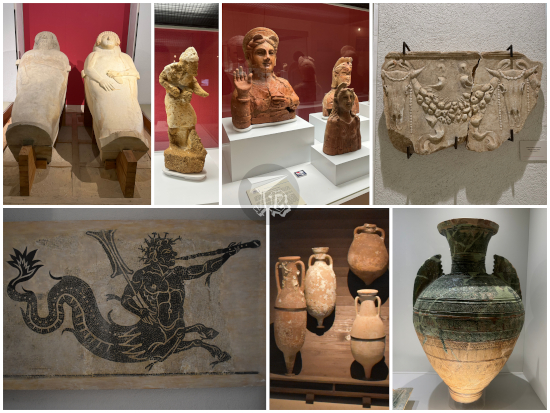
The Museo de Cádiz tries to follow this trail of history, but only the archaeological floor was open. The most important artefacts date from the Phoenician, Roman and Moorish periods. Of particular interest are two Phoenician sarcophagi which were found in completely different areas, but are presented as a couple of sorts, and a complete dowry. From Roman times, they exhibit a few dozen amphorae, sculptures and columns. Finally, the remains from the Moorish domination are quite colourful in comparison with everything else. The second floor of the museum was closed, so I was done earlier than expected.

Cádiz Museum

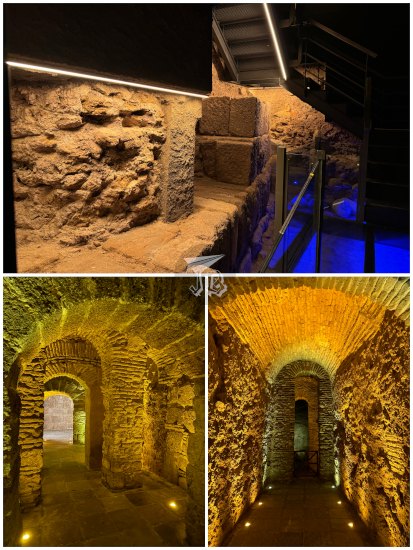
Thus, I decided to push my luck a little and try to get to the archaeological site called Cueva del Pájaro Azul for the 10:30 visit in English. The place is a former flamenco tavern built within the repurposed dry docks of the Phoenician Gadir. Most of the structure has been covered in brick and barely the original shape can be traced back, enough to calculate that the dry docks served war ships. While building new stairs, they did find part of the original Phoenician harbour though, the most important remain that survives. The tavern itself might be considered of minimal historical importance as it was a considerable cultural hub in the 1960s.

Archaeological site Cueva del Pájaro Azul

To keep in the mood, I decided to visit the archaeological site Yacimiento Arqueológico de Gadir, making a stop for a coffee first. Unfortunately, the site was closed that day. Thus, I decided to check out the Roman Theatre Teatro Romano de Cádiz – it might feel a little back and forth, but distances in central Cádiz are small and I wanted to prioritise Phoenician remains (I said I lived in the area, but all these archaeological remains are newly discovered). The theatre is the second largest one in what was Hispania, and dates from the 1st century BCE. It could host up to 10,000 people, and the stage, stands and the vomitorium (corridor underneath the seats) can be visited. There is an extra room with miniatures of the different stages of the history of the theatre.

Roman Theatre Cádiz

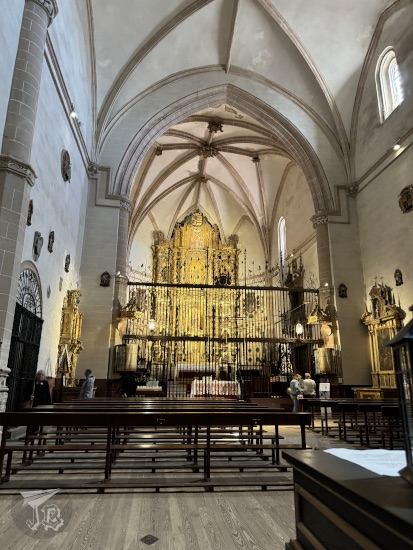
I left behind something called “The Elf’s Alley” Callejón del Duende, the narrowest street in town, now closed off. Very near both the alley and the theatre, I found the old cathedral Catedral Vieja de Cádiz officially Parroquia de Santa Cruz. This was the original cathedral of the town, commissioned by king Alfonso X around 1262. The original building was destroyed during the scuffles between the Spanish and the English at the end of the 16th century, and a new one was erected a few years later in a mixture of the Renaissance and the Baroque styles.

Former cathedral of Cádiz

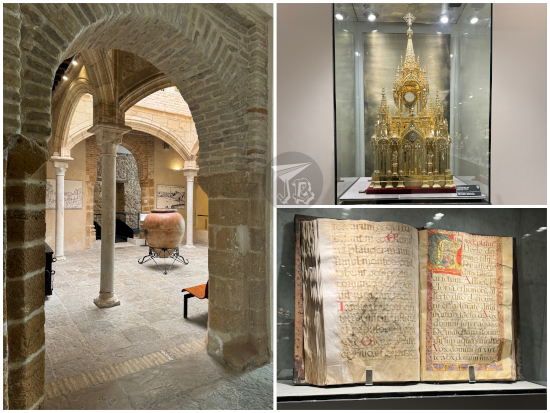
Next to the old cathedral stands the museum of the cathedral Casa de la Contaduría. The museum comprises a number of rooms disseminated in a conglomerate of buildings dating back from the 16th century – including the tower of the old cathedral and a Mudejar courtyard. The museum holds – obviously – religious items: paintings, sculptures, mass paraphernalia, codexes…

Cathedral Museum Cádiz

Afterwards, I crossed the city centre all over again, and reached the park Parque Genovés, a sort of botanical garden and the largest park in the old town. It has a small lake with a waterfall and a man-made cave with a lookout of the town and the ocean.

Park Parque Genovés in Cádiz

Then, I had booked lunch in the café of the Parador de Cádiz – Hotel Atlántico, a cute not-so-little place called La Tacita del Atlántico. I had set my heart on a grilled urchin dish – erizo de mar relleno y gratinado con huevos de arenque ahumado which I combined with a salmorejo (a creamy soup with a base of tomato and bread, garnished with ham and hard boiled eggs), though the dish had a local twist salmorejo cordobés, huevo y mojama. The urchins were delicious, but the salmorejo was lacking. I liked the idea of exchanging the ham for salt-cured tuna (mojama), but overall I found the food overpriced and the service mediocre. On my way out, I stopped by reception to get my stamp for the Red de Paradores rally.

Lunch at La Tacita del Atlántico

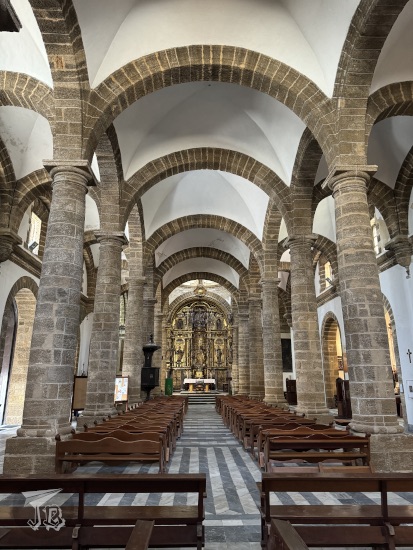
I stayed at Parque Genovés for a bit after lunch, then headed out towards the “new” cathedral Catedral de la Santa Cruz. The cathedral was built between 1722 and 1838, in a mixture of styles – Baroque, Rococo and Neoclassicism. It was erected in an assortment of materials, from noble marble to the humble local piedra ostionera, a sedimentary rock with a high concentration of seashells (biocalcarenite). The interior has three naves, and a Latin cross floor plan, over whose crossing there is a has dome, covered by golden tiles on the outside. The main altar is neoclassical.

Underneath the cathedral stands the crypt, and one of the towers can be ascended, leading to a great view of the town. The tower has very few stairs, most of the way is done on a ramp. Unfortunately, though, the cathedral is in rather poor state, and a net is cast under the ceiling to prevent debris from falling. I also climbed the tower since it was included in my combo ticket.

Cathedral of the Holy Cross in Cádiz

View of Cádiz from the cathedral tower

Behind the cathedral, I found myself back at the promenade Paseo del Vendaval, and I walked towards the beach Playa de la Caleta. In historical times, it was the natural port for Phoenician, Carthaginian and Roman shops, now it is a small-ish beach in the heart of the city. It is located between two of the castles of the old city, and its most characteristic structure is the bath house I saw in the morning.

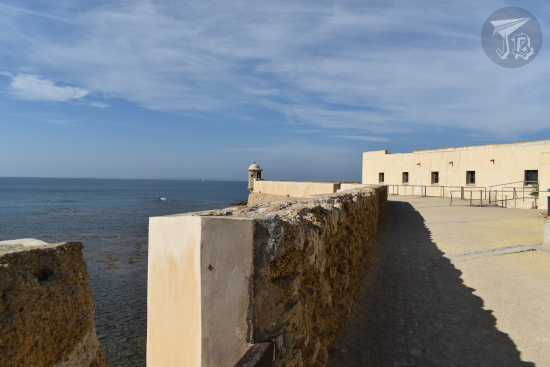
The beach has a sand area where most people sunbathe, but there is a long bridge separated in two sections – one directly built upon rock, Puente de Hierro and the other with arches to let the water flow through, Puente Canal. At the end of the half-kilometre of bridges, stand the ruins of the castle Castillo de San Sebastián, which today includes a working lighthouse, and an archaeological site. The first structure in the ancient island dates back from 1457, and the castle itself was built in 1706. Though it was warm and sunny, I walked the bridges and around the castle walls.

La Caleta Beach Cádiz & San Sebastián Castle

Upon my “return to mainland”, I passed by the bath house again and I reached a second castle, Castillo de Santa Catalina. The outpost, in the shape of a five-point star, was built towards the end of the 16th century to defend the city form sea warfare. In later years, a church and a sacristy were added, and from the 18th century onwards it was used as a prison. Today, it mostly hosts cultural or cinema-related events.

Santa Catalina Castle, Cádiz

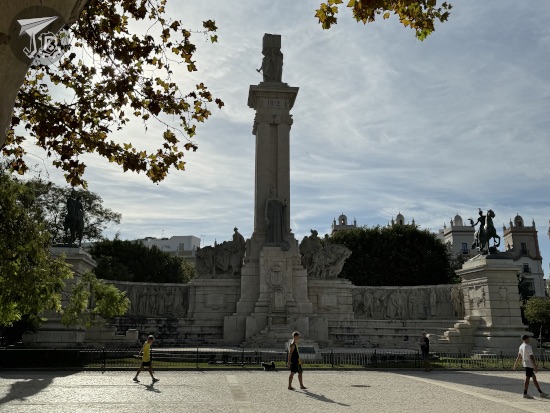
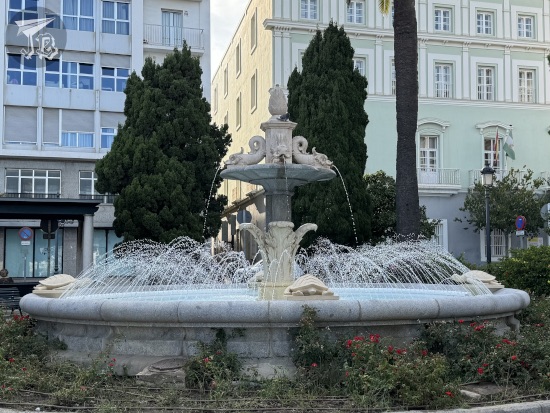
I continued on my walk around the city, left behind a knee cramp, the Parador de Cádiz and Parque Genovés until I reached the bulwark Baluarte de la Candelaria and the park Jardines Clara Campoamor. From there, I went on towards a second bulwark and the remains of the city walls Baluarte y Murallas de San Carlos. The bulwark was built towards the end of the 18th century to protect the harbour. Not far from there stands the square Plaza de España with the monument to the 1812 Constitution Monumento a la Constitución de 1812, the political response to the Napoleonic invasion. A bit further away stands the fountain Fuente de la Plaza de las Tortugas, with lots of cute turtles as decoration.

San Carlos Bulwark and Walls Cádiz

Monument to the 1812 Constitution Cádiz

Turtle fountain in Cádiz

At this time I decided to get an early dinner around 18:30, so I bought some fast food to take to the hotel. That is when the ant invasion started. It was something I was not expecting – one or two bugs is workable, but this was a whole nest out for my fries. It was not nice. I decoyed them into bathroom and decided to have the room cleaned the next morning.

I set off again about 20:15 to look for a place to watch the sunset at the beach Playa de la Caleta, which did not disappoint, and I sat there until the sun disappeared beyond the water line. Luckily, I made it today, as it would be ridiculously windy the following day.

Sunset at La Caleta, Cádiz

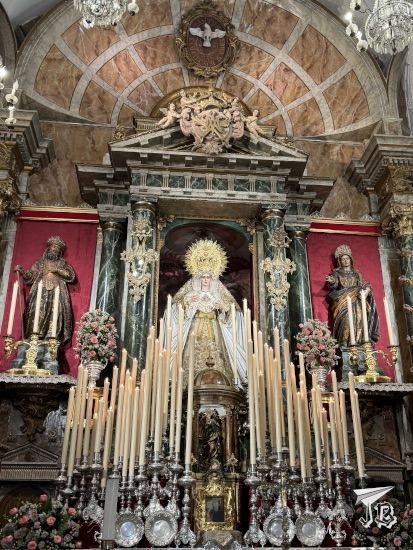
I then found the street Calle the la Virgen de la Palma, at whose end stands the small church Parroquia de Nuestra Señora de la Palma. It was built in the 18th century and it hosts a sculpture of the Virgin Mary credited with stopping the waters during the 1755 tsunami. In the street, there is a signal marking the highest water point, but there were so many restaurants and people that it was impossible to find it!

Sculpture of the Virgin Mary

I went back to the hotel afterwards to have some sleep – I was beat. I did manage to make a stop at a supermarket to buy coffee and pastries for breakfast the following morning though. Because one late latte per trip is enough.

31st May 2024: Santa María de Huerta & Medinaceli (Spain)

For the last few years, I’ve tried to do (or visit) something cool on my birthday, especially when it fell on a long weekend. In 2024 I could not plan anything big despite the long weekend,. Instead, I broke it off into a small outing with my sibling and a little road trip. There are a couple of places not too far away that I wanted to see, but the roads are not so great. One of my parents is keen on driving anyway, so they were happy to oblige, and I could get away with not driving the curves myself.

Our first stop was the Cistercian monastery Monasterio de Santa María de Huerta. The Order of Cistercians are a Catholic religious order. A group of Benedictine monks founded the new order in 1098, as they wanted to strictly adhere to Rule of St. Benedict, and felt that the other had “relaxed” too much. Cistercian monks are credited with creating very “pure” churches as they believed that ornamentation was superfluous and distracting from prayer.

The monastery is located in the village of Santa María de Huerta, which actually grew around its walls at the side of Jalón River. The building dates back from 1162, though the order had been in Spain for two decades at the time. Most of the building was erected halfway between Romanesque and Gothic styles, with some add-ons from more recent times, mostly the Herrerian cloister and a Baroque altarpiece – which distorts a little the idea of the “pure Cistercian lines” and no extra decoration. But then again, I am not a fan of Baroque decoration.

Entry is from the side of the church to the Gothic cloister Claustro de los Caballeros, around which all the dependences can be accessed. The first one is the church, the first area to be built. There are still some of the original paintings, and a baroque organ. The monks’ refectory is the most important room, built from 1215. It has large pointed-arched windows which allow light to come in, and it is communicated with the kitchen. There is a second refectory, more Romanesque, for the lay brothers who took religious vows but were not actual monks. The last cloister, in the Herrerian style, is severe and impressive. As we were leaving, there was a black out, not sure what that could have meant…

Santa María de Huerta Monastery

We went back to the car and we drove towards the town of Medinaceli, which has a couple of monuments I wanted to see. Reputed for dating back to Roman times, it has a free-standing arch Arco Romano de Medinaceli, the only one in Spain with three arches. It is a triumphal arch built in reddish sandstone during the first century, at an altitude of 1200 m, where it rains, snows, and so. It feels like a miracle that a small structure (around 13 metres long, eight metres high and two metres wide) has withstood two thousand years.

Medinaceli: Roman triumphal arch

We saw the collegiate church Colegiata de Santa María de la Asunción, built in a late Gothic style. Artistically, the most important item is the iron grating in front of the altar. Religiously, there is a figure of Christ, which is called Cristo de Medinaceli, a wooden sculpture from the 16th century (though the most famous sculpture with that name is in Madrid). It was a little underwhelming, and most of the sculptures were not pretty.

Medinaceli: Collegiate Church

Afterwards we visited the main square of the village Plaza Mayor de Medinaceli. To one side stands a 16th-century building called La Alhóndiga, current town hall and former prison, with rounded arches on the ground floor and a balcony all along the façade on the first floor.

16th Century commercial building turned into town hall

To another side, the palace of the former dukes Palacio de los Duques de Medinaceli, which was saved from the ruin turning it into a semi-private art gallery. Inside, the most important part is the Roman mosaic. The palace was built around 1430, and today only the Renaissance yard stays undisturbed. I am not a big fan of modern art, so I just can say that some of it was colourful and pretty. The entry ticket included entrance to a rural-house-turned-erotic-art-exhibition which… was weird. The whole house was painted pink, and the works were neither interesting and nor felt artistic at all. So 10 bucks to in the end see a Roman mosaic was a bit steep.

Medinaceli Duchate Palace

We decided not to stay in town for lunch, but – almost in a bit of a joke – we drove off to have lunch at what is probably the most iconic roadside restaurant in the centre of Spain – Área 103, a brasserie that is over 125 years old. It includes a small hermit-church built for truckers, Capilla de los Conductores.

Drivers' chapel, Area 103

It might have not been a glamorous birthday, but hey, along with the escapade on Tuesday, I guess I spent it doing what I like – discovering new things.

7th May 2024: “Dragon Hunters” in Alcalá de Henares (Spain)

The Archaeology and Palaeontology museum in Alcalá de Henares is running a temporary exhibition on the history of digging dinosaur bones, called “Dragon Hunters”. I was drawn to it because well… dinosaurs. Driving in the city centre is a nightmare, so I left the car in an easy-to-park area a bit away, and walked downtown.

I had been trying to see the cathedral of the Magistral Cathedral of Saint Justus and Saint Pastor Santa e Insigne Catedral-Magistral de los Santos Justo y Pastor, but it was always either locked, booked for events, or “closed to visitors”. This time around, I was able to finally see it – and it was honestly a bit underwhelming. Though I generally enjoy Gothic buildings, I guess I was so hyped after trying so many times, that reality did not live up to expectations. Furthermore, I dislike when places do not advertise that part of the visit is closed / unavailable, so I guess I’m still pretty out of luck with this one cathedral. I missed the chance to climb up the tower and see the views of the town due to construction, but oh well.

Legend has it that catholic Saints Justus and Pastor were martyrized in the year 304, near the Roman city of Complutum. In the year 414, a chapel was built to keep their remains in the place where the martyrdom happened. The current building was erected by architects Antón Egas and Enrique Egas in late Gothic and Renaissance styles around 1446. The tower, by Rodrigo Gil de Hontañón and Rodrigo Argüello, is Herrerian. The interior has three naves with pointed arches, and to one side stands the cloister, with access to the museum, and – when it is open – the tower. It was a bit of a bummer not to even be able to step into the open part of the cloister. Underneath the altar there is a crypt with a gold-and-silver urn with the remains of the Saints, and the stone where they were killed.

Afterwards, I continued on towards my real destination, the local Archaeology and Palaeontology museum Museo Arqueológico y Paleontológico de la Comunidad de Madrid, MARPA. They are currently running the exhibition Cazadores de Dragones (Dragon Hunters). The exhibit summarises the historical hits of palaeontology, starting with prehistoric and classical references and theories about them, such as a the phoenix having been inspired by Protoceratops skeletons, or the bones of giants being actually dinosaur fossils. This area has a few replicas and small statuettes – running from the originally-made ones to the newest reconstructions.

Exhibit entrance, protoceratops, corridor

The exhibit name-drops a few of the big figures in dinosaur-digging history such as William Buckland, the man who described Megalosaurus as an antediluvian creature; Gideon Mantell, who tried to reconstruct an Iguanodon from a tooth (now in the Natural History Museum in London); Georges Cuvier, who proposed the idea of extinction, and named animals such as Megatherium, Pterodactyl or Mosasaurus; and Richard Owen, who “invented” the word “dinosaur”, meaning “terrible lizard” – though today we know that a lot of dinosaurs had more in common with birds than with reptiles, down to protofeathers and even feathers.

Archaeopteryx, titanosaur

The following section follows the “Bone Wars” – Charles Marsh and Edward Cope were two palaeontologists who raced through the Morrison Formation (Montana, USA) to discover up to 30 species of dinosaurs – they were not always honest in their competition, and it did not help that Cope messed up a reconstruction of an Elasmosaurus, placing the skull at the end of the tail. The Morrison formation was (is) in the middle of nowhere, and digging during the 19th century had its risks. This concept ties with the idea of “the adventurer” à la Indiana Jones, mentioning Roy Chapman Andrews and Barnum Brown, the man who excavated the first Tyrannosaurus. And then you turn a corner and are greeted by a replica of a T-Rex. Of course, I stayed a while here – trying to take pictures without the security guard in them.

Tyrannosaurus rex replica

After World War II, palaeontology hits moved from the USA to Mongolia and the Gobi desert, with new species being discovered every so often. Later, in the last years of the 20th century, the idea of “the avian dinosaur” arrived, and there is a replica of a Deinonychus, with screens showing recreations of the creature looking “like a lizard” and looking “like a bird”, feathered and all.

Titanosaur, therizinosaurus, eggs, deinonychus

Finally, there are the local dinosaurs: a tail and part of a foot from Qunkasaura pintiquiniestra, a nest from the Poyos Site (Guadalajara), and the star of the show – the original fossil holotype of Concavenator (Concavenator corcovatus), a theropod found in Cuenca. The fun part? The museum which holds the holotype, Museo de Paleontología de Castilla-La Mancha, bans pictures – so I took my sweet time with this. There is also a life-size reproduction, with colours tuned down to more realistic than the originally proposed blue and red.

Concavenator fossil and reproduction

Afterwards, I wandered around MARPA, mostly to go to the palaeontology room, as I have explored the museum extensively before. The palaeontology ward is relatively new, and it has quite a few nice reproductions and… even if I have explored that one too. I also dropped by the shop to get the exhibition book. Finally, I went back to run through the Dinosaur exhibit again, just because I could, before I headed home. I had thought I’d look for a nice restaurant for lunch, but nothing drew my attention.

27th & 28th April 2024: Paris & the Fan Festival (France)

27th April 2024: From the Fan Fest to Les Invalides

My grandmother used to say that nothing good happens before sunrise, and to be honest, when the alarm clock rang at 4:40 on Saturday, I was very tempted to believe so. However, there were planes to catch, and red-eye flights are called so for a reason. My sibling and I had tickets for Paris on a 7:25 flight, which required us to be at the airport with enough time to board ± 30 minutes in case we had to get to the Satellite Terminal. Since I started planning with time – back in January – I had booked a parking spot in the actual terminal parking lot, for just a couple quid more than the long-stay one, and I activated a service the airport has so your card is billed automatically when your licence plate is detected, for convenience.

We reached the terminal with plenty of time (± 30 minutes) but recent problems with French air controllers going on strike, I was anything but calm. However, we took off on time and I just huddled off to nap. Arrival in Orly was early, and we did not taxi much, nor need buses. We just stepped off at the gate, and headed towards the Orlyval. We bought a Paris Visit card each, in order to be able to ride the public transport system as much as we needed for the weekend, and hopped on the shuttle. After a couple of transfers and a short walk, we arrived at the exhibition centre Paris Expo Porte de Versailles, where Paris Fan Festival took place.

Paris Fan Festival is a yearly convention that focuses on everything geek / nerd / niche, whatever you want to call it: video games (and retro video games), Star Wars, TV series, Ghostbusters, manga, comics, K-pop, there’s something just for everyone. I think it’s a bit of what Japan Weekend aims to be, but openly. It felt a little like that Funko slogan “Everyone is a fan of something”.

My reason to be there was European comic, actually. Authors (and married couple) Stjepan Šejić and Linda Lukšić Šejić, whom I’ve been following for a few years now, were in attendance. Stjepan Šejić has worked for DC in works such as Aquaman, Harley Quinn, and Suicide Squad, but he has gone independent, focusing on his own content creation. So has Linda Šejić, who started off at Image Comics and currently works on her own web comics. I’m currently buying his works Sunstone, Fine Print and my favourite Death Vigil, and her Blood Stain and Punderworld, the latter based on the Greek myth of Hades and Persephone. I also have the Aquaman hardcover that compiles all of Stjepan’s issues, and the Batman-character self-conclusive Harleen.

Of course, I wore an appropriate “Velocirapture” T-shirt to the event. The goal was to get an issue of each collection signed, and maybe a commission and some merch. In the end, we could only get a commission from Linda – we almost got one from Stjepan too, but things did not work too well on that front. I hope to get one next time they’re reachable – I actually wanted to go and meet him a while back, but I was in the middle of a weekend in Cuenca back in 2017.

Paris Fan Festival: Stjepan Šejić and Linda Lukšić Šejić

My sibling and I wandered through Paris Fan Festival for a few hours. We had something to eat at a Paul’s bakery, which I had discovered in Toulouse, and whose prices were not stupidly inflated by being inside the convention. Unfortunately though, I had followed the instructions of the venue and I was not carrying any water, and just a small backpack. I could’ve completely ignored the rules though, just like… most everybody else did. I did learn a valiable lesson though – when travelling to conventions for people, you buy tickets for both days. Just in case.

One of the most interesting vendors at Paris Fan Festival was the Lyon Cinema and Miniature Museum Musée Cinéma et Miniature, which had brought many sci-fi props from their permanent exhibition. They had the tip of a pyramid, a hieroglyph stone and a mask from the original Stargate film, ), a compsognathus animatronic, and the velociraptor claws from the Jurassic Park saga (), Loki’s mask from The Mask, a xenomorph head from Alien, suits from one of the older Batman films and Armageddon, prosthetics from X-Men

Samples of the Lyon Cinema and Miniature Museum at the Paris Fan Festival

As every other niche convention, were tons shops with merchandise, books and comics, not all of them legal. They held an exhibit of figures and statuettes. There were also a number of conferences – pity that the one about Jurassic Park was in French, too. Also, I discovered that France has a lot of “replica” culture – there was an actual “Imperial Army” (Star Wars), someone who had customised a car into the Ectomobile from Ghostbusters (2016), even people impersonating Tolkien’s orcs… It goes a little beyond cosplay… Supposedly, there was someone walking around with a dragon, but we did not run into them.

Paris Fan Festival snippets

Eventually, we left the convention to find our way to the hotel and drop the luggage, since comics are heavy, and Paris is on high alert and most places won’t let you through with backpacks. We wasted some time finding the hotel as it was raining cats and dogs – and they were remodelling, so the outer signal was not there. After check-in, we headed out again, and when we reached our next destination, it had literally stopped selling tickets – it was one hour and four minutes to closing time, and the recommended time is one hour and five minutes, so sadly, we could not get in.

It was a bit disappointing, but we moved on towards Arènes de Lutèce. Lutetia (Lutèce) was the Latin name for Paris when it was part of the Roman Empire, and the amphitheatre is one of the most important remains from that period. Built during the first century CE, it would have seated 15,000 spectators. It was restored and open to the public at the end of the 19th century. Today, it is the centre of a park.

Lutetia Amphitheatre

After that, we took the underground towards the high-end department store Galeries Lafayette Paris Haussmann. In 1894, two Parisian businessmen opened a shop that would eventually become the biggest department store chain in Europe. Through the following decades, the businessmen bought buildings around the shop in order to grow their emporium. In 1907, architect Georges Chedanne carried out the first main renovation in the Art Déco style, and Ferdinand Chanut completed it with a Neo-Byzantine dome, built in 1912. Today, the galleries focus heavily on luxury products, and not that we could afford any, but I wanted to see the dome.

When we arrived, we snooped around – it was packed, full with high-end tourists, mostly Asians. The brands selling their products were the most expensive ones – from Chanel to Cartier. As we were admiring the dome, we saw there was a glass walk hanging from the balcony on the htird floor. Of course, we had to investigate. It was around 17:30. We found the end of the queue, and saw that there was a QR to reserve a spot. I was able to book us in for 19:20 – surprising, considering it was the same day, and access is free – maybe it was a language barrier or something? I’m not going to complain.

There was a nearby gallery I also wanted to see, Passage du Havre, a typical Parisian shopping passage. It was less impressive than the Lafayette, but also surprisingly cosy – as my sibling put it “the other guys have Chanel, they’ve got Sephora”. It had some nice decoration and quite a different crowd. Furthermore, we had been up since 4:00, and ate quite early, so when we found a Pret a Manger, we decided to buy dinner there.

Passage Du Havre escalators

We went back to Galeries Lafayette for our “Glasswalk” experience, and it was really, really cool. The staff were also impressively friendly and we enjoyed ourselves immensely for the whole… five minutes of it. I really loved the dome.

Upper floor of the Galerie Lafayette

We finally headed off towards Napoleon’s tomb, the Dôme des Invalides in the complex Hôtel des Invalides. Hôtel des Invalids was originally commissioned by Louis XIV in 1670 as a hospital for disabled soldiers. The church-and-chapel complex was designed by Jules Hardouin-Mansart in several iterations from 1676 on. The complex is considered one of the most iconic examples of the French absolute monarchy Baroque style. When Napoleon’s remains were repatriated in 1840, a state funeral was held, and a mausoleum projected in the crypt under the Dome. Construction of the grave extended until 1861, when the former Emperor was finally entombed there.

We were going to see the light mapping event Aura Invalides, a spin off of sorts from the display in the Notre-Dame Basilica in Montreal (Canada). The show highlights the history, architecture and meaning of the monument through light and orchestral music. The event lasts about 45 minutes, and it comprises three parts: First Movement: Creation, which focuses on the architecture of the monument; Second Movement: Collective Memory, through which you get to wander, seeing different effects in the chapels; and finally Third Movement: Universal Elevation, more spiritual and ethereal.

Projections inside the Invalides church

Les Invalides church by night

Afterwards, we headed towards the hotel to have a shower and sleep.

28th April 2024: No plans, really

After a nice breakfast at our hotel, we tried our luck at the Paris Fan Festival again. We got our drawings from Linda Šejić, but Stjepan Šejić had brought all the wrong markers and was not doing any more commissions. I offered my own pen, just to test the waters, and it was unfortunate that he did not take the bait.

Oh, well. You can’t win all the time. Instead of wallowing in our bad luck, we decided to get going and do something cool. For me that meant the park known as Jardin des Plantes, to visit two sites of the French Natural History Museum Muséum national d’Histoire naturelle. The day had started weirdly, with my underground ticket not working, but my sibling’s doing so. A lady who did not seem to enjoy being stuck at work Sunday morning waved us through without exchanging it. As the ticket was still not working when we left Paris Expo, another employee exchanged it.

The first site we visited was the Great Gallery of Evolution, Grande Galerie de l’Évolution, the biggest site of the French Natural History Museum. It has four visitable levels – the upper balcony (third floor), focused on “Evolution of life”, the second floor “Impact of man in life”, and the first and ground floors that deal “Diversity of life” (terrestrial on the first, marine on the ground floor). The way it is arranged makes it, in my view, a companion to the Gallery of Compared Anatomy – (which I still like best, to be honest).

The collection finds its core in the disappeared Zoology Gallery, whose building dates back from 1877. Designed by architect Jules André, the interior was a cast-iron structure with a central nave and a skylight. Although the original project was never completed, the Galerie de Zoologie was inaugurated in 1889. It closed down in 1966 for restoration, although works were actually only carried out between 1991 and 1994. During this time, taxidermist also took care of about a thousand animals. Today, the gallery holds a cavalcade of savannah animals on the ground floor, and more conservative vitrines and glass cases on the upper floors. The museum still keeps the 19th century allure and entertaining aura – we did not go into any of the VR experiences, as they were sold out (and, you know, in French), so we did not see the more modern area of the museum.

Great Gallery of Evolution

We started off on the third floor and made our way down to the ground level. There were a ton of taxidermy animals, collections of insects and shells, even a wool one, and some bizarre specimens such as a tiger attacking an elephant with a chair on top… To be honest, though, I think it is more of a regular zoology gallery, just arranged in a surprising way. I found the evolution angle better developed at Brussel’s Natural History Museum. The classical design is extremely cool, though, and it would have given a great feeling had it not for all the free-range kids wildly running around…

Afterwards, we headed off to the geology and mineralogy gallery, Galerie de Géologie et de Minéralogie, which had a really nice collection of gemstones, crystals and jewellery. And of course, fluorescent rocks which kept my attention for a very long while.

Mineral and geology gallery

It was almost lunchtime and we decided to head out towards a busier area to grab a bite. My Paris Visit ticket was not working again, and I exchanged it yet once more. I went through, but my sibling did not, so they had to wait in queue again to exchange that too. Apparently, I was keeping the tickets too close to my phone – even if it was the one without internet? I deemed my sibling responsible for the tickets from then on.

We stepped out at Palais Royal–Musée du Louvre, hoping there were places to eat, and we were right – there were a bunch of them along the street. The one that grabbed our attention was Café Brasserie Ragueneau, a small eatery close to the Louvre. There, I splurged on a Tartare de boeuf poêlé au foie gras (Pan-fried beef tartare with foie gras) just to be a snob. It was delicious. The foie gras version came slightly cooked, though the raw version would have been fantastic. Our waiters were extremely friendly too, and tolerated my poor French with a smile.

Pan-fried beef tartare with foie gras

After lunch, we walked to the last place on my list for the trip – the church Église Saint-Germain l’Auxerrois de Paris, which mixes elements of Romanesque, Flamboyant Gothic, Rayonnant, and Renaissance styles, though the tower – my favourite – was only added in 1860 as part of Baron Haussmann’s plan to reconstruct the city. The base of the church dates from the 12th century, and during the 14th and 15th centuries it was decorated with a balustrade by Jean Gaussel, multiple sculptures, and gargoyles. The interior is lighter than usual gothic churches, and there is a monumental set of carved wooden seats for the royal family. There are multiple windows with stained glass, although not all of them are the original Medieval ones, since they were destroyed during the French Revolution and replaced in the 19th century.

Church of Saint-Germain l’Auxerrois

The Louvre was not selling same-day tickets, so our idea to spend a couple of hours there went bust. Then, we decided to walk towards Île de la Cité to check on the cathedral’s progress, as it is supposed to reopen this year, when reconstruction from the 2019 fire has been completed. I wanted to check something called Tunnel des Tuileries, but I misunderstood – I thought it crossed underneath the Seine to get to the Isle of France; apparently I mixed it with a pedestrian tunnel under the Thames – it turned out to be a place of modern art, and it did not feel too safe. Thus, we continued under the sun, and reached the flower market Marché aux Fleurs Reine Elizabeth II.

We found out that a sort of stage has been built for visitors to sit in front of Notre Dame, and we saw a lot of people taking pictures of the pictures on the wall, which was a bit weird. We sat for a while, but not long because there was a guy singing really badly at the square.

Notre Dame under reconstruction

We went on and saw the park Square René Viviani, where the oldest tree in Paris stands. Next to the park is the church Église Saint-Julien le Pauvre and close to Église Saint-Séverin. We could not enter any of them, so instead we decided to sit down to have a coffee – in my case a “detox smoothie” because the orange-and-carrot blend reminded me of one in Japan I really like.

We finally set off to collect our things, and this is when I usually say I got home without an incident. Not this time. The public-transport tickets worked fine to get to the airport, we bought dinner and settled to wait. There was nothing much too strange, we were late – forty, forty-five minutes? I’m not sure, but not an obscene amount of time – the crew announced connections over the PA system, I thought that was nice of them. When we landed… I had a moment that I did not know where we were, which is strange, because the terminal is pretty straight forward. It turns out that in order for the travellers who had connections to South America to make it, we had landed at the Satellite Terminal, not the main building! Which meant over thirty minutes of “commute” back to the parking lot… I had taken a leeway of around an hour and a half after landing to get out, but we barely made it!!

A nice weekend to break out the routine, a lot of comics signed, and a lovely piece of artwork were achieved. Unfortunately, I caught a stupid, stupid cold, my first since the whole Covid thing started, and my immune system freaked out. It seems it’s back to facemasks on planes for me.

20th July 2023: Herculaneum and the Naples National Archaeological Museum {Southern Italy, July 2023}

Knowing my way to the station of Napoli Porta Nolana, this time I only had to buy the ticket and wait for the 8:14 Circumvesuviana Line 4 to Poggiomarino, which was supposed to reach Ercolano Scavi in the town of Herculaneum [Ercolano] by 8:33. It took longer than that because there were a lot of stops. Then again, my strategy of the first station in order to travel sitting down was successful once more.

Unlike the modern city of Pompeii, the modern Ercolano was built before the ancient town was discovered. It was originally called Resina, but the name was changed in 1969. Despite the legend saying that the Greek hero Heracles (Hercules in Latin) founded the original Herculaneum, the early history of this city is parallel to that of Pompeii. It was first an Oscan settlement, then Etruscan, then Greek, and it eventually became a Roman municipium in the first century BCE. It was a small vacationing town for people from the north, apparently.

Much like Pompeii, the ancient city of Herculaneum – what today is the Parco Archeologico di Ercolano or Herculaneum Archaeological Park – was buried by the 79 CE eruption of Mount Vesuvius, and it belongs to the Archaeological Areas of Pompei, Herculaneum and Torre Annunziata Unesco World Heritage Site. However, the different location of the town changed how it fared during the eruption.

The 79 eruption lasted two days (thought to be 24th and 25th October 79 CE). The citizens of Pompeii and Herculaneum who fled and survived were the ones who escaped during the first 12 hours – during these, heavy pumice and ash came down on Pompeii, destroying buildings. At this time, Pliny the Elder was commander of the Roman fleet at a nearby town, and he sent galleys to help the evacuation of the coast. We know this because his nephew, Pliny the Younger – a teenager at the time who would grow into a lawyer and magistrate – left in writing what he had seen in two letters. Those letters are now lost, but Medieval copies of them survived.

At the time of the eruption, Herculaneum stood right by the shore. Most of the bodies found were at the coastline, probably trying to escape by sea or reach Pliny’s ships. A boat was actually found carbonised in the vicinity. As wind blew pyroclastic flows towards Pompeii, burying it in volcanic ash and pumice, only a few centimetres of ash fell onto Herculaneum. These, however, rightfully freaked people out, and caused most of the population to flee during the first day.

As Herculaneum lies closer to the volcano, when the cloud of volcanic material (called a “volcanic surge”, composed by gas, ashes and pumice) collapsed in the middle of the night, it hit the town at over 400 ºC. Everyone who had stayed behind was instantly killed by the heat, leaving behind the skeletons of around 330 people. There were no casts made of them – unlike the thousand unfortunate Pompeiians.

Pliny the Elder died in the early morning of the second day. During the second day, the second pyroclastic cloud collapsed on top of Pompeii, but at this time, not a soul remained alive in Herculaneum. Subsequent volcanic clouds and pyroclastic surges (not lava) buried the towns until excavations started in the 18th century – barring some grave robbers, apparently.

About one fourth of Herculaneum has been unburied, even if it was the first city to be discovered. There is a bit of a paradox here – although it is in better condition and it suffered less structural damage, it is worse preserved. It still holds a lot of mosaics in situ, despite many frescoes taken to the Archaeological Museum. Unfortunately, its current condition has deteriorated terribly.

Herculaneum is less famous than Pompeii. A much smaller area can be visited, and the unexcavated part is underneath the modern cities of Ercolano and Portici. There are many buildings closed and a lot of scaffolding is needed due to a period or abandonment at the end of the 1990s. One of the telltales that it expects fewer tourists is that the webpage is only in Italian.

I reached the station Ercolano Scavi around 8:45, and ten minutes later I was at the entrance of Parco Archeologico di Ercolano. The park was already open and there was a line to buy tickets, and people struggling with their phone passes. I had printed mine out, so it was stupidly easy to wave it, get it scanned, and go through. Most people who went in before me decided to stay at the museums because that is the first thing you reach, but I reasoned that the earliest I went into the archaeological area, the less time I’d be under the sun when it became scorching. Again, this helped to be alone in a couple of houses.

Herculaneum general view

Restoration is a race against time in Herculaneum and as you walk you can see the scaffoldings and workers going on their daily lives – archaeologists, restorers, gardeners. Here, the effect of the volcanic activity are seen extremely clearly, on the floors and the walls – bulging mosaics and cracked frescoes and tiles. There is no doubt, however, that the damage was less. There are columns that still stand, covered in their original paint, and the bathhouses could just be used today with some refurbishing – and of course running water.

Another phenomenon that happened in Herculaneum was that a lot of wood became instantly charcoal when the pyroclastic surge collapsed onto the town. That means that some of the beams that are still in the buildings are the original ones, which is unbelievable. There are even surviving stairs and furniture. I wandered the streets for a few hours, going into anything that was open and in general feeling in awe at the mosaics and the frescoes. I was also astonished as how people felt comfortable poking the slabs and the paint – as there were fewer caretakers than in Pompeii.

Some highlights included:

Terme Maschili or Male Baths, where you can see the wavy mosaic on the floors.
Herculaneum mosaic - Merfolk

– The mosaics in Casa di Nettuno e Anfitrite or House of Neptune and Amphitrite.
Mosaic covering a foutnain in Herculaneum

Casa del Rilievo di Telefo or House of the Relief of Telephus, one of the best preserved structures with a lot of paintings, even on the columns.
Herculaneum: House of the Relief of Telephus

Terrazza, statua e altare di Marco Nonio Balbo or Terrace, statue and altar of Marcus Nonius Balbus.
Terrace, statue and altar of Marcus Nonius Balbus

It was noon when I decided to retreat towards the museums, which hold only small trinkets and some jewellery. Just as I was thinking that the Herculaneum inhabitants could rest in peace instead of being on display, I reached the Boat Pavilion Padiglione della Barca, which holds a carbonised boat where some of the residents tried to escape. There are panels which explain that they are planning to make copies of the three hundred something skeletons they found at the coastline and place them in the same spot they were found. So much for resting in peace.

I went back towards the station and took a train back to Napoli, where I transferred to the underground and headed off to the National Archaeological Museum – Museo Archeologico Nazionale di Napoli (MANN). I had read online that the ticket was valid for two days, so the plan was to grab a leisure lunch there, wander around for a while in the air-conditioned areas of the museum, then come back the following day. Unfortunately, the ticket read that it was only valid for one admission that day. I had to reconsider my plan then. It was barely 13:30, so I decided to go right into it. Also… there was no air-con.

The roots of the MANN are the so-called Collezione Farnese, or Farnese Collection, one of the first collections of the Greco-Roman Antiquity. The original collector was Pope Paul III when he was still Cardinal Alessandro Farnese (1568 – 1549). In the 18th century, the marbles were inherited by Elizabeth Farnese. Her son Charles would become King of Naples, Sicily and Spain, and was the great sponsor of the excavations in Herculaneum and Pompeii. The mosaics and frescoes taken from these two cities are the second core conforming the museum.

The Farnese Marbles are fantastic. It’s been a while since a work of art took my breath away, but some of these did. The collection preserved a lot of Roman copies of Greek original sculptures, and although a lot of them were restored during the Renaissance, I enjoyed the gallery a lot. Some favourites were the Resting Hercules, Atlas, Apollo playing the lire, and of course the Farnese Bull.

Farnese Marbles: Farnese Hercules, Farnese Bull, Farnese Apollo, and Eros with a fish

The Hercules sculpture shows the hero leaning on his club after having finished the last of his tasks – the apples of the Hesperides garden, which he holds behind his back. Atlas kneels, holding the world. The Farnese Bull is the biggest surviving sculptural group from antiquity – the twin brothers who founded Thebes, Zethus and Amphion, tie their stepmother Dirce to the horns of a wild bull as revenge for how she tormented their mother. The original is attributed to Appollonius of Tralles. Apollo playing the lire is sculpted in two marbles, one darker for the tunic and a white one for skin and the lire – and one of the few sculptures I can share on social media as he is totally clothed…

After the Farnese marbles, I explored the rest of the classical sculptures. Then I moved onto the second floor to the collection of mosaics from Pompeii and Herculaneum. When I was little I saw a mosaic of fish in my history book, and I had always wanted to see it. I finally did, along with one that implies “beware of the dog”. I did not get to see the Alexander the Great mosaic because it was being restored (though I did see the in-situ reproduction in the Casa del Fauno / House of the Faun). There was even a whole fountain with columns that were almost completely covered in mosaics.

Mosaics from Pompeii and Herculaneum

At the end of this area stands the “Secret Cabinet”, which holds the images and sculptures from Pompeii and Herculaneum that were over the centuries considered “too pornographic to be seen” – including penis amulets and a sculpture of “Pan making love to a goat”.

I continued on to the second floor, to “Archaeological Naples”. In this area there also were sculptures, a lot of bronzes too – including a beautiful Athena and a Drunk Faun. The central hall of this floor held an exhibit about Alexander the Great and his influence in the Mediterranean. It hosted the Farnese Atlas and the Artemis of Ephesus. Afterwards, I went to the Protohistory and Prehistory area – which did not hold many attention-grabbing artefacts, especially consider how spectacular everything else was.

Sculptures in the Napoli Archaeological Museum

By this time, I needed a break. It was a bit later than 15:00 so the café was practicable. I got myself a lemon sorbet and… fried pasta pasta frittata, a typical street food bite. Which is basically a croquette made out of pasta. It was surprisingly good, actually.

Pasta fritatta

I went back upstairs – I was tired by now, and if I had had the chance to do the museum in two days, I would have left now. But I did not, so I continued towards the exhibitions of “everyday life” and frescoes of Pompeii and Herculaneum. These include dishware, glassware, decoration, mirrors, jewellery… and of course the frescoes, including the Portrait of Terentius Neo and his Wife, that were taken down from the walls of the houses during the 18th century in order to preserve them. They feel weird as they hang on the blank walls – framed, far away from the place they used to be. I know it can’t be, but it would be cool to see them all on site. While I could really imagine how some of the houses would have looked 2,000 years ago when I was in Pompeii, I could not imagine the perfectly-framed frescoes on the walls. It was a bit unsettling.

Pompeii and Herculaneum frescoes

I bought the extra ticket to see the Magna Graecia Collection. At first I was not convinced because after a while all the Greek pottery starts looking the same to me. You get to wear shoe coverings in order to walk in there, at first I thought it was not to upset the marble floors, but then I walked onto the mosaics and wow. Just wow. I mean… after a bit you don’t even realise that you’re supposed to be looking at pottery and just keep staring at the floors…

Magna Graecia Mosaic

I ended the visit with the Egyptian collection, where – on top of it being the only area of the museum with air conditioning – I saw one of the crocodile mummies that I might have seen at Kom Ombo.Finally, after basically snooping round the whole museum including the gardens, I headed back to the station area to buy some food and go get some rest in the hotel.


For the sake of completion, here is a relation of all the spots I visited in Parco Archeologico di Ercolano or Archaeological Park of Herculaneum:
Boathouse and shoreline
Access bridge
Casa dello Scheletro or House of the Skeleton
Casa dei Galba or House of Galba
Terme Maschili or Male Baths
Casa dei Due Atri or House of the two atriums
Sede degli Augustali or Hall of the Augustales
Casa dei Salone Nero or House of the black salon
Bottega del Plumbarius or Shop of a plumbarius (metal worker, welder or blacksmith)
Casa del Bel Cortile or House of the Beautiful Courtyard
Casa di Nettuno e Anfitrite or House of Neptune and Amphitrite
Terme Femminili or Female Baths
Casa Sannitica or Samnite House
Casa del Tramezzo di Legno or House of the Wooden Screen
Casa del Papiro Dipinto or House with the painted papyrus roll
Casa dell’Alcova or House of the Alcove
Casa dell’Erma di Bronzo or House of the Bronze Herm
Casa dell’Ara Laterizia or House of the Brick Altar
Casa dell’Atrio a Mosaico or House of Mosaic atrium
Casa dell’Albergo or House of the Inn
Casa del Telaio or House of the Tailor
Casa del Mobilio Carbonizato or House of the Wooden Furniture
Casa dell’Apollo Citaredo or House of Apollo the Lyre-player
Casa del Bicentenario or House of the Bicentenary
Pistrinum di Sextus Patulcius Felix or Bakery of Sextus Patulcius Felix
Taberna di Priapo or Bar of Priapus
Casa della Stoffa or House of the Cloth
Casa dei Cervi or House of the Deer
Palaestra
Casa del Rilievo di Telefo or House of the Relief of Telephus
Terrazza, statua e altare di Marco Nonio Balbo or Terrace, statue and altar of Marcus Nonius Balbus
Terme Suburbane or Suburban baths
Area Sacra or Holy Area
Sacello di Venere or Shrine of Venus
Grande Taberna or Large bar
Casa del Gran Portale or House of Large Portal
Thermopolium (food shop)
Casa di Aristide or House of Aristides
Antiquarium (museum)
Padiglione della Barca or Boat Pavillion

9th June 2023: Arribes del Duero & Ciudad Rodrigo {WNW Spain, with a splash of Portugal, June 2023}

We set off from Zamora in order to drive up towards the Portuguese town of Miranda do Douro, though we were not due to reach the town itself. We were heading to the International Biological Station, which organises environmentally-friendly cruises up River Douro.

The drive was to take around one hour, and we stopped at the reservoir Embalse de Ricobayo, which has a dam and a hydroelectric central. We stumbled upon a nice little outlook above the reservoir to see both the dam and the meandering river. It was not long before we noticed the vultures – a kettle of Eurasian griffon vultures (Gyps fulvus), and even some solitary birds that showed off (or were trying to find breakfast, who knows?).

Meander and Dam of Ricobayo

We reached the International Biological Station Estación Biológica Internacional | Estação Biológica Internacional (EBI) in time to swap our 12:00 tickets for 11:00 tickets, and the little boat took off. The cruise runs up the area of River Douro Río Duero called Arribes del Duero, a gorge nor dissimilar to the Galician gorge of River Sil. It was an hour-long course where we got to see some more birds of prey, a few nests, lychens and local flora, but none of the wild otters that are supposed to swim on the river. The guide collected some water to observe under the microscope and show us copepods and water fleas. At the end of the boat ride, we saw the “emotional therapy otters” (Lutra lutra) that the EBI keeps at the entrance. Oh, and had a sip of Porto wine. I was not too keen on the whole thing though, despite the pretty landscapes.

Arribes del Duero

Otter playing in the water

We “boycotted” Miranda do Douro as the ascent road from the river to the town looked horrible and full of curves. Thus, we headed off to Ciudad Rodrigo, in the Spanish region of Salamanca. We had booked at the local Parador Parador de Ciudad Rodrigo, Castillo de Enrique II de Trastámara. It is a really cool building – a castle from the 14th century, commissioned by the King . The main feature of the building is the keep, which you cannot climb (technically you can, but you have to know that you need to ask beforehand), but you can walk around the walls to have a look at the skyline. In front of the Parador stands a pre-Roman sculpture of a verraco – a granite animal, maybe a pig or a boar, dating back from the Vettones (3rd century BCE – 1st century CE).

Parador of Ciudad Rodrigo

There was a mishap with our reservation, so instead of getting a three-person room, we got the doggy-friendly room. I’ve been long-supporting of pet-friendly travel, but this made me rethink my stance. The room did have a pull-out sofa bed, but the layout made it awkward to share it among three people. Furthermore, it smelt and there were a bunch of flies and fruit-flies at the windows. That was a bit of a bummer.

We went to walk around town and found the tourist office in the mansion called Palacio de los Águilas, a 16th century Renaissance building erected by the family in charge of the castle upkeep. It has two patios with arches, and an exhibition area about the role that the town had in the war against Napoleon’s armies in the 19th century.

Palacio de los Aguila

We wandered around the town for a little, but then it started pouring. Thus, we hurried towards the cathedral Catedral de Santa María de Ciudad Rodrigo. The original building dates back from the early 12th century, and it was in construction and reconstruction until the 18th century. The main building was finished in the 14th century, but the tower collapsed after the Lisbon Earthquake in 1755. One of the most important features of the cathedral is the Romanesque portico Pórtico del Perdón, similar to the one in the cathedral in Santiago de Compostela. The gothic cloister is really nice, and it holds frescoes from the Romanesque period.

Cathedral of Ciudad Rodrigo

Cloister in the Cathedral at Ciudad Rodrigo

By the time we finished, the storm was over. I climbed up the remains of the town’s defensive walls Adarve Juan Martín Zermeño.

Ciudad Rodrigo: wall

We ditched the chamberpot museum (yes, it is really a thing) and to end the day we walked around the town for a little to find the traditional buildings – the manors Casa de la Marquesa de Cartago and Palacio de los Miranda, the square Plaza del Buen Alcalde, the old army HQ Antiguo Cuartel de Artillería,–the churches Iglesia de Cerralbo and Capilla de la Venerable Orden Tercera, and the main square Plaza Mayor.

Ciudad Rodrigo typical buildings

8th June 2023: Tordesillas & Zamora {WNW Spain, with a splash of Portugal, June 2023}

Tordesillas used to be one of the Spanish Crown’s strongholds throughout the Middle Ages, starting around 1340 when Alfonso XI ordered the construction of a palace. In 1494, the Spanish and Portuguese monarchs signed a Treaty which divided the lands “discovered” by Columbus among them – of course, this Treaty was largely ignored by any other European powers which wanted to explore America, and never acknowledged by any indigenous people. In 1519, the town was part of the rebellion against Carlos I, naming his mother – and daughter of the Catholic Monarchs – Juana as queen, despite the rumours that she was insane. After the defeat of the revolts – and beheading of the instigators – the town lost importance.

We left early in the morning to try and ditch the traffic, but we were not successful – driving around Madrid, we ran into a couple of jams traffic caused only in part by the intermittent storms, which made the beginning of the road trip stressful. Thankfully, we parked at the outskirts of Tordesillas and the sun was shining again, as we had to cross the village on foot. Our first stopover was the Main Square Plaza Mayor. In the Castilian Main Square fashion, it is actually square in shape, with the main buildings supported by columns, where cafés and shops stand today. The current plaza dates back from the 16th century, and has been painted in a questionable bright mustard colour.

Main Square in Tordesillas

In the end, most of the history in Tordesillas is linked to Alfonso XI’s palace, known today as the Convent of Saint Clare Convento de Santa Clara, which stands a few minutes’ walk from the square. It was home, and later prison, to royal women, both loved and unwanted ones. It became a convent of the Order of Saint Clare in 1363, and the nuns living there were tasked with praying for the health and salvation of the Royal Family. Today, it is managed by the Spanish National Heritage Foundation Patrimonio Nacional. It can only be visited under supervision – seriously, aside from the guide, you get a security guard following you around – and photography is forbidden in all the interior areas.

The castle-convent was built throughout the 13th to 18th centuries. The oldest part of the building is a chapel dating from the 11th century, and the bulk of the construction was carried out in the 14th century. The monarchs employed Mudejar builders, a fact that yielded to multifoil arches, ceramic decorations, and Quran verses (officially “decorative nonsense”) in some of the chapels and the façade of the building.

Inside the palace there is a Baroque cloister and the gothic church, with a wooden ceiling painted gold and the emblem dragons of Carlos I’s shield. Truth be told, the church had been pretty much hyped up on me, so I found it a bit underwhelming.

Santa Clara convenent in Tordesillas

The party separated for a bit so I could explore on my own for a while. I got to the stone bridge over the River Douro Río Duero, just called “the bridge” el Puente, right at whose ends stands a monument to the fighting bull Toro de Tordesillas. The associated bullfighting festivity was one of the oldest in Spain until it was vetoed by the regional government – the fighting bull was set loose in the meadow, chased by horsemen and lanced to death. Today, the festivity is controversial and it’s trying to find its place in the midst of new sensitivities.

Tordesillas

I climbed up the medieval wall Muralla de Tordesillas to the park where the monument to Queen Juana Monumento a la Reina Juana I de Castilla stands, in front of the museum dedicated to the Treaty Casas del Tratado, and the church Iglesia de San Antolín.

Monuments in Tordesillas

We walked back to the car to drive off to the next spot in the route, and Tordesillas became the first spot where we spotted birds of prey during this trip, maybe a golden eagle Aquila chresaetos. Or, you know. Anything else.

Eagle

We drove off towards the municipality of Zamora, a Medieval town and villa by the Douro, known for its Romanesque churches. We reached the Parador de Zamora in the middle of a horrible downpour that was over as quickly as it had started. The Parador hotel is a former noble family’s Renaissance palace, with a military style and a middle patio with a glass-window gallery

Parador in Zamora

We had a late lunch and walked to the manor Palacio de los Momos, near the Main Square Plaza Mayor, home to a church Iglesia de San Juan de Puerta Nueva which has a sculpture representing two figures of the local Holy Week celebrations Monumento al Merlú. Other buildings include the old and new town halls Ayuntamiento Viejo and Nueva Casa Consistorial, and blocks of colonnaded buildings.

Buildings in Zamora

The first Romanesque building we came across was the church Iglesia de Santa María Magdalena, which contrary to many other places has got rid of the Baroque add-ons, and stands severe and naked in its stony glory. It is considered one of the most important and pure Romanesque constructions in Europe, sparsely decorated save for the tomb to the side.

Church of Saint Mary

From a side stop I overlooked the river Río Duero and the medieval bridge Puente de Piedra.

Zamora Medieval Bridge

We continued off to the cathedral Catedral del Salvador de Zamora. It is considered the first cathedral in the “Douro Romanesque” style. After the original cathedral was destroyed during the Muslim conquest of Spain, the reconstruction began around 1151. It must have been finished towards the beginning of the 13th century. The building has two particularities – the thick tower, and the umbrella dome, in a style that travelled from Byzantium to the Islamic architecture and reached Spain with the Nasrid artists. The inside holds a cloister and two small museum – one of religious art and the other of archaeology.

Zamora Cathedral

Afterwards, we visited the ruined castle Castillo de Zamora – a purely-defensive Romanesque fortress built around the 11th century. The castle has a moat, and you can wander up the walls and defensive towers. The interior is ruined, but the ancient structure can be guessed by the arches and different walls that would have separated the fortress’ halls.

Castle in Zamora

Finally, we explored a few more religious Romanesque buildings: Iglesia de San Pedro y San Ildefonso, Convento de Clarisas El Tránsito and Iglesia de San Cipriano. From the viewpoint next to this last church, we got to see a stork nest with a baby chick in it.

Zamora churches

Stork nest

We had dinner at a restaurant called El Horno, a traditional places that offers tablas – wooden trays full of treats to share. We shared a serving of tabla de fiambres – Iberian sausages (ham, loin, chorizo…) and cheese on a bed of crisps.

Zamora at night

25th March 2023: Brussels, Antwerp, and Starset {Belgium, March 2023}

As my companion D****e was caught in the French air controllers’ strike, she did not make it to our hotel until the wee hours of the morning. I let her sleep, and headed out to explore another area of Brussels. My first stop was again Mont des Arts, because it was on the way to Anneessenstoren, remains of the old city walls – which were being renovated, so I could not see a thing.

I had decided not to take the umbrella because the wind made it useless anyway, so I had to take cover a couple of times. I continued off to the Romanesque-evolved-into-Gothic Church of Our Lady of the Chapel Église Notre-Dame-de-la-Chapelle | Onze-Lieve-Vrouw-ter-Kapellekerk. It was closed, but I hung out around the area for a bit. There is a skate park, a Memorial to Pieter Bruegel the Elder (who is buried in the church) and an obelisk Obelisk Kapellekerk sculpture.

I decided to come back when the church was open, and continued walking towards another church in the area, the Church of Our Blessed Lady of the Sablon Église Notre-Dame du Sablon | Onze-Lieve-Vrouw ter Zavelkerk. It was built in the 15th century, in late Brabantine Gothic. It does not have towers, but a deep portal in the main façade. It is richly decorated inside and out, in light coloured stone from the nearby Gobertange quarry. In the beginning, the church was a parish for the noble and wealthy citizens of the city, but it slowly lost lustre over the centuries. In the late 19th century and beginning of the 20th century, it was “restored” according to the principle of unity of style. The whole building is laden with ogival windows, and the light inside is very beautiful. When I was there, the choir was rehearsing, and there was a “do not visit beyond this point” notice which I abided by.

Gothic church: exterior + nave, flanked with long windows

I went out again, and crossed the street to the garden Square du Petit Sablon | Kleine Zavelsquare , which features statues depicting some of the great humanists of the Belgian 16th centuries, and a fountain in the honour of two noblemen who were executed by the Spanish regime in the same century. The fences are decorated with sculptures that depict the different guilds of the city. It was designed by romantic architect Henri Beyaert in the Flemish no-renaissance style in the 19th century as a flower garden.

I saw the Palace of Justice of Brussels Palais de Justice de Bruxelles, a massive building built between 1866 and 1883 in an eclectic Greco-Roman-inspired style, designed by architect Joseph Poelaert. When it was erected, it was the largest building in the world, and it is currently… being renovated, as part of the ceiling collapsed in 2018.

I had to take cover again as another shower hit, but it went away eventually. I walked further until I reached a former medieval city gate Porte de Hal | Hallepoort, which looks like a tiny French château – it was transformed into a a Neogothic castle in the 19th century, by Henri Beyaert. Today it is a museum, but I decided not to go in and head back towards the city centre.
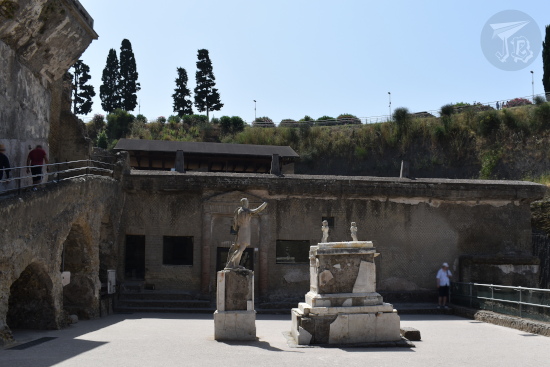
Decorated medieval-like tower

I backtracked towards the Church of Our Lady of the Chapel Église Notre-Dame-de-la-Chapelle | Onze-Lieve-Vrouw-ter-Kapellekerk which had been closed in the morning, and it had fortunately opened. I walked in. The church has an early 13th century Romanesque base, and the building was erected or reconstructed later in Brabantine gothic in the late 13th century. The nave was reconstructed in the 16th century and is Flamboyant Gothic. It leads to a dark-wood painted altar which contrasts with the wide, light nave. All in all, I guess I can say I was a fan of the gothic style in Brussels.

A gothic church with a dark wood altar and altarpiece, with coloured windows behind

When I was in the church, I received a text from D****e, who had finally woken up. I walked back to meet her and we decided to take the train to Antwerp [Anvers | Antwerpen], where we had plans for the evening. We got off at the central station Antwerpen-Centraal railway station Gare d’Anvers-Central | Station Antwerpen-Centraal. Designed by architect Louis Delacenserie, it was built in eclectic style at the turn of the 20th century. It has two underground levels in modern tunnels, and the original station stands at level +1 (a total of four levels), with an extended train hall in iron and glass designed by the engineer Clément Van Bogaert. The station is sometimes called a “railroad cathedral” with domes, glass windows, an ornate clock, and marble floors.

Antwerp Centraal Station - a red iron tunnel-like structure with a decorated front with a clock at the end

The idea was to look for a place to have lunch near the main square, but the weather did not agree. We ate at a Wagamama chain restaurant instead, to wait out the storm, then headed to see the Bourse of Antwerp Handelsbeurs. It was the first building ever erected with the idea of being a commodity exchange place, but burnt down and was reconstructed in the 19th century by architect Joseph Schadde, who mixed Neogothic and iron architecture elements. The building was abandoned in 1997, but it was later recovered as a cultural and event centre. I absolutely loved it.

The Handelsbeurs inside - lots of gothic details supported by decorated iron beams

We had a look at the Cathedral of Our Lady Onze-Lieve-Vrouwekathedraal, but we were pressed for time and did not want to pay to have to rush through the building (a future visit, maybe), so we just peered inside. The cathedral is included in the Unesco World Heritage Site of “Belfries of Belgium and France”.

The cathedral of Antwerp

Outside the cathedral there’s a sculpture of a boy and his dog, from a sad novella about an orphan boy who wants to be a painter, and although written by an English author (Marie Louise de la Ramée) it sounds like the Belgian version of “The Little Match-Seller” tale. It’s called the Nello & Patrasche Statue Nello & Patrasche beeld and it was created by Batist Vermeulen.

A sculpture of a boy sleeping on his dog. The bricks on the road seem to tuck them.

Eyeing the weather, we decided to head out to our destination for the evening, the Trix concert hall – though this meant sacrificing seeing the main square, we were happy that we were under cover when it started hailing at around 16:15. On the way, we saw a mouse happily hopping the main streets, some sculptures, including the Monument to Rubens and the entrance to Chinatown. We had purchased VIP tickets to see the American band Starset, who toured with Japanese singer Hyde in 2018.

Starset is an American alternative rock band formed in 2013 by vocalist Dustin Bates. Aside from Bates (lead vocals, keyboards, soundboard, guitar), the core of the band is formed by Ron DeChant (bass, keyboards, backing vocals), Brock Richards (guitars, backing vocals) and Adam Gilbert (drums, percussion). Touring members currently are Siobhán Richards (violin, keyboards), Zuzana Engererova (cello) and Cory Juba (guitar, synth), and I guess they’ve got an honorary member in Ernie (Dustin’s French bulldog, who apparently attends pizza parties with VIPs when the band tours the US). One could say that Starset is a “concept band” revolving around sci-fi – the band’s fictional backstory refers to The Starset Society, who aims to alert the public about a “Message” they obtained from an outer-space signal. The fact that Bates holds a Master’s in electrical engineering and worked for the US Air Force and the International Space University might have something to do with the theme.

Starset released their fourth album, Horizons, in 2021. After Covid, cancellations and rescheduling, the Horizons Tour finally took place. Since we had a VIP ticket, we had early access and we had to be at the venue at 17:00. We got there a bit after 16:00 – and it was a good place with a hall, so we were under cover when it started hailing. In the end, we were not admitted till 17:20-ish, when a nice lady came and took our names to let us in. The first part of the experience was a short acoustic concert with some games and Q&A. For the games, you were given a raffle number, and if it was picked, you got to spin a wheel and maybe get a price – or a hug.

During the acoustic, we stood next to violinist Siobhán, who is not only beautiful, she is also super elegant. Dustin looked a bit like a hobo, to be honest, and he’s taller than I remembered him. We noticed that Ron’s arm was on a sling – apparently he had hurt himself and was unable to play during the tour, but he still tagged along. Afterwards, we had the chance to take a picture with the band, pick up the free goods that we had a right to – a CD and a signed poster. As we did, we moved into the actual concert hall, where we got the last available spot on the first row barrier.

Starset during the accoustic

The supporting artist was Smash into Pieces, a Swedish rock band composed by Chris Adam Hedman Sörbye (vocals), Benjmain Jennebo (guitar), The Apocalypse DJ (drums) and Per Bergquist (guitar). They were very good, and they fit really well with Starset, I thought. They started playing when the hall was full – it has a capacity of about 1100 people, and maybe they started around 19:30.

Setlist:

  1. Wake Up
  2. Glow in the Dark
  3. Big Bang
  4. Let Me Be Your Superhero
  5. Sleepwalking
  6. Running Away from Home
  7. Vanguard
  8. Boomerang

Smash into Pices front men.

This made the event run faster than expected. Starset were scheduled for 21:00 but came out at around 20:20, and the whole thing started with a bang – almost literally. A big curtain was pulled up and then let down when the band was on stage.

Setlist:

  1. Unveiling The Architecture (recording)
  2. Carnivore
  3. Manifest
  4. Echo
  5. Trials
  6. Icarus
  7. Unbecoming
  8. Monster
  9. It Has Begun
  10. Interlude. BMI ad (video recording)
  11. Satellite
  12. Ricochet
  13. Infected
  14. The Breach
  15. Die For You
  16. Devolution
  17. For Whom The Bell Tolls (Metallica Cover)
  18. Earthrise
  19. My Demons
  20. Boomerang

Dustin (vocals) and Brock (guitar; dressed as an astronaut) from Starset in the middle of the concert

My mind was blown because somewhat this setlist comprises all my favourite songs from the band: Carnivore, Monster, Ricochet and My Demons. The concert was full of little visuals and cool ambience tricks – I mean, Brock actually plays in astronaut suit. There was a lot of smoke and the lights were not good, but the concert itself was amazing. I was very grateful for the barrier, I would not have made it standing for the whole event – probably not even half of it. All in all, I had a lot of fun. I love that Dustin sings with his geek glasses, too.

After the concert, we managed to take the 23:09 train back to Brussels and even get a snack on the way – the one previous to the train I had wanted. That was lucky, because the last train was delayed over an hour and a half, and was a slow one.

12th & 13th February 2023. The Epic Apocalypse Tour in Madrid (Spain)

The year 2020 was going to be so amazing that I actually would have had to choose the things I wanted to do and sacrifice others. It didn’t turn out that great in the end, with lots of rescheduling and cancellations. I was eventually able to budget time and money for one of those rescheduled events – the joint concert by the metal bands Epica and Apocalyptica in their Epic Apocalypse Tour. For a while, however, there was a bit of uncertainty with dates, as they bounced between Sunday 12th and Monday 13th of February, so I needed to juggle work dates in order to make sure I’d be free on Monday. In the end, I was all clear, all the concert-related activities were set for Sunday evening, and I decided to make a two-day trip out of it – I needed to take a hotel for Sunday anyway.

I arrived in Madrid around 9:30 in the morning. I had some time before my first appointment so I walked into one of the large parks of the city Parque del Buen Retiro, which is part of the Unesco World Heritage Site Paisaje de la Luz (Light Landscape), officially called Paseo del Prado y el Buen Retiro, paisaje de las artes y las ciencias, declared in 2021.

Parque del Buen Retiro was built in the 17th century for one of Felipe IV’s palaces, and it was opened in the late 18th century as public park. The park was almost destroyed during the war against Napoleon’s troops in the early 19th century, so most of it has been rebuilt. Aside from the obvious flora, it features sculptures, fountains, buildings… It is home to a lot of birds, and unfortunately a large number of invasive and fearless monk parakeets (Myiopsitta monachus), whose culling has been controversial in recent years. I got to see common blackbirds (Turdus merula), a European green woodpecker (Picus viridis) and a European robin (Erithacus rubecula).

One of the most important features of the park is the sculpture Monumento al Ángel Caído, which represents an angel falling from grace. It was originally designed by Ricardo Bellber, who made it in plaster in 1877. It was later cast in bronze and the original plaster destroyed, and eventually the sculpture was made into a part of a fountain in 1885. Around the area, there is also an ancient water mill, and to my surprise, the almond trees (Prunus amygdalus) had started blossoming.

Retiro Park collage: a pathway with trees and bushes on both sides, ducks, and a robin.

Retiro Park collage: a water mill, blossoming almond trees, and the fallen angel fountain

At 10:15 I had a guided visit to the Real Observatorio de Madrid (ROM), commissioned around 1785 by Carlos III, as an centre to develop and study astronomy, geodesy, geophysics and cartography. The main building is the astronomical observatory, built by Juan de Villanueva in what then was the outskirts of the city. Today, ROM belongs to the National Geographical Institute (IGN), and it is home to the National Astronomical Observatory, the Central Geophysics Observatory, and the data gathering division of the National Volcanic Service, though no measurements are taken there. The main astronomy measurements are carried out in the Centro Astronómico de Yebes, in a town around 80 km north-west of Madrid. The observatory is also part of the Unesco World Heritage Site.

The visit comprises three stops. The first one is the main building, called Edificio Villanueva, which has three rooms – the main rotunda with a Foucault pendulum, the library, with the spot where gravity was first measured in Spain, and the “Time room”, where the sun used to be traced to determine the hour.

ROM collage. A small Neoclassical building, an inner room with a pendulum and telescopes, a telescope and a 19th century library.

The second stop is the Great Telescope, a replica of one that William Herschel built in the 18th century – Hershchel was one of the greatest telescope makers of the time, and is credited with discovering the planet Uranus, two of its moons, and two moons of Saturn. The telescope was destroyed during the war against the French, but later rebuilt thanks to the number of laminates that had been preserved – the original had a focal distance of 7.6 m and a 61-cm diameter mirror (which is displayed in the main building), and Herschel himself considered it the best he ever built.

Herschel grand telescope: a wooden scaffolding structure keeping a huge black tube pointing at the stas

The final stop, the little museum of “Earth and Universe Sciences” has a small collection of ancient instruments used for astronomy, navigation, and geophysics. There are also a couple of seismographs – one of them new, which is up and running – and material retrieved from the volcanic eruptions of El Hierro in 2011 and La Palma in 2021.

Collage. Ancient telescope, old tide measuring device, an old globe, and lava bombs

I had planned for a typical sandwich at an iconic bar afterwards, but I ran into a political demonstration. Thus, I scratched that idea and took the underground westwards. When I was in Egypt, one of the places I visited was Lake Nasser, created by the Aswan High dam. The lake swallowed a lot of villages and monuments, but a few of them, such as Abu Simbel and the Temple of Philae were saved by Unesco. Between 1960 and 1980, a total of 24 monuments were saved, and five out of these were presented as “grants-in-return” to five countries which had offered exceptional technical and financial assistance to the campaign – Germany, Italy, Netherlands, the United States and Spain, the latter being impressive as Spain was in the middle of the dictatorship, and pretty shunned by the international community at the time.

The monument was a small and ruined temple in the now-flooded town of Debod, to which it owns its name Templo de Debod (Temple of Debod). Dedicated to the god Amun, it was built around the location of the First Cataract of the Nile, some 15 km south of Aswan, about 2200 years ago, though the core of the building may have been older. The monument was actually affected by the original dam at the beginning of the 20th century, and it was covered in water for most of the year, which destroyed its colours and damaged the reliefs.

During the Unesco salvage mission, it was dismantled, and eventually granted and taken to Spain, and “freely” reconstructed – a lot of information had been lost, and there were missing blocks. National stone was used to fill in the gaps, and the gates (remains of the pylons) were built in the wrong order, according to some old pictures. The restorers built an air-conditioning system, a wooden roof, and the main hall was closed off with a glass door and window panes. Today, the temple is open to the public at weekends, but unprotected from the Spanish weather – rather different from the Egyptian one – and pollution, it is rapidly deteriorating.

I went inside the temple once when I was a child, and I had a clear memory of it that kept surfacing when I was in Egypt – so I wanted to go back. The entry is free, but capacity is reduced, so I had to queue for almost an hour to enter. I finally matched my memory to reality. The interior of the sanctuary has a small chapel and some carved stones had been taken to a makeshift second floor to display them as a little museum.

A collage of a small Egyptian temple - it has two floating gates that lead up to the main building, which is small with four columns. One picture shows a tiny and dark inside room with an altar.

After the temple, I got lunch on the go, then walked towards the hotel to check in and change clothes. Around 16:15, I set off to La Riviera for the concert. I had a Meet and Greet ticket and had to be there before 17:00. Personnel from the venue were extremely nice, and there was no chaos at all, even if things had been a little disorganised and some fans were lacking M&G confirmation emails. Everything was well-handed and everyone who had paid for an upgrade got through. There were about 30 people to meet and greet Epica and we were ten for Apocalyptica.

Apocalyptica is a Finnish four-man band – Eicca Toppinen, Perttu Kivilaakso, Paavo Lötjönen and Mikko Sirén – founded in 1993. They are “semi-officially” a symphonic metal band, but they’ve ventured into everything from Metallica covers (which was their origin) to pure classical works. They have a very specific style heavily using classical cellos and combining them with modern drums. They currently collaborate with American – self-identified as Cuban in the concert – singer Franky Perez for vocals.

Meeting the four of them was really fun. I got autographs and took the most epic picture I’ve ever taken with a band or artist before. As we were only ten, after it was over, I had time to buy some merchandising and still be the second person to settle on first row – despite having decided that I was going to sit back and relax.

Apocalyptica white and black poster, signed by the four members

General admission started at 18:00, and the crowd was surprisingly tame throughout the whole thing. The venue filled up and the supporting band, Wheel, came up at 18:30. Wheel is a Finnish progressive metal band that consists of James Lascelles (Vocals/Guitar), Santeri Saksala (Drums), Aki ‘Conan’ Virta (Bass) and Jussi Turunen (Lead Guitar).

Wheel Setlist

  1. Hyperion
  2. Blood drinker
  3. Movement
  4. Vultures
  5. Wheel

Wheel playing, each member at his insturment: bass, guitar, singer and drummer

The second band was Epica, which I remember having listening to back when the world was young. They are a Dutch symphonic metal band currently composed by Simone Simons (lead vocals), Mark Jansen (rhythm guitar, vocals), Coen Janssen (keyboards, synthesizer), Ariën van Weesenbeek (drums), Isaac Delahaye (lead guitar) and Rob van der Loo (bass). Simone can go insanely high with her voice, and she has an amazing presence on stage, and the whole band has an immense amount of energy – she also reminded me of a comic character. The keyboardist had a lot of personality too, and he was extremely fun.

Epica Setlist

  1. Abyss of Time – Countdown to Singularity (recording)
  2. The essence of silence
  3. Victims of contingency
  4. Unleashed
  5. The final lullaby
  6. The obsessive devotion
  7. The skeleton key
  8. Rivers
  9. Code of life
  10. Cry for the moon
  11. Beyond the Matrix
  12. Consign to oblivion

Collage of Epica playing, showing different members at their choice of insturment - singer, bassist, guitarist, and keyboardist with a portable keyboard

Finally Apocalyptica came on stage, and it was extremely fun. The things those guys do to their classical cellos would make some classical musicians cry, but the sound is super-powerful. We had Franky Perez for vocals, and a very fun moment regarding “listen to our classical music album at home, because we still feel like death metal”. They interacted a lot with the public, and it felt somehow very friendly / warm – yes, I’m talking about metal here. It was really that fantastically weird.

Apocalyptica Setlist

  1. Ashes of the Modern World
  2. Grace
  3. I’m not Jesus
  4. Not strong enough
  5. Rise
  6. En route to mayhem
  7. Shadowmaker
  8. I don’t care
  9. Nothing else matters
  10. Inquisition Symphony
  11. Seek & Destroy
  12. Farewell
  13. In the Hall of the Mountain King

Apocalyptica playing with Franky Perez. Perez is in the foreground, dressed in black. The thee cello-playing members are in the frame, playing. The drums peek behind them, but you can't spot the drummer

Apocalyptica playing at La Riviera. They have classical cellos. Two of the members stand on the sides, playing their cellos. Another one is walking swinging his as if it weighed nothing, The final one is slamming drums in the background.

We finished off just short of 23:00, I bought off some fast food for dinner, and headed back to the hotel to have a shower and get some sleep. I was woken up early in the morning due to the cleaning crew and the garbage mini-vans noises, but I did not leave bed until 9:00, then set off at 9:30. I bought some cold coffee on the way and walked into the former royal palace gardens, now public park Jardines del Campo del Moro.

Though I’d seen the gardens a few times before, this was the first time I actually walked into them. Despite the frost covering everything, I got a nice view of the palace and different fountains and buildings sprinkled throughout the green – Chalet de Corcho, is a small hut with coloured windows; and Chalecito de la Reina a wooden house that is currently closed. I was insanely amused by a little grass-cutting robot.

Jardines del Campo del Moro. Collage. It's winter and most trees are grey and bare. At the end of the walkway stands the Neoclassical Royal Palace. Two smaller buildings - one of them is white with brown beams, reminscing of German architecture; another one is a small kiosk with colourful windows - red, green...

I wandered around for an hour or so, then headed off via underground to the National library of Spain Biblioteca Nacional de España for the absolutely worst guided visit of my life. Like… it’s true that it’s free, but tickets run out within hours of coming out – on the 20th of the month, for the following month. I’d actually been trying to do this since Covid lockdowns ended… It turns out, we did not see any real books, we could not even peer into the reading area, the book and reading museum is closed and the only information we got was… that the guide did not like the Library. We did not get to see anything interesting or that we could not see on our own, and we did not get to learn anything, so this was a huge blunder. Live and learn – but it was one of the few things that was open on a Monday. The library is a huge Neoclassical building with a fantastic marble staircase inside. The doors and gates are protected by intrincate ironwork fences.

Biblioteca Nacional de España. A Neoclassical building in white and grey tones. The exterior has columns and statues of writers. The interior showcases a pair of twin staircases with the statue of one of the most important library directors between both.

I met with family for a quick lunch and then we went for a walk. We had thought about going to one of the terraces to see the cityscape, but it was closed because it was a Monday. We ended up at the Parque del Retiro park again to make some time and walk. We sat in the sun for a while, then went to see the Palacio de Velázquez there. Currently, it’s part of the modern art museum Museo de Arte Reina Sofía, and I did not really care much about the exhibits, but I like the building. Architect Ricardo Velázquez Bosco built it in brick (with ceramic tiles by Daniel Zuloaga) for the Mining Exhibit in 1883, inspired by London’s Crystal Palace, now gone. The interior is pristine white with hints of iron architecture, but the building’s official style is “neorenaissance historicism” whatever that means.

Palacio de Velazquez: A brick building with large windows and tile decoration. The inside is all white with bits of iron architecture.

Velázquez Bosco and Zuloaga also came together when they designed another building I really like, the glass-and-iron greenhouse Palacio de Cristal, which was built to home tropical flora and fauna from the Philippines in an exhibit in 1887. In front of the palace, there’s a small pond home to some cheeky ducks and geese.

Palacio de cristal. A huge greenhouse with a dome, and two wings. A white duck wanders in the foreground. Between the greenhouse and the duck there's a small pond.

Then, we went to have a snack. Trying to find something on the map before the trip, I’d come across a place called La Mejor Tarta de Chocolate del Mundo, which translates to “The best chocolate cake in the world” and that had to be tried! It was really nice, even if the place was pretty small and felt a bit cramped.

A slice of chocolate cake in front of mugs and teapots

We finally took a stroll down towards the sunset, and I took the train back without much of a hitch, then drove home

15th October 2022: The castle in Olite and the cathedral in Tarazona {Aragón & Navarra Oct. 2022}

Today, Olite is not much of an impressive town – but it has a dream castle Palacio Nuevo de Olite. The original fortress is reported to be a first-century Roman building where the Old Palace stands now. The first mention that we have of the old castle dates from the 13th century. In 1388, as Carlos III of Navarra (whose grave we had seen the previous day in Pamplona ) starts the process of clearing the area surrounding it, buying houses and so. The official ampliation of the palace started in 1399, and the actual construction of the new castle in 1402. First, the keep was erected, then the surrounding towers, without much planning, giving was a capricious space with staircases, yards, and even a hanging garden. Construction ended in 1420.

When Navarra was annexed to Castille, the decline of the castle started. Later, during one of the several Spain-France wars, soldiers’ distraction caused the first fire in 1794. later, in 1813, the castle was intentionally burnt down in 1813 to avoid that the French made a stronghold out of it. The wood-decorated room were completely destroyed and only the stone walls remained, although barely. The castle was used as makeshift quarry from then on, until in 1902 the modern regional government bought it. In 1925, after considering three proposals, it was decided too restore the castle using Jose Yárnoz Larrosa, who became the main architect. He chose a restoration style known for aiming to make things “as they should have been” – so rather idealistic. And one has to admit that the castle does look pretty cool, even though apparently it does not preserve the original structure too much. Throughout this time, a mulberry tree might have thriven for about 500 years.

The point of this is that the castle is cool. Pretty much fake, but cool.

After having breakfast, I set off for a few pictures. It was not too early in the morning, even, but at least the square was empty and clean, unlike the evening before. I stopped to examine the entrance of the church Iglesia de Santa María la Real. The church dates back from the 13th century, and is famous because of the decoration of its main façade and the sculpture around the portal, though personally, I was more taken by the atrium just in front of the church. While it does obstruct the view of the façade, the architectural ensemble ends up looking super cool – except for the little porch built in the 2015 restoration that… well… might be necessary but does not allow for the best view.

Church Santa María la Real: Gothic façade with an arched atrium in front of it. The portal is decorated with religious figures

I went around the complex formed by the two Medieval castles Palacio Viejo and Palacio Nuevo de Olite, the walls and the old egg-shaped building that used to work as a snow-powered fridge of sorts.

Collage with different sights of the new Olite palace. The walls, archs and merlons are shown, brown-gold colour. Some of the pinnacles have grey slate pinnacles.

We went in. The restoration of the palace is “in style” so you cannot tell what is new from what it is not. The inner area includes access to the towers, the keeps, the so-called King’s gallery, the hanging garden, and the centennial mulberry tree. I climbed about half of the towers and the keep itself, and I have to say it was pretty fun.

Palace of Olite - Gothic archways, one bare, one full of vegetation, and views from the towers, showing the merlons, pinnacles, and the rest of the towers

Palace of Olite - looking from the interior, the structures show vegetation and the pinnacles. The last part of the collage shows the mulberry tree

Unfortunately, when we left the castle, we were not allowed into the church Iglesia de Santa María la Real as there was going to be a wedding – despite being no notice outside but the normal opening times, within which we were. Sometimes I feel tempted to take pictures even when I know it’s not completely okay, in order not to miss opportunities later. Before we left town, we found a nice viewpoint to try to catch site of the whole castle.

Palace of Olite from afar. It looks like a fairytale castle with pinnacles, walls, merlons and flags.

Afterwards, we drove southwards towards Tarazona, back in the region of Aragón. It is not a big town, with but an interesting point to get to know – the cathedral Seo de Nuestra Señora de la Huerta de Tarazona. Built throughout the evolution of Gothic art, between the 13th and the 15th century, it was later enriched in the 16th century with Renaissance decoration and interior, and sprinkled with Mudejar details. The cathedral is in the middle of restoration, and the organ is fenced off. The cloister shows lots of panels on the works being done, too.

Tarazona cathedral - outside. The façade looks weirdly grey, and the belltower is on the right, darker. A close-up of the dome shows its Mudejar influences

Interior of the Cathedal of Tarazona, showing Gothic columns and the Baroque altarpiece. The cloister is modified Gothic with arcs and spikes. A close-up of the Mudejar-style bell tower.

We had lunch after visiting the cathedral, but we did not feel like staying around until the archaeological gardens. Thus, we just took the car back home, even though we might have been better off checking out some more places in town. Lesson learnt then, more planning is required in this kind of escapades…

14th October 2022: Pamplona, the city of the bulls, and Olite {Aragón & Navarra Oct. 2022}

In order to avoid crossing Zaragoza, we tried to go around it. Unfortunately, trying to save up 30 minutes, we ended up wasting an hour at the entrance of the highway, and we reached the city of Pamplona or Iruña. Today, it is the capital of the region of Navarra, which is roughly the size and shape of the old Kingdom of Navarra, which existed roughly between 1162 and 1512, when it was conquered by the Catholic King Fernando.

There had been a slight misunderstanding on who was going to plan the day – I was convinced my father had not wanted me to do it, but when we arrived he turned to me and I was supposed to know. In summer, I had drafted a small itinerary, but as he was supposed to have taken charge, I had not gone further. It turns out, I should have. Fortunately, I still had the map on my phone and the opening schedules on my travel notebook. Unfortunately, I had not really delved into all that the city has to offer and we missed a few interesting thing

Thus, I tried to take charge, but not too much because it’s hard to balance that with my parents. Even if we have travelled together before, I tend to let them do the planning and only insist on some stuff I want to do or see, and that’s how they end up at dinosaur parks (≧▽≦).

We left the car in a parking lot underneath the congress centre and walked towards St. Nicholas Church Iglesia de San Nicolás de Bari Eliza. The first building dates from the 1100s, and it was built along the now-disappeared walls, as a defensive construction at the same time as a religious one. It was demolished and rebuilt location makes the building awkward, and to add insult to injury, we arrived almost at the same time as mass started, so we just took a quick look.

Iglesia de San Nicolás de Bari Eliza - exterior with pointed arcs, and inside, showin the altar

We walked to the next church dedicated to St. Lawrence Iglesia de San Lorenzo, actually associated to the Unesco World Heritage Site Routes of Santiago de Compostela: Camino Francés and Routes of Northern Spain Caminos de Santiago de Compostela: Camino francés y Caminos del Norte de España. The current building is Neoclassic, and the façade was rebuilt at the beginning of the 20th century when the original was damaged during war. On the right of the main nave, a side chapel holds the famous sculpture of St. Fermin, the patron saint of the town. The chapel was built between 1696 and 1717, when the sculpture was placed there. Every 7th of July, the sculpture is taken out in the religious procession. From the 6th of July and for a week, Pamplona celebrates its local festivals, famous around the world for the encierros, or running of the bulls. While there are similar runnings all throughout Spain, the encierro in Pamplona was popularised by Ernest Hemingway, the American novelist, in his work “The Sun also Rises” (1926).

Church of Saint Lawrece - Neoclassical façade and interior, with the sculpture to Saint Fermin, the patron saint, in a red cape and a mithra, surrounded by red and precious metals.

We continued onto main street Calle Mayor, which ends at the main square Casa Consistorial de Pamplona, which opens to the main square Plaza Consistorial. The building was erected between 1951 and 1953, though the project kept the 18th century façade, halfway between late Baroque and Neoclassic.

Pamplona town hall / council hall, with flags hanging from the balcony.

We continued onto the cathedral dedicated to the Virgin Mary Catedral de Santa María la Real de Pamplona. The building is Gothic (French Gothic, actually), with a Neoclassical façade designed by Ventura Rodríguez (who also worked on the Basílica del Pilar in Zaragoza). One of the most interesting things in the cathedral are the paintings on the walls and columns themselves, just non-religious decorative motifs. In front of the altar lie the tombs of King Carlos III of the Kingdom of Navarra, and his wife Leonor of Trastámara (or Castille).

Cathedral of Pamplona, including a close-up of the bright polychromy in red and blue, and the altar, from far away and a close-up. The most distinctive feature are the pointed arched and the very clean masonery.

In the inner area, there is a beautiful cloister, and you can climb into the false ceiling, see the kitchen of the former convent. And, let’s not forget – they have a stamp, because it is one of the “official” starting points of St. James Way, Camino de Santiago, and also part of the Unesco World Herirage Site related to it.

Collage: Cloister in Pamplona cathedral. The gothic ars are pointed and ornate, standing on bright green grass. One of the corners shows a fountain, the other the iner walkways

We stopped for lunch, then we walked by one of the “iconic” points of the bull-running, the corner at one of the streets of the route – Esquina de la Estafeta, and continued on until we reached the bullfighting ring Plaza de Toros de Pamplona, but since we are not big into the culture, we did not enter.

We did stop by the sculpture to the bulls and runners Monumento al Encierro, a huge bronze composition with a number of real-life pieces: nine bulls (six fighting bulls and three guiding bulls) and ten runners.

This bronze sculpture represents several life-sized bulls and runners. The runners are in front of the bulls, and one of them has been trampled.

Finally, we went to have a stroll alongside the walls of the former citadel Ciudadela de Pamplona. Although now it is a park, and only the foundations are left, the Citadel was one of the most important defensive constructions in the Spanish Renaissance, in the shape of a five-pointed star.

Several angles of the Ciudadela of Pamplona park. Not much is seen except for the building foundations, though they stand two or three metres high.

After that, we took the car and drove towards the town of Olite also known as Erriberri , where we were going to sleep. The town was home to the Monarchs of Navarra, and today there are two distinctive buildings – the old palace Palacio Viejo de Olite, where the Parador de Olite stands, and the new palace Palacio Nuevo de Olite. Originally the most extravagant Gothic castle in Europe, it burnt down during the war against the Napoleonic troupes, and was rebuilt in 1937 using the philosophy of bigger, cooler more teeth. We checked in at the Parador and I collected my stamp. From our room, we could see the main structure of the old palace, as we had a very long balcony.

Old palace of Olite. There is a tower on the right and an old Medieval house to the left. The building is made of irregular masonery and the windows are perfectly rectangular.

We went for a walk, and were surprised at how many people there were in the area. We sneaked into the church Iglesia de Santa María la Real, but did not take any pictures as (once again!) mass started. We planned to come back the following morning as it was barely a 30 seconds away from the door of the Parador.

On the left, a modern red-brick house stands on older arcs. The façade sports a protection made of intricate white ironwork.
On the left, a Romanesque church, blocked by construction and a tractor.

We walked around for a little and were not too impressive by the Medieval city centre, but we did find the typical balconies and the Romanesque church of St. Joseph Iglesia de San José.

We were beat, to be honest, it had been a stressful day after a short night’s sleep, so we turned in early after dinner. I did not even think to wander round to see if I could get any cool pictures of the area, because the area was packed and I was exhausted.

9th October 2022: Atémpora, Sigüenza (Spain)

Sigüenza a Medieval town in the centre of Spain that is currently trying to gain the status of Unesco World Heritage Site. It has a castle, a protected historical centre, and in the heart of it stands the cathedral Catedral de Santa María La Mayor de Sigüenza . The cathedral dates back to 1124, when the original Romanesque building was was erected. The construction finished in 1326 , with remodelling and decoration elapsed several centuries, with different add-ons, until it was “declared” finished after the Spanish Civil War, with later works being just conservation.

Cathedral in Siguenza, a late-Romanesque / early-Gothic building, in a reddish colour. Left: side view, showing the bell tower. Right: façade, with two side towers.

In summer and autumn 2022, there is an exhibition in the cathedral – Atémpora. Sigüenza entre el Poder y la Gloria, which translated to something akin to “Timeless. Sigüenza between Power and Glory”. It displays some of the treasures of the cathedral and the museum, along with a few archaeological devices. We had seen most of the religious artefacts in a previous visit, but the historical chronicle was rather interesting.

The first block, around the cloister, deals with Celtiberian (the Arevaci tribe) and Roman weapons and everyday life. The second block deals with the Goth conquer and the newfound Christianity.

Upper Left: entrance to Atempora, flanked by two angels. Upper right: Celtiberian Daggers. Bottom left: oil lamp looking like a bird. Bottom left: clay bowl.

Interwoven with the exhibition are the treasures of the cathedral, including two collection of Flemish tapestries, one focused on Athena, the other on the story of Romulus and Remus. Another highlight is an Annunciation painting by Domḗnikos Theotokópoulos “El Greco” a Greek artist of the Spanish Renaissance (since he moved to Toledo in his prime). Of course, the cloister is fantastic. There is a tiny gothic altarpiece in one of the chapels that is delicious. The problem? As always, Baroque trends building choirs in the middle of the naves, blocking the view, and overdecorated altarpieces. The wooden ceilings are extremely beautiful where they have been preserved.

Upper left: tapestry collection, hanging from walls. Bottom right: Annunciation by El Greco. Bottom left: decorated wooden ceiling. Bottom right: Cloister of the cathedral.

The three final blocks present different Christian symbols and pieces of art from the Middle Ages onwards, and interestingly enough, a watermill from the old salt marshes. The exhibit makes a particular emphasis on Wilgefortis, a Catholic folk saint which is supposed to be buried in the cathedral, with the silver arch where her body lies brought from the altar. Other pieces include coins, sceptres, and even a few elements from the times when there was a Medieval university in town – one of them being a human skull with “anatomy notes” on it. There are also late Medieval sculptures, most importantly crucified Christ representations and Virgins with the Child, though probably the nicest one is the one which is permanently at the entrance of the cathedral. Next to it, a mill from the nearby salt mines (Salinas de Imón) has been brought – I really want to visit those at some point too, so great reminder.

Altar of St. Wilgefortis on the left. On the right, a coin, a scepter and half of a skull with writings on it.

Top left: Romanesque virging with child. Bottom left: watermill. Right: Crucified Christ with four nails on his hands and feet.

The most important monument, or area, in the Sigüenza cathedral is the chapel called Capilla del Doncel. It holds the tombs of Martín Vázquez de Arce and his parents. The de Arce men participated in the war against Granada Muslims during the 15th century, where the son was killed in an ambush, as the Muslims created a flash flood from the watering system they had to control the waters of River Genil. Though he was already 25 years old, too old to be called a doncel, teenage boy, the name has stuck for centuries. The parents’ tombs are traditional burials, however, the Doncel’s grave is an arcosolium, with the decorative sculpture showing the young man awake and reading a book, rather than lying in death as it is the typical representation.

Chapel of"El Doncel", showing the traditional burials in the foreground, and the Doncel's tomb in the background.

We went to have lunch after the visit, we went to have lunch at La Taberna Seguntina, where we shared some typical cheese, sausage, and roasted pork before we went home.

Typical Siguenza Dishes. Top: sausages and cheese. Bottom: roasted pork leg with potatoes.

25th July 2022: Half a day {Salamanca, July 2022}

Mondays are always tricky because a lot of things close then. We reprised our latte/croissant and visited the Tourist information office that claimed that everything was open – which… was incorrect. My companion wanted to see Iglesia de San Marcos, a Romanesque church which has an interesting circular shape, probably built in the 11th century (that we had found in the book we got from the cathedral).

A Romanesque church. It has a round nave and a short bell tower with two bells.

We saw the local market Mercado Central de Salamanca, designed by the same architect as the Casa Lis. As this is a public building, it was in working order – though funnily enough, all the fishmongers were closed – no fish in Salamanca on Mondays! The building is modernist, with iron structures and colourful windows.

A Modernist building with colourful glass windows

To finish off the morning we went to visit the palace Palacio de la Salina, also a public building so also open. The architect in the project was Rodrigo Gil de Hontañón (who also designed the University building in Alcalá de Henares). It was built in 1538, mainly in Plateresque style, with some Italian elements.

The patio of a Plateresque palace, in gold tones with a lot of decoration on the stonework

Right across the park from the palace there is a lonely Renaissance tower Torre del Clavero. It was a 15th-century defence tower, with a square base that turns octagonal in height.

A

We walked around for a while longer, had lunch, and our train back left around 3:30. It was a rather uneventful trip full of gothic, modernism and iron, which I really enjoyed. I keep trying to get to like guided visits, and I have somehow got fond of climbing up towers.

Walking distance: 11737 steps / 7.31 km

24th July 2022: Up, up and down {Salamanca, July 2022}

After a latte and the best croissant I’ve had in a long time, we went over to see the gothic palace Casa de las Conchas, which was built between 1493 and 1517. The façade is decorated with sandstone-carved shells (concha, in Spanish). The exterior sports ironwork-protected windows, and the interior a patio with artistic arches.

The gothic palace called House of Shells. There are hundreds of them carved on the façade. The inner patio is carved in golden stone, with very thin columns and lots of decoration

It was still early for our visit to Palacio de Monterrey, a 16th-century Renaissance palace inspired in the Italian style of the time, combined with Plateresque decoration, which was heavily imitated later on in the 19th century. The building currently belongs to the House of Alba, probably the most prominent Spanish noble family. The House opened the palace to the public, and the inner area cannot be photograph – it was weird anyway, with some antiques and art pieces, but all of it was… prepared and staged, though the carpets were rolled out of the way. In this case the only option to sneak out a picture was from the tower, as a member of the staff followed us all the time.

Monterrey palace, built in golden-like masonery. The roofs and towers are decorated, and there is a row of windows alongside the upper floor.

Next, just in front the palace, we visited the 17th-century church Iglesia de la Purísima, in Italian Baroque style. Its altarpiece is considered to have one of the best images of the Virgin Mary in her Immaculate Conception advocacy.

A Catholic altar showing the Inmaculate conception in the centre, she is dressed in blue, and standing in front of golden clouds, with angels around her. The back of the altar is built in white stone, and ornate.

Our next spot was the second university of Salamanca, the see of the Universidad Pontificia de Salamanca, a building called La Clerecía. As the original university went secular, the Jesuits built a clerical university. The building, built in Baroque style between the 17th and 18th centuries is composed of a church, a cloister, a patio and a magnificent staircase, forming the complex (read: guided tour) called Vita Ignatii.

Collage: On the left, a very baroque church from the outside, also showing the gold inner altar. On the right, some shots of the upper and lower cloister, the patio is ornate and reddish, the staircase is made completely out of stone.

Then there are two towers that give out really awesome views of the town, named Scala Coeli, the stairs to the Sky.

Views of Salamanca from the above: the dome of the church from the outside, the cathedral, the House of Shells, and the bells.

It was rather hot, so we had some unremarkable lunch and went to the hotel to wait out the blunt of it. It did not really work, and we eventually tried our luck with some more sightseeing. The first stop was the garden known as Huerto de Calixto y Melibea, based on a literature work Tragicomedia de Calisto y Melibea or La Celestina. It is considered the first Renaissance writing in Spanish, and it echoes with Romeo (Calisto or Calixto) and Juliet (Melibea), with an extra character, the old matchmaker Celestina, who is a horrible person trying to break the lovers up to marry Melibea to someone else. Though the writing does not have a firm setting, some say that it is probably Salamanca, where the author attended university. It was nicely shaded and had nice views.

Gate to the gardens, a bust of Celestina (the fictional character), from the cathedral, and some flowers: star-shaped and orange, bell-shaped and red.

Then, we wandered off to see the bridges over the river Río Tormes again: both Puente de Enrique Estevan and Puente Romano. Next to the Roman bridge there is a statue of a verraco (ancient Celtic sculpture) Verraco del Puente Romano, which is supposed to have been there since the 16th century. A bit to the side, there is yet another literary monument, which represents the book El Lazarillo de Tormes, Lazarillo being the word for “guide dog (for the blind)” in Spanish (such an eye-seeing dog). Also written in the 16th century, it is considered another of the peak writings in Spanish, telling the story of a young lad who learns to survive by gathering street-smarts and shedding off any morals he ever had, finally settling in Salamanca with his unfaithful wife: Monumento al Lazarillo de Tormes.

Collage. The historical bridges in Salamanca: the Roman one, made from stone with wide archs, and the iron-architecture one, in greyish-green. Sculptures: Lazarillo with his master, and a prehistoric bull or pig, with a flat head

Then we found a very air-conditioned and interesting place – the automobile museum Museo de la Historia de la Automoción (which reminded me a little of the Megaweb Toyota City Showcase and History Garage in Tokyo). It has a lot of classic cars, and some historical pieces such as vehicles that belonged to dictator Francisco Franco or the writer Camilo José Cela (and air-con).

A collage of some cars: A Rolls-Royce, a Ferrari, a Wolkswagen 600; and a Harley-Davidso

I had then booked myself an evening visit around sunset time, to go up the towers of the cathedral, an experience called Ieronimus, with the hope to see some cool sunset and night views. It makes sense, right? Wrong. I should have realised when it turned out to be a guided visit that most of it would be inside, listening to the guy fanboy his own city – then he started speaking about the Lisbon earthquake and its effects in Salamanca and gave out wrong information. I stopped listening to him at that point. There was a light/music show in the cathedral, and I did get some neat pictures, but honestly? The choir concert in the old cathedral would have been a much better choice, had we known about it.

Views of Salamanca at night, with the gothic architecture highlighted by the illumination. The city looks Romantic and mysterious.

Walking distance: 13017 steps / 8.00 km

23rd July 2022: Plateresque Salamanca {Salamanca, July 2022}

Officially in western Spain, Salamanca stands next to the Tormes river and sports a Unesco World Heritage title for its old town. I was five or six the first time I was there, so it’s not like I remembered anything from it, except memorising excerpts from the book El Estudiante de Salamanca (José de Espronceda), my favourite Spanish Romantic poet.

Salamanca is known due to its university, which is considered one of the best in the teaching of Spanish as a second language, the oldest Spanish university and one of the oldest in Europe, founded in 1218. There are actually two universities, but we shall get to that later.

There is a period in Spanish history referred to as the Gold Century, Siglo de Oro (Not an actual century, the given dates are between 1492 – the year when the Catholic monarchs finished conquering the country, Europeans realised America existed, and the first book on Spanish grammar was published – and 1659 – when the Pyrenees treaty was signed after the war with France). It was throughout this period when Salamanca thrived, especially late-time Gothic styles and early Renaissance ones. Then of course Baroque later on, but you know my stance on Baroque by now I guess… The mixture of late-gothic and Renaissance gave way to a unique style, Plateresque – with a strong Gothic base and a blend of Mudéjar, Flamboyant Gothic, Lombard and Tuscan Renaissance elements and decorations. Plateresque is characterised by heavy decorations sculpted onto the main architecture, especially in the typical fusion of doors and altarpieces. The motifs are plants, animals, shields and medallions… All and all, an impressive style considering we are talking about carving stuff on stone – in the case of Salamanca, a lot of it is sandstone, which gives the old city a golden tone.

We had to take a couple of trains, but and made it to Salamanca around 10:30, and were in the city centre a few minutes later. After dropping the luggage at the hotel – I had been requested the hotel to be near the cathedral and I found one which was literally across the street from one of the flanks. Then again, here’s the thing – Salamanca has not one but two cathedrals: the Old Cathedral Catedral Vieja de Santa María and the New Cathedral Catedral Nueva de la Asunción de la Virgen. Apparently, instead of building over the old one, they decided to keep both, making the historical complex unique in the country.

The New Cathedral was built mainly in Gothic style with later Baroque add-ons, with an ornate Plateresque façade. It was commissioned by king Ferdinand V of Castile, and built between the 16th and 18th century, in the Gothic style, even though this was at time when Gothic was already in decline. However, the town authorities wanted it to “match” the old Romanesque cathedral. A cupola and a choir were added in the Baroque period, and the façades were decorated in the Plateresque way (in a 20th-century restoration, someone thought it would be funny to add an astronaut to the decoration, causing some hoaxes to pop up afterwards). The most important architect who worked in the new cathedral was José de Churriguera, one of the leading Baroque architects / sculptors / urbanists.

A very ornate Gothic cathedral. The entrance has so many carvings that it actually looks organic, if not for the fact that it is made out of golden / reddish stone

The New Cathedral connects to the old Cathedral, which is late Romanesque / early Gothic in style (I know, it’s confusing. Historically, the old cathedral is between Romanesque and Gothic, and the new one between Gothic and Renaissance – and this is the reason why the Gothic makes the two cathedral “match”). It was built between the 12th and 14th centuries. The most impressive thing in the Old Cathedral is the altarpiece, in which the highest-quality paintings were made by the Italian Dello Delli. On the way out, I let myself be tempted by a paper guidebook of the city – which was helpful because we had to remake all of our plans a couple of times.

Interior of a Romanesque church - the nave has very high and severe-seeming columns

Afterwards, we headed off to the main university building Universidad de Salamanca, the first university building. The university was founded by King Alfonso XI in 1218, which makes it the oldest university in the whole Spanish-speaking world. The most important building today is the Escuelas Mayores, the upper school, built between 1411 and 1533. The façade, which looks towards the newly-discovered New World is sculpted in the Plateresque style, with a ton of decoration – and the most famous motif is the frog that stands on top of a skull. The university was built around a cloister for the students of old, and it has the most amazing library I have seen in a long while – selfishly (I’m joking of course) closed to the public. There is also a chapel and the classroom where the Spanish academic Fray Luis de León, who was famously jailed for four years, and picked up his lectures with “as we were saying yesterday”. The cloister has two floors since the 19th century, and in the centre there is a small giant sequoia (which I thought was a simple fir). There are chapels, and halls, and areas where university holds events.

Very ornate entrance to a building. there are two doors (four or five times as tall as a person) and the decoration, all carved in stone, is on top. Three floors of decoration, with columns and shields. A close-up shows a frog on top of a skull.

The problem with Salamanca is that the entries and exits of the building make you have to backtrack a lot (and the horrible street lights), but I love Gothic so I did not mind wandering around anyway. After the Escuelas Mayores, we went to another university building the lesser school or Escuelas Menores. Today, there is a cloister which dates from 1428 with a Baroque upper veranda. In one of the side halls there is a fresco panting that used to be in the library and that was moved over in 1950. The fresco represents a night sky was used in teaching.

Gothic patio and a suck picture of a fresco painting, showing stars and the representation of constellations

We had lunch, then we went to the Dominican monastery Convento de San Esteban and its church. The current monastery dates from 1524-1610, and it was built over the previous one. The façade of the church is considered the best example of Plateresque, and José de Churriguera also worked in the main altarpiece. The monastic building has a portico with Italian loggias, typical of the Renaissance. The cloister is mainly Renaissance with Gothic features, and a small temple in the middle. The ambulatory in the cloister has beautiful Gothic columns and nerves on the ceiling.

A convent, built in ornate gotic style. The covered corridor around the cloister shows pointed arches and rich decorations

Right in front of the monastery stands the Dominican convent Convento de las Dueñas. The building is Baroque, and before being a convent it used to be a palace – which has caused the convent to have some eclectic elements of architecture, such as the Mudéjar arch mosaic or doors. The inner cloister is Plateresque and full of roses and flowers.

A Baroque building. The inner patio is decorated with plants and Moorish-seeming blinded arches

Next, we found the tiny Romanesque church Iglesia de Santo Tomás Cantuariense, where I happily sicced the oh-so-bored guide onto my companion.

Small Romanesque church in reddish-gold stone. It has a tiny bell tower.

After a stop for a cold drink we went to the Art Nouveau and Art Déco Museum Museo de Art Nouveau y Art Déco Casa Lis, which is one of those places that takes itself very seriously and does not allow photographs. I got scolded for having my camera to my side even closed – but I have to admit that I did sneak up a few things with the phone, mostly because I wanted a record of the central hall with the glass ceiling, and the green windows from the inside, more than the decorative details, though some of them were pretty nice. The Lis house was built by Andalusian architect Joaquín de Vargas towards the end of the 19th century for the first owner, Miguel de Lis.

A Modernist building with brightly-coloured glass in the ceiling and walls.

We headed to the main square Plaza Mayor for dinner, and then to see the pretty lights. On the way we found the other university Universidad Pontificia and the palace Casa de las Conchas, which we would visit the following day.

The main square was another of the city landmarks first designed by Alberto Churriguera, and later one of his nephews – it seems that the Churriguera family claimed dibs on doing stuff in Salamanca. The square is fantastic by day but when night fell and the lights were turned on, it was unbelievable. We had some local sausages and cheese for dinner at one of the street tables in the square.

A plate of sausages and cheese, and two views of the Main Square in Salamanca, one in daylight, one at night, and lit up. The square buildings have a lot of windows and arches on the ground floor

Afterwards, I wandered alone for a while, to revisit some of the sights at night, and a couple of new ones.

Salamanca at night. The cathedral is lit and the ornamets almost shine. The Modernist house is lit in green and blue lights.

I headed off to the riverside of Río Tormes, which as any river has bridges. The first one I found is the Puente de Enrique Estevan, commissioned in 1891 in order for the town to be ready for the new cars. It has six iron arches and at night it is lit in bluish light. A few minutes downstream stands the older stone bridge Puente Romano, which according to the legend was built by Hercules – it dates back to the first century, but it has been heavily rebuilt and reconstructed through the years, especially after it was damaged by a flood in the 17th century.

A collage showing an iron bridge, and a stone bridge, both lit in the dark

Finally, around midnight, I went back to the hotel for a shower and sleep.

Walking distance: 17269 steps / 10.76 km