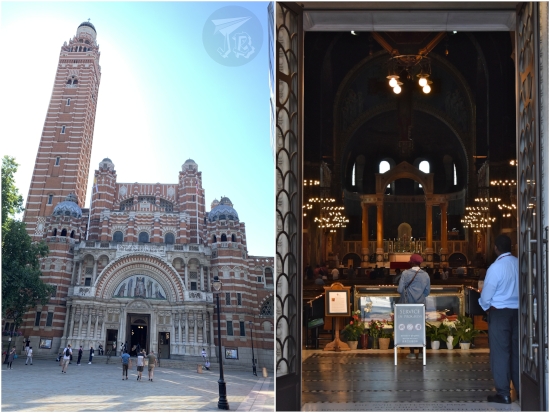
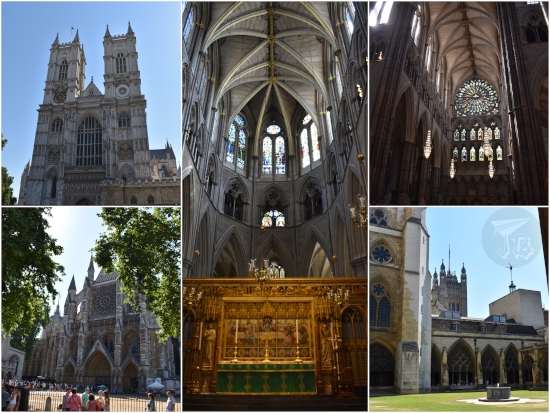
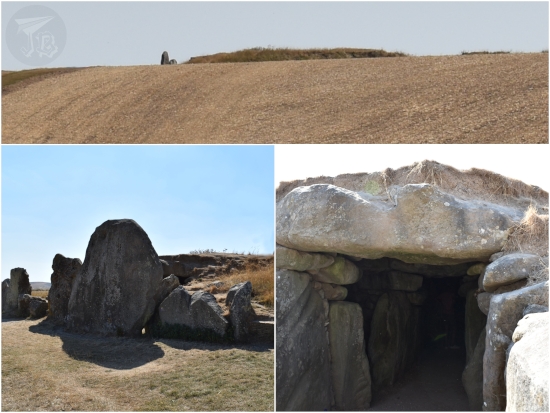
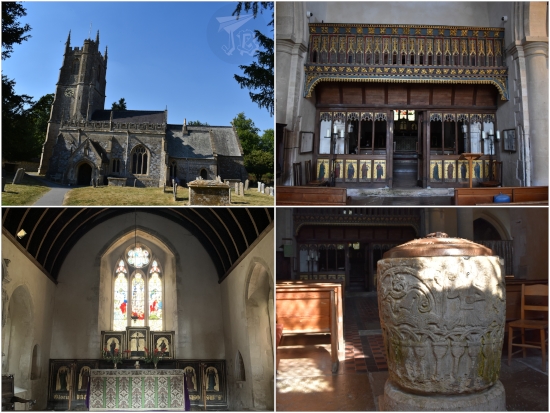
15th & 16th March 2025: Canterbury (England, UK) for “The Shark Is Broken”

I’ve travelled for – or with the excuse of – concerts (take your pick) and documentaries (at least thrice, even twice for the same one), but this was my first time travelling for a theatre play. Don’t get me wrong, I like theatre – I’ve even squeezed Wicked into a London trip a couple of times – but it had never been a main driving force. Until I stumbled upon the information that The Shark is Broken was heading towards the UK and Ireland. There were no shows in London, and my connection to everywhere else – including Dublin – was not good, especially due to work schedules. However, there was one date which was, if not convenient, at least doableCanterbury, in the county of Kent. Unfortunately, neither the Gods of Trains nor the Gods of Buses were as willing to smile upon me as the Gods of Air Travel.

Once I secured a ticket for the play (£55.00, dead centre of the stalls), a hotel in Canterbury, and the plane ride, I checked out what to see in town. This was back in December 2024. I also booked my parking spot at the airport, and since it was so long out, I could reserve Terminal Parking for just a couple of quids more than long-distance parking. That’s an extra 20 minute snooze! However, as I’d been hearing about train disruptions in England, I decided to wait a little before buying the Stansted-London and London-Canterbury trains. And sure enough, when a couple of weeks before the trip I went to check on the trains, the Stansted Express was indeed not running. There were ticket sales, at normal prices, but the trip would be by bus – taking as long as a bus usually takes. Thus, I decided to buy a coach trip at coach prices instead. That added a couple of hours of travel / waiting to the whole journey. Then, I went on to the South Western Rail website, which claimed that purchasing tickets would be easy. My definition of easy is… different, but, I was able to secure tickets. I was supposed to download the app to use them – but the app cannot be downloaded outside the UK. Fortunately, I was able to download a copy of the tickets from the confirmation email and use those.

When the day came, I left home a bit after 3:00 for my 5:45 flight. It was extremely cold, but at least it was not raining. I had some time at the airport before take-off, but of course everything was closed. It felt a bit weird, knowing it was the last time I could fly to the UK “for free”, considering that all countries are implementing the stupid Visa fees everywhere. We landed in London’s Stansted Airport on time, so I made it to the 08:10 coach I had booked – despite the utter chaos that Stansted coach station has become. The nice 40 minutes by train to London Liverpool turned into an over-two-hour coach obstacle course through London’s construction work.

Since I had been forced to buy a bus ticket, I got a direct one to King’s Cross – St Pancras International, where my train to Canterbury was due to depart. I had calculated for a safe train at 10:40, and I reached the stop around 10:05, which gave me enough time to find the nearest Costa Coffee before I went to Platform 13 to board my train. I chose the carriage poorly, as I ended up in the midst of a boisterous hiking group, but the trip was less than an hour, and I reached Canterbury West at 11:34. This was a bit over an hour later than what I had originally hoped for, due to the train-bus adjustment. Looking back, maybe it had not been necessary to buy that ticket in advance.

The city of Canterbury is a Unesco World Heritage Site in the county of Kent, in the south-east of England. The area has been inhabited since the Lower Palaeolithic, through the Iron Age, and Roman times on. The town saw the first Christian conversions in the British Isles, and the foundations of the cathedral were set in 596. Canterbury survived the Viking raids around the year 1000, but it fell into William the Conqueror’s hands in 1066.

In 1170, Archbishop Thomas Becket was murdered in the cathedral, an event which triggered massive pilgrimages from all the Christian countries. Between 1387 and 1400, author Geoffrey Chaucer wrote The Canterbury Tales, one of the key works in English literature, a fictional compendium of stories told by pilgrims towards the cathedral. During the early Middle Ages, Canterbury became one of the most populated towns in England, until the Black Death decimated its people. In the 16th century, there was an influx of French protestants (Huguenots) who fled mainland Europe to resettle, revitalising the economy and introducing the silk-weaving industry that flourished for over a century.

After the 17th century, things changed. Canterbury became an agricultural hub spot, so the Industrial Revolution only affected it with the construction of railways. The historical centre was damaged during WWII bombings, after which the historical area was pedestrianised and a ring road built around it. Today, Canterbury lives off tourism, retail, and higher education, with a large floating population of university students.

And it was cold that weekend. A climate topsy-turvy seemed to have exchanged the Spanish winter anticyclone and the British rains, so it was storming in Spain and crispy in Britain those days. But at least, it was not raining, which allowed for freedom and seeing a lot of things. Upon leaving the station, my first contact with Medieval Canterbury were the Westgate Towers Museum & Viewpoint, the largest Medieval gateway surviving in the UK. It was erected around 1380 to substitute the Roman ones. Even before that, there were other hits like “the oldest brewer in Britain.”

Westgate tower, former gate to the Medieval city

I reached the pedestrian St. Peter Street, which merges into High Street, the town’s spine. My first real stop was the Cathedral and Metropolitical Church of Christ, Canterbury (Canterbury Cathedral for short). The cathedral is the seat of the Archbishop of Canterbury, the symbolic leader of the Anglican church, and the spiritual leader of the Church of England – whose official residence is actually in London though, for some reason. I wanted to get to the cathedral first just in case it closed at any time for a service, and so I did not pay much attention to the main street for the time being.

The cathedral precinct is accessed by the Christchurch Gate, completed around 1520 in the Tudor Gothic style. It features restored colours on the decoration, restored between 2018 and 2022. In the square in front of it stands the Canterbury War Memorial, to honour the victims of WWI, which was damaged during WWII, along with most the historic area, due to bombings.

The cathedral was established in the year 597 after the arrival of St Augustine to Kent. During its first period of existence, it was a Roman Catholic place of worship. The building burnt down and was completely re-erected towards the end of the 11th century, and a lot of construction and reconstruction went on until the end of the 16th century – around the time of the English Reformation, when the Catholic monasteries were disbanded and the cathedral turned Anglican. Most of it has remained in the 12th-century Gothic style, except the crypt, which is Romanesque. The west front – under conservation work – hosts statues of people who are considered influential in the life of the cathedral and the church of England, from Augustine of Canterbury to Kings and Queens including Elisabeth II. During the Roman Catholic period there was a Benedictine Abby attached to the cathedral. Today, only the cloister and the ruins of the infirmary remain from that time.

I bought my ticket and headed to the entrance of the cathedral. There was a trail, and I decided to follow it. That led me to see the West façade, with the statue of the Saints, Kings and Queens, and then down a corridor towards the cloister, which might have been the most beautiful one I’ve ever seen, with gothic arches and family crests painted on them. After the cloister, I found the herb garden and the water tower, and I got to see the ruins of the infirmary.

I went down to the crypt, and then up to the cathedral. The building already looks big from the outside, but the inside feels huge, with columns and pointed arches soaring up to the ceiling, and paned glass windows letting the light in. I first toured the quire (choir), where the Shrine to Thomas Becket used to be. Thomas Becket (Saint Thomas of Canterbury) was King Henry II’s friend and chancellor when he was appointed Archbishop of Canterbury in 1162. He clashed with the King regarding the rights of the crown and the church, and even if the Pope tried to mediate, in the end Becket was murdered in the atrium of the cathedral in December 1170, which propelled him to martyrdom first and sainthood a couple of years later. His body was hidden for decades until he was buried in a shrine under the quire in 1220. The shrine became a pilgrimage destination in the Middle Ages known as The Pilgrims’ Way, from either Winchester or Southwark Cathedral in London. During the Reformation, in 1538, King Henry VIII ordered the destruction of the shrine and Becket’s remains. Today, there is a candle burning where that shrine stood, and the Pilgrimage is still encouraged by the cathedral.
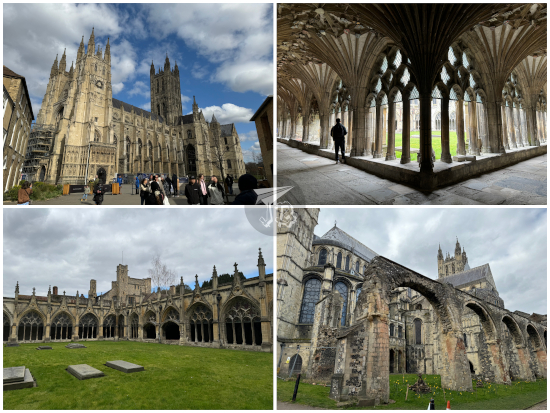
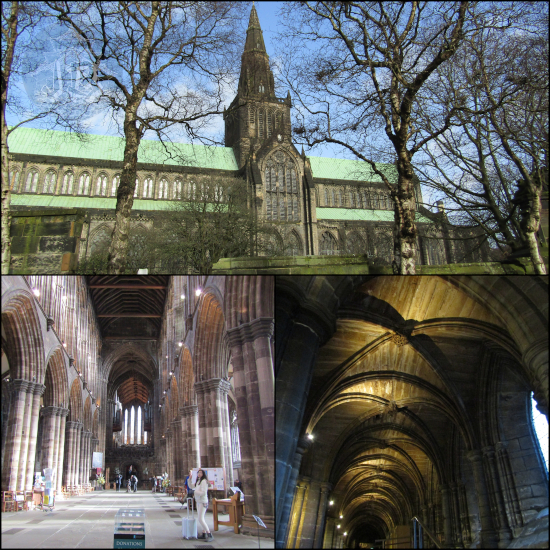
Canterbury cathedral - exterior

Canterbury cathedral - interior

I saw the place of the murder, called the martyrdom, on the way to the main nave, where a concert was being rehearsed. It sounded beautiful, but I could not stay forever, because there were many more things to see in town. Outside the cathedral itself there is a memorial garden and the six-metre sculpture War Horse (named Joey), in honour of all the animals that have died in war.

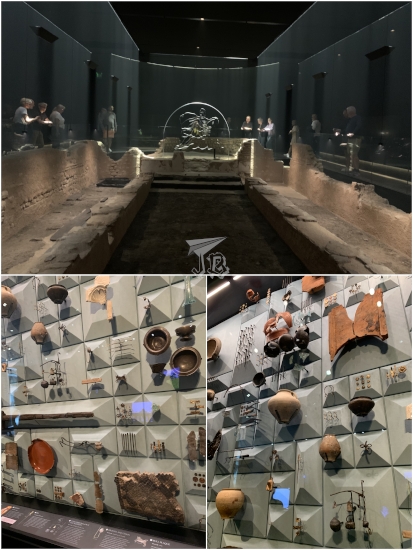
I had to move on, as it was windy and cold out in the open, and I still had more places to visit. I went on towards the Canterbury Roman Museum. The British are always extremely proud of their Roman ruins, though sometimes these are just a few objects. This time, however, the museum lives up to its hype. Even if the artefacts are not that impressive, it hosts the only in-situ Roman pavement mosaic in the UK. Unfortunately, nobody thought about building an overpass viewing platform…

Roman mosaic on the ground

I then headed back towards the main artery of the historical area, High Street and the local museum, The Beaney House of Art & Knowledge, which also doubles as Tourist Information Centre. I broke the worker’s brain when I asked for advice considering that I’d already seen the cathedral and the Roman Museum. What I actually wanted was an estimate of how long the trail around town would take, and confirmation of opening times. I was not too successful as they gave me some schedules which were not accurate. Anyway, I snooped around the place.

The Beaney House of Art & Knowledge was designed by A.H. Campbell in 1897 in the Tudor Revival style. It is named after James George Beaney, a Canterbury-born medical doctor who left money to the city to create a cultural hub. Today, the house hosts the Tourist Information Centre, an art gallery, an auction gallery, the local library, and a museum with collections about different aspects of the town’s history, including a lot of worldwide items that seemed brought by aristocrat’s Grand Tour.

The Beaney House of Art & Knowledge

I decided to do the walking trail around the town then. Now that I was not bee-lining any more, I could take in the statues, houses and buildings in High Street. The statues include Aphra Behn and Geoffrey Chaucer. Behn was a 17th century writer, one of the first English women to earn her living from her art, and possibly even a spy in the colonies and Antwerp. Along the street, I located my hotel, the Great Stour Canal, the theatre and the restaurant where I wanted to have lunch. I exited the centre through the Westgate Towers again, and ended up in the Westgate Gardens. I had started exploring, but then I got dizzy, and my legs shook a little. I had been on the go for almost 12 hours, on four hours of sleep, so it was time for a break. Thus, I backtracked to the Old Weavers Restaurant. I have to admit that I almost got sidetracked to have an authentic afternoon tea, but I had come across this place during my planning, and I was glad I went.

It is true that British food has a horrible reputation around the world. But honestly, it is not that bad – it’s just not such an important social event as it could be for example in Italy or Greece. Furthermore, there is a theory that most “traditional” recipes diluted away with industrialisation, when people worked too much to bother with cooking – the Industrial Revolution was something so new, nobody really knew how to deal with so many changes. Then, WWII food rationing and post war pre-made foods prevented a whole generation from learning how to cook. And thus, Chicken Tika Masala became the staple of English cuisine. In reality, however, this is not accurate. The British gave us scones, bangers n’ mash, roasts and pies, all of which are delicious.

Pies were what grabbed my attention from the Old Weavers Restaurant menu. The eatery is located next to the canal, in a house which dates from the 1500s, with foundations from the 1200s, and the original interior structure. The building was originally a weaving centre in the 16th century by the Huguenot refugees, which then became a weaving school – hence the name. When the school closed, the restaurant was established. moreover, almost all the “nice” restaurants in the area were offering a 15% discount with theatre tickets too.

The place was warm and a hot meal was a nice break to have. I was seated at a small table on the ground floor and ordered a Chicken, ham & leek pie in a hot skilled with a puff pastry lid, and a side of chips. I like British pies. Conversely, the first recipe of British pie on record was also written by Chaucer in 1381.

Pie and chips

Since I was quite literally outside my hotel, I decided to check in so I could drop my backpack and relieve the weight on my shoulders. I was not carrying much at all, but the hours were getting heavier, I guess. The hotel turned out to be an old refurbished house, with narrow stairs, and my room was on the upper floor. It turned out to be tiny, and weirdly distributed – I had to open the bathroom door in order to take off my coat. But it had a working bathroom, a radiator, and it was warm, so I was all right with it. The price was cheaper than anything I would have found in London and it would save me a lot of stress when I left the theatre. While taking the train back to London was doable, it’s not like I felt like one hour on the train, and then a commute in the Tube in the middle of the night.

I left again, and tried to pick up where I had stopped before lunch – this was my mistake. I should have done my walk clockwise, but I thought I had a bit of time. I had not counted on admission ending up an hour beforehand – but it was all right, and my plan ended at a local supermarket to buy snacks, dinner, and something I wanted to bring back with me. Thus, I went to the Westgate Gardens again, and I took a bit of time with the buildings and the ruins there.
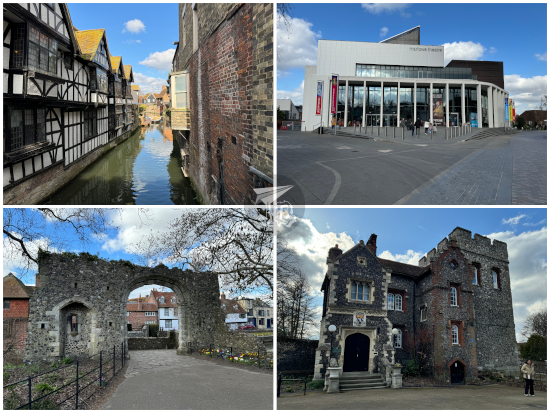
Canterbury - Marlow theatre and Medieval buildings

Canterbury is located on the River Stour, usually known as Great Stour to distinguish it from its tributaries. There are at least three main waterways through town, and even businesses that give boat rides to tourists. The Westgate Gardens are built along the Stour. They host The Guildhall (town hall) and Tower House, a narrow Victorian house built around a bastion of the city walls. I strolled along the riverside, mindful of the mallards and the seagulls who owned the place, until I crossed the Rheims Way Underpass – Canterbury really likes its underpasses, and they’re all right when you get used to them – full of graffiti and contemporary art (graffiti). I eventually veered back towards town, towards an area called Tannery Field and I came across the Canterbury Bull Sculpture, by local artist Steven Portchmouth, an artwork which honours the agricultural and industrial history of the area.

Canterbury Great Stout & Westgate park

I found St. Mildred’s church, an 11th-century stone church with a small graveyard, and totally missed Canterbury Castle for a minute there. I knew it was closed, but it turned out it was completely covered in scaffolding. The castle dates back to 1066, when Canterbury surrendered go William the Conqueror, who proceeded to commission a motte-and-bailey structure, with the motte being what remains today, though underneath the protective scaffolding.

A few minutes away, I got distracted by something which had not been in my plans – Dane John Gardens. Dane John was not a person as I originally thought – the name comes from the corruption of the Norman word for “fortified mound”, donjon, and there is actually a theory that the mound that still stands in the middle of the park is a former defensive motte, though during the Roman times it might have also been a burial mound, on top of which stands the Simmons Memorial – Simmons was the local alderman who built the gardens between 1970 and 1803. The park ends at the reconstructed Roman wall, with rebuilt defensive towers, and it hosts small attractions like fountains, a giant sundial, a Band Stand…

I went along the Canterbury City Walls until I reached ground level again – and then I went underground to cross the wide roads. When I emerged, I finally made my way to St. Augustine’s Abbey. The abbey was originally dedicated to other saints, but it was repurposed after St. Augustine, who had established the cathedral, died. It was a Benedictine monastery from the year 598 on, until the English Reformation forced its dissolution in 1538. Afterwards, it became a royal residence, which was then rented out to noble families. Most of it was eventually dismantled to build new houses, until it was bought in 1844 by a religious Member of Parliament who established a missionary college. During the 20th century, the abbey ruins and the college were separated for classrooms and boarding houses. The British Government took charge of the ruins in 1940, and the abbey is part of the Unesco Heritage Site.
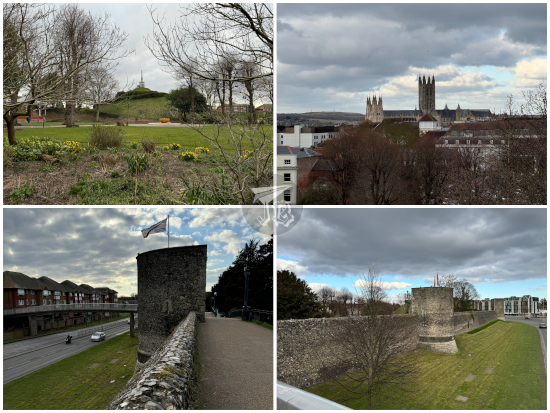
Dane John Gardens and Medieval walls of Canterbury

It was a little past 16:00, and I assume the ticket booth had just closed, though opening times were listed until 17:00 and there were people – a dogs – inside. I first saw the Fyndon Gate, the original gate to the abbey, built in the early 1300s, with two octagonal towers on the side, and a chamber above the entrance arch, which has an overlooking arcade. Though I could not enter the abbey, I was able see to the main ruins through a convenient lookout to the side of the locked-down area.

St Augustine Abbey Canterbury

I saw a signpost regarding the pilgrims’ route that lead me to both Rome and St. Martin’s church. Rome was a little far away to be back on time for the theatre, so I decided to settle for the church, which had been the plan all along anyway, as it was the third key point in the Unesco Heritage Site. The church recognised as the “oldest parish church in use” in the English-speaking world. It was used by Queen Bertha of Kent as her private chapel even before St. Augustine arrived from Rome in 597. Though her husband, Æthelberht of Kent, was originally a Pagan, he allowed her to continue practising her Christian Faith and he himself eventually converted. The building was erected reusing a lot of Roman bricks and tiles, along later stone. It has a small graveyard where many notable families have been laid to rest. The sun was setting, and the wind had calmed down, so it was nice. I did have a moment of slight worry when I glimpsed someone and I heard a bang – I thought maybe they had closed the gate and I would have to jump over the wall. Luckily, it was not.
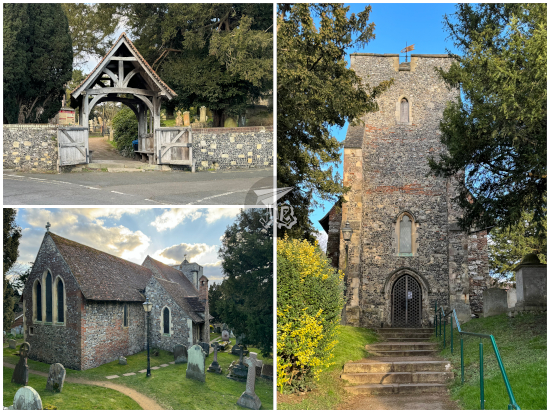
Canterbury St Martin chuch

I headed back towards the centre. In front of the abbey’s Fyndon Gate I found the statues of King Æthelberht and Queen Bertha of Kent. King Æthelberht was eventually considered a saint for his role spreading Christianity among Anglo-Saxons, but his main contributions were more earthly. He created the earliest written Law code in any Germanic Language, and minted the first coins which circulated in Kent.

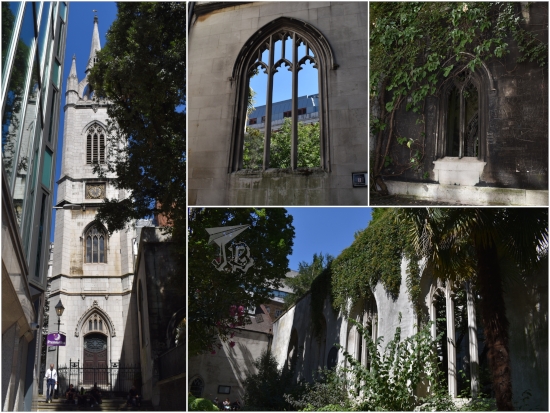
Still heading downtown, I walked by St. Paul’s church without the Walls, which could’ve been built in Roman times as a cemetery chapel. A bit further along, there was the St. Thomas of Canterbury Roman Catholic Church, the only Catholic church in town, built in the late 1800s in the Gothic Revival Style. Adjacent to the church stands the tower Tower of St. Mary Magdalene, which belonged to Medieval parish that was demolished to build St. Thomas. There is a memorial inside the tower, protected by glass.

Back in the High Street, most shops were closed or closing down, and I did not come across any bookshops, where I would have purchased a copy of Chaucer’s The Canterbury Tales just to have a copy from the town. What I did find was a Sainsbury’s Local supermarket. There, I bought a sandwich for a late supper after the theatre, some Cadbury Eggs, and a can of Bisto Gravy granules. Cadbury Eggs are a confection made of chocolate with a yellow-and-white sugary filling. Gravy is a cooking sauce I can’t recreate to save my life so I enjoy having the ready-to-make at hand, it’s just small granules that you dissolve in boiling water to create the sauce. Neither – I reasoned – should be a problem at the airport.

I went back to the hotel to have an hour or so of rest before I headed out to the theatre. Marlowe Theatre was obviously named after one of the most famous Canterbury locals: Christopher Marlowe, the 16th century playwright, poet, translator, alleged spy and reportedly atheist, whose work is reported to have influenced Shakespeare himself. His plays were extremely successful, and they include The Tragedy of Dido, Queen of Carthage, The Tragedy of Jew of Malta, and the first dramatised version of the Faust legend, The Tragical History of the Life and Death of Doctor Faustus. The Marlowe Memorial, depicting The Muse of Poetry (either Calliope or Erato, one guesses).

There have been at least three “Marlowe Theatres” in Canterbury. The current one was rebuilt from a previous one between 2009 and 2011, as a stainless steel and aluminium building with a colonnade, and at night it glows electric blue, pink and purple. It is not a pretty building on the outside, but the inside is all right. It seats 1,200 spectators, it has a bar and a tiny merchandise stall.

Canterbury cathedral and Marlowe Theatre at night

Before I went into the theatre, where I bought the programme, I headed towards the cathedral to take a few pictures the building at night. On the way back, I must have taken a wrong turn somewhere, because I was disoriented for a minute before I found the bluish glow of the theatre. Back in December, when I booked the tickets, I also got “ticket protection” (insurance, basically), but I was ecstatic that I did not need a refund. I had managed to get there, and I could finally enter the theatre. I did not feel even a bit tired, even if I had been on the go for over 16 hours.

The Shark is Broken is a ninety-five-minute play written by Ian Shaw and Joseph Nixon, based on actor’s Robert Shaw’s diary of filming the 1975 film Jaws, directed by a young Steven Spielberg in 1975. It follows three very different men who try to hunt down (fish down?) a great white shark which has found the perfect feeding ground off Amity Island, a small beach community in Long Island. Jaws is often credited as the first summertime blockbuster, and it went on to win three Academy Awards – Best Original Score for John William’s music, Best Film Editing and Best Sound.

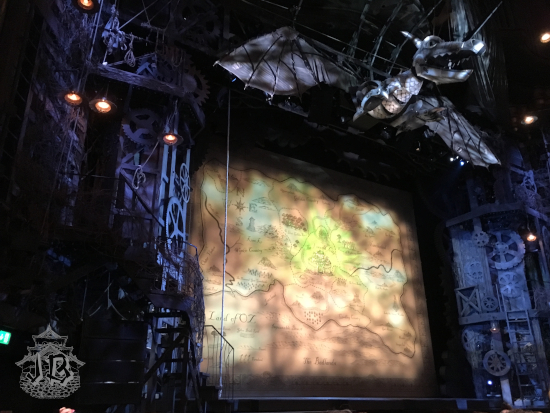
Canterbury Marlowe Theatre - The Shark is Broken

It is a commonplace piece of trivia that working on Jaws was a nightmare for everyone involved, as the mechanical sharks used for filming kept breaking down, which caused delays and going over budget again and again and again. Main actors Roy Scheider (Chief Brody), Robert Shaw (Quint) and Richard Dreyfuss (Hooper) were stuck on the little ship set for days on end while the film crew worked on “Bruce”, the shark. On top of authoring the script, Shaw plays his father. Dan Fredenburgh plays Roy Scheider, and Ashley Margolis plays Richard Dreyfuss. The stage play was originally directed by Guy Masterson in its Broadway run, and Martha Geelan is acting touring director.

The play is a number of connected, sequential scenes depicting different conversations over several days, showing the rising tensions amongst the actors. There are plenty of rather uncensored references to Robert Shaw’s rampant alcoholism, which his son, Ian Shaw, has not tried to hide or dilute. The set is just the ship, and only the three actors are on stage, you only ‘hear’ about the shark off-scene.

Was it a comedy? No. Was it funny at points? Extremely. Did I enjoy it? Immensely. I’ve read reviews saying that it is not worth it unless you are a huge Jaws, which I am. It includes known trivia, obscure facts and several hilarious meta references, including “It’s a thriller, do you think people will be talking about it in 50 years?”, which delivered on the 50th anniversary of the film is hilarious. Another one, referring to how Spielberg bailed on the last day of filming fearing the crowd would dunk him in revenge for all the inconveniences, and his upcoming career, is “Sharks? Aliens? What’s next, dinosaurs?” The scenes were chronological towards the end of filming, until the last one. Another known piece of trivia is that Robert Shaw was extremely drunk trying to do one of his scenes, the so-called “Indianapolis Speech” – and he screwed it up every time until he sobered up and delivered it in one go. The speech is referred to a few times throughout the play, and the very last scene is its re-enactment. It was glorious.

The Marlow Theatre was just a minute away from my hotel, and I could use the back door to get back in. I climbed up to the room and took a shower to warm up. Unfortunately, the bathroom had one of those fixed nozzles and the shower screen was… way too short for it. I might have caused a teeny-tiny flooding – good thing that I had extra towels to contain it. Afterwards, I had my sandwich, and a Cadbury Egg, even if it should have been too late for chocolate. Predator was running on TV, so I watched that while I charged the phone. Finally, I set my alarm and went to sleep, thinking that maybe being able to be on the go for twenty-something hours straight is my superpower.

My train back to London was at 7:24 – I had to miss my breakfast at the hotel, which started at 7:30, but that’s life. Fortunately, there was a kettle with some instant coffee and creamers in the room, along with biscuits. I woke up around 6:15, got ready, and hurried to Canterbury West station not because I was late, but because it was extremely cold. The train was on time and I was back in London St Pancras International just before 8:20. The train ride was uneventful, and once there I crossed over to Kings’ Cross Station to get breakfast from Costa Coffee. Since I was there, I peered over at Harry Potter’s Platform 9⅓, and I discovered that they actually take out the cart when the “attraction” is closed. I knew they charged for pictures, but I did not know that the cart was detachable. Which… I guess makes sense… considering that people would take free pictures with it if it was there. I just thought there would be a screen or something…

Anyway, not my thing. I headed out to explore St Pancras International Station. The original station was constructed in the Gothic Revival style (or Victorian gothic) in the 19th century, opening in 1868. The exterior was made out of dark red bricks, while the interior displays a complex roof in wrought iron and glass. The overall station layout was commissioned to engineers William Henry Barlow and Rowland Mason Ordish, and the adjacent hotel was designed by architect George Gilbert Scott. It is a magnificent building only slightly defiled by the contemporary expansion tracks. St Pancras was all but abandoned around 1960 until the 1990s, with extensive reconstruction, renovation and restoration in the 2000s. In 2007, it became the “international” station as it became terminus for the Eurostar train which covers the route between London and Paris in 2h 16 mins.
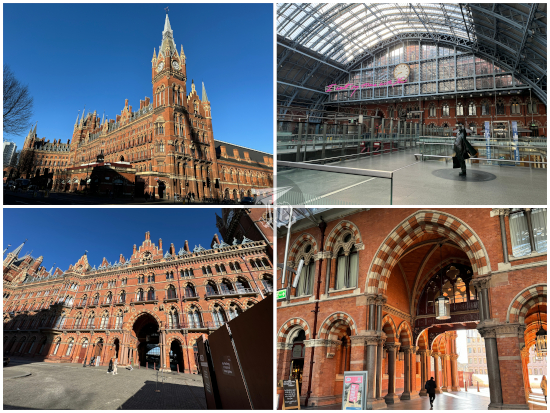
St Pancras international train station

I had to sit down for a few minutes because I made a wrong movement and my back cramped, but it passed soon. I was able to do a little bit of shopping in the station. A lifetime ago, I bought an umbrella in a franchise called Boots, and they had the same style and brand in the shop at the station. Considering that said umbrella served me well between 2012 and 2024, I had decided to buy another one if I ever saw it. I also got a book, because books in the UK are comparatively very cheap.

I found the coach stop, where I had to be at 15 minutes in advance. It was cold and windy, and it felt long. Apparently, the bus before had not come either, so there were a lot of people waiting. However, my ticket and seat were guaranteed. The only problem was, again, that the traffic was horrible due to construction. We took 43 minutes to cover something that should have been done in 10. Despite it all, the coach arrived at London Stansted Airport on time and without issues.

I went straight to security. Stansted is implementing new security protocols, which is great if you don’t get stopped. I got through two times ago, but last time my keyring created a problem – I have since changed that. This time around, the security lady was opening playing-card boxes to check for chemicals (not even kidding) and had to swipe my gravy granules for drugs, or explosives or who-knows-what. When I said “I didn’t even realise that could be a problem” her – rather sheepish – answer was “it isn’t.” Then… why did it get flagged? I’ll never understand airport security.

After 20 minutes waiting at security, I had some sushi at the airport, and bought a Playmobil Royal Guard, because they have always drawn my attention, and I thought that today was the day. Then, it was just waiting. My plane back was at 14:10, landing before 18:00, because I needed to get to a hard week of work on Monday. Part of me wishes I could have stayed until a later flight, but I needed to be reasonable. I did not get emergency exit seats either flight, so there was no issue with the cabin crew. However, when I tried to get my car out of the parking lot, the plate-recognition system would not work, so I had go down all the way back to find a person to talk to – good thing, then, that my plane had not arrived at 23:00.

The truth is, everything would have been more efficient had the Stansted Express been running, but at least I waited to book tickets so I could make the most out of the commuting issues. I did not pay train prices for coach transit, and I did not have to wait much between transportation choices. Furthermore, I could fill the time I had with things to do – and stuff to buy. And the most important thing, I saw The Shark is Broken, along with getting to know a new city.
17th June 2024: Horniman Museum and Gardens {London, England, June 2024}

I woke up early-ish and got ready to leave. I stopped by the local supermarket to grab a coffee and got on my way towards the closest Overground station – this being London, it was not far. This was an easy commute since there were no changes, and I could just relax on the train. I got off on Forest Hill and walked up the… well, the aforementioned hill, until I reached the Horniman Museum and Gardens, in the Borough of Lewisham around 9:00 – passing a Costa Coffee on the way. I filed this information for later reference.

Normally, I would not have gone to a museum which had a Natural History Gallery closed for renovations, but they were running a dinosaur exhibit that created the perfect excuse to go there, even if it was a bit out of the way. Frederick Horniman was the heir to his family’s tea emporium in the 19th century. He started travelling the world around 1860, collecting artefacts from his travels, and developed the museum to exhibit them. The original museum opened in 1890, and the gardens in 1895.

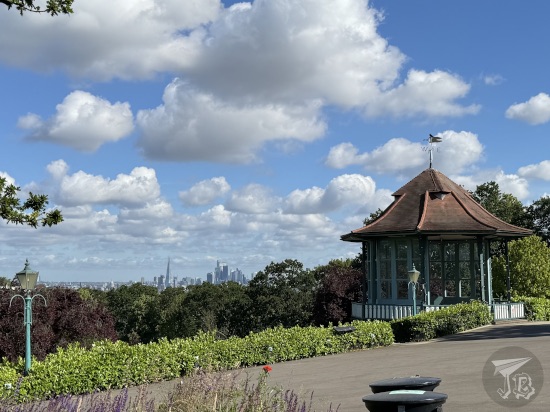
The gardens are almost 6.5 hectares (16 acres), divided in different areas, including a bee garden, a sound garden where you can make music with metal tubes, a grassland garden, a prehistoric garden, a grassland garden… I wandered around a little and was surprised to catch a glimpse of City of London by the 1903 bandstand. I knew the gardens were a bit far out, but I had not realised how much.

Horniman Gardens with the City in the background

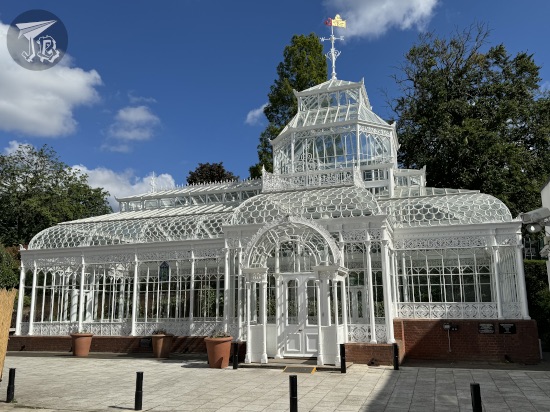
I explored for about an hour, then I headed towards the Victorian Conservatory, built in 1894 in Horniman’s private residence. A century later, it was transported to the gardens and restored by British Heritage. It is a quaint little greenhouse in white iron and glass, with pressed tiles on the floor. Next to it stands a little café that I would have stayed at if I had not wanted to see some of the themed flowerbeds.

The Horniman Conservatory

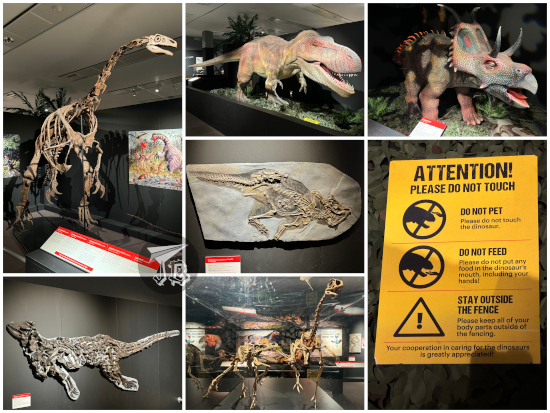
At 10:00, when the museum opened, I entered to see the exhibition Dinosaur rEvolution, which looked at the evolution of Dinosauria into birds. The travelling exhibition has five animatronics, a couple dozen cast fossils, several plushies and beautiful palaeoart. The T-Rex animatronic had some feathers, and the information notice asked the reader if they would find the Jurassic Park tyrannosaur less scary with them. I honestly would find a feathered Rexy even more terrifying. The exhibition was all right, with plenty of information, but there was nothing real, which was a bit of a bummer. But since it is a travelling exhibition, it makes sense they would not be moving around the real thing. However, given the ticket price, I expected something a bit larger.

Dinosaur revolution

After I was done, I decided to check out the rest of the museum. First, I saw the anthropological galleries, which had the most bizarre array of artefacts – from an Egyptian mummy to a Spanish inquisition chair, along Inuit costumes, European masks, African religious items, Indian masks, Easter eggs, prehistoric items from all around the UK… There was a wish tree, where you can write something on a colourful paper and hang it from the branches.

Horniman athropology museum

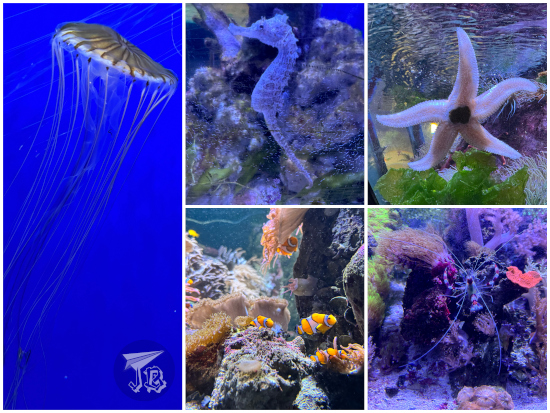
In the basement of the museum there is a small aquarium, which was full of schoolchildren on a day trip. I could have got the tickets online for that. However, I did not know how big the dinosaur exhibition would be, and I did not want to rush over. When I seemed to have the time, I decided to go down to the aquarium. It had a handful of tanks – jellyfish, coral reefs, Amazon rainforests, a lot of clownfish and a handful of poisonous frogs, mostly colourful stuff to grab attention. I managed not to get run over by the kids, which was a good thing.

Horniman Aquarium

After I had seen the aquarium, I considered checking out the Butterfly House, because those are always beautiful. However, since I knew I’d want to go back to the museum and gardens in a couple of years, when the natural history gallery reopens, I decided to head towards the train station. I would see the butterflies another time. That way I could be on my way to the airport with some buffer time without rushing my way through and stressed over connection. Instead, I checked the museum’s tea gallery, which summarised the history of tea and how it ties with colonialism, not pulling any punches towards the Horniman tea emporium itself. Funnily enough, the tea brand still exists in some Mediterranean and South American countries, but not in the UK.

On my way back to the station, I stopped at the Costa Coffee I had seen before for a drink and a snack. Unfortunately, the nice barista forgot to put the vanilla syrup into my vanilla latte – oh, the drama. Since the coffee was hot, I did not really notice until I was already on the Overground, and turning around was not worth it.

I had to change at Whitechapel into Hammersmith & City, but since I had the extra time, I decided to walk a little and go down into the Elizabeth Line, which, believe it or not, I had never used before. The commute time was the same anyway. The platforms felt so new and clean, lacking the grit that other stations have – not that they are dirty, really. They’re just… not that new or aseptic.

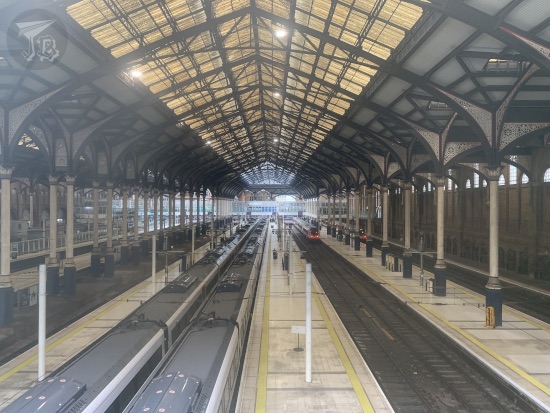
Even with the little detour, I reached Liverpool Street with time to take an earlier train than I had originally given myself as ideal – which is a couple of trains earlier than the one I would need to be right on time, but since that time the train just did not reach the airport, I’ve lost some faith in the Stansted Express. I went to the end of the platform, and sat down in the first carriage of the train. I was the only person there, even after the conductor announced that “the first carriage was almost empty, please move forward for comfort so the rear of the train is less crowded.” Happy to be an “almost”, I guess – and good that the carriage did not become anything close to full during the trip.

There were no issues reaching the airport, but security was crazy. I don’t think I’ve ever seen as many queues, and so long ever. When my backpack was flagged for secondary inspection I understood why – the person in front of me was told he was carrying “too many contact lenses”, and my tiny handcuffs key chain was apparently extremely threatening. Then they needed to check aaaall the electronics, and my boots. However, the security guard said that he was sorry and that I should not have been pulled over because of the key chain. I’ve never had a security officer apologise to me for pulling me over for secondary inspection – and honestly, that was the key chain I bought for my first apartment… in 2001? I’ve flown with it before countless of times… Hilarious…

I put on my boots, and headed off to buy some sushi at the Stansted Itsu. Sadly, the quiet area has stopped being so – they have closed the upstairs toilets and now they send everyone downstairs, so it was packed with holidaymakers and people hyping up toddlers, which I find a horrid mistake to make just before jumping on a plane. Thus, I drank my miso soup, ate my sushi, and buggered off to wander the airport – better than the cacophony of kiddos running, squealing and acting up. The airport was full, and while I am usually better at dealing with other travellers, I had been looking forward to the “quiet area”. Either that or I was a bit tired and everyone was rubbing me off the wrong way, I guess.

When it was time to board, queue went extremely slowly. The airline line personnel were being extremely picky with the luggage, measuring every backpack and trolley. Eventually, the slow process made departure late, so the end of the queue was rushed. They barely eyed my backpack, though I was asked to turn around to show it to the check-in agent.

The plane was full and way too many people were not aware of “boarding from the rear door” when their seat number was high, causing a bit of a jam. I found my seat, huddled in, and shut off for a while. I woke up with 40 minutes to land. When we did, we took a bus which conveniently left us right in front of passport control. The only problem on arrival? It was 31 ºC and sunny, and I was wearing clothes chosen for the 13 ºC and rain in London. I guess the order of digits is… important when you’re wearing longs sleeves, layers, and knee-high boots – which by the way I think have seen their last concert trip. RIP. You will be missed, cool concert boots.

16th June 2024: Southwark, the National Gallery and Kamijo at The Garage {London, England, June 2024}

According to the weather forecast, there was a chance of rain in London in the morning. When I got up and drew the curtains open, it was actually pouring, so I decided to wait the rain out. When I left the hotel around 9:00 to head to the queue, there was still a bit of drizzle which cleared as I was walking. However, when I reached the venue, I was surprised to find a notice on the door “We reserve the right to refuse entry. Anyone queueing before 16:00 will be refused entry.” Ho-kay, that sign had not been there the evening before – or I would have planned accordingly. I shrugged it off and resolved to make the most out of the morning and early afternoon, and be back at 16:00 sharp. I mean, what else could I do, mope at the hotel?

I took the Underground to the London Bridge stop, in Southwark. The first thing I came across was Borough Market, which had never even been in my radar before – I tend to stay on the other bank of the Thames. The market is an Art Decó building designed by Henry Rose in 1851. As a business, it had been in operation for centuries at the time though, and the building would get many refurbishments in the following years. Borough Market claims to be place for sustainable products with a short supply chain. There were wholesalers, coffee brewers, tapas bars and for some reason a bunch of guys yelling that everyone should try their mushroom risotto. The area was packed, and it was almost impossible to get a good picture.

Borough Market

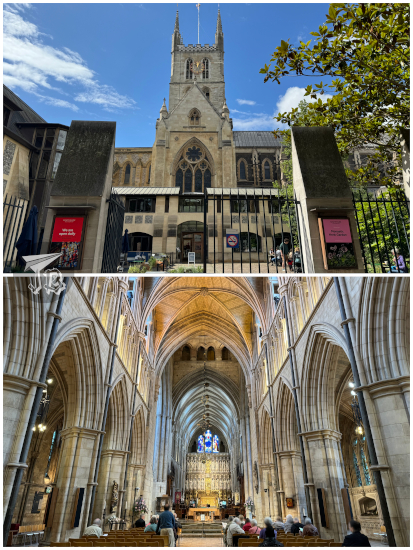
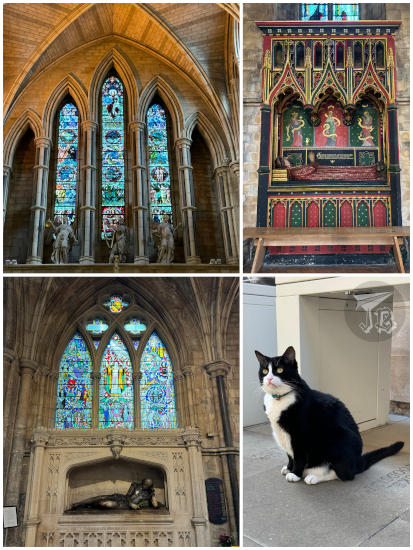
Next to the market, stands Southwark Cathedral, officially Cathedral and Collegiate Church of St Saviour and St Mary Overie. London has four cathedrals: St. Paul and Southwark are Anglican, and Westminster and St. George are Catholic. Southwark Cathedral has stood in place for at least a thousand years. However, there is a legend that places its foundation in the early 600s, and there is archaeological evidence of a Roman road dating even further in time. The current structure is gothic, erected after the previous building was damaged in an area-wide fire in 1212, then transformed with the passing centuries. In the 19th century it was “remedievalised”, and in the 20th it became damaged by the Blitz and requited restoration. Today, it prides itself in being LGTB-friendly and having a resident cat, Hodge. It is also common that a fox, nicknamed Richard, visits the garden. Not sure either keeps the cathedral mouse- or rat-free, or they are too full with treats from the congregation.

Southwark cathedral - outside and nave

Southwark Cathedral details

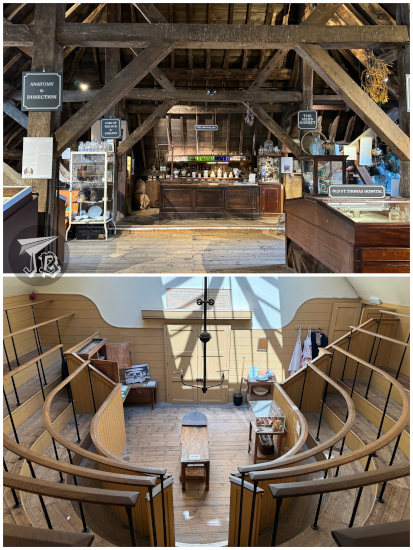
After the cathedral, I headed to the actual reason I was in Southwark, The Old Operating Theatre Museum and Herb Garret. The museum is located in the attic of a former church – in other to access it, you have to climb up a spiral staircase with 52 steps, up the bell tower. The church was attached to a medieval hospital, in whose attic (or garret) the apothecaries dried medicinal herbs and stored medicines. In 1822, this garret became an operating theatre, with a huge skylight built in order to let light in – we are talking about a time when surgery was performed without anaesthetics, painkillers or antibiotics. The hospital was abandoned some 40 years later, and the theatre was lost to time, until it was rediscovered in 1952 – it is considered the oldest surviving operating theatre in Europe.

The museum has a small collection of pathology specimens, a bigger one of nightmarish medical tools, and a reconstruction of an apothecary shop, with a counter and a lot of herbs, and informative panels. Funnily enough, it also runs through the history of medicine, and the great London epidemics using… rubber duckies. Not collecting rubber duckies is becoming more and more difficult… Anyway, these particular rubber duckies have been painted and modelled over, and next to them there is a list of symptoms. From those, you need to diagnose the duckie with “silent killers of the past” – measles, tuberculosis, cholera…

The duckies were a good comic relief of sorts from the pathology collection and specimens, the pre-science artefacts, and the history underlying at the theatre itself. The theatre had several rows of stands where people watched / learnt from the operation while the patients were awake – allowing the procedures to be public was the only way poor people had access to medical treatment and the good surgeons. Honestly, the idea of surgery is scary enough, but just thinking about amputation without anaesthetics makes me shiver. Especially when you see what was used for it – basically a handsaw – with spectators.

The Old Operating Theatre and apothecary

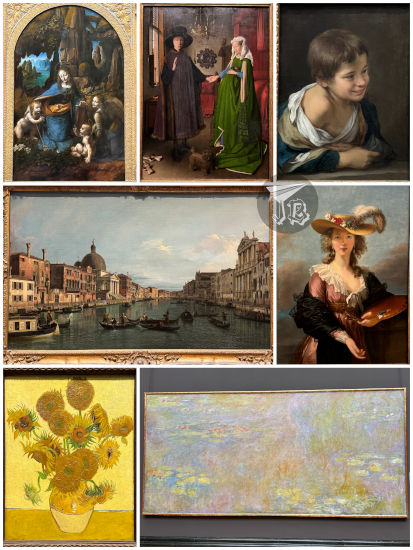
It was still early afternoon, so I hopped onto the Underground towards Charing Cross and Trafalgar Square. I had not seen The National Gallery London since I was a child, and I remembered next to nothing of it, so I wanted to revisit it. The National Gallery, in the City of Westminster borough, dates back from 1824, when the government bought 38 paintings from a private collector – and it has been continuously expanding since then. The current building was designed by William Wilkings in 1832, and opened in 1838. the collection comprises over 2,000 paintings by 750 artists, among them Giotto, Leonardo da Vinci, Dürer, Michelangelo, Raphael, Tintoretto, Veronesse, El Greco, Caravaggio, Velázquez, van Dyck, Rembrandt, Vermeer, Canaletto, Goya, Constable, Delacroix, Degas, Monet, van Gogh…

Here’s the fun thing, I always thought I liked the impressionists, but it turns out that seeing Monet’s Water Lilies myself was rather underwhelming. Conversely, I found myself enjoying British landscapers a lot, especially Constable. I spent a few hours in here, looking for the masterpieces, but a lot of them were on loan to other sites.

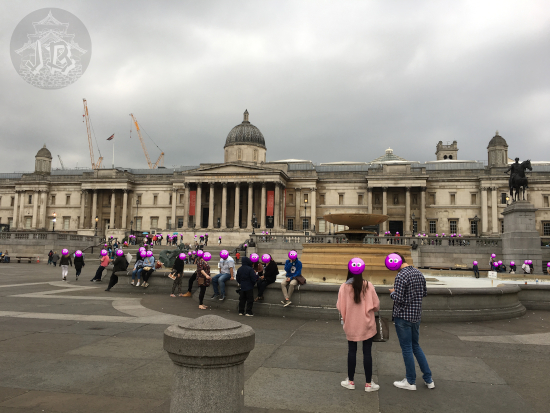
National Gallery London

At one point I was taking a photograph and a gentleman thought he was on my way. When I reassured him he was not bothering me, he said something akin to “That’s because you’re a professional”. I wonder, a professional what? I was not carrying a camera or anything, just the phone…

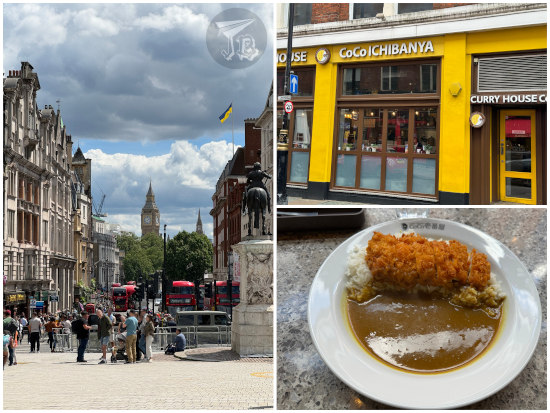
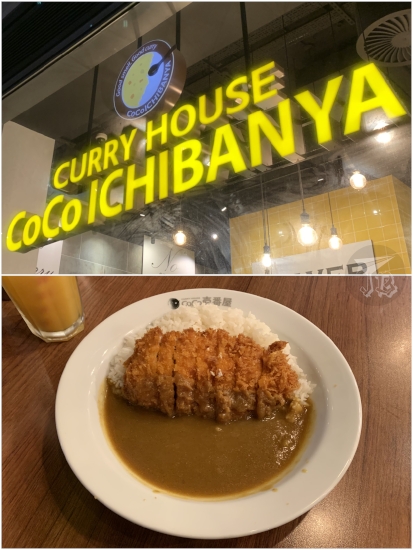
I did a run throughout the whole gallery, and I was considering staying at the café for a bite, but… I was rather close to Leicester Square… so I thought I could walk there and check if I could have lunch at Coco Curry or somewhere in Chinatown. The line at Coco was rather short – surprisingly, since the Chinatown Coco is always pretty full. Thus, I decided to wait it out and have lunch there – after all, it is the “iconic” one, and the previous time I had only visited the Bond Street shop. I’m not sure when Coco became the feeling of a taste of Japan, but it is one of my favourite food places.

Coco Curry Leicester Square

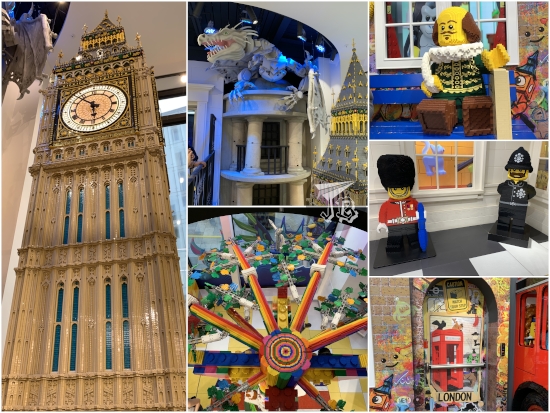
I had a bit of extra time. Not much for exploring, too long to just stay at the restaurant. I wandered Chinatown a little, and then got to Leicester Square. I’ve been to the Lego store, and the M&Ms place, but there is also a tea boutique, the TWG Tea Shop which I had never stepped into. I did it this time, and I was really tempted by a few of the green teas in pretty tins. I however talked myself out of buying any, since it would be silly to take them to the concert, and if a water bottle is a hazard, I cannot imagine what would be thought of a metal box.

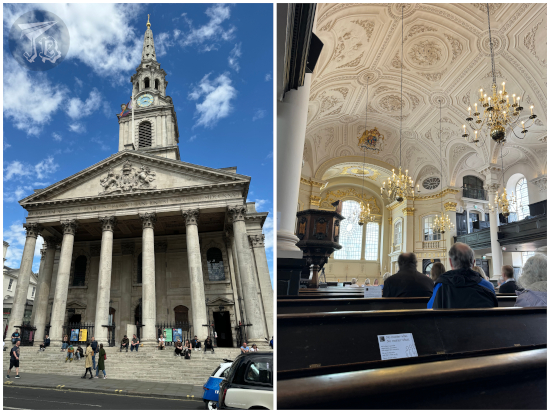
Instead, I headed back to Trafalgar Square and stepped into the church Saint Martin-in-the-Fields. This ancient church was rebuilt in the 1720s by James Gibbs – though it was originally “in the fields”, in the outskirts, by this time it was already part of the city. It is a simple rectangular nave with Corinthian columns and a vaulted ceiling. The church holds choir concerts every Sunday afternoon, and I sat there listening to the music for a bit. I then I headed off to Charing Cross to take the underground towards the venue and the surprise of my life.

The church of St Martin in the Fields

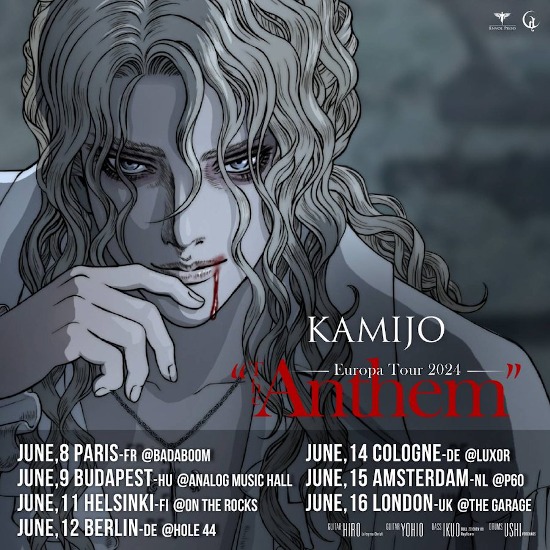
I arrived at The Garage for Kamijo’s Europa Tour 2024 “The Anthem” at 16:00 sharp thinking the queue would be assembling, but no. Apparently there was some “secret parallel queue” going on somewhere – there were between 40 and 50 people there already, so I only got the 18th place due to my type of ticket. I was a bit disappointed, but oh well, what can you do? Nothing any more, so I did not dwell on it. The promoter had actually sent a schedule in advance, saying that doors would be at 19:00 for the VVIPs and showtime at 20:30. Of course, it would not be followed, but it was good having an approximate timetable.

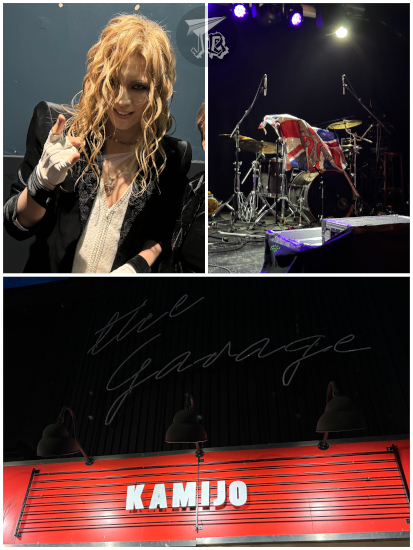
Queuing was okay, not extremely long since we actually went in around 18:30. There was a lady organising the line and giving out the numbers, and the venue staff were willing to go along that, so even if there was a “secondary queue”, there were no issues that I know of. The venue was a bit weird. There were a couple of stairs and a small hall before the actual concert hall. In that tiny hall, all painted black and stuck between the two fire doors, and under horrible lighting, stood Kamijo and his dazzling smile, ready for the meet and greets and pictures for the VVIPs and handshakes for the VIPs.

Kamijo The Anthem poster

I walked in, he gave me a warm smile, and said ‘bonjour’. I smiled back. I don’t know whether I’m getting old, or that sitting on the floor with Yoshiki was a game changer for my brain. And despite the fact that I’ve been neglecting my Japanese, I was able to convey my message. He was adorable. I said something like “There is no ‘I’ve missed you’ in Japanese, but it’s really been a long time.” A staff took our picture, he said thank you again, I said thank you back, then walked into the venue. I received my signed poster – a grey A4 signed in black. Apparently, gold or silver markers were out of the budget…

The barrier was almost completely full, but I was able to squeeze on the left, amongst the people I had queued with, closer to the centre of the stage than I had even hoped. Truth is that Kamijo tends to go to the right more often than to the left than the right, but since he holds his microphone with the left hand, you don’t see his face, so I was happy with my place. However, the hour and a half until concert started felt pretty long, since I was quite squeezed in. Maybe I should have sat, I don’t know. The concert started around 20:00, and it was no pictures of videos allowed.

The supporting musicians were Hiro on guitar – Hiro was also the guitar in La’cryma Christi, one of the most important V-kei bands in the 90s. Also on guitar came Yohio, a Swedish artist who managed to break into the Japanese scene a few years back – he actually got a lot of hate at the beginning, so good that he received some love. On bass came Ikuo (Bykk Zeichen 88, Rayflower), and on drums Ushi (Vorchaos). I’m not sure who the sound tech was, but he or she deserves to be yelled at – for about the first third of the concert Kamijo’s microphone was powerless, to the point that his voices was inaudible at times. There were a few songs I did not know (or was unable to identify due to the noise), amongst them the song that gives the tour its name: The Anthem.

Sound was so bad that at times I could not hear what Kamijo was saying, much less understand it. However, he sang two of my favourite songs, Moulin Rouge and Eye of Providence, and I was lucky enough that he repeated my favourite line twice. Despite my being amused by his idealisation of Napoleon, there is a line in Sang I (it took me stupidly long to realise that sang is French for ‘blood’) that resonates a lot with me: ‘Just like flying with the wind: no pain, only gain’. He started the song and interrupted himself halfway to make the musicians greet the audience in English. He either forgot he was going to do an emcee, or since he said it was his favourite song, he wanted to sing it twice.

He had fun, and unlike other times I’ve seen him, he indulged in a lot of “fan service” with the musicians, which sent the crowd screaming. Aside from the sound issue, there was one other hiccup during the concert. At one point Kamijo tripped over a wire, stumbled and ended up almost sitting down on the drums, but he did not fall, which was good.

Setlist:
  1. 闇夜のライオン (Yamiyo no lion)
  2. Conspiracy
emcee, with Kamijo saying he was glad to be back in London, and inviting the audience to go to Paris with him.
  3. Moulin Rouge
  4. The Anthem
  5. Louis 〜艶血のラヴィアンローズ〜 (Louis ~Enketsu no la vie en rose)
  6. 運命 (Unmei)
  7. Eye of Providence
  8. Habsburg
  9. mademoiselle
  10. CRIMSON FAMILY
  11. Castrato
  12. Beautiful Rock’n Roll
  13. 薔薇は美しく散る (Bara wa Utsukushiku Chiru; song by Lareine, Kamijo’s first band)
  14. Sang I & emcee, where the musicians said what the tour had meant for them
  15. Sang II
  16. Nosferatu
emcee
  17. Avec toi〜君と共に〜
  18. NOBLESS OBLIGE part 1
  19. Throne
  20. NOBLESS OBLIGE part 2
  21. Vampire Rock Star

During the emcees Kamijo said that he was glad to be back to Europe / the UK, and that he was especially happy to be in London. He talked about how great the tour had been, and how amazing an audience we were – though he tells that to everyone anyway. All in all, I had a lot of fun, enjoyed myself, clapped during mademoiselle and even jumped (once, I’m not that crazy) during Vampire Rockstar. Whenever his musicians or himself sing / yell the chorus, the words ‘vampire rockstar’ come out as ‘vampire lobster’. This time, he made the audience yell them all, so considering this was London, it sounded correctly for once.

Snippets pre and post Kamijo's The Anthem concert

After the concert, which lasted a bit over two hours, I bought a sandwich at the open-late supermarket next to The Garage, and headed to the hotel for a shower and sleep. I kind of… forgot to go to bed though. God, I love concert highs, as short as they are. It is always hard to come back to reality, but there was still half a day before that.

15th June 2024: The Old Naval College, and a mishap {London, England, June 2024}

I am getting weirdly used to 5:00 wake-up calls. I drove to the airport and arrived at the long-stay parking lot just before 6:00, with the exact time to catch the bus at the nearest stop. I might be getting too comfortable with timings – either that, or the flights have started taking off a bit later, because I remember having to leave by 3:45 for the first Ryanair flight a few years back. Anyway, security was nice and smooth, but passport control was maddeningly slow – the shiny brand-new machines the airport has spent a fortune on were not working, and there were only two agents, and three flights leaving around the same time.

We left on time and landed on time too, and since works at London Stansted have been finished, I was fast out of immigration. I considered going to the hotel first thing in the morning in order to make sure the credit card went through – and have time to find an exchange office if it did not. When I was able to buy my usual breakfast in the Costa at the arrival area without an issue, I decided I should be all right. Thus, I just headed off towards the centre, reached Liverpool Street station, and transferred to the TfL system. I got a bit confused at the DLR. London’s railway is divided in the Underground, the Overground and the Docklands Light Railway or DLR, which are mostly automatic trains which involve more transfers than I had expected. I needed to backtrack a station or two before I got to my final destination, the area know as Isle of Dogs in the borough of Tower Hamlets. I’ve recently found out that there is a footpath under River Thames which connects the Isle of Dogs with Greenwich. The footpath, the Greenwich foot tunnel, was built from 1899 onwards, and it opened in 1902. You can literally walk from one bank of the Thames to the other in just a few minutes!

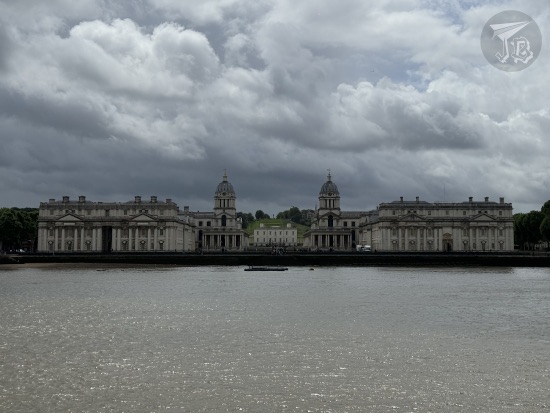
Old Royal Naval College from across River Thames

The tunnel was damaged during World War II, and there is a section which is held together by an inner steel lining. The whole tunnel is lit and either painted or tiled in white, so it does not give off any kind of claustrophobic feeling. Something cool that happened to me was that I could actually feel the water running above me, similarly to how I feel when I’m standing on a bridge and look at the river underneath. That was unexpected. Though there are lifts – the original ones were installed in 1904, but there are new ones from 2012 – I took the stairs.

Greenwich foot tunnel

I stepped out of the tunnel and into Greenwich, next to the Cutty Sark. I have already visited the museum inside the ship. This time around, I was going to try to see the Old Royal Naval College, which has been closed whenever I’ve tried to see it – they film rather often there. This time it was actually open to visitors.

The Old Royal Naval College, today part of the Maritime Greenwich UNESCO World Heritage Site, was originally designed as a veteran home and hospital. The current iteration of the building was designed by Christopher Wren – also responsible for St Paul’s Cathedral. The complex has two complexes or courts, Queen Mary Court on the left from the river, King William Court on the right. William III (reigned 1689 – 1702) and Mary II (reigned 1689 – 1694) were offered the throne as joint monarchs when their predecessor James VII and II was declared unfit because he became a Catholic. The building served as hospital and hospice until 1869; later, in 1873 it became a training academy for the Royal Nay until 1998.

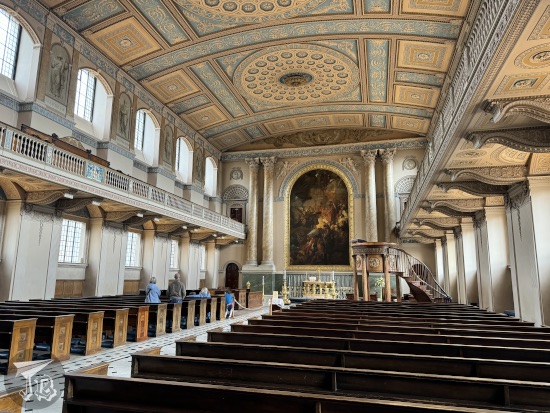
I first went into the Chapel of St Peter & St Paul in Queen Mary Court. It was reconstructed after a fire by James ‘Athenian’ Stuart in the neoclassical style. It has one nave, and a wood ceiling decorated with naval themes. The altar piece was painted by Benjamin West. I found the chapel quite beautiful, it gave off a warm feeling. The security personnel were also very nice.

Old Royal Naval College chapel

Then, I headed off to King William Court, to the pièce de résistance of the building. The Painted Hall is a huge ward decorated with Baroque paintings by Sir James Thornhill. The ceiling and walls are painted to honour the kings and queens who gave their patronage to the “Royal Hospital for Seamen at Greenwich”, depicting them surrounded by mythological and allegoric figures. The art was impressive, and the volunteer who explained it was a former teacher who made the whole tour really informative. While I usually avoid guided visits as much as I can, I found the painting too complex to interpret on my own.

Old Royal Naval College - Painted hall

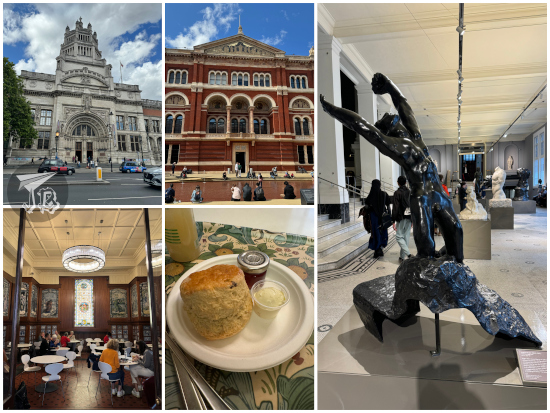
I backtracked through the Greenwich foot tunnel and took the Underground towards the Victoria & Albert Museum. Last time I was over they were running an exhibition I wanted to see… only this time around they had moved to another of their sites. I shrugged it off and decided to have a scone instead – any scone. I mention this because the couple before me wanted two particular scones from the basket. Afterwards, I went to see a gallery within the museum which I missed in 2023, which turned out to have bronze sculptures by French artist Auguste Rodin, considered the initiator of modern sculpture.

Snapshots at the V&A museum

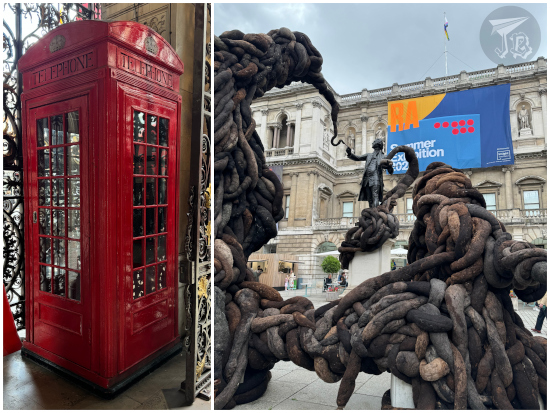
After that, I hopped back onto the Underground and headed off towards the Royal Academy of Arts, located in Burlington House. I was… surprised, to say the least, about the current display in the courtyard, but I was there to see oldest surviving red telephone box – Sir Giles Gilbert-Scott’s original prototype “K2” kiosk, made in wood in 1924.

Burlington house

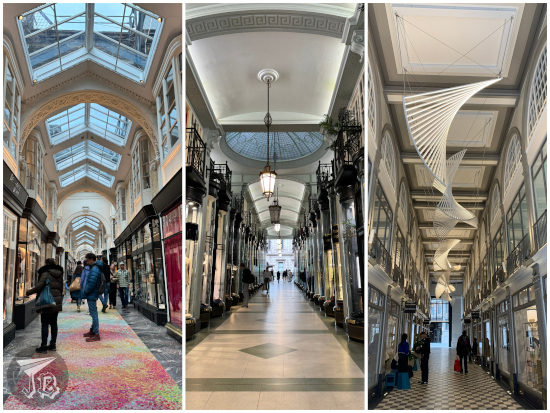
I then snooped around three of the high-class shopping centres along the Oxford Street area, all of them out of my price range, of course – Burlington Arcade, Piccadilly Arcade and Quadrant Arcade. I walked past Piccadilly Circus and Leicester Square, and headed off to Forbidden Planet to check out if they by any chance had a copy of a comic I’ve been looking for (Alligator Loki, if you ever find it, give me a shout?). I did not find the comic but I did see some stuff by Stjepan Šejić in the wild.

High-end London shopping arcades

Finally, I headed off towards the hotel / venue area, I found the venue – just outside the station. I bought some snacks for dinner and breakfast, then headed off to get to my hotel. The credit card thankfully went through and I got my room. I spent the rest of the evening watching films and snacking on salt and vinegar crisps. Truth be told, the weather was not that nice, but most of the rain happened when I was inside the buildings in the Old Royal Navy College. It’s been a long time since I was in London and there was not a heat wave, so I am not going to complain.

15th – 17th June 2024: London for Kamijo’s “The Anthem” {London, England, June 2024}

I first saw Kamijo in Barcelona in 2018. The reason for that was that tickets came through around my birthday and neither them nor the upgrades were expensive, it was easy to get there, and I thought I would support a V-kei artist in the country. I was not expecting to like him as much as I did – it probably had to do with the brief interaction we had when he “sang” to me. The next year, I joined the fanclub and attended two shows of the Persona Grata Japan tour with a fanclub ticket. Then Covid struck and I just let membership lapse, because there was little disposable income and even less chances to make anything out of it.

At the end of 2023, Kamijo announced a new Europe tour, and I weighed out France or England. I decided on London due to easier language, worry about the Olympics creating issues – price gauging, controllers’ strikes – and because the French fandom can be too intense for me. In February, I rejoined the fanclub with a cheaper “four-month web membership” so I was able to access the pre-sales on the 19th. I managed to buy a “VVIP” ticket, which included first priority entrance, a meet & greet, a solo photo and a signed poster for 152 €.

I checked for planes and accommodation. Flights were okay, but hotels were stupidly expensive. In the end, I could not find anything reasonable in my usual areas, so I decided to just book two nights at the closest hotel I found near the venue. It was still stupidly expensive, but I thought it would be convenient. When I had time, I checked for stuff to do, bought a few tickets, and just a couple of days before leaving, I had a credit-card scare. Because what would a trip be without a hiccup? But I needed a mental break, and this long weekend was it…

Thus, I was off to London.

12th – 14th October 2023: Yoshiki Classical World Tour “REQUIEM”, London (England, Great Britain)

This was my third and last trip to London in these five crazy weeks, and it was again to see Yoshiki. Someone once told me that I love Yoshiki because he appeals to both my wild and posh sides – it is partially true, I guess. It has a lot to do with how many of his lyrics resonate with me, more deeply than I am comfortable admitting sometimes.

I don’t think I would have travelled twice so close in time for any other artist. And believe me, organising this trip was a logistics nightmare. In other circumstances I would have flown out the same day of the event, which was Friday the 13th, but I don’t think that airports in the UK have completely recovered from the Covid chaos, and there are still a bunch of issues – just the previous week to my arrival, a good number of flights were cancelled in Gatwick. Second, the 12th is a holiday where I live, and since it was a Thursday, it kickstarted a long weekend. And last but not least, the 12th is also my parent’s birthday, and they were excited for a big celebratory lunch.

Taking all this into account, I tried to coordinate everything the best I could without breaking the bank. I found the last plane leaving on Thursday the 12th, at 21:50. That gave me time to have lunch at my parents’, then drive off past 19:00 – there should not be too much traffic. I booked the parking lot – the shuttle runs every 15 minutes in the evenings. In the worst case scenario, if my flight was cancelled or too delayed, there was space to manoeuvre on Friday morning. The plane was scheduled to arrive in London Gatwick close to midnight, but I was quite sure it would be delayed, and in order to avoid late-night trains and stress, I reserved a hotel next to the airport terminal – I did not have to worry about dinner as my parents make food to feed a small army. For the following night, I found a “boutique hotel” next to the venue. I booked my return flight on Saturday the 14th in order to avoid the end-of-weekend traffic that would concentrate on Sunday.

Great plan. In the end, something happened and the celebration had to be postponed, so I spent the evening watching the clock, and checking and rechecking both the weather forecast and my luggage – finding something to wear that was nice and still weather-appropriate was difficult. I changed my mind regarding footwear about six times.

Around 19:00 on the 12th, I finally drove to the airport. Considering that the forecast was rain both at home and at London, I took boots in the end, but more comfy shoes for driving. I reached the parking lot and airport a bit earlier than expected, and I found a nice covered spot for the car – which I had to check that it was not reserved a few times. As I entered the international terminal, I was disoriented for a second – since I usually take planes before 7:00, I had not seen the shops open for a long time! It turns out there is a Duty Free just after passport control which I had not even realised before, and that threw me off track for a heartbeat or two.

I had some dinner at one of the fast food stands, and as expected, the plane was delayed. Then it needed an engineer. Then it taxied forever. And after almost two hours of delay, the two-hour-and-a-bit flight to Gatwick was cut short – we landed not even ten minutes late, so we flew the route in a little over an hour. I never knew you could step on it so bad on a plane! I went through passport control and found my hotel – just outside the North Terminal, and much closer than I had calculated. Gatwick was also crazy busy even if it was nearly midnight.

I checked in, and I was surprised that even though it was the same chain I had stayed at next to the O2 Academy Islington, the procedure was completely different. But it went without a hitch, and I was in bed within thirty minutes. I even caught some sleep. For some reason they gave me a room with a sofa-bed aside the regular one.

Leaving in the morning was a bit more complicated. After a much-needed caffeine boost at Costa Coffee, I took the inner airport shuttle from the North to the South Terminal, where the train station is. From there, I found my connection to central London. The good thing is that Gatwick trains belong to a regular line, so they do not require a special ticket, you can use the Oyster card, which I did. The shuttle and train went through awful weather, but when I reached London, rain and wind had calmed down a little. I wanted to leave my things at the hotel because of the bad weather and not to go into any museums with the backpack – just in case. The nice person doing my check in was very stressed that I might want my room – it was before 10:00 for a 15:00 hour check-in. I really just wanted them to hold my luggage. After that was successful, my next step was finding a bank that would exchange a handful of old pounds for new ones. In the end, train, underground, hotel and bank took a bit longer than I had expected and I was running a bit behind my self-imposed schedule.

My first stop was Sir John Soane’s Museum. Sir John Soane was a neoclassical architect – he worked in the remodelling of the Palace of Westminster, but his most prominent legacy is his house-museum. He bought a couple of attached houses in the centre of London, and combined them both as an architecture experiment and to host his collection of antiquities, copies, paintings, and pieces of architectural interest. There was a special Act of Parliament to establish the museum while Soane was still alive, stating that after his death the houses should be kept as they were, to avoid his son selling the collection, as some of pieces were / are worth a fortune. For reference, one of the most important artefacts hosted there is the sarcophagus of Egyptian Pharaoh Seti I (Second Dynasty). Adventurer Giovanni Battista Belzoni tried to sell the piece to the British Museum after taking it from the Valley of the Kings in Thebes. The Museum was not willing to pay what today would equate to almost £200,000, but Soane bought it in 1817 to exhibit it in the basement “sepulchral chamber”, where it still stands today.

Entry to the museum is free, but you are requested to purchase the guide for £3, which I did. The first area you visit is the lovely library, and then you step into the real treasure – the area comprised by “the dome”, “the colonnade” and “the corridors”, where literally hundreds of sculptures, friezes, amphorae, decorative pieces… pile up on one another to the point that everything is overwhelming and fantastically chaotic. Wherever you look, there is something else to notice – whether it is Apollo, a copy of the Farnese Hercules, a pegasus… Then you go down to the basement, and both the “catacombs” and the “sepulchral chamber” are equally cluttered – a pair of Chinese guardian lion-dogs, Aphrodite bathing, a Poseidon head, and of course Seti I’s alabaster sarcophagus, encased in glass, which sucks for pictures but protects it in the super-tight space.

Artefacts at Sir Soane Museum

Sarcophagus of Seti I in Sir Soane Museum

Other spaces include the kitchen – which feels strangely empty in comparison– the drawing rooms on the first floor, and the picture room on the ground floor – with some of Canaletto’s Venetian landscapes, and drawings of ancient monuments. All in all, whenever you blinked, you missed a detail. It was almost stressful, but an amazing place to visit.

Afterwards, I met up with fellow Yoshiki fans A****d and A**i, at the British Museum. They were going there first thing, and we had arranged to get together around noon, but I ran a bit late and only reached them around 12:20. Through that time, they went through the must-dos. We met at the Ancient Middle East and saw a few exhibits about the history of money, one on clocks, Roman Britain, the library… They asked me if there was anything I recommended, and we went past the Moai so I could show them one of my favourite sculptures ever – the Bodhisattva Guanyin [觀音 in Chinese], associated with compassion, in the Chinese Art Gallery. Guanyin sits with one leg up in a very relaxed and informal position compared to other Buddhist imagery, and I just adore this wooden representation.

Artefacts in the British Museum

Around 14:00, we went out for lunch. We tried an okonomiyaki place near the British Museum, but it was unfortunately full, and both my friends had had CoCo Curry the previous night. We walked into Chinatown and we found a self-proclaimed izakaya Japanese restaurant called Oita (Soho). I ordered sushi bento for £16.95, which at first felt a bit expensive, but I had forgotten British-sized servings. It was actually very proportionate size-wise, and came with complimentary miso soup. The bento (“boxed lunch”) itself comprised a small salad, seven pieces of assorted raw fish on sushi rice (tuna, salmon, butterfish, mackerel, squid, prawn and octopus – these last two were no raw, actually), four assorted nigiri (tuna, salmon, butterfish, mackerel), three salmon sashimi, two tuna sashimi, three avocado hosomaki, and some garnishing including cucumber, radish and alfalfa, along with pickled ginger and wasabi. It was really good.

Oita Soho sushi bento

The three of us separated after lunch to go to our hotels and get ready. On my way, I bought a sandwich and a bottle of water from a supermarket to have for the night, and decided to take a shower before changing into concert gear. When I reached my hotel, they showed me around, and told me my luggage was in the room – which it was not. I had to come down again to get it, which embarrassed the staff a lot. The room was posh to the max – I even had a bed with a canopy! Apparently, boutique hotels are “small hotels with a personality” that try to “tailor the experience to the customer”. For me, a hotel is just a place to sleep in, so I’m just happy with them being safe and clean. I can do without the personality, the steeper price, and the surprise extra service charge.

I reserved the hotel through Booking, and they got in touch that they wanted payment outside the page. I dislike this, but it is not unheard from. I needed to demand my payment receipt, too, because the page did not generate any. Later, they tried to charge me through Booking again (though in their “defence” this might have been a Booking issue, as it has been hacked). In the end, the image I got from them was that of an overpriced wannabe high-end hotel, but there were too many blunders to consider coming back if I can help it.

At least, the hotel fulfilled the one reason I had chosen it – it was a short walk from the Royal Albert Hall. Considering how badly I felt after the Miyavi concert a couple of weeks before, I was a bit apprehensive this was going to be too much. It was, but not in the worse sense of the word. The recital was emotionally hard on me, as I tend to connect a bit too much with Yoshiki’s music, but fortunately I did not take ill this time around.

I was deeply moved when I attended the first Yoshiki Classical concert in Paris in 2014, but this time my mind was absolutely blown. Back in May, in a moment of fanby weakness, I decided to buy RAH membership (£55) in order to get access to the presale. Despite that, I only managed a sixth-row seat to the side – Arena F – Row 6, Seat 27 (£60). These were sent by post and arrived in physical form in late July. I decided on this delivery method because even if the tickets did not arrive on time, or got lost, I still had the option of “will call” with my ID and the card used for purchase (of course, my bank decided to cancel my cards meanwhile and get me new ones, so I’ve been running around with both working and not-working cards in my wallet for the last couple of months).

Having a RAH account also meant that I was notified about a “Yoshiki meet and greet VIP package” within minutes of its release, which included an exclusive opportunity to meet Yoshiki after the concert in the 1871 Bar, a photo opportunity with Yoshiki, and a piece of merchandise for signing (£150) – I booked it as soon as the email came through, and I think I was the 10th person to buy the upgrade. These tickets were supposed to arrive by post, too, but the venue changed them to e-tickets the week before the show – when I was already antsy about them arriving – “will call” was still an option, but I was restless.

Around 18:15 I left the hotel to walk to the venue to meet A****d and A**i. The Royal Albert Hall is one of the most famous concert venues in the United Kingdom. It was world’s first domed amphitheatre, designed by two civil engineers, Francis Fowke and Henry Y.D. Scott, and inaugurated by Queen Victoria in 1871. The outer structure is built in Fareham Red brick with a mosaic frieze that represents the arts and sciences, and the roof is a glass and wrought-iron dome. It has several halls and a corridor surrounding the amphitheatre, with several bars and other hospitality offerings.

The three of us walked around and found the merch stand, which was a bit underwhelming – two short-sleeve T-shirt models, and a tote bag. I kind of regret not getting the tote now, but I felt I had already spent too much money. A****d was sitting next to me, and A**i just a couple of rows behind. However, upon being shown to the amphitheatre when doors opened around 18:45 for the 19:30 concert, my brain shortcut. Rows 1 to 5 were inexistent. My row 6 ticket was a first row ticket. I was first row for a Yoshiki concert!

Fine, to the side and with some camera equipment in between, but I was first row for a Yoshiki concert. In particular, for Yoshiki’s Yoshiki Classical 10th Anniversary World Tour with Orchestra 2023 “REQUIEM” on the 13th of October 2023.

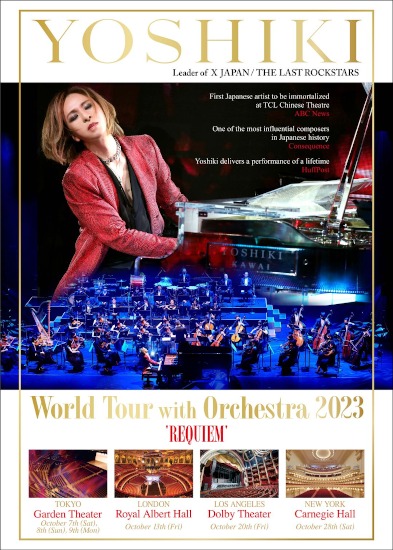
Yoshiki Requiem Poster 2023

Most seats had a small booklet, and since mine did not, I decided to “steal” it from a still-empty seat – I’m selfish, sue me. Once my brain settled down enough to take everything in, there were two things I noticed – one, that the grand piano in the centre of the stage was not Yoshiki’s trademark glass piano, and two, that his drum set was there. This was not a huge surprise as he had hinted it during the Q&A in September that he wanted to do something with it. We passed the time looking at people come in, being impressed at how fancy some people dressed, meeting other friends, and taking photographs in front of the stage.

Inside the Royal Albert Hall

The concert / recital was intense. Most of the music played had been composed by Yoshiki himself either for his different collaborations or for X Japan. Vocals were entrusted to pop singer Beverly [ビバリー] and soprano Ai Ichihara [市原 愛]. Special guests St.Vincent and Ellie Goulding sang their own songs. The Royal Philharmonic Concert Orchestra was conducted by Ward Stare. Ballet dancers from Jlee Productions performed on stage during Forever Love and Swan Lake..

Setlist:

Part 1
   1. Amethyst (orchestra alone)
   2. Tears
   3. Angel
   4. Miracle with Ai Ichihara
   5. Forever Love
   6. Kiss the Sky with Beverly
   7. Anniversary
Part 2:
   8. Drum improvisation while the orchestra played Serenade for Strings (by Pyotr Ilyich Tchaikovsky) and Symphony No. 3 (by Henryk Gorecki) and Ai Ichihara on vocals
   9. Say anything
   10. Swan Lake (by Pyotr Ilyich Tchaikovsky)
   11. New York by and with St.Vincent
   12. Love me like you do by and with Ellie Goulding
   13. Red Swan with Beverly
   14. Requiem
   15. Without you
   16. OPUS 13 in A-minor (by Felix Mendelssohn)
   17. Art of Life (second and third movements)
   18. Endless Rain

Although the auditorium opened later than it was supposed to, the concert started almost punctual, a bit past 19:30 – which for Yoshiki is a miracle of ontimeness. He had probably done all his interviews the month before. Director Ward Stare came on stage and the orchestra played Amethyst as warm-up – this is the song that was usually heard at the start X Japan’s concerts, before members came in. Yoshiki walked on stage to play piano from the second song on, Tears. The tour title Requiem comes from the song Yoshiki wrote to honour his mother after she passed – he was understandably devastated, and it made sense to start the show with Tears.

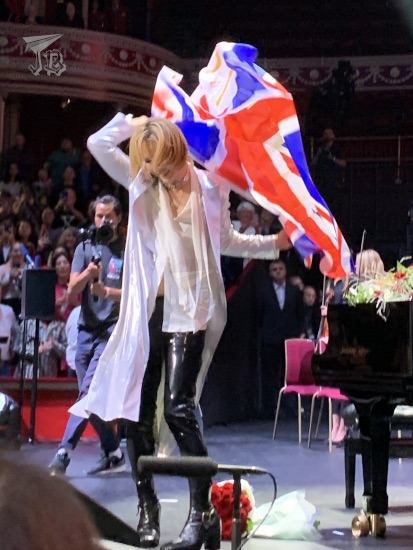
Yoshiki playing piano at Royal Albert Hall

Throughout the concert, he alternated piano-playing and talking – most of the talks we had heard before, but a few were new to me. He told us that when he felt that he had managed a great achievement his mother used to bring him back to earth with questions like “have you eaten?” or “did you sleep?”. He explained that she really praised him when he composed Anniversary for former Emperor Akihito. We also had some promotion of the Under the Sky film, and Yoshiki’s champagne line, along with a recap of him being honoured in LA’s Chinese Theatre. There was also some “thank you to my sponsors” talk, and he might have said “amazing” around a thousand and three times.

The first part went more or less as expected – except for the ballet dancers. I did not think we would get them, but I am not going to complain. I did miss Hero, because I really enjoy listening to that one live, but something had to be taken out to accommodate the songs by the special guests. Some people say that he talks too much, but I think that he’s just trying to catch a breather – both physical and emotional. At one point he spoke about an “X Japan song that we would never really hear”, which was heartbreaking. There is a difference between knowing that there won’t ever be any X Japan ever again, and having it confirmed. Both in September and now, we’ve heard him openly say things that usually went only implied, which I think means that we are in a new stage of his artistic career / life.

Yoshiki Royal Albert Hall with orchestra and ballet dancers

For the second act, he pushed himself even harder with a drum solo to start off. He always smashes the drums as if he were trying to get a confession out of them – it is like he has so much anger inside him and the drums are his only way to release it. In a way, it probably is – he always says that he turned to drumming to deal with his father’s suicide, and that is how he expresses himself. But then he goes back to the piano, and it feels that the keys are crying with him.

The acts with St.Vincent and Ellie Goulding, in my opinion, were more promotional than anything else. Both are well-known and established in their own niches – and Yoshiki likes female singing voices because they can hit high notes better, I think – though I miss Katie Fitzgerald and Ashley Knight, to be honest. St.Vincent was okay, Ellie Goulding left me wondering… what she was doing there. Apparently the pinnacle of her career until now has been composing Love me like you do for the film Fifty shades of grey… And I hate to be that person, but both of them could have chosen way better outfits.

The titular song, Requiem, was extremely poignant. It was the piece Yoshiki wrote to deal with his feelings for his dead mother, in his own words, the means he found to stop crying for her loss. Just like he took to drumming after his father’s death, he took to composing after his mother passed. Later, he explained again how the song Red Swan symbolises standing up through the pain and the blood. The original version of this song is sung by vocalist Hyde, and since he was bringing in people from all around the globe, I would have been extremely happy if he had flown him in for it, and I was hopeful for about one tenth of a heartbeat. Unfortunately, you cannot have everything.

Throughout the recital there were sad moments and happy moments, to thank fans, and to remember those who are gone, moments with ballet dancers and with the torch on the phone on, moments to sing and to laugh, and to feel your heart shrink. In the end, Endless Rain with all the audience was extremely special – it never feels that it is going to be, I keep thinking “this time it’s not going to affect me this much”, but it gets me every time.

Yoshiki talking at the Royal Albert Hall

In the end, the show lasted for about three hours, plus a twenty-minute intermission. He thanked the conductor, the orchestra and dancers and the guests, and received lots of flower bouquets. Next to me, A****d managed to give him a Union Jack with a small EU flag sewn into it, which he proudly wore around his shoulders. It’s fun how he is such a huge super star and then he becomes all shy and embarrassed. Or he just… crashes.

Yoshiki with the Union Jack flag, Royal Albert Hall

After the concert was over, we said goodbye to A**i and, A****d and I made our way to the 1871 Bar, where the Post Show Meet & Greet Experience was to take place. We went to one of the doors, but of course then we needed to go to the other one. Eventually we got in, and rather quickly – I was the 20th person in the queue, and got to wait inside the bar. It was upholstered in blue, turquoise and green tones, with the most garish decoration I’ve seen in my life, including mirrors, golden wallpaper, bright plastic deer heads (better than real ones but still gaudy), lava lamps… There were about… four or five sofas, and the whole floor was carpeted in reddish and green / grey tones.

I was a bit nervous – waiting to meet an artist is actually the worst moment of queueing, I feel. To be honest, the first time I saw Yoshiki in person in 2017, my brain went 404 on me and I was not able to utter a word, though in Vienna I did a bit better and got a selfie. I was shaking so badly it came out horrible and moved.

As we were waiting, a staff member came to tell us that we could talk to Yoshiki a little, and that they would take our pictures with him and email the link to us. He explained that Yoshiki had just played a three-hour show and that he was bound to be tired – and how amazing he was. We smirked that we knew that already – most of us were not local, after all. Meanwhile, lights were set up, and signed posters brought out.

Yoshiki arriving for the M&G in the 1871 Bar at the Royal Albert Hall

Once he came in, we clapped and then everything went very fast and very slow at the same time. Everyone got to talk to him a little indeed, ask for an autograph or give him a present. Some people conjure amazing gifts for artists, but I never bring anything for them, because I feel it’s imposing and they don’t need any junk I could get them. However, I was clutching my bad selfie print-out, running through my head what to say. It was finally my turn, and then something I could have never prepared for happened – he declared that he was tired and just sat down on the floor. Not one of sofas. Yoshiki, superstar, just plopped down on the garish carpet of the bar at the Royal Albert Hall.

I have no idea how or why but my brain kicked into gear at that point. Before the staff could react in any way, I asked Yoshiki if it was all right to sit down on the carpet with him – I really did not know if he wanted to have his picture taken on the floor. I’m not sure if the staff and the aides knew what to do, but when he said it was all right, I approached and sat – A****d had stayed behind and was able to document the whole thing, apparently I sat in the proper traditional Japanese way for the conversation.

I thanked him for his music, and told him how his lyrics helped me feel better after a bad situation. Then I asked him to sign the “horrible selfie” – I actually said this – from Vienna. He thanked me for coming back, and I said “no, thank you for coming back”. The whole thing was absolutely surreal. There we were, sitting on the carpet of the Royal Albert Hall, surrounded by dumbfounded staff and… sofas. Photographer Andy Paradise took our picture, and what I saw when I looked at the camera was the photographer crouching, the video-camera person kneeling, someone else also crouching down, and a fourth person coming in with a chair (despite… sofas). I said thank you again, and dragged myself away – the guy whose turn it was behind me also sat down on the floor.

A****d and I got our signed posters, while I clutched to my now autographed bad Vienna selfie, and left the venue. Some people asked questions on the way out, and we explained how it went. When we came out, it was cold, so damn cold. My hotel was a block over, so I asked reception to order a taxi for A****d, and we parted ways, hoping to see each other soon.

I went up to my room to take my third shower of the day, and have my snack. I was so overwhelmed, it was hard to sleep. It was also stupidly cold because unbeknownst to me, I had not closed the window well, and there was an open crack. I burrowed under the bed covers, a towel and a bathrobe, and got some rest.

The next morning, I made myself a hot instant coffee to start off the day, but it did not do much to get my blood pressure up. I vacated the room around 9:00 after asking the hotel to keep my luggage – but considering what had happened the previous day, I made sure I had all the important things with me. I had a nice plan for the day, but I decided to discard it last minute because underground disruptions had escalated – it was not worth it to get stressed due to commuting issues having alternative things to do. Seeing the first red phone cabin will have to wait for another time.

It was still extremely cold when I stepped out. First, I went to see the Albert Memorial in Kensington Gardens, and I crossed to Hyde Park. I also found the Monument to Livingstone. I went around the Royal Albert Hall, and a bit before 10:00, I joined the queue to enter the Victoria and Albert Museum. Whenever I am in Kensington, I always get distracted by the Natural History Museum, so I had forfeited the V&A for a while now. Today was the day to finally explore it.

The Albert Memorial

Royal Albert Hall from the outside

Founded in 1852, the V&A is one of the largest museums in the world – it’s actually the largest museum of applied arts, decorative arts and design. It covers 51,000 square metres, with 145 galleries and almost three million individual items in its permanent collection. It is a chaotic museum, and yet, it makes sense. The museum is organised by “themes” such as Buddhism, England Middle Ages, metalwork, porcelain, glass, Baroque sculpture… I tried to see things in some kind of logical order, but it was pretty much impossible. Apparently they tried to rearrange it a while back and they just… gave up, as it would diffuse expert knowledge. I found this very interesting, but since this was my plan B, I did not really have time to plan the visit very thoroughly.

Before diving into the galleries, I headed over to the museum café for a gigantic tea-infused scone with jam and proper clotted cream, and a mug of coffee, and sat down at the Gamble Room. When it opened in 1868, it was the first museum café in the world. It is decorated with tiles imitating the Italian Renaissance majolica tiles, columns, golden ceilings, and weirdly modern lamps. After breakfast, I felt a bit more grounded, though I felt a bit off all day.

Scone and coffee at the Gambler Room in the V&A museum

I roamed around the museum for a few hours, and I know that I missed some important areas. I found it difficult to keep track of where I was and where I wanted to go, but I got a bit of a taste of all. I was very impressed by the Cast Courts, where copies of some of the most iconic pieces of architecture and sculpture are kept. These were made in the 19th century, and represent “the truest spirit of the Victorian museum.”

Artefacts at the Victoria and Albert Museum

On the ground floor, I wandered the Korea, Japan, China and Buddhism galleries, and I came across another depiction of Bodhisattva Guanyin, in the same pose but a completely different artistic style. I saw the largest Middle East and Islamic Art collection in Europe, and the adjacent galleries –South Asia (especially India) and South East Asia had a lot of interesting artefacts, too. The sculpture galleries are tantalising.

Other areas I visited included Medieval and Renaissance, Britain though history, ironwork, metalware, gold, silver, ceramics, glassware, jewellery, stained glass, architecture, and I could have gone on and on. But alas, I had a plane to catch.

Artefacts at the Victoria and Albert Museum

Victoria & Albert Museum

Around 13:00, I left the museum, collected my luggage, and made my way to South Kensington Station amidst the Tube closures of the lines that would take me directly to Victoria. A while back, I had to take a similar alternative route from Earl’s Court due to the wires overheating when I was going to the Apollo Victoria Theatre to watch Wicked. The South Kensington station runs the same Tube lines, so I was able to reach Victoria railroad station at the desired time – even with a line change and more than double stops. I was off towards Gatwick airport on the expected train.

Once there, I went through security without a hitch. I had a snack in the most expensive and unfriendly Wagamama in history – give me Stansted’s Itsu anytime. I wanted something warm because my body gets weird after emotional highs, and I was freezing. I even wondered if I was taking ill again, but no. I was just cold. I did not let either the restaurant nor the chill spoil my mood though, and I might even have had a nap on the plane. By the time I got off, I had warmed up. I cleared passport control, found my shuttle to the parking lot and – aside from the inevitable idiot on the road – there was not even that much traffic, which is good. You know the routine – shower, snack, bed.

I was not ill in the end, just stupidly exhausted. Going back to normal was quite difficult, especially as I still had Sunday free. I did not ever dare look at my phone to see if the photographs were real. A few days later, on the 18th, we received the email with the meet & greet professional photos. I look ridiculously happy, sitting on the carpet ,with a sofa behind me, with who is probably my favourite artist. I feel a bit guilty that I burdened him with my problems – I really hope he forgot quickly. Nevertheless, I am mostly glad that I was able to take these three crazy trips to London without incident. I feel extremely lucky that all three of them worked out, if not flawlessly, without any huge mishap. There is actually another Yoshiki event announced for December, but as much as I would love to go, it is just not in the budget, and I am a bit sad about that. But then I think “I sat with Yoshiki on the carpet of the Royal Albert Hall” and smile.

3rd October 2023: Highgate Cemetery {Miyavi in London 2023}

I own up to my love for older cemeteries, in particular Victorian ones. After stumbling across Brompton Cemetery for the first time, I learnt about London’s Magnificent Seven. These are seven cemeteries “within a crow’s flight of Saint Paul’s cathedral” (9 km), all established privately in the 19th century. During the 1800s, London was the largest city in the world. Its population increased from one million to 2.3 million throughout the century – more living, more dead.

Several problems arose. There were too many burials in the churchyards within the city limits, and decaying matter contaminated water supplies, which in turn led to severe epidemics. Furthermore, a culture of grave-robbing had been established – for clothes, jewellery and the bodies themselves, to be sold to anatomy students and professors. And lastly, British visitors to Paris became impressed by Cimetière du Père-Lachaise – they would not be less than the French.

And thus, as many as eight new cemeteries were established in the outskirts of London. The seven left today – most in use – are called The Magnificent Seven. They became private endeavours, competing against each other to sell plots where people would build their graves. During Victorian times, “pretty” graves were their way of marketing, as it was usual to just go walk in cemeteries – so they had to look “inviting”. Hanging around cemeteries was a very socially-accepted past time due to all the romantic influence.

Though not the first to open, the most famous of these private ventures is probably Highgate Cemetery. Designed by architect Stephen Geary, it was dedicated (basically, opened) in 1839, and it became quite popular – with eye-catching sculpture, architecture, trees, shrubbery, wildflowers… It was not to everybody’s tastes, of course – writer H.G. Wells (who, with permission of Jules Verne, is considered “the father of science fiction”), despised the “cheap urns and obelisks” overpopulation there. The cemetery was abandoned in the 1970s when the company that owned it went bankrupt, and in 1981 the charity Friends of Highgate Cemetery Trust acquired ownership. The cemetery is divided in two areas – the West cemetery is the older one, built uphill; the East cemetery is the newer one.

Admission is required, unless you have a “grave pass” or are attending a funeral. I had a ticket for a guided tour at 10:30, since after how huge and overwhelming Père-Lachaise felt, I had decided that the difference between plain admission and a tour was not that steep.

I got up around 8:00, still feeling a bit queasy, and headed for Costa Coffee for a vanilla latte and a cookie, which I finished on my way to the underground. After figuring out the Tube changes – the Northern line bifurcates and comes together a few times – I arrived at Archway, and walked the rest of the way. I reached the cemetery gates just before opening time at 10:00 (I had planned to be there at 9:45, so not bad), and a nice lady took my name and gave me my paper ticket. I had booked the Highlights Tour, which takes you around the West Side of the cemetery, but allows you to do a “self-guided tour” at will through both sides.

I used my first 30 minutes to wander around the East Side, I visited the grave of Douglas Adams, a writer to whom ball pens are offered, and philosopher Karl Marx. The East Side is more modern and thus a few contemporary “celebrities” are interred there.

Highgate Cemetery Eastside views

Then I headed off towards the West Side, the most Victorian area. The guide was actually pretty lovely, but the actual “highlights” side of the tour was a bit too swallow for my taste – more anecdotal than anything else. The guide took us to see several “pretty” or unusual graves, but the information was mostly about the people buried there, and not the art. Thus, I feel that we did not get a real taste of the actual Victorian cemetery. The most interesting area in Highgate West Side is the Egyptian Avenue, leading to the Lebanon Circle – so called because of a tree that grew in the centre, though it had to be cut down due to sickness and a new one planted. The guided tour is also the only way to visit the Catacombs and Terrace, which are otherwise closed. Unfortunately, our visit here was cut short due to a classroom of primary-schoolers coming in and trying to scare each other.

Highgate cemetery westside

Highgate cemetery Lebannon circle and Egyptian avenue

Overall, the burial site is a nice place, but I was a bit unimpressed… I think that Highgate is the cemetery that people who do not usually visit cemeteries go to, and thus the fame. I was really expecting more spectacular funerary architecture and sculpture, especially after visiting Brompton. Or maybe I was still feeling a bit off, and I did not enjoy the visit as much as I hoped, so I might have to go back, eventually – after I’ve visited all the remaining Magnificent Seven.

I undid my way and took the underground back to central London. I had promised myself to stop by Leicester Square to get the mug I had loved, so I visited the M&M’s Store London, where I became the proud owner of an I’m afraid of what might happen if I relax bright orange mug. I thought about having some warm lunch in Chinatown, but it started raining, so I decided to head to the station and either have lunch or take my train over there.

I was thirsty but not hungry, so I bought a smoothie and went on towards the airport – the trip went without a hitch, unlike the previous time. As I was about to go through security, I was redirected to the new scanners that they are testing, where you don’t need to take your shoes off nor put your liquids or electronics on a separate tray. I did not beep nor was stopped, but it looked like if you do, you go through heavier scrutiny.

Stansted Airport has an Itsu restaurant, which is a Japanese / healthy-fast-food fusion chain, which I always visit when flying through there. I wanted sushi, but I felt like something warm, so I got some chicken & spring onion gyoza, a bowl of miso soup, and a bottle of coke that finally helped set my stomach. There is a Lego Store at the airport, but it had no stamps. That was a bit of a bummer.

My plane got delayed for an hour, so as I waited I also got a yoghurt. I discovered that I severely dislike people who use “quiet areas” to hold video conferences or phone calls. There was no explanation for the delay, but there was no issue with the flight once the plane was there. After landing, I reached passport control and they directed me to the machines, which had a long waiting queue, so I just asked if I could go through the empty manual checks. I was able to – yay – and as soon as I reached the shuttle stop, the bus arrived. When I reached the parking lot I was easily able to sort the problem of the licence plate not being detected, though I took a bit longer to find the car – it turns out I’m not a good directions-memoriser at 5:00. Thus, despite the delay, I was able to get out of the parking lot on time and was home around 23:00, ready to shower and sleep, in order to get ready and recover, considering I had another trip coming in less than 10 days.

All in all, not trusting the airport nor public transport systems turned out to be productive, even if a bit more expensive – obviously, with an extra hotel night – than usual. However, since Brexit I’ve been seeing more and more transport issues in London. Miyavi’s was the first concert by a Japanese artist I’ve attended after the pandemic, and it was extremely enjoyable, even if there was a bit of a price to pay afterwards. It’s nice to be reminded of the good things in the world.

1st October 2023: The City and North Greenwich {Miyavi in London 2023}

As I was going to drive myself to the airport, I had a parking reservation at 5:00 for my 7:00 flight – you have to love those wee hours of the morning wake-up calls. I reached the airport around 4:55, just as the shuttle was leaving. I didn’t worry too much because there were people at the bus stop though. I found a nice parking spot under cover, but did not see the number on top, so I tried to memorise where I had parked. The shuttle arrived again around 5:25. Security was not a problem, but then I was sent to the automatic passport control, which did not work, and I had to go through manual control. The plane took off and landed on time, and despite the strike warning, the Stansted Express was only delayed 10 or 15 minutes, so I reached London a little after 9:30 – much earlier than I had expected.

Since I had time – for once – I decided to hang around London Liverpool station, where the Stansted Express terminates. Though I’ve always liked this building, which is actually listed for its historical importance, it is “just” a train station – I somehow have never had the time to explore as I seem to always be in transit. Construction was decided in the early 19th century, and development of the project displaced around 10,000 residents. The station was designed by engineer Edward Wilson, in a Gothic-inspired style in brick and bath stone. He added a trainshed in wrought iron and glass which was restored and expanded in 1894. The Victorian station survived the Blitz, a subsequent renovation in 1975, and it’ll hopefully will make it through the refurbishing proposed in 2022. I went around the station once, and then moved on – they had not cleaned the windows though.

Liverpool street station trainshed ironwork

Well, I went to have a vanilla latte at Costa Coffee, because I love that blasted beverage. I then decided to kill some time around the City of London. I went to Aldgate Square, home to the Church of Saint Botol, a school, and a very fun fountain with lights.

I found The Gherkin and Saint Helen’s Church, which I wanted to visit, but unfortunately they were about to start a service, so in the end I did not go in – I find interrupting religious acts disrespectful, and this was one of those “we welcome you at the door” community services… It would have made it awkward. I realised I had not wandered around The City for a long time (since… 2011), so I checked out some interesting buildings, such as Saint Michael’s Church or The Counting House or the Shanghai Commercial Bank.

There was a modern-art exhibit going on in the area, but the only work that drew my attention ended up not being even a piece of art. I walked by Leadenhall Market, which was sporting… purple tentacles. It turns out that since 2021 the area has “dressed up” for Hallowe’en! I was not expecting that… Though I have to admit, it’s a fun idea.

Leadenhall market and the purple tentacles

I went towards Bank station, which hosts Mansion House, where the Mayor of London lives, the Royal Bank of Scotland and the Equestrian statue of the Duke of Wellington. I finally reached London’s Guildhall, the old town hall still used for ceremonies and so. It was built between 1410 and 1440, though only part of it remains today. It was damaged in the Great Fire of London, and the façade that can be seen today was added in 1788 in the neo-Gothic style. I did not expect anything to be open, but the Guildhall Art Gallery was. I had less than an hour to my timed ticket somewhere else, so I decided not to go in.

The main façade of the old Guildhall building

Instead, I walked towards River Thames, passing by Saint Stephen Walbrook church, 1 Queen Victoria building and No 1 Poultry. I reached Walbrook Wharf and the Thames Path / Riverside Walk, including Fruiterers Passage and Millennium Bridge.

Thames Walk in London

At noon, I had a ticket to London Mithraeum Bloomberg Space. The Roman ruins of a Mithraic temple were found in London. The cult of Mithras flourished throughout the Roman Empire between the 1st and 4th centuries CE. It “recycled” the the Persian god of the sun and justice into the patron of loyalty to the emperor. Mithras is usually representing slaying a bull (tauroctony), though archaeologists are not really sure why. The London temple was discovered in 1952 in a construction area, transported off-site, then brought back to its original position in 2010. Today, it lies in an underground ward in the European HQ of the Bloomerg company. When I connected to the Wi-Fi to read up on the items on display, I received an email that my car had not been detected at the parking lot – and for a second I worried that I had parked in the wrong place, but I knew I had not.

The visit consists on a glass case display with several objects from the Roman era, including sandals, jewels, glassware, even a cabinet. Then there is an audiovisual show that does not make much sense since everybody is walking around wondering what is going on. Finally, you are admitted into the temple, which yields to an “immersive experience”, with a projection of lights and shadows and a few chants in Latin. When the lights go out, you finally get to see the temple. The remains are barely a few foundational stones and a little of the altar. Apparently the actual Mithras sculpture was also dug up, but it is in the Museum of London, closed until 2026. To be honest, it was a bit underwhelming, but after all, I’ve recently done an Italy trip, so I might be hard to impress in that sense at the moment.

London Mithraeum temple and artefacts

I headed to the hotel, but I decided to make a stop at Leicester Square to find two of the Scenes in the Park I had missed last time. I might have also dropped by The LEGO Store Leicester Square because I discovered that there is a Lego Stamp Rally. Of course, I needed to get myself a Lego passport to try and get some stamps. I thought about buying a mug from the M&M’s store, but I decided that I did not want to be carrying it around, and I would get it on my last day if I had the time.

Batman and Laurel & Hardy from LEicester Square Scenes in The park, and a Lego passport

I took the underground to Paddington Station and I stumbled onto the bronze sculpture Wild Table of Love by public art creators Gillie and Marc. Their characters, Rabbitwoman and Dogman, have invited several endangered animals to their table – giraffe, elephant, tiger, koala, chimpanzee, zebra, gorilla, rhino and lion – and there are two free spaces for onlookers to sit and become part of the banquet.

The Wild Table of Love sculpture

I went to my hotel and took a short break before I set off to catch the Jubilee line towards the Greenwich Peninsula in south-east London. I had been there to attend a L’Arc~en~Ciel concert in the O2 Arena a lifetime ago, and I was surprised how much the area had developed. This time over, I was not going to an event but to the building itself, the Millennium Dome, one of the largest structures of its kind in the world. The exterior of the Dome is a huge tent-like construction that pays tribute to the concept of “time” in its design – 365 metres in diameter (for the year’s days), 52 metres high at its highest point (the weeks) and twelve support towers (the months). It was originally built as an exhibition centre to host a number of shows and activities throughout the year 2000. Eventually, the inner structure was built. Today it has the arena and a smaller concert venue for events and concerts, there is a shopping centre and it offers dozens of activities…

One of the experiences that can be carried out is Up at the O2, which takes you on the marquee to the top of the dome and then back again. You are not allowed any bag or rucksack of any kind, and you can only “carry your phone in a jacket zipped jacket pocket”. I cheated and took my wallet in the other pocket. They have shoes to let, vests and jackets if you are not dressed appropriately. You have to sign a waiver and provide an emergency contact

As instructed, I was there fifteen minutes before my scheduled time, 17:30. I was offered a spot at the 17:15 climb and I shrugged into it. I was okay with that. First, you watch a “preparation” video that is more of a self-promo. Then, you are given a climbing harness and a tether, and told to never ever ever get your phone out during the climb – probably to avoid having to pick any little device up from the tent structure, or risking getting sued if they decline to do so. The harness is easier to put on than I thought, and it holds your upper legs and your torso. The first few metres are ascended on a plain outside staircase and the rest on a PVC catwalk that has a railing for you to get tethered to. The guide pranced up and down providing mostly funny commentary, but you could only hear him if you were close.

The steepest point at the catwalk has a thirty-degree inclination, but it did not feel extremely demanding. From the upper platform there are some cool views, especially of Greenwich and Canary Wharf, along with the Thames. The views were cool, and something very different from what you get from places in the city like the Sky Garden. I think I was expecting a bit of a further thrill / exertion though, so even if it was fun, I did not get as much from the experience as I thought.

Up the O2 experience

Some staff members take pictures of you that you can buy at the end. You ascend on the front area of the O2 and descend on the rear, so you need to walk all around the inner area to exit – and boy was it crowded with concertgoers (Muse) and dinners. After I walked out, I turned to the side of the O2 Arena where an area called The Tide has been developed. This is a public walkway, sort of an elevated platform with endemic plants sprinkled with public art installation, including The Mermaid by Damien Hirst, or the psychedelic stairs named Poured Staircase by Ian Davenport.

The Tide Greenwhich, showing the Mermaid, the Thames, the Spire and the Melting Staircase

I went back to the underground. I wanted to go to back to Chinatown to try the British version of Curry House CoCo Ichibanya, one of my favourite Japanese chains. Whenever I’ve walked by it around food time, there was a big line. However, when checking online if you can book a table, I discovered that there was another location in Bond Street, which I thought might be less busy. I am not sure it was, or I was lucky with timing, but I did find a spot in that shop within minutes. I was happy to enjoy a hand made chicken katsu curry (手仕込チキンカツカレー), the equivalent to my usual choice in Japan, and be on my way.

London Curry House CoCoICHIBANYA chicken katsu curry

While the hotel bathroom was tiny, it was more than enough for a shower and a change of clothes. Also, despite being so close to the station that one could feel the trains pass by, I slept pretty well until around 7:00.

1st – 3rd October 2023: London (England) {Miyavi in London 2023}

Probably three trips to London in a little over three weeks are a bit too much combined, but both Miyavi and Yoshiki seemed to be planning around the same schedules, and their European dates ended up almost overlapping. I have to admit I did consider Paris for Miyavi, but in the end, the conditions on Ticketmaster were weird, and I decided to attend a concert in a country where I spoke the language – and considering Paris’ current bedbug (ew) problem, I’m extra happy I did. There were announcements regarding strikes and problems with trains and undergrounds, so I did not set my plans too hard in stone.

Except, you know. The Return of the Samurai Guitarist, because Miyavi is one of those people that makes you feel that all is good with the world, even if just for a couple of hours.

The concert was on Monday, but I had decided to take a plane on Sunday for cost-effectiveness, and because I was wary of travel issues. I booked one hotel from Sunday to Monday near a major station, and another one for Monday to Tuesday, next to the venue. I made loose plans and I got on my way.

11th & 12th September 2023: 23h 45min in London (England) for Yoshiki’s “Under the Sky”

Considering that Japanese musician Yoshiki recently got his hand- and footprints enshrined at the TCL Chinese Theatre in Hollywood, I guess he’s not one of my obscure artists any more. Yoshiki is a Japanese drummer and classically-trained pianist who, alongside vocalist ToshI, founded the band X Japan in 1982. They started as a heavy metal band, and eventually shifted over towards progressive rock. Their flashy looks probably gave way to what is now called Visual Kei (V-kei) [V系], though they had dropped them in the mid 1990s, before they disbanded when vocalist ToshI left the band basically to join a cult. In 2007, X Japan reunited.

Yoshiki, born Hayashi Yoshiki [林 佳樹], is considered one of the most influential Japanese artists of all times. Aside from a musician, he is also a songwriter, composer, producer, and fashion designer. He collaborated with Stan Lee for a special four-issue comic collection called Blood Red Dragon, and with international musicians and bands such as Bono (U2), Roger Taylor and Brian May (Queen), KISS, and Sarah Brightman. He composed the theme of the 2013 Golden Globe Awards, worked on the soundtrack of Saw IV, and has composed music for anime such as Saint Seiya and Attack on Titan. Within Japan, aside from tons of collaborations and solo works, he became “mainstream” when he played a concert to honour former Emperor Akihito upon the tenth anniversary of his enthronement in 1999. He also has a Hello Kitty line named and modelled after him, Yoshikitty. And I’ve been using one of his songs as my alarm clock since roughly 2010 (since 2015 it is Born to be free).

Back in 2017, Yoshiki hosted a Q&A in several cities throughout the world, including Vienna (Austria) for special showings of his documentary film on X Japan. The documentary should have premiered in the scheduled March 2016 concert, but when that was postponed, the film went on to be shown at different events festival. When I went to Vienna, I had already travelled to see it in X Japan concert in London and the Beefeater In-Edit festival in Barcelona (and owned the blu-ray).

In 2020, as the Covid-pandemic lockdowns eased up, Yoshiki organised an online concert on a bunch of rooftops, connecting with different artists and having others over, to celebrate his birthday on the 20th of November . Now, he has made a documentary out of the event, called Yoshiki: Under the Sky, which has “premiered” four times, the third of them in London on 11th September 2023. As the London announcement only came mid-August, it was a challenge to get everything running, but I managed to find doable flights and a hotel near the venue. I was able to buy a second-row seat for the cinema, which was pretty good too.

On the 11th of September, trying not to reflect too much on the date, I left the house around 5:00, and right as I merged into the motorway, it started pouring. There was more traffic than usual because the plane was an hour later, but I managed to make it to the airport a bit before the time I had booked to enter the parking lot – yay accuracy. I went through security and passport control without issues, and had to walk to the end of the terminal for my flight, which was also uneventful. Upon landing at London Stansted Airport, we had to wait for a bus because the escalators were broken or something, but I was outside around 9:30. I bought breakfast at Costa Coffee, and settled to wait for a friend I had met in Vienna, A****d. Her flight was due half an hour after mine, so we had decided to hang out for the day. She agreed to tag along to the Natural History Museum – I wanted to go back to the the Jurassic Park 30th Anniversary #NHMxJURASSIC store before it closes down at the end of the month. I really really wanted the rubber ducky cosplaying as a velociraptor, but I feared that if I got that one, I would end wanting to collect rubber duckies… I bought get a limited-edition “opening weekend ticket”, which had been out of my budget on my previous visit, and a titanosaur coin that I had not seen when I visited the exhibit.

A****d had never been to the museum, so we took a tour of the highlights – dinosaurs (of course) and other fossils, the “journey inside the earth” (escalator that goes into the inner core of the planet), the historical building, and Cadogan gallery… Unfortunately, the hall of mammals had recently closed for renovations, so we could not visit that one.

Natural History Museum London

Afterwards, we took the underground and got off at Leicester Square to have a late lunch in Chinatown. We found a little place for lunch. I ordered some rice and duck, which was nice but the duck had a lot of shattered bones. We looked for a place she had known that sold ice cream taiyaki, but sadly we did not find it.

London Chinatown

We located the cinema where the film was showing, Odeon London Covent Garden, but there was nothing going on yet, there was not even a poster announcing the film. After taking pictures, we continued down the block to snoop around the Forbidden Planet London Megastore, one of the biggest comic, manga and related merchandise shops in the world. Luckily, they had few things I wanted badly, and the ones they did were stupidly expensive, so I was able to get away with all my money, yay me!

A****d had decided that she would go back to the airport after the film, but I had taken a hotel a few minutes away from the cinema, right in front of the university and a few minutes away from the British Museum. I dropped by to check in, then we backtracked to Leicester Square as the museum was already closing for the day at 17:00. As we walked by the cinema, they were setting a poster for Under the Sky outside.

We decided to do something a bit silly and headed off to the The LEGO Store Leicester Square, two stories dedicated to selling LEGOs, either in sets, or just blocks. There are also different decorations – for photo-ops – made with oversized blocks, which include Shakespeare in the park, a Bobby, a Buckingham palace guard, a whole Aston-Martin with a Bond sculpture – you can actually go into the car – and lots and lots of Harry Potter. It was a bit disconcerting that they were already displaying Christmas sets!

Lego Shop London

Then, we crossed the street for the M&M’S Store London, which has four floors. The ground one has a recreation of the Beatles crossing Abbey Road, with M&M’S. There was a logo asking “which M&M’S colour are you?” which I thought was a little silly, until I found the orange M&M’S section, whose motto seems to be “I’m scared of what might happen if I relax”. I connected immediately. Next time over I should totally buy a mug or something. Also, there was no Christmas decoration yet, as they were preparing for Halloween. Oh, and they were looking for staff, offering “London liveable wages”.

M&Ms Shop London

We came out and it was 18:00, the Swiss glockenspiel at Leicester Square was chiming. The glockenspiel is a Swiss-themed clock which was built in the 1960s as part of the Swiss Centre, a ploy to drag rich British tourists to the country. The centre failed, and the clock was taken away, but it was eventually restored to the area in 2011. I could have sworn it was playing Poncelli’s Dance of the Hours?

Swiss Clock Leicester Square

Leicester Square is built around a sculpture of Willian Shakespeare, and the gardens around him hold a number of statues dedicated to cinema, Scenes in the Square. We spotted Mary Poppins, Don Lockwood (Gene Kelly’s character in Singin’ in the Rain), Charles Chaplin, Paddington Bear, Harry Potter, and an Indiana Jones which is supposed to be temporary. Apparently, there are a few more I should be checking out for, but that’s okay because I’ll be coming back to Chinatown eventually, and it’s just a few blocks away.

Statues of cinema figures in Leicester Square + Willian Shakespeare

We headed back towards the Odeon London Covent Garden cinema, and we reached there around 18:20. Another poster had been put up, and some fans were already waiting. We met another friend of hers, M**, who told us she had found a sitting area inside, so we sat and chatted away for about an hour. The staff was extremely friendly and did not peep a word of complain, even if we did not buy anything.

Yoshiki Under The Sky at Odeon Covent Garden London

Finally, we were allowed into Screen 2 and found our seats. I lost count of how many people tried to get away with ignoring the seating numbers. Nobody did. I had a second-row seat, pretty centred. The film was introduced by some film producer who explained what we were going to see as if we had just accidentally wandered into the cinema.

There was supposed to be a trailer for Yoshiki’s upcoming concert in October, which was not shown. We had a few in-house adverts before the documentary started. Through the film, Yoshiki talked a little about the power of music, and how he had come together with all these great musicians to create a world-class event, very Covid-compliant. All the songs featured were either composed by Yoshiki himself, or had been arranged by him in some way. Perched on an LA rooftop, he mostly played piano, but occasionally he donned the drums.

The narrating thread of the whole film is life. Yoshiki was a sickly child, and his father committed suicide when he was ten years old, so he grew up with the idea of death deeply ingrained in his brain. As the film goes on, he speaks about how music can bring people together, and how it is important to find the strength to go on. Halfway through the film, he talks about recently losing his mother and how he cried for days. At some point a voice is introduced. It is a regular John Doe who once reached out to Yoshiki on Twitter as his dying wife had just entered palliative care. The man asked for some encouragement for her, and he got it, from Yoshiki and a lot of the fans, until she passed away. There was a heart-wrenching Zoom call with the man, who spoke about how overwhelmed he was by all the support he received. Unfortunately, she passed away.

The documentary runs for an hour and a half, and it’s a mixture of the Yoshiki’s thoughts, the performances alongside different artists, each in their corner (or rooftop) of the world, and a bit of conversation with them, or a making-of. I was familiar with most of the featured musicians, but not all.

Sarah Brightman: Miracle. Sarah Brightman has had an extremely long career and is an excellent soprano – my first memory of her dates back to the 1992 Olympics. She collaborated with Yoshiki on Miracle in 2018. I was really sorry I was not able to go to any of her performances back then.

Jane Zhang: Hero. The original version of Hero was sung by Katie Fitzgerald for the soundtrack of Saint Seiya: Legend of Sanctuary. Though Saint Seiya was my favourite anime as a kid, I had wandered away from it. The song featured in the film actually made me want to go to see it, and eventually dragged me back into the world. Zhang did a good job, but I personally prefer Fitzgerald’s version.

SixTONES: Imitation Rain. As a music producer, Yoshiki must have realised a bit ago that the Japanese boy-band panorama was dire. For long years, the boy-idol company Johnny’s Entertaining (JE) had dominated the business, with bands as SMAP or Arashi. However, an extremely protectionist policy and the open secret that the director had sexually abused some of the boys, lead to the company losing power. I have no doubt that this is why Yoshiki decided to create and produce a boy-band, and thus looked for the six young men that comprise SixTONES. Having followed some of JE’s bands back in the day, I can see how they would tap into the niche (serious flashbacks to KAT-TUN circa 2005, to be honest).

Scorpions: Wind Of Change. Formed in 1965, Scorpions paved the way for a great deal of the big names in 1980s hard rock such as Guns N’Roses, Mötley Crüe, Helloween, Megadeth… And Yoshiki is a little fanboy of theirs, of course.

Sugizo: La Venus. Sugizo is one of X Japan’s members, who took over guitar duties after they reunited. While the band was separated, original guitarist Hide died in “mysterious circumstances” – either accidentally or by suicide. For a long time, Yoshiki claimed that Hide’s death was an accident, and on this film he for the first time acknowledges otherwise. Thus, Hide was the second person in Yoshiki’s circle to take his own life. Sugizo, who also plays violin and is a member of an insane number of bands, including LunaSea, is credited by Yoshiki as the reason X Japan could come back together, which made him very embarrassed. They played a rendition of La Venus without lyrics, with Sugizo on violin.

Hyde: Red Swan. Hyde is without a doubt one of the best rock vocalists in Japan. He was originally the voice of L’Arc~en~Ciel, when they were still a thing. He worked alone for a few years, then he and KAZ founded VAMPS, and finally he went solo again. Red Swan was a collaboration between Yoshiki and Hyde for the anime Attack on Titan!, released as “Yoshiki feat. Hyde”. Yoshiki explained how the red swan represents rising even covered in blood. After this collaboration, there was a second single, released as “Hyde feat. Yoshiki” with the song Zipang, in English and Japanese, which I personally find even more powerful. The significance of Red Swan in Under the Sky comes from how many versions there are on YouTube, especially as anime songs tend to be translated. Thus, it ties in with the concept of coming together through music.

St. Vincent: New York. St. Vincent is known for her clear voice and her complex arrangements, with lots of instruments playing a part. She is considered one of the best guitarist in the 21st century. Yoshiki arranged her song New York for piano and vocals, which made it extremely powerful. All LA artists were invited to sing on Yoshiki’s rooftop, as it would have reduced the logistics involved.

Nicole Scherzinger: I’ll be your love. Scherzinger was the lead singer of the Pussycat Dolls between 2003 and 2009, but before that she had already performed with Yoshiki with this very same song.

The Chainsmokers: Closer. They are an American electronic DJ pair: Alex Pall and Drew Taggart, whom I honestly know nothing about other than they do electronic remixes. They have some supporting musicians.

Lindsey Stirling: Forever Love. She is a violinist who performs and dances at the same time. I had never heard of her either, but she did feel the music. Regarding her, Yoshiki said that she made him realise that not all songs need lyrics and vocals. She did a great job.

Yoshiki and fans: Endless Rain. In a way, Endless Rain is the emotional ballad that keeps showing up in anything X Japan related – and breaking people’s hearts. A while back, there was a request on social media for fans to send recordings of themselves singing the song, which were used for the film. Hearing a Ukrainian girl singing “endless rain lets me forget all of the pain, all of the sadness” was soul-wrenching. Once more Yoshiki circled back to the idea of music bringing music together, along with living, just keep living.

Yoshiki Q&A in London, 11th September 2023

The Q&A afterwards was awkward. The guy who carried it out – Toby Amies – had done his homework but it was not a Q&A, it was an interview by someone who had just learnt about Yoshiki, and was curious, so he had a ton of questions, most of them absolutely unoriginal, such as hey, I’ve just discovered V-kei, explain that to me! Or “do you prefer piano or drums?” which we hear every time – I could swear that Yoshiki was a bit annoyed at that one. The only input that the audience had, before Yoshiki was even in, was “are the Last Rockstars coming to Europe?” (we know the answer to that: never) and “When is the next X Japan album coming out?” (we know the answer to that, too: also never), but when the interviewer got around to ask those, he messed them up! At some point Yoshiki explained the meaning of the title “Under the Sky” – basically, we’re not in Heaven yet, we are underneath. As he was leaving, he was kind enough to sign autographs and take pictures with fans.

After the film, we took a bunch of selfies with other fans in front of the poster(s), then moved on. I went back to my hotel for a shower and a few hours’ rest. The bathroom was tiny but hot water did its job, and I could not find the cereal bar I had packed for dinner. The bed was extremely soft, and the carpet smelt strongly as England is in the middle of yet another heatwave, and my nose clogged – I need to remember to start packing my allergy pills. I did not sleep much if at all, and I ended up leaving the hotel before 5:00. I had to decide between breakfast at London Liverpool station or catching the Stansted Express at 5:25. I decided to go for the train and have breakfast at the Stansted Costa, so I boarded, found a seat, and settled down for a travel nap.

Ten minutes away from the airport, as we left Harlow Town, the second-to-last stop, there was an announcement. We were informed that the train would terminate at Bishop’s Stortford, the last stop before Stansted Airport. There were technical issues at the terminus platform, and the train could not reach it. Passengers should vacate the train at at Bishop’s Stortford and ask the platform staff for instructions. The instructions were that we had to fend for ourselves to reach the airport as there was no alternative transportation provided. It was chaos for a second, with everybody scrambling for buses, taxies and so. I was near a young woman who was going to Uber and had some extra seats. She asked if anyone wanted to tag along and I said yes. She said it would be free because her company would reimburse her, so I was lucky on that account, and I arrived at the airport a bit after 6:30. I waved my Uber-companions good-bye and headed to Costa Coffee for breakfast, feeling relieved that I had decided against waiting for the 5:40 train in London Liverpool.

After a sandwich and a vanilla latte, I passed security, where I had to go through secondary screening because… no idea. There was like no metal on me whatsoever. Then the scanner complained about me having something in my pocket – my damn handkerchief! Seriously, now. This has happened a few times. Where do people keep their hankies / tissues if not a pocket??

A****d had not yet departed when I was through, so we could hang out for a little longer – it’s fun that we had only met in person for a few hours in 2017 and we hit off so well. We even had gates in the same area of the airport, so it was cool. This is the first time that I have done the “going to the airport early in the morning” in London, but to be honest there was a 100 € difference between that flight and the next up, since the whole thing was announced and happened so fast. I asked for a refund from the Stansted Express, and now I’m wondering whether to cancel the train for my next trip to London as they’re threatening with strikes on those days… (ETA: I received a full refund, and there was no major incident during the following trip).

The trip back was uneventful except the road was stupidly full when I drove off the parking lot. I napped most of the plane ride, and I had a Coke before 9:00. Talk about living wildly, especially considering how all this happened in 32 hours, and I was in London for less than 24! My only regret was not taking the camera, but I was trying to pack extra-light this time around.

22nd and 23rd April 2023: A date with a dinosaur (London, England, Great Britain)

Since I cannot keep my mouth shut, I offered to organise a trip to London with some people from work. Despite prices skyrocketing everywhere and my ridiculously hectic schedule, I managed to secure a weekend when flying would not be stupidly expensive, and an activity I would really be looking forward to – the Natural History Museum was running couple of things I was very interested in. One was an exhibition on a gigantic dinosaur: Titanosaur: Life as the biggest dinosaur. Well, twist my arm – NHM is much closer than the actual Titanosaur home in Argentina. Furthermore, there was a collaboration with Jurassic Park (‘an adventure 63,000,030 years in the making’ is the motto), and coming back to the museum would give me the chance to purchase the rock I wanted the last time I was over and did not get because I was heading out to Stonehenge on the same day.

In the end, only one person took up the offer, and I figured out that well, London is pretty much always a good idea for a weekend – so I figured I’d arrange myself a date with a dinosaur. Unfortunately, it turned that London Marathon was held that weekend. Hotel prices were bloated for the night and we ended up at Earl’s Court because I wanted to stay close to South Kensington and the other person wanted the cheapest place possible. We left on a red-eye flight to London Stansted which took a long time to land – we spent about an hour circling the airport, and eventually the head cabin attendant said that there was bad visibility at the airport, and that the pilot required all electronic devices to be turned off so he could use the autolanding system. I did not like that one bit – after I visited Santiago de Compostela in 2022, I felt that I had got over the bad-visitiblity near-miss when I was a teen. Apparently not, the feeling of uneasiness is still there. We landed over an hour late, but we were on our way on the first Stansted Express a few minutes after getting on it. After reaching Liverpool Street Station at around 9:30, I asked my companion to take us to Guildhall as part of the incentive of the trip was introducing them to international travel. It was not a good idea. Their phone trolled us and tried to take us to Guildhall… in Stratford upon Avon. The Costa at the station was closed, but at least I had got myself a sandwich and a latte before we started walking.

After backtracking, we were in known territory around 10:15. As it turns out, my companion was only interested in “walking the city” and shot down any activities I had proposed – thus, some things I just imposed in order not to feel that I had wasted the whole day away. By 11:00, I had confirmed that our travelling styles were not compatible. After some time at the docks next to the Tower of London, I wanted to enter the Anglican church All Hallows by the Tower. All Hallows is the oldest church in the City of London – founded in 675 CE, it predates the nearby Tower of London. The parish used to take care of a lot of the prisoners executed there. The building withstood the Great Fire of London (1666), but it was severely damaged through The Blitz – the German WWII bombing campaign against the UK throughout 1940 and 1941. The church was rebuilt and reconsecrated in 1975. Its windows are decorated with symbols from the different London guilds and some families.

Collage of a church. The outer building is brick and it has a tower crowned with a greenish metal spire. The inside has huge windows decorated with guild symbols. The small crypt inside is covered in white stone.

Underneath, there are a few chapels and a small Crypt. Most of the crypt is a museum which chiefly holds artefacts from the Roman period – including remains of an old road. There are other historical items from the Saxon and Medieval times, and the 20th century Crow’s Nest of the vessel Quest, in which Sir Ernest Shackleton sailed for Antarctica for the third time, and where he died.

When we were done, we went to Saint Dunstan in the East Church Garden. I was hoping to use this as a relaxing point for a few minutes, but there was work being done on the parterres. We continued towards the River Thames for some views of Tower Bridge, the museum HMS Belfast and The Shard skyscraper.

We walked by the Monument to the Fire of London on our way to the Sky Garden. The Great Fire burnt inside the Roman city wall for four days after breaking out a bakery after midnight on the 2nd of September, 1666. Though the number of victims is (theoretically) small, the fire destroyed over 13,000 houses (15% of the city’s housing), almost a hundred parish churches, governmental buildings, St Paul’s cathedral, and even some of the city gates.

Afterwards, we walked over to Leadenhall Market, a covered shopping street which can be traced back to a 1321 food market, and marks the centre of Roman Londinium (ruins from the Forum and Basilica are buried underneath). It was given to the city in the 15th century, and in the 19th century, the City Architect Sir Horace Jones designed an iron-and-glass arcade. Today, it holds restaurants, wine bars, varied shops and even beauty parlours.

A covered shopping gallery or street, in dark red and beige tones.

Around the market stands a mixture of modern buildings and traditional buildings, mostly small churches. Among the former:

  • The Lloyd’s Building (25 Gresham Street), sometimes called the “Inside-Out building”. It was finished in 1986 and it is consider a great example of Bowellism – an architectural style that maximises inside space by building ducts, lifts, and other structural necessities on the outside. It was designed by Richard Rogers & Partners, and it still maintains the original entrance of the building that stood in its place in 1928 – the East India House.
  • The Leadenhall Building (122 Leadenhall Street), designed by the Rogers Stirk Harbour + Partners. It opened in 2014.
  • The Willis Towers Watson (WTW), designed by Norman Foster, it was finished in 2008.
  • The Scalpel (52-54 Lime Street), which yields to cool reflections along with the WTW, and has a strange sculpture at the entrance – it made me think of several ship wheels fused together. The building was designed by Kohn Pedersen Fox and only completed in 2018.
  • And of course The Gherkin (30 St Mary Axe). It was designed by Foster + Partners and it is the first ecological building ever built in London. It opened in 2004.

The historical buildings we encountered (having survived both the Great Fire of London and the Blitz) include:

  • Saint Andrew Undershaft Church. It dates back from 1147, although it has been rebuilt several times. The current building was erected in 1532.
  • Saint Helen’s Bishopsgate Church, where Shakespeare himself used to worship in the 1590s. The building can be traced back to the mid 12th century, and it was restored during the Victorian period and later during the 20th century.

Skyscrapers reflected on the glass that covers yet another huge skyscraper

A small church built in Stone in the background with a huge modern high-rise building behind it

Afterwards, we headed towards Embankment on the Tube. There, I was happy to find a Costa Coffee and get my vanilla latte fix. In the area, we saw the Victoria Embankment Gardens and I wanted to visit Cleopatra’s Needle – half of a pair of obelisks (the other one is in New York), originally made and carved in Heliopolis, what is Cairo today. It has inscriptions from the 18th and 19th Egyptian dynasties (around 1450 BCE). It was presented to the United Kingdom by Sultan Muhammad Ali in 1819, and later transported to London in 1877. Two sphinxes and other decorations were added when the Needle was erected, and the plinth under one of the sphinxes was damaged during London Bombings – it was never restored as a tribute to memory.

An Egyptian obelisk standing against a cloudy background

We walked over to the Westminster area to see the Palace of Westminster and Elizabeth Tower. There was an environmental protest there, which made it packed, but at the same time diverted traffic, allowing for new views from the middle of the street. On the way, I encountered an adorable pit bull mix I got permission to pet – coffee and dog pets made everything better.

A view of the palace of Westminster, with the Elizabeth tower on the left

We continued off to Saint James’s Park, home to squirrels, geese, swans, pigeons, mallard ducks, robins… all of them extremely used to people and tourists, and rather unconcerned by dogs being walked. We ditched the marathon fencing and reached Buckingham Palace, but by then my companion was beat. Thus, we had to go to the hotel so they could get some rest. The hotel was better than expected for a London 2*. It was nice and warm, although the bathroom was tiny – it was difficult to stand inside and close the door.

Buckingham Palace and some of the animals at Saint James' parks

A couple of hours later, we were off into the evening to see Piccadilly Circus, the entrance to Chinatown, and Leicester Square. Companion was beaten, so they were not sure they would be up for anything the following day – we arranged to touch base at 9:00 for them to evaluate. Once in my room, I had a shower and booked a free time slot for the British Museum the following day, just to avoid the queues. I thought, even if we did not make it, at least we had assured entry if we did, and I could always cancel and release the ticket.

Central London at night - Picadilly Circus' Eros and entrance to Chinatown

The next morning, I left on my own around 8:00 to look for a nearby Costa Coffee for a large vanilla latte breakfast, and I came across Brompton Cemetery. This had not been on my radar, but since I had time, I decided to explore it a little. Brompton Cemetery, formerly West of London and Westminster Cemetery, opened in 1840, and it has belonged to the British Crown since 1852. It is on of the oldest garden cemeteries in Britain and comprises around 35,000 monuments. I wandered for about half an hour before I had to head back.

Brompton cemetery, a 19th century graveyard and garden

We managed to get to to the Natural History Museum on time for my date with a dinosaur just after opening. I had my Titanosaur ticket at 10:15, and left off my companion to wander on their own after agreeing to check with each other around noon. The exhibition Titanosaur: Life as the Biggest Dinosaur brings a cast of Patagotitan mayorum to Europe for the first time, along with a few real fossil bones, of a front leg, some teeth, and an egg.

Patagotitan mayorum is one of the largest known animals to have ever lived. It was a sauropod dinosaur – a tetrapod with extremely long neck and tail. It lived in forest regions during the Late Cretaceous (102 to 95 million years ago) grazing on ferns and tree leaves. The species was discovered in Argentina in 2010, and it’s calculated that it could have been up to 31 metres long and weigh over 50 tonnes. It is widely considered the most complete of the South American dinosaurs. The cast that the Natural History museum brought is considered the holotype, and it was reconstructed from the partial skeletons of six specimens.

Titanosaur skeleton. People walking around don't even reach its knees.

The best thing about the exhibit was being able to actually touch the cast, so I kinda hugged my date, I guess. As far as I know, there are only three casts of titanosaur – the one in Argentina (Museo Paleontológico Egidio Feruglio in Trelew), one in the US (Field Museum, Chicago), named Máximo, and this one.

After I had pranced around the exhibition to my heart’s content, and as it filled up with kids, I moved on to reason number two of this visit having to happen asap in 2023. To celebrate 30 (thirty!) years of the 1993 release of Jurassic Park, the Natural History Museum was running a limited-time-only collaboration pop-up shop – the Jurassic Park 30th Anniversary #NHMxJURASSIC store in which I did not even spend that much! I bought a replica badge and a commemorative coin, both limited, numbered editions. The shop had both Jurassic Park and Jurassic World merchandise, especially toys and T-shirts, and a few props, including a life-size sculpture of Blue the velociraptor.

Jurassic Park pop-up shop, with Blue the velociraptor just hanging out

I then headed to the official museum shop to get myself the rock I had wanted – a piece of aura silicon carbide, a shiny mostly-artificial mineral. I also bought a souvenir guide, just because. They did not have anything from the Titanosaur exhibit there, so I backtracked to the exhibition shop to buy a pin.

Whenever I got to the Natural History Museum, I end up in the dinosaur gallery (well, there was that one time I walked through the whole thing throughout a winter day). This time, however, I decided to wander the upper area of the historical building. I was drawn to the Treasures in the Cadogan gallery. I had not been there since it opened in 2013, and my mind was blown. The collection includes a first edition of Darwin’s On the Origin of Species, and some of the pigeon specimens that he used to develop the theory of evolution. I also got to see the first-ever-found iguanodon teeth (not the replicas), the first fossil ever found of the Archaeopteryx (the link between dinosaurs and birds), and a skeleton and egg of the great auk, the first confirmed victim of anthropogenic extinction (due to human activity). I was very impressed, these were all treasures indeed – no overselling.

Treasures at the Natural History Museum - ancient bird fossil, extinct penguin-like bird, a book, dinosaur teeth. Whale skeleton.

After wandering the second floor for a bit, I ran into my companion and at noon we left towards the British Museum, where I had booked entry for 12:40. I left them to their own devices again and headed off to the Japanese galleries, which had been closed the last couple of times I was in the museum. I was… a bit on the disappointed side, I remembered them being way more impressive from my early 2000s visits.

Japanese Galleries at the British Museum: Samurai Armour, lion dogs pair, articulated metal animals, a standing Buddha.

I visited the Moai, the Elgin Marbles, the Babylonian bulls and the Rosetta Stone, and I headed off to the shop to get myself a treat – retail therapy is a thing. Eventually, we left the museum and managed to get to Liverpool Street to take the Stansted Express to the airport. Security was smooth, not as crammed as other times, and then, as tradition calls, I got myself some sushi at Itsu.

When we boarded the plane, I had been assigned an emergency exit seat. In order to sit there, you need to be able to take responsibility about opening the exit if something happens. I flagged a flight attendant to inform them that I would be physically unable to do so. I had a new seat in 4.5 seconds, and it turned out to be a window seat. We took off a few minutes late, and landed with a delay of almost a quarter of an hour. Nevertheless, after passport control and all, I managed to reached the parking lot payment machines with a few seconds to spare the overstaying fee – all good!

Balance – The marathon barely interfered with the weekend. I had a date with a dinosaur and hugged them. That was awesome. I got limited edition Jurassic Park and Jurassic World merchandise. I found some Kettle Sea Salt and Balsamic Vinegar of Modena crisps at one of the supermarkets. I got two new books, commemorative coins and a shiny rock. I also discovered new places to explore in the future, and had Costa – twice. Unfortunately, we ran out of time for extra visits on Sunday – so I could not fit in either the HMS Belfast or the Jack the Ripper Museum. Furthermore, the Grant Museum of Zoology is closed for renovation, and the Petrie Museum of Egyptian Archaeology does not open on Sundays, so in the end I was not really able to scratch much off my list. Whoops!

Souvenirs from London: books, crisps, commemorative coins and Jurassic Park merch

13th August 2022: Smoothness in Chaos {England, August 2022}

As rail strikes rolled out both in London and the rest of England, I was thankful I had found out in advance. The hotel internet was patchy and I would have had trouble booking a coach ticket for the airport. I decided not to try and cram more than I had already on my plate for the day, and stick to my booked tickets and original timing.

I took an underground line to Victoria railway station, from which I went to find out where my airport coach would leave from. After that, I walked from Victoria coach station towards Westminster, stopping at Westminster Cathedral, a rather out-of-place Neo-Byzantine building, which serves as the Catholic cathedral. Designed by John Francis Bentley, it was completed in 1903. It was closed for service, unfortunately.

Westminster Cathedral, a Chrsistian neo-byzantine building: a view of the exterior, in white and red brick, and the open doors showing the inner altar from afar

Due to the strikes and potential issues, Westminster Abbey had rearranged its opening hours, and waived all the “entry times”. So basically it was a bit on the chaotic side, though I arrived for my own timeslot, as I had calculated that would be all right for the tour I had signed up for. The abbey is officially called Collegiate Church of Saint Peter at Westminster. It was a originally a Benedictine abbey, and William the Conqueror, in 1066 made it the “official coronation ceremony” place, and many Royal Weddings have occurred there. It is built in the Gothic style, with Neo-Gothic towers. Furthermore, most British monarchs were buried there, along with a number of personalities that were either earthed there, or had memorials erected – Darwin, Newton, Hawkins, Shakespeare… The Abbey features a 19th-century wooden choir in the middle, and an outer cloister in early Gothic style. It was bustling with people fighting the audio guide and extremely hot though. However, this completed my tour of the Unesco World Heritage Site of “The Palace of Westminster, Westminster Abbey and St Margaret’s Church”

Westminster Abby, a Gothic Protestant Cathedral. Collage showing the towers and main entrance, the inner Norman altar in golden wood, the ceiling in the nave, and the cloister

Before the train strikes and the chaos in English airports, I had booked a 12:15 “Westminster Abbey hidden highlights” tour as my last activity in London before taking the Stansted Express to the airport. The change of plans meant I had to take the 14:00 h coach instead of the 15:00 h train to be at the airport by 16:00, to make sure that I would have plenty of time to go through security. That meant that I unfortunately had to cut the tour short. Event then, I got to see St Margaret’s Church, the old Medieval sacristy, the inner chambers of Samaria and Jerusalem, and got close to coronation chair. Not bad at all, even if I unfortunately had to miss the library to walk back to the station.

A collage showing an archaeological excavation (very professional holes on the ground, some showing a hint of brick foundations); the Coronation Chair and the hanging flag over it; ornate wooden ceilings; and a mythological-themed tapestry hanging from a wall

I have to say that the return was exhausting. Even with one hour difference, I got on the coach for the airport at 14:00 and did not land until 22:00. However, flying out of Stansted always has a good thing – goodbye sushi!

Tray of sushi and sashimi

All in all, this non-weekend weekend was an amazing mental break! Even if the last day did not work as originally organised, I had a heads up in order to prepare my contingency plans. I got to see something that I always wanted to see – and even if Stonehenge was smaller than I thought, it was not disappointing. Also, I checked that entering the UK after Brexit is pretty much the same as before, so I can organise more escapades in the future, because I still need to go to Jurassic Coast…

Walking distance: 11.27 km / 16672 km

12th August 2022: Stones, the reason for the trip. Lots of Stones {England, August 2022}

I was convinced I’d sleep like the dead and set a couple of alarms. Unfortunately, laundry and house service got going at 6:30, and woke me up. At least, the room had a kettle and some instant coffee which, along with one of the sandwiches I had procured the previous day, got me going. I made sure that the camera was charged, put everything I needed into the backpack and strolled off. My hotel was close to Earl’s Court, and I was walking to South Kensington to check out sandwich and coffee shop. And – to my eternal surprise – to queue for a museum! I don’t think I’ve ever seen so many people waiting for a museum to open in my life.

I’m referring to the Natural History Museum, one of my favourite ones. This time, it was a must, so I booked free entry with the special exhibition – “Dippy is Back”. Dippy is the diplodocus cast replica that used to stand in the middle of the museum, the Hintze Hall (where now the whale skeleton hangs). Dippy was the first of its kind to go on display in the world. The original skeleton was discovered in 1898 by railroad workers in an area called Sheep Creek, in Wyoming, USA. At the time, Andrew Carnegie had made a fortune in the American steel industry, and become one of the most important philanthropists in the US and the British Empire. He paid for casts of the bones to be made (some sources also say that he bought the actual skeleton, some that he had sponsored the dig) and sent to museums in Europe and South American. For the first time the public got to see a whole dinosaur skeleton, which was actually named Diplodocus carnegii after Carnegie. Dippy was gifted to the National History Museum in 1905, and was exhibited there until it went “on tour” around the United Kingdom in 2017.

Here is a little trip down memory lane: back in the mid-nineties I was a teenager in London with my English class. We had free time and they wanted to go to Harrods, so… instead I got myself into the Tube to go to the Natural History Museum just to see this dinosaur (I also ditched the group in the British Museum, but that’s another tale). The point was that I was around 14 or 15, bouncing through London by myself, on my way to see this very cool dinosaur! And I did not have to listen to people being rowdy, nor try to keep the peace in group – I was alone (scared out of my skin, true), but I was free by myself. And for me, that was very important, even if I would not come to realise that until recently.

The fossilised skeleton of a diplodocus, seen from the front. Lots of people are trying to take pictures with it

I saw Dippy again in 2011 when I went to London, but I was surprised when he was not there in 2018, shipped around the country in a travelling exhibition. For some reason, knowing that it was there made me really, really want to see it again. Since the pandemic, you need to reserve at ticket at the Natural History Museum, even if it’s free, so I booked mine for 10:00, to be there first thing as they opened – thus the queuing-before-opening.

Originally a gallery of the British Museum, the Natural History Museum was first designed by civil engineer Captain Francis Fowke, and then it was revised by Alfred Waterhouse, who redesigned the façades in a Romanesque-like style, with architectural terracotta tiles to withstand the British weather. These tiles have flora and fauna decoration and reliefs. The building was finished in 1880, and all the material had been moved by 1883. In the 20th century, the museum rebranded itself as a separate entity from the British Museum, and in recent years different areas and expansions have been opened.

Anyhow. The gates opened a little before 10:00 (If I lived in London I would totally be a member and stroll the museum before opening hours), and the queue started moving. There were lines for ticket holders and non-ticket holders, but my ticket was not even checked. Thus, I just moved towards the area where Dippy was and spent a while there. I felt a little emotional, thinking that, in a way, I owe that dinosaur one.

After seeing Dippy, I wandered around the dinosaur gallery for some time, then I went to buy a sandwich and have a coffee and a painkiller, because I had a long day ahead of me and my head was buzzing a little – I needed to get that under control beforehand. At 11:40 I took a coach with a company called Anderson Tours for an organised day trip: Stonehenge Special Access – Evening. Even though I am not too keen on guided tours, I will admit that they can be handy at some particular circumstances. They will never become my preferred choice of travel, in this case, choosing a tour was the best option.

Regarding Stonehenge, if you want to get up close and personal with the stones, you need a VIP ticket, which means you have to be there before they open to the general public, or after they close, and for that you need transportation – either a taxi, or renting a car, and a hotel as close as possible. The Stonehenge VIP ticket is around £50, and I booked my tour for £135, a full-day tour, including coach, Stonehenge at sunset, and two other destinations, with pick up and drop-off near my London hotel. In the end, that was cheaper than a taxi or a rental plus a hotel near the site (I did a lot of maths before deciding to book this). Anderson Tours offers different combinations of “Stonehenge and…”, with places like Bath or Bristol. However, those are easily reachable by train, and I can explore them on my own. Nevertheless, there was a particular trip that interested me – it went along two or three spots that are a bit off the beaten track, and related to the theme – a Neolithic tomb and another stone circle. This particular tour happens only on certain specific Fridays, thus why my “weekend” away was not such a weekend, as I had to make sure I was in London on the 12th.

The first stop of the day was West Kennet Long Barrow. A long barrow is an elongated prehistoric (3800 – 3500 BCE) stone monument that has been linked to the worship of the dead and the ancestors. Sometimes, human remains have been found in them. If one imagines what Great Britain was at that time, the south-east area would be the one with less tree coverage, and therefore the best option for primitive people who had started to settle and use agriculture. The counties of Gloucestershire, Wiltshire, Somerset and Dorset have a lot of chalk-rich soil (the Salisbury Plain), which makes it difficult for tress to root and grow. Thus, it would have been easy for the primitive humans to settle and build their villages and monuments. Today, the whole area is known as Stonehenge and Avebury World Heritage Site, listed by Unesco in 1986, and it includes over 700 prehistoric monuments from the Neolithic and Bronze Age.

Collage: elongated mound of dirt on top. On the borrom, the gate. On the left the protective slabs, standing upright, and on the right, the entrance. It is a construction of vertical walls made from grey slabs and another slab on top. The interior is dark.

West Kennet Long Barrow is situated in the middle of a farm. There is a tiny parking lot to the side of the road, and a fifteen-minute walk to the barrow itself. It is one of the largest built in Britain, and around 50 sets of remains have been identified, along with pottery, beads and other personal items. Around 2000 BCE, it was closed down and barricaded, then discovered in the 19th century and scientifically excavated and restored in 1956. It is private property under the care of British Heritage. Apparently, all these sites have become a point of pilgrimage for neo-pagans, and on this day, there was a bunch of them chanting inside the barrow…

On the opposite side of the road from the barrow stands Silbury Hill, a mound or artificial mountain. It stands 30 metres high, with 160 metres in diameter wide, and it is estimated that half a million tonnes of material (mostly local chalk) were used to build it throughout several generations of humans. It cannot be climbed, due to a collapse a while back, that would have been neat!

View of a small hill and dry grass.

After that, we headed off to the village of Avebury, which hosts the largest Neolithic stone circle, with smaller circles inside. It originally had over 100 stones, and it might have built between 2850 and 2200 BCE. Today there is a village in the area, with a few shops and museums in the centre, and a lot of sheep grazing the area. Around three quarters of the circle is still standing, along the henge (long ditch that used to be built with the stones in Neolithic circles).

We had two and a half hours in Avebury – a bit too much, I would say – to explore the Avebury Stone Circle and Henge and its sheep. The guide told us about ley lines and trees that were supposed to have inspired Tolkien’s Ents from “The Lord of the Rings”, and I needed to ask about the geology of the stones – here I learnt that they are made out of sarsen, like the Stonehenge ones. Sarsen refers to silicified sandstone blocks, common in the area, and it has been proven that the ones used in the megaliths come from Marlborough Downs, some 25 km away (35 km from Stonehenge). Once we were dismissed for our “free time”, I walked along the three fourths of stone circle remaining.

A collage showing different megaliths from the Avebury stone circle. Small pillars mark the spots where the stones have been lost. There are some sheep grazing on dry grass.

There are other places to visit in town, such as a Medieval manor with a dovecote. The stables of the manor are the site of the archaeological museum is hosted, and here I made a mistake. I should have got in, but I wanted to visit the church, and by the time I was done, the museum was closing down. Live and learn. There is also a tiny chapel, and a lot of souvenir and “crystal” shops.

The Church of Saint James dates back to the 1000s, though later centuries saw the addition of many items, such as the aisles and the 15th-century wooden roof. The nave and the chancel are separated by a one-of-a-kind wooden rood / screen with an original 13th century base. There are Saxon windows and a Norman font. It is a fantastic little church.

Gothic church, from the outside. The inside shows a wooden Normand altar, the standard altar, and a carved stone baptismal font

Finally, the time came. At 17:30 we met up on the way to the coach, and then we started off towards the highlight of the day – Stonehenge. Stonehenge was erected between 3000 and 2000 BCE – the primitive human somehow got the sarsen stones into Salisbury plain and planted them so they stood in a circle. They measure up to four metres long, and some of them are arranged in the shape of trilithons – two large vertical stones (posts) support a third one (lintel) which is set horizontally on top of them, with carved studs so the structure fits like a snap. There is a tear-shaped monolith standing a few metres away called “Heel stone”, which marks the entrance.

Some of them are indeed collapsed now and some are covered in lichen – there is a special type of lichen that only grows in three places in the world, and that is one of them. For thousand of years, these stones have remained standing, and the first historical study of them dates from 1666, carried out by an English antiquary, natural philosopher and writer John Aubrey, and has been restored a several times, especially during the 20th century, when they were roped off and a fee charged for entry.

Currently, the stone circle belongs to the Queen of England, and according to the British Ancient Monuments Bill, it cannot be touched or altered in any way that is not to preserve its current status. In 2020, a core taken from the stones during the 1958 restoration was returned. This allowed researchers to analyse the composition and prove that the megaliths are indeed sarsen from the Malborough area.

The rules when you are allowed into the stone are “simple”: do not touch the stones, do not step on the stones, do not hug the stones, do not lick the stones, do not get naked among the stones. Judging by the tone in the guide’s voice, all that has happened before. Apparently, there are a lot of ley-line believers, neopagans and neodruids wanting to “connect” with the earth energy there (there is even a “yoga at sunset group”). In a kind of compromise, they allow you to take off your shoes and socks – which I did not do.

According to archaeologists, Stonehenge was designed in alignment the Winter Solstice sunset. The site was probably a celebration of the end of the worst of the winter before days started getting longer again. Other theories propose that it was originally a burial site that became a place to worship the ancestors.

The great thing about the after-hours tour is that you get to see the sunset around the site. Our timing was 18:45 – 19:45. The guide was nice too, and gave us “permission” to wander around and did not expect to listen to him all the time – don’t tell me twice. I explored and wandered to my heart’s content. We stayed there for about an hour, and it was really cool. I mean, not magical or “I feel the magic of the earth” or anything, but the circle is a fantastic piece of engineering, especially considering it was built five thousand years ago, before writing was even invented. Sometimes, humans are neat.

Stonehenge collage. Two shots of the megaliths standing on dry grass, from the outside; the sun shines between the darkened stones. One shot from the inside of the circle, showing the megaliths circling inwards.

It was over sooner than I would have liked, but about an hour later we were back on the bus after hitting the souvenir shop – where I got a guidebook – and we arrived in London around 22:00. When I got off the bus I just walked to the hotel, had my sandwich. Good thing I had left the window open, too, as it made the temperature slightly more tolerable – I own up though, I slept with the fan on, but… like a rock. Or a stone.

Walking distance: 11.96 km / 18742 steps
Coach distance: 317 km

11th August 2022: 21 hours straight of ups and downs in London {England, August 2022}

The first thing I had to do was waking up for a 6:30 flight – though considering I did not sleep very much that night due to the heat, I’m not sure if that it counts as waking up. The previous day, the airline had sent warning emails about arriving at the airport early – three hours before the flight would have meant being there at 3:30, so… not really. I arrived at the airport around 5:10, and I was at the gate by… 5:20, I’m not even kidding. While I normally do not queue to enter planes – the advantages of backpacks, I just kick them under the seat – I had been assigned seat 1A, which meant I had to put my luggage into the overhead compartment. I had decided to take a small backpack too, because I would be carrying it around for a while, and it would get searched in a couple of places.

Surprisingly, despite Brexit, the Ryanair strikes, airport chaos, and the fact that apparently the automatic passport reader cannot cope with my new look, I made it into the United Kingdom first and straight to London without a glitch. Not only that, I managed to get my Oyster recharged without any problems, and as soon as I had bought some food, I was on my way to the first stop of the day: Crystal Palace Park, for which I got to ride the shiny new underground line, the Elizabeth Line, then the Overground. Even though there are another couple of landmarks (that might warrant a visit when / if the restoration project finally goes through), what interested me in Crystal Palace was a collection of Victorian sculptures – the Crystal Palace Dinosaurs.

Though Ancient Greek already knew about fossils before the current era, it was in the 19th century when it hatched as a “science”, according to some spurred by Darwin’s “On the Origin of Species”. Fossil hunters ran amok, excavating and spoiling the North American badlands. In England itself, Mary Anning kept discovering cool things. There was a sort of a “Dinosaur fever” – the Victorians became fascinated with all things prehistoric. In 1852, a number of extinct animal reconstructions were commissioned to be erected in the gardens of the Crystal Palace, after the World Exhibition. Using the knowledge available at the time, Benjamin Waterhouse Hawkings, a natural history illustrator and sculptor, who did his best according to scientific knowledge at the time.

Not all the animals represented are real dinosaurs, but the nickname stuck. From today’s standards, most of the reproductions are extremely inaccurate, with some exceptions, such as the ichthyosaur (discovered by Mary Anning around 1811), and the plesiosaur (of which Mary Anning also found a skeleton in 1823, and then another in 1830 – I love that woman). Today, the park is organised in several “islands” where you can see the sculptures, though the water was a bit down due to the heatwaves:

  • Amphibians and therapsids: Dicynodon and Labyrinthodon
  • Marine reptiles: Ichthyosaur, Mosasaurus, Plesiosaur and Teleosaurus
  • Dinosaurs and pterosaurs: Hylaeosaurus, Iguanodon, Megalosaurus and Pterosaur
  • Mammals: Palaeotherium, Anoplotherium, Megaloceros and Megatherium

I have been aware of these sculptures for a long time – since I was a child and started liking dinosaurs. However, only recently did I find out that they really existed, and where they were. I arrived at Crystal Palace station a little after ten (making whole travel from the airport about two hours). I walked by a small farm with typical fauna such as… an alpaca, then I ate my sandwich overseeing the first island.

A collage showing differet statues of prehistoric creatures. Some try to be dinosaurs, and they look almost comically wrong, like giant iguanas or chameleons. There is one plesiosaurus looking rather acurate - it has a long neck and flipers. Finally, some mammals: a deer with huge antlers and a tiny horse-looking creature

I walked around for about an hour and then I set on my way back. Though I had planned to have a relaxed day at first, I had to adjust due to cancellations and train strikes. It was around that time that I calculated that I could actually cram my original Thursday and Saturday plans onto Thursday, plus the alternative plans I had made if I tweaked the time a little. So I back-rode for another hour towards the city.

Near Tower Hill stands the Sky Garden, on the 35th floor of the 20 Fenchurch Street building, designed by Rafael Viñoly. Sky Garden is considered the highest garden in London, and a fantastic viewpoint of the city. I almost accidentally came across the option to book a free access ticket for this – while I had not wanted to pay for any morning / early afternoon activities in case my plane was delayed, I figured out that I could book this for free, especially as they go stupidly fast! I made my 12:30 timeslot with a few minutes to spare, but I was let in after a queue, ID check, X rays and metal detection.
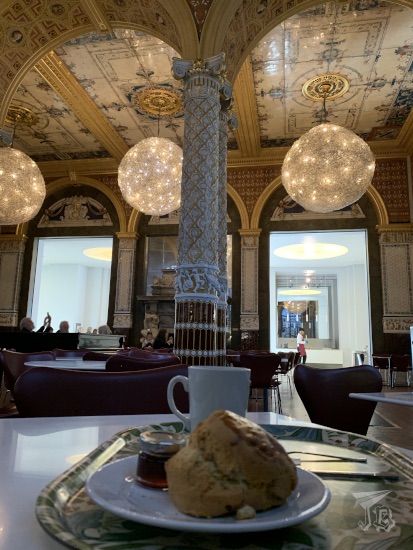
The Sky Garden features two terraces full of plants (landscaped by Gillespies), a couple of restaurants and bars, and an “open” gallery which has glass above your head so the feeling of opening dissipates – the glass is stained and scratched. It was one of the “must-do’s” in London I had never visited before, so I thought it would be a good opportunity. Fortunately, they have relaxed the rules on no bottles because of the unusual high temperatures.

After wandering around for a bit, I continued onto Saint Dunstan in the East Church Garden, the ruins of an old Wren church destroyed by The Great Fire of London and destroyed again during the Blitz (World War II bombings). Dating back to the 1100s, it was opened as a public park in 1970. Aside from being a very cute building park I wanted to see for a while, a music video by the band VAMPS was filmed there.

Ruins of a gothic church turned garden, with hanging ivy and bushes overgrowing the walls and windows

As it was lunchtime, the park was bustling with people, so I just had to move on rather quickly, and went back to the underground to get to the area of Westminster. I had originally booked tickets for Saturday (back in May) but then they were cancelled due to “repair work” going on that day (I do wonder if it was a security measure related to the strikes though).

But of course, first I feasted my eyes on the very new Elizabeth Tower clock tower aka Big Ben – though Big Ben is one of the bells in the tower, but nobody really cares about that any more.

Elizabeth Tower, shining gold with the restoration. It almost looks fake. The clock marks Quarter to two.

The Palace of Westminster or Houses of Parliament is the centre of the United Kingdom’s turbulent political life. The current palace was built after the previous one was destroyed by a fire in 1834. The new palace was erected in the Neo-Gothic style, and it was mostly finished by 1860, although it did open to be used in 1835. There was a competition regarding the design, which was won by sir Charles Barry. The Palace of Westminster holds the two chambers where the British government meets – the House of Lords and the House of Commons – alongside the Norman Porch, St. Stephen’s chapel, and the different corridors where the MPs vote or discuss state matters. I’ll forever be amused that “for security reasons, photography is not permitted in these chambers with dozens of cameras for TV broadcasting and Internet streaming”, but alas. The woodwork on the Norman Porch ceiling is fantastic, and some of the decoration choices, such as Churchill’s sculpture are… interesting. It is noteworthy that it is part of the Unesco Heritage Site “Palace of Westminster, Westminster Abbey and St Margaret’s Church”.

Collage: a view of the houses of parliament (London), with the Elizabeth Tower on the left. Two shots of the Norman Hall, a huge ward with an intrincate design of wooden ceiling. A gothic corridor with a wooden door and some coloured glass panels

Afterwards, I just found my way to the hotel – though I had to wander a little to find the nearby supermarket, bugger those never-ending attached-house neighbourhoods, rested for a little and then went to the station to go to the theatre – I wanted some extra time to check out where my airport coach would leave, so I gave myself 45 minutes for a 22-minute trip. It turns out there was train trouble and I was barely on time, taking an alternative route instead of the direct one.

When I realised my flight timing would give a free evening in London, I booked tickets for the Apollo Victoria Theatre to watch the “Wicked”. This musical tells the story of “The Wonderful Wizard of Oz” from the point of view of the witches, and somehow gives the “Wicked Witch from the West”, Elphaba, an amazing personality and backstory that resonates a lot with me. For the same price as the ticket I was eyeing back in the day, I found a VIP upgrade just one seat over, so I was entitled to a drink and “snacks”, an early entry, along with access to the “Ambassador Lounge”, a tiny reception hall with access to a private restroom.

“Wicked” was great. The actress who plays the main character, Elphaba (Lucie Jones) came out a little yelly though in her solos. The duets with the other female singer (Glinda, Helen Woolf) were fantastic, and the male love interest’s (Fiyero, Ryan Reid) song was absolutely great, even though he is a character I have never cared for.

Apollo Victoria Theatre: the inner theatre, showing a dragon and a closed curtain showing a map of Oz. The outer theatre: there is a sign reading Apollo Victoria Wicked, and everything is lit green. The VIP lounge, with a glass of soda, and some chairs. The cast at the end of the show, taking their goodbye bows.

By the time I was out, the trains were running again, and one-to-three-minute delay on a line that runs every five minutes or so, and I was at the hotel by 23:00, absolutely beat. The room was extremely hot, because London is absolutely not ready for heat, so I had a snack in front of the fan, took a shower and then got some sleep – 21 hours on the go were over. Funnily enough, by the time I went to bed, I had that wobbly-world jet-lag feeling I have after my first day in Japan. It must have been the barely sleeping the night before. I fell asleep very fast.

Walking distance: 30.52 km / 46192 steps

11th – 13th August 2022: Non-weekend weekend in England

When, back in May, I decided to book this trip, I was surely not anticipating the chaos in the European airports this year, nor for sure the England transport strikes. I did not foresee that the Palace of Westminster would suddenly cancel my visit, nor that it would be through my Westminster Abbey reservation that I would be informed of trains cancellations. I did not know that I would have to buy a last-minute bus ticket and miss half of a tour… Lots of things went almost wrong, but in the end, most everything worked out.

23rd & 24th June 2018: London Express (England, Great Britain)

I took some family members over to London for the weekend, and they asked me to organise something so they could see a lot of things. We took the red-eye flight so we were downtown London something around 8:30. Our first visit had tickets for 10:00, so first spot was a Costa Coffee for breakfast! (≧▽≦)

Afterwards we saw the Tower Bridge over the Thames.

Then, at the right time, we walked into the Tower of London, where we wandered around visiting all the areas, including the White Tower, the dungeons, the Crown Jewels vault and the raven nests.

Once we were done, we took the underground to the British Museum for a quick visit through the most important collections, along with a few of the less known but interesting things – in the end we saw the Babylonian, Grecian, Egyptian collections, and had a glimpse at a few of the Chinese artefacts and the Hoa Hakananai’a from Easter Island.

We had lunch in-between and then went to the hotel to drop our things off. After that, we took off again and, via underground, we reached Trafalgar Square. We walked towards Piccadilly and on the way we stopped at Legoland and M&Ms shop. Then had dinner in an Angus steakhouse in Leicester square, and to end the day, we had a look at the lit Piccadilly Circus.

We got back to the hotel, and honestly, I had not realised how close to the centre we actually were until I looked out of the window.

The next morning we woke up early and headed off to have breakfast on the go – actually the weather was super nice so we got ourselves some Nero coffee and sandwiches and ate them in front of Westminster’s Abby. As it was Sunday we could not visit the Abby, but we saw the scaffolded Big-Ben, and walked around the Houses of Parliament.
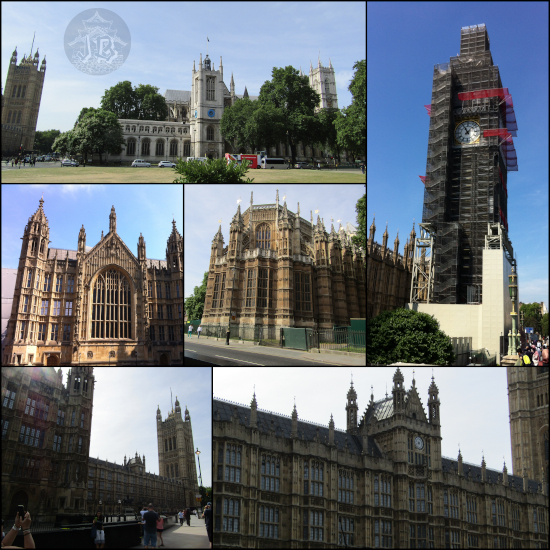
We went to visit the Monument to Emmeline Pankhurst because the youngest person in the group needed to be told about a period in history in which she would not have been as free as she is today.

After that, we crossed over the Thames, then moved on to the London Eye. Half of the group wanting to go up, the other half being not fans of heights, we divided and conquered – two of us went to the London Aquarium while the other three enjoyed their VIP ride in the London Eye. I know you are not surprised I picked the side with the sharks instead of going up.

This guy judged us, very hard:

After our riverbank separation, we regrouped and headed off towards the Natural History Museum where we first saw the Butterfly carp that was installed outside it – they were extremely pretty and beyond friendly, because we were landed on quite often.

When we had finished the walk, we stepped into the Natural History Museum itself to wander through the dinosaur area for a bit, and then around the animal collection.

We decided to head out to the restaurant to have a bite to eat, and as we were walking through the marine invertebrate area (the room with all the crabs and so on), there was a nice lady showing items. And that’s how I ended up holding a megalodon tooth and fanbying like there was no tomorrow. Don’t judge me. Or do so, I don’t care ☆⌒(ゝ。∂)

As they walked into the insect / general creepy-crawler gallery, I walked around the gallery that held “less impressive” fossils, including the ones discovered by Anne Manning. We had lunch in the NHM, then moved on.

A short underground ride later, we were at St James’s Park, where we took a bit of a walk towards Buckingham Palace. As the weather was nice, we got to see a lot of the local fauna, even the local swans.

We hung around for a while as we saw Buckingham Palace, then headed off back towards the airport. Although we had a couple-of-hours delay, we made it home without further complication.

9th & 10th June 2018: Wicked London (England, Great Britain)

This will be the last work-trip, at least for a while. I might change my mind later, but for now I’m done with them (although there’s an upcoming family trip rather soon…). Again, we flew in early Saturday morning, and we went to walk around the Tower of London and the Tower Bridge.

Then we went to the British Museum. I left them for a couple of hours there and I went to visit some of the lesser-seen galleries.

We had booked tickets for the musical “Wicked” in the Apollo Victoria Theatre at 14:30, so we headed over there. Wicked is a parallel story to “The Wizard of Oz”, focusing on the story of the Wicked Witch of the West, who becomes a social outcast due to her tendency to speak her mind and the strength of her magic. I had really wanted to watch this for a long time, so I used this chance and convinced the group to get there. I absolutely loved it ♥.

After the show, we dropped our things at the hotel. The group wanted to get some rest, so we stayed there for a while, then got out again. We took the underground towards London central and we were in Trafalgar Square for a while.

Then, we went to Chinatown for dinner.

Later, we walked around Piccadilly Circus, checking out some shops and so. We even stopped for cake.

On Sunday morning we went to Saint James’s Park, where we got to meet the local fauna, especially a very adventurous squirrel.

Then we dropped by Buckingham Palace. Although we did not watch the Guard Change, we did see one of the relief marches.

We walked from there to Westminster, saw the Houses of Parliament and the Big Ben, along the outside of Westminster Abby.

We visited the Monument to Emmeline Pankhurst and stayed for a while in the Victoria Tower Gardens.

As a final visit, we went to the Natural History Museum.

Finally, we headed off to the airport, and the icing of the cake was that we got caught in a controllers’ strike, so we had like a three-hour delay on our flight and it took forever to get home (;¬_¬). All in all, this was a very… strange trip, and without a doubt the highlight was going to see Wicked, which is something I had wanted to do for a long time, and gave me a couple of hours of enjoyment to myself.

10th – 12th February 2018: Highlights of Glasgow and Edinburgh (Scotland, Great Britain)

This is another trip that I took with customers. We flew into Edinburgh and took a bus directly to Glasgow, where we arrived at around 9:00 on Saturady morning. We made a stop for breakfast, then we walked to Saint Mungo Cathedral.

Then, of course, I guided them up the Necropolis Hill. The weather was very nice for a chance – because I have the exclusivity of good weather in London, but not in Scotland, which yielded to a nice walk.

We had lunch in my favourite Greek restaurant, and then walked around Glasgow – some of the members of the party wanted to go clothes-shopping so I took the opportunity to get into a bookshop or two. We dropped our things off at the hotel and walked in and out some of the shopping centres in the Central Glasgow area. In the evening, I took them to try Wagamama, a ramen / British fusion food chain. I’m always in for ramen (≧▽≦).

On Sunday morning we took the train to Edinburgh. We visited the Old City and Edinburgh Castle, with some awesome sights (because again, the weather was really good – albeit cold as hell, because, have you seen that snow??) and fumbled around for a while.

We had lunch at the Deacon Brodies Tavern, a traditional a restaurant in Castlehill – mince pie here.

We also took a walk towards the New City – and there was shopping again. In the end we had an amazing cup of chocolate as early dinner before we went back. I was supersuprised they wanted dinner, but I had had enough with that chocolate and just some tea at night. The shop where we had chocolate was called Coro: The chocolate Café, and I have no doubt I would go back to that shop.

Just before we headed back to Glasgow, we came across an art installation in Prince Garden, which had lots of pretty coloured lights.

And when we woke up on Monday to go to the bus station and head off to the airport… it was snowing! Honest to god snow on the streets!

We reached Spain without further incident in the afternoon, and that was another weekend wrapped up.

11th & 12th June 2017: Highlights of London (England, Great Britain)

As part of my day job, I took a group of customers on a trip to London. Not the best decision in my life, but one that I would repeat a couple of times before I had enough. This was a short getaway – we took off on a red-eye flight on Saturday and we came back on Sunday evening.

Our first stop was The Tower of London, officially called “Her Majesty’s Royal Palace and Fortress of the Tower of London”. The main Tower, “White Tower”, was built in the 11th century, and additions to it were made up to the 1400s. It was designated Unesco World Heritage Site in 1998. The Tower holds an armoury, some treasure, documentation offices, a few shops and the Crown Jewels of England. And, according to the legend, quite a few ghosts.

After the Tower, we took a moment to see the Tower Bridge.

We had a hotel basically at the end of the world, and we decided to go to drop our things off before we continued on the visit. We saw the Wellington Arc in Hyde Park on the way to the royal palace.

Then we fooled around Buckingham Palace.

Finally we went to Chinatown to have dinner…

… and rounded up the day at Piccadilly Circus.

The next morning we headed off to the British Museum. We had breakfast outside because of course it was one of those times when it’s all warm in London. Waffles = ♥

The British Museum was established in 1753, and opened to the public, in its current location, in 1759. It focuses on human history and art, having branched the natural history items to the Museum of Natural History and all the documentation to the British Library. The museum holds the awe-inducing number of 150 million of artefacts from dozens of cultures of the world, both ancient and modern, with amazing Grecian and Egyptian collections (albeit having disputed ownership…)

Inside the British Museum we separated. I left them to have a walk around the most important areas and I walked into my favourite spots (although the Japanese galleries were still closed. I also got a ticket to see the Hokusai – beyond the Great Wave exhibition, which presents a number of Hokusai’s works organised in series or topics. One is waves, and it shows how Hokusai experimented with textures, shapes, swirls and foam until he found the “perfect” wave – his most famous work, the Great Wave. There is a series on people, another one on mythology, and another one on himself and his family.

After I was done and we had met up again, I helped them found some stuff that they had not seen but still wanted to. Then, we headed off to the Westminster area to see the Big Ben, and although there was some scaffolding already visible, we managed to see the whole thing.

Finally, we headed off to the airport to get back home.

3rd – 5th March 2017: #XDAY in London (England, Great Britain)

The X JAPAN concert in Wembley was scheduled for the 12th of March 2016. Unfortunately, on the 15th of January, guitarist PATA was admitted to the ICU in Japan, which set back the date a whole year. For the record, I’m very happy that PATA made a full recovery.

Since January 2016 I had been trying to arrange one of the VIP packs that were being offered and which included transportation, but the promoter ONTOURS had been skittish. The postponement did not come as a surprise. In the end these packages blew up and there was a different kind of VIP upgrade arranged, that my friend C***** and I chose to buy. This included half of the merchandise and access to the sound-check. Later on, it was announced that the band would be signing copies of the “We are X” album at hmv in Oxford street. My friend C***** and I also managed to get tickets for that one, so we were elated.

Friday, 3rd of March 2017: We Nailed It

C***** and I met at the airport on the 3rd of March, Friday, for an early afternoon flight, and everything went smoothly. The only minor bump was that she was carrying a trolley and the lady at the gate decided that there were already more than fifty trolleys being loaded as carry-on – there were not, I had counted them and that she had to check in. She tried to protest (literally, the attendant started tagging the line when she saw us) to no avail. I was not having it, so as soon as we walked past the boarding pass check, I ripped off the “check at gate” tag and produced a copy of the boarding pass (without the check-in sticker), and we were allowed in without problem.

We arrived in London Stansted, went through immigration without any impertinent agent bugging us, and we took the Stansted Express, then changed into the underground. It was all smooth once more, we got to the Oxford Street stop, alit, and found the hmv building. When we reached the queue, sheshe stayed and I went in to buy the CDs for the autographs. I also bought a bottle of water, and the cashier actually got a chuckle out of my face when they gave me a new £5 note, which are sort of plastic-y, and have a transparent part. After this, we settled to wait. It took a long time to finally get to the signing area, but the weather was reasonable and there were no weird people around.

You could take pictures on the approach to the band, but as you arrived at the front, you had to leave all your things. As you approached the band, one of the assistants would take the booklet from you and handed it over to the first artist, guitarist Sugizo, who did not look too awake. Then ToshI, who was smiling all the time. Yoshiki was happy as he tends to be when he is the centre of attention. Patatried to look like nothing had to do with him. Finally Heath handed (what you hoped was) your booklet back to you.

All in all you might be seeing them for 3 or 4 minutes top as the hmv staff kept yelling at you to hurry up. It was however worth every second, although all my pictures ended up being horrible.

hmv building outside, autographied CD and a very blurry image of the band signing

And here is my not-so-little secret: I froze. I had practised so much what I wanted to tell each and every one of them, but I just froze and I couldn’t get the words out except a mumbled thank you to Heath when he gave me my booklet back. I remember looking at Sugizo and Yoshiki thinking “they’re real, they’re here, it’s happening…”

We knew that there would be a crowd after the event, and we wanted to avoid that, as C***** has a bad back, so we decided against waiting for them after the fact. Instead, we headed off for the hotel we had booked just next to Wembley Arena. On the way, we stopped at a Salisbury supermarket to get some stuff that we might need – aka some drinks and snacks for the following day – we needn’t have worried though as when we turned the corner we found a whole shopping centre with restaurants.

We checked in, left our things, had a shower, and headed off for dinner. She had never been in a Wagamama before, so I thought it was a great idea to try it for dinner. I think she enjoyed it – and so did I, I might have eaten a bit too much.

Dinner: dumplings, fried chicken, ramen with a lot of veggies, sweet buns

Saturday, 4th of March 2017: The Actual #XDAY

On Saturday morning, the actual #XDAY, the fourth of March 2017, we had breakfast at a Costa Coffee – I have to say that I really enjoyed introducing her to a bunch of “my favourite British things”.

Tall coffee latte mug

We hung out at the outside of the venue all morning until we could get our VIP accreditations and be admitted. Before everything started, though, we had some burgers for lunch.

Fancy burger with overflowing lettuce and avocado sauce

After lunch, we went to the VIP line. I saved up the space while my friend made a run to the merchandise booth to check if they had the We are X soundtrack CDs – yes, exactly the same one that we had bought the day before, except that this time they had a special cover – blue, red, or purple. And with each CD you got a set of “trading cards”. We were not lucky at this time.

The venue, with lots and lots of windows

The whole experience once within the venue started with watching the rehearsal, at least what we were allowed to – to this day I don’t understand why we were let in late and escorted out early so we only caught about 50% of it. Highlights of this are Yoshiki in pink sweatpants, and ToshI waving his hand at us whenever “nobody” was looking.

The band rehearsing

We were chased out to wait in the halls and I used the time to slither towards the merch booth, where I got the CDs – all three colours (twice, actually, for both myself and C***** as she kept the spot). Eventually, the doors opened again and we took the picture on the stage – unfortunately without the band – as the arena started filling up with people. After this we found our seats. I made a run to the ticket booth again because I had won an extra set of tickets and we needed to check whether by any chance they were better than what we had. Through this process, I ended up having a riff-raff with the security staff at Wembley that lead me to file a complaint letter. Of course, I had to run into my least favourite things about British people.

Late, of course, everything started. First, we were shown the documentary “We are X”, and it hurt every bit as much as the first time in Barcelona. And as the documentary was coming to an end, the music rose up and we got started with the chords of Rusty Nail. The concert was fantastic – we had had to wait for over a year but we were finally there. This was my first real X Japan concert, and my heart was soaring all through the event. Everything was magnificent: all the members, the music, the crowd… It was so amazing I wished it never ended.

Unfortunately, though, everything comes to an end, and so did the concert, though I hope the memories never fade away.

Stills of the concert

Sunday, 5th of March 2017: Excitement Hangover

The next morning, we woke up and went to find the Costa again, because Costa is amazing. It was raining, cold, and I was not feeling too well as I had hit a wall, but coffee revived me a little. We got into the underground to go to the commuting point to the train and kept an eye out for any We Are X posters that we could find (we decided against trying to find the billboards because that would mean a big detour and we did not feel comfortable with the flights timing).

We eventually found some posters at Baker Street and… after a quick Instagram check we realised that we had stumbled upon the very same poster in front of which ToshI had taken his pictures, and we had a laughing flash.

The concert promo in the underground.

When we reached the airport we had some hot food at the Stansted Itsu – not the best but it was warm and it helped me feel a bit better.

Lunch - containers of fast food: gyoza, miso soup, turkey with peas, and meat broth. The logo says itsu eat beautiful

We separated at the airport because C***** had a better connection to her town to return than she had for arriving in London. All in all, this was one of the best weekends of my life and it all worked almost perfectly – all the important things anyway.

Also, I made a promise to myself after this – that I would not freeze again in front of a star. I hope I can keep it.