25th May 2025: Gozo Tour {Malta, May 2025}

I had booked a second tour, in order to get to know the Island of Gozo. This time around though I had a very clear pick-up point, which I hoped would work out, unlike the previous day. Fortunately, the instructions from Gozo Tours were extremely clear and I knew exactly where the pick up point was, without any non-working links. There were other people from my same hotel, so we got nervous together. The driver was not too late though. We were driven in a mini-van towards the passenger terminal in the north of the island, Cirkewwa. There, we waited for pick-ups from other parts of the island. We had a charter high-speed boat that crossed the Gozo Channel and dropped us off at the Mgarr Harbour terminal in the second-biggest island of Malta (country).

Gozo | Għawdex is less urban than the Island of Malta, so I had decided that maybe the Full Day Jeep Safari Of Gozo could be a good way to get a feeling of the island, without having to plan much and depend on public transport. In hindsight, it was probably unnecessary but it eliminated the need to plan. All in all, the tour was convenient, but not something I would choose again – the landscapes were beautiful and dramatic, but not as crazy as I had expected.

I became really amused at how many people (read: most everyone) were unaware of the speed a speedboat reaches. I was glad that the boat was so fast; it glided over the wind-waves, and there was no swaying. That was good, because said wind would have made the trip miserable at a slower speed. However, there was a group of Italian girls who were absolutely petrified.

We reached Mgarr Harbour in Gozo and separated into small groups for the different jeeps. I was placed with four Londoners and an English guide, which suited me just fine. I don’t remember whether I actively chose the English-speaking tour, or I got assigned to one because I used the English webpage. There must have been tours in other languages. Apparently, all the jeeps go to the same spots at different times of the day so they don’t run into each other, so we followed a bit of a zigzagging route, with specific spots in different cities and towns. The information said there would be a “swim stop” during summer, I was just not sure whether the 25th of May would count as summer. I carried my swimsuit and towel anyway.

The first stop was barely five minutes in: Qala Belvedere, a panoramic spot in the town of Qala, which allowed us to catch sight of Comino, the third-biggest island in the archipelago. Afterwards, we got back on the jeep and headed off towards Ramla Bay in Xaghra. As he was describing the landscape, the guide at some point mentioned volcanic rock, which threw me off, as I believed that the islands were sedimentary. I thought maybe he meant there was some tuff. However, everything I have read about the geology of the islands agrees – the whole of them is sedimentary rock, in five main strata. From oldest, at the bottom, to newer, these are coralline limestone (Żonqor), globigerina limestone (Franka), blue clay mudstone (Tafal), greensand sandstone (Ġebla s-Safra) and coralline limestone again (Qawwi ta’ Fuq).

The Upper Coralline limestone formation (the most recent) is pale and grey, and it is embedded with biological structures. The most important rock is the globigerina limestone, which is golden and between 23 and 14 million years old. It is called so because it contains a lot of globigerina – a type of plankton – fossils (I did see a lot of shells in the rocks, but I was not carrying anything to dig the fossils out). This is the majority of building material in the country, even in a lot of the prehistoric temples. It has been designated a Global Heritage Stone Resource, something I did not even know existed until now. The blue clay is also key in Gozo as it is the one that allows for the creation of freshwater aquifers through the filtration of rainwater. The thing with limestone is that it erodes very dramatically, creating very capricious forms which are the base of the striking landscapes in the island.

The shore of Ramla Bay is one of the few sand beaches in the country. It is called Ramla il-Ħamra (Red Sands) because of its reddish colour due to the presence of iron clay in the area. The beach is locked by two rocky formations / cliffs that protect it from the waves – unfortunately, not from real estate developers.

Ramla Bay - a small reddish sand beach inbetween rocky cliffs

We continued towards Xwejni Bay in Żebbuġ. It has a small beach of pebbles, with a promontory to one of the sides, and a dramatic walk along the other side which leads to the salt pans. Unlike the ones from Birżebbuġa, these pans are commercially exploited. Between May and September, each pool is filled, individually and manually, with sea water which proceeds to evaporate and leave behind the dry salt crystals. With good weather, salt can be harvested once a week, and it is sold as flakes without further processing – rather nice, I’d say. We also were shown to a small shop that had tastings in hopes you bought stuff, and I did try the salt and the oil.
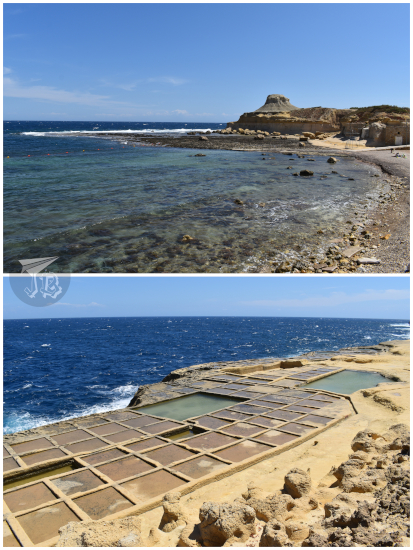
Xwejni - a beach made by the erosion of limestone, with salt pans excavated into it

We drove by Basilica of the Blessed Virgin Of Ta’ Pinu | Santwarju Bażilika tal-Madonna ta’ Pinu, though we did not stop. The current building is Neo-Romanesque – construction started in the 1920s – and it looks like something from a fantasy cartoon. However, it is a serious Catholic temple, dating back from the 16th century at least, even if it kind of stands in the middle of nowhere.

We crossed the town of Għarb and made a short stop at the SG 8 globigerina limestone quarry. It made me sad that the SG did not stand for “Stargate” but what can you do? The quarries through the island extract the rock which is used as construction material in many buildings through the country.
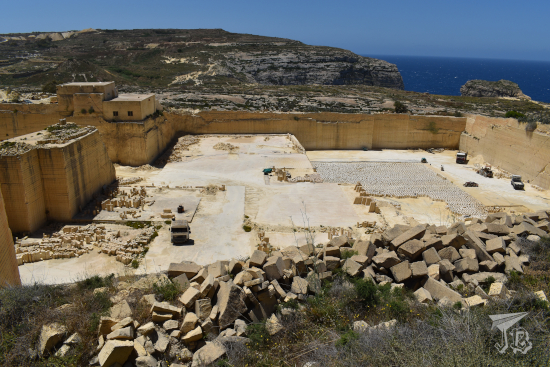
Limestone quarry

Instead of going to the other side of the galaxy, we headed off to San Lawrenz to see the Inland Sea | Qawra, a lagoon connected to the sea through a cave fault in the cliffs. When the weather is nice, there are boats giving you a ride past the archway and out to the sea, but not this time around – there were some pretty decent waves coming in, so it was too dangerous to sail the crossing.
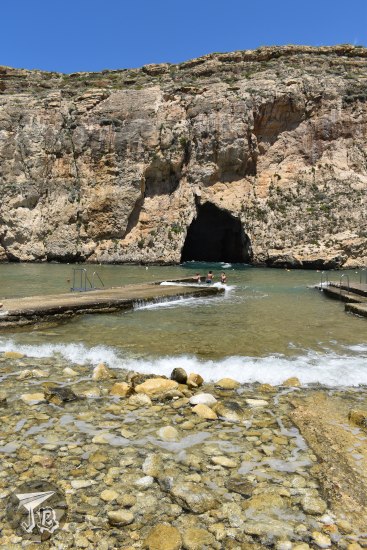
Small lagoon connected to the ocean by a cave

We drove through Għarb again, where I could catch a glimpse of the Basilica and Collegiate Parish church of the Visitation of Our Lady, and continued towards Xewkija where we were to have a “three-course course light lunch”. This consisted on a Ricotta Pastizz (pastry stuffed with ricotta cheese), Maltese Bragioli | Beef Olive (stuffed beef roll), and vanilla ice-cream, along with wine that I did not have, I went for water instead. Food was all right, I was not hungry so it was fine. Afterwards, the guide offered to take us to a gelateria to have “the best ice-cream ever”.

Pastizzi (pastry filled with cheese), and a meatball with potato wedges

Before that, we crossed the scorching square to see the Rotunda St. John Baptist Church | Basilika St. Johannes der Täufer, which had recently been struck by lightning. This is a Baroque church established in 1678, though the building was erected in limestone in the mid-20th century. The new building actually encased the original church, which now is a small chapel to the left side of the main altar. St John is the Spiritual Seat of the Knights Hospitaller.
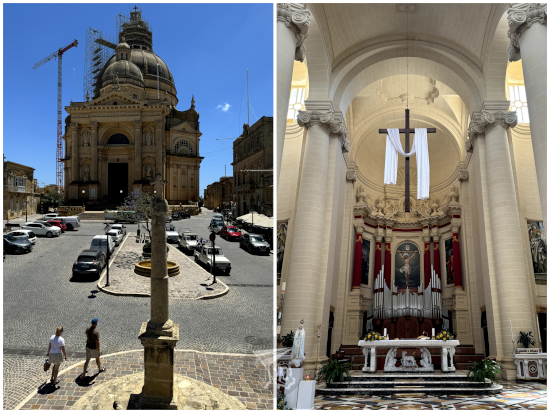
Neoclassical church with a dome

The next stop was Xlendi Bay and the beach town of Xlendi. There stands Xlendi Tower, built by the Knights in 1650, restored in 2010. The natural landscape was stunning, but the town itself was just a touristy beach town. The promised ice-cream parlour was a chain called Gelateria Granola, where I decided to try the cookie ice-cream, because it was something I had never come across before, and I had next to no time to choose, it felt – I have no idea how I ended at the front of the crowd.

Xlendi: cliffs and breaking waves

Ice-cream happily consumed, we drove off. We stopped in Fontana where there is a natural water spout called the Knight’s Wash House, halfway between a historical landmark and a local fountain. As a curiosity it was all right. We continued to Victoria, whose historical seed is called The Cittadella | Iċ-Ċittadella, the Citadel. The area comprising the Cittadella was first inhabited during the Bronze Age, and it probably went on to become the Roman acropolis and eventually a castle in the Middle Ages. The castle defences were reconstructed in the 17th century, but they were not considered the best – the Cittadella actually surrendered in the 1798 French invasion and counterstrike, without much resistance either time.

Our allotted time there felt too long for just a walk and too short to the whole thing, unfortunately, so I could not snoop around the museums. Furthermore, the Cathedral of the Assumption – The Matrix, Parish Church, Sanctuary, Collegiate and Cathedral of the Assumption of the Blessed Virgin Mary into Heaven | Parrocca Matrici, Arcipretali, Santwarju, Kollegjata Insinji u Katidral ta’ Santa Marija Assunta was closed. The whole area looked like it would be awesome to be able to sleep over there – especially because walking uphill to visit it would be hard in the sun.

Fortification made in limestone with a baroque cathedral

The hour approached to head back to the quay. We started making our retreat with two short stops on the way, in the town of Għajnsielem. The first one was for the guide to take our pictures with the Monument to the bench in the village square, a metal bench showcasing a pair of grandparents, a young woman with a smartphone and a cat begging for attention. The bench is located in front of the Għajnsielem Parish Church. The second stop was a panoramic view of Gozo Straight and the Church of the Madonna of Lourdes | Knisja tal-Madonna ta’ Lourdes. There was no swim stop in the end, so late May is not summer yet. All in all, we started off around 10:00 and were done by 16:00, and it cost 80 €.

We made it back to Mgarr Harbour, where we took the speedboat back, first to drop off some passengers in Comino, which gave us a peek into the Blue Lagoon there. Again, I was glad for the speed, because the waves would have made a leisure trip miserable. Afterwards, we were driven back our points of origin. Back in my hotel, I snacked on some salt-and-vinegar crisps from my favourite British brand that I had found in the supermarket.
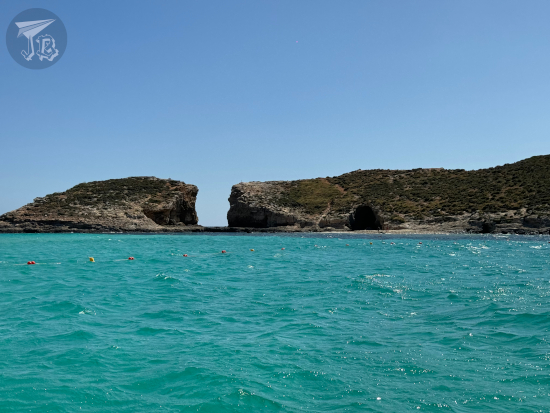
The turquoise water of the blue lagoon in front of the island of Comino

Around sunset, I went out to explore Saint Julian’s | San Ġiljan a little further. I had considered some of the typical restaurants there, but since I ate the crisps I was not hungry. What I did was walk around Spinola Bay, along Spinola Slipway and Saint Julian’s Promenade, and past the Fisherman Monument – with yet another cat begging. I tried to reach the marina, but it was all uphill and taken over by the luxury hotels.

A sculpture of a fisherman cleaning the nets while a cat looks eagerly at him, and a view of an urban bay front

Instead of dinner, I had another snack, and then headed off back for a shower, some sleep and… yes, another 5:00 wake up call. Talk about jet lag without changing your time zones!

7th November 2024: The Spanish Cultural Heritage Institute (Madrid, Spain)

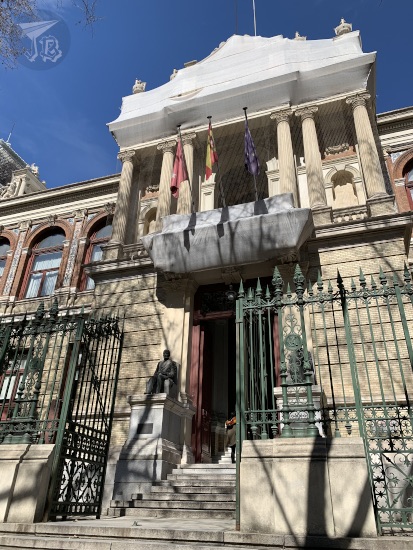
I know you do not believe me when I say I don’t like guided visits, but they are the only way to do some stuff – such as stepping into the Stonehenge circle, or basically anything managed by the Madrid city hall. The Spanish Cultural Heritage Institute Instituto del Patrimonio Cultural de España IPCE is a governmental organisation whose functions are preservation and conservation of cultural items, research, communication, and safekeeping of the documents in its archive. It can only be visited on certain dates, by appointment, and with a guided visit. I managed to secure a free Thursday visit at noon, so I headed out to Madrid. Surprisingly, neither trains nor underground had issues, so I was over an hour early on site. The IPCE is located in its own building in the area known as “University City” (Ciudad Universitaria), close to the Fine Arts faculty – by design – and the President’s official residence – by chance.

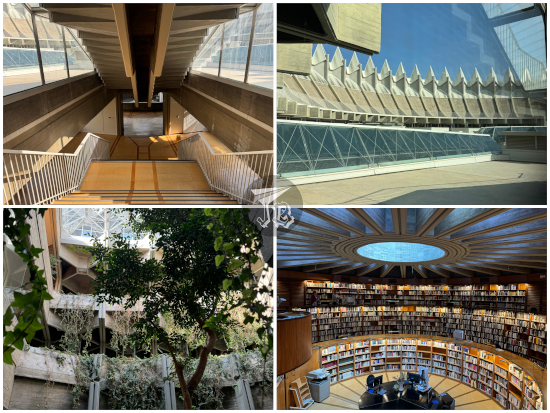
The headquarters building was commissioned in 1965 to architects Fernando Higueras and Antonio Miró. The architects’ original project had to be severely modified, but it became a very different structure. Construction was stalled for years, and the building was not usable until 1985 – when new remodelling was tackled. The building is circular, nicknamed the “Crown of Thorns” (La Corona de Espinas) because at the top there are “spikes” of sorts. Top-view, the structure is divided in 30 sectors, with 56 semi-sectors and four empty ones for the main access staircase and gate. It has four floors and at least one basement. It was built in concrete and glass, with some cork floors, but lacking plaster or any kind of concealment for the structural items. The centre of the building is an open space with a glass dome, and serves as reception. Unlike the original project, this space is covered with a glass vault. The interior has a lot of plants, even three small “gardens” mainly with hanging plants. The building is considered an important cultural asset BIC (Bien de Interés Cultural), and these plants are protected along with the structure.

Spanish Cultural Heritage Institute building

The visit consisted of an introduction to the building and the work which is carried out there. We saw the model of the original project – the only similarity is that it was also vaguely circular. We climbed the stairs to the upper floors to snoop at the rooftop and the “thorns”, and then rode the lifts down to the basements to see some X-rays of paintings and sculptures. Back on the main floor, we were shown into painting restoration workshop – they were working on Maerten de Vos’ Abundance, having repaired the work and erased some extra (puritan) clothing to make the goddess Ceres look less… naked. Finally, we were invited into the library, which is round and has three levels. It has natural light due to its own skylight, a decorative glass dome in the middle of the main open area.

Spanish Cultural Heritage Institute inside

The visit started at noon, and it lasted two hours. Heading out to the centre of Madrid would take around half an hour of walking and underground. Thus, it gave me the opportunity to book a late 15:00 lunch. Since I was lucky with my connections, I was in the Cuzco neighbourhood almost half an hour in advance.

It was the perfect opportunity to go get some groceries at the Chinese supermarket Ibero China Madrid in the street Calle General Margallo. While I needed some items, I was distracted as I walked the “geek” fizzy drink aisle. There is a company called Ocean Bomb which makes sodas – sparking water, yoghurt drinks and bubble milk tea with “creative packaging”. I was aware of them because a friend collects the Sailor Moon ones and we checked for them in London in 2023. Well, now I went and found myself some Saint Seiya sodas – Gemini Saga (grape yoghurt flavour) Aries Mu (apple yoghurt flavour) and Virgo Shaka (peach yoghurt flavour). They were out in 2023, but I had not heard about them, it is the first time I saw them. And of course, I bought them (I have no idea if they are official or not, but the publicity I found afterwards has the Toei stamp on it, so I’m hoping they are).

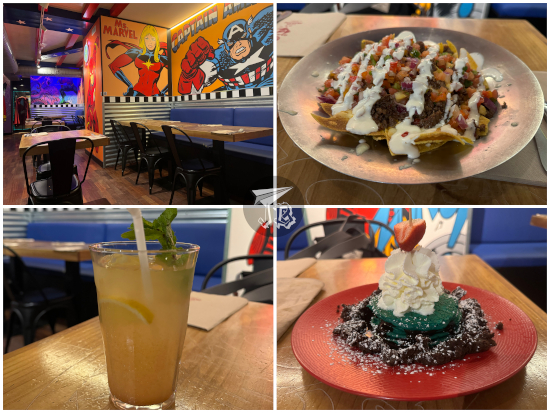
For lunch, I had a reservation at Comic Planet. Last time I was there, a member of the party was late, so in order to keep the table, we ordered appetizers. They were great, but afterwards there was no stomach-space for dessert. And dammit, I wanted some dessert – particularly, I wanted pancakes. I had been looking at coming back to Comic Planet for a while just to have them, but it never worked out. This was finally my moment. I had a lemonade, some nachos – which were delicious – and I finally got to eat my pancakes – which are green and called Hulkcakes, and come with whipped cream, brownie and shortcake crumbles , and around ¾ of a strawberry. I ended up extremely full, but happy.

Comic Planet lunch

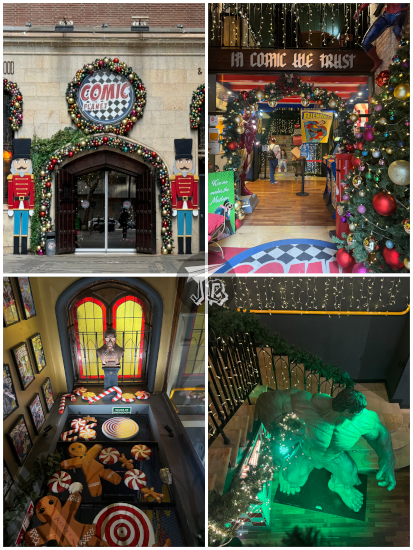
Oh, and I was confused because it was early November but… already Christmas in Comic Planet!

Comic Planet Christmas decoration

I left the restaurant and headed towards the archaeological museum Museo Arqueológico Nacional, which is running a temporal exhibit regarding Nature in Ancient Greece “Between Chaos and Cosmos: Nature in Ancient Greece” Entre Caos y Cosmos. Naturaleza en la Antigua Grecia. It hosts over one hundred pieces of classical Grecian art. Most belong to the museum’s own collection, acquired from the 19th century collector Marquis of Salamanca, and some are national and international loans. Since a large percentage of items were original and not replicas, it was really cool. Then again, I have to admit I have a thing for Grecian vases, especially with mythological motifs.

Entre Caos y Cosmos. Naturaleza en la Antigua Grecia

The exhibition was not big, so later I used my National Museums card Tarjeta de Museos Estatales to go and take a walk around the permanent exhibition. There is a loaned exhibit from the Mont’e Prama archaeological site in Sardinia, Italy. Mont’e Prama was discovered in 1974, unearthing remains from the Nuragic culture (1800 – 700 BC). This Bronze Age civilisation created large sculptures called the Giants if Mont’e Parma (Giganti di Mont’e Prama), depicting wrestlers, archers, warriors and boxers. One of these colossi Il Pugilatore (The Boxer) has been brought to the MAN for display for a few months. Boxers were characterised for having a glove with metal reinforcements on their right hands. Il Pugilatore is the largest sculpture, two metres tall and 300 kilograms heavy – which has been travelling across the world to promote the archaeological site. There was… something imposing about the whole thing, and not even its size. Some kind of… presence there. It made me want to visit Sardinia, to be honest (and it is much, much affordable than Easter Island…), so I guess the promotion… worked?

Il Pugilatore

I took a stroll through the permanent collection afterwards, especially the Iberian and Talayotic areas, because I am fascinated with them these days – and I shall make the most out of my pass for as long as I can. It was getting dark though, and the commute to the IPCE had taken long, so I headed back.

Museo Arqueológico Nacional

15th June 2024: The Old Naval College, and a mishap {London, England, June 2024}

I am getting weirdly used to 5:00 wake-up calls. I drove to the airport and arrived at the long-stay parking lot just before 6:00, with the exact time to catch the bus at the nearest stop. I might be getting too comfortable with timings – either that, or the flights have started taking off a bit later, because I remember having to leave by 3:45 for the first Ryanair flight a few years back. Anyway, security was nice and smooth, but passport control was maddeningly slow – the shiny brand-new machines the airport has spent a fortune on were not working, and there were only two agents, and three flights leaving around the same time.

We left on time and landed on time too, and since works at London Stansted have been finished, I was fast out of immigration. I considered going to the hotel first thing in the morning in order to make sure the credit card went through – and have time to find an exchange office if it did not. When I was able to buy my usual breakfast in the Costa at the arrival area without an issue, I decided I should be all right. Thus, I just headed off towards the centre, reached Liverpool Street station, and transferred to the TfL system. I got a bit confused at the DLR. London’s railway is divided in the Underground, the Overground and the Docklands Light Railway or DLR, which are mostly automatic trains which involve more transfers than I had expected. I needed to backtrack a station or two before I got to my final destination, the area know as Isle of Dogs in the borough of Tower Hamlets. I’ve recently found out that there is a footpath under River Thames which connects the Isle of Dogs with Greenwich. The footpath, the Greenwich foot tunnel, was built from 1899 onwards, and it opened in 1902. You can literally walk from one bank of the Thames to the other in just a few minutes!
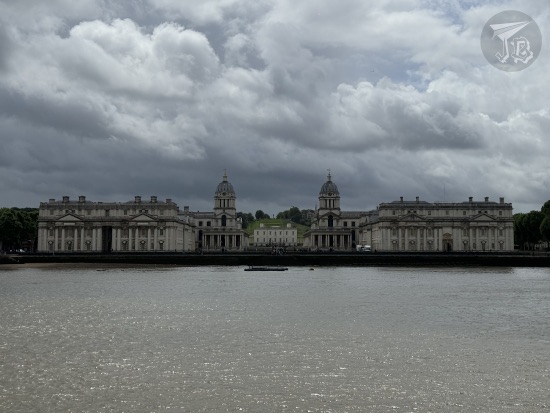
Old Royal Naval College from across River Thames

The tunnel was damaged during World War II, and there is a section which is held together by an inner steel lining. The whole tunnel is lit and either painted or tiled in white, so it does not give off any kind of claustrophobic feeling. Something cool that happened to me was that I could actually feel the water running above me, similarly to how I feel when I’m standing on a bridge and look at the river underneath. That was unexpected. Though there are lifts – the original ones were installed in 1904, but there are new ones from 2012 – I took the stairs.

Greenwich foot tunnel

I stepped out of the tunnel and into Greenwich, next to the Cutty Sark. I have already visited the museum inside the ship. This time around, I was going to try to see the Old Royal Naval College, which has been closed whenever I’ve tried to see it – they film rather often there. This time it was actually open to visitors.

The Old Royal Naval College, today part of the Maritime Greenwich UNESCO World Heritage Site, was originally designed as a veteran home and hospital. The current iteration of the building was designed by Christopher Wren – also responsible for St Paul’s Cathedral. The complex has two complexes or courts, Queen Mary Court on the left from the river, King William Court on the right. William III (reigned 1689 – 1702) and Mary II (reigned 1689 – 1694) were offered the throne as joint monarchs when their predecessor James VII and II was declared unfit because he became a Catholic. The building served as hospital and hospice until 1869; later, in 1873 it became a training academy for the Royal Nay until 1998.

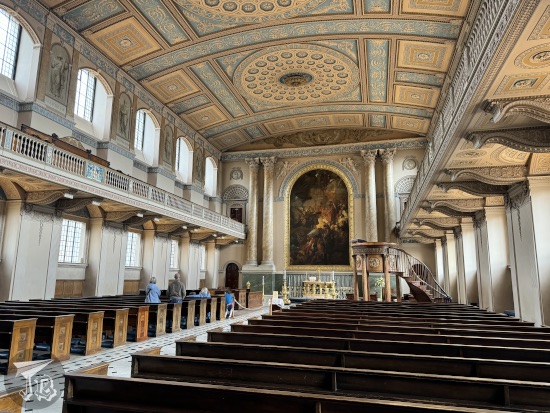
I first went into the Chapel of St Peter & St Paul in Queen Mary Court. It was reconstructed after a fire by James ‘Athenian’ Stuart in the neoclassical style. It has one nave, and a wood ceiling decorated with naval themes. The altar piece was painted by Benjamin West. I found the chapel quite beautiful, it gave off a warm feeling. The security personnel were also very nice.

Old Royal Naval College chapel

Then, I headed off to King William Court, to the pièce de résistance of the building. The Painted Hall is a huge ward decorated with Baroque paintings by Sir James Thornhill. The ceiling and walls are painted to honour the kings and queens who gave their patronage to the “Royal Hospital for Seamen at Greenwich”, depicting them surrounded by mythological and allegoric figures. The art was impressive, and the volunteer who explained it was a former teacher who made the whole tour really informative. While I usually avoid guided visits as much as I can, I found the painting too complex to interpret on my own.

Old Royal Naval College - Painted hall

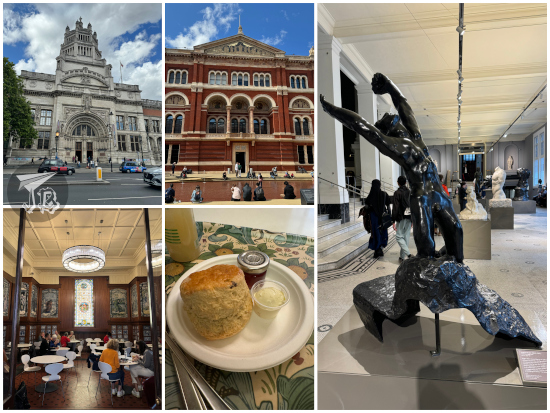
I backtracked through the Greenwich foot tunnel and took the Underground towards the Victoria & Albert Museum. Last time I was over they were running an exhibition I wanted to see… only this time around they had moved to another of their sites. I shrugged it off and decided to have a scone instead – any scone. I mention this because the couple before me wanted two particular scones from the basket. Afterwards, I went to see a gallery within the museum which I missed in 2023, which turned out to have bronze sculptures by French artist Auguste Rodin, considered the initiator of modern sculpture.

Snapshots at the V&A museum

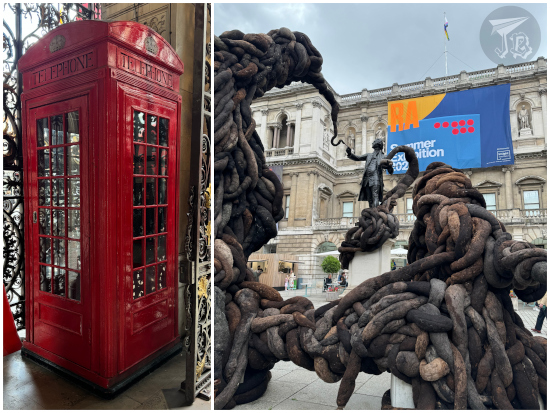
After that, I hopped back onto the Underground and headed off towards the Royal Academy of Arts, located in Burlington House. I was… surprised, to say the least, about the current display in the courtyard, but I was there to see oldest surviving red telephone box – Sir Giles Gilbert-Scott’s original prototype “K2” kiosk, made in wood in 1924.

Burlington house

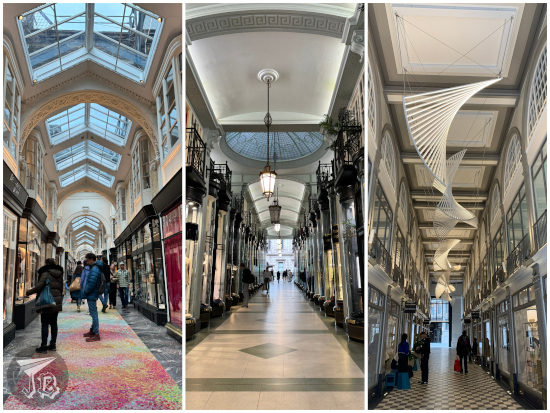
I then snooped around three of the high-class shopping centres along the Oxford Street area, all of them out of my price range, of course – Burlington Arcade, Piccadilly Arcade and Quadrant Arcade. I walked past Piccadilly Circus and Leicester Square, and headed off to Forbidden Planet to check out if they by any chance had a copy of a comic I’ve been looking for (Alligator Loki, if you ever find it, give me a shout?). I did not find the comic but I did see some stuff by Stjepan Šejić in the wild.

High-end London shopping arcades

Finally, I headed off towards the hotel / venue area, I found the venue – just outside the station. I bought some snacks for dinner and breakfast, then headed off to get to my hotel. The credit card thankfully went through and I got my room. I spent the rest of the evening watching films and snacking on salt and vinegar crisps. Truth be told, the weather was not that nice, but most of the rain happened when I was inside the buildings in the Old Royal Navy College. It’s been a long time since I was in London and there was not a heat wave, so I am not going to complain.

17th March 2024: Council Houses & Royal Collections (Madrid, Spain)

Madrid’s town hall opened a new season of their “walking Madrid” Pasea Madrid to show off some of the usually closed-off monuments in the greater area of the city. I’ve signed up for a few before (also under the name of open for restoration); while I am not a fan of guided visits, the program grants access to otherwise closed off places. This time I was lucky enough to get a spot for the old town hall Casas Consistoriales.

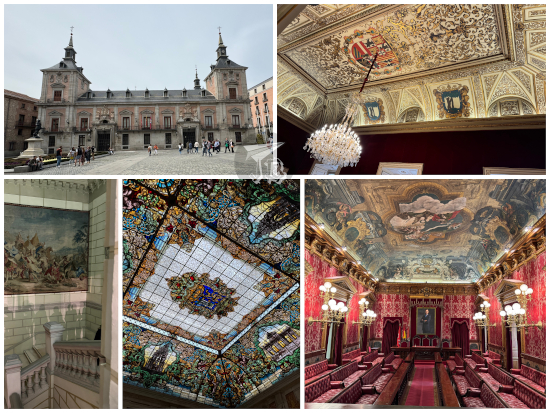
The original council house was built around 1645, following the plans by Juan Gómez de Mora, in the Herrerian style – the exterior is sober and barely decorated, erected in bare brick, with towers in the corners. The interior used to host a square courtyard, around which the whole dependences were designed. Subsequent remodellings closed off that patio, gave the construction a balcony overlooking Main Street, and exchanged the wooden roof for black slate. Even later, the structure was connected to the nearby palace Casa de Cisneros, a Plateresque palace built round 1537, by a passageway on the second floor. The two buildings were the main site of the town hall until 2011. Nowadays, the complex hosts some offices and is used for special events.

After going through the metal detector / X ray machine, we gathered at the entrance. The visit took one hour, and we were shown some of the most important points in both buildings, permanently followed by an armed security guard. In the actual Casa Consistorial, we saw the monumental staircase, the “royal room” with a fantastic glass lamp and frescoed ceilings, the so-called “crystal courtyard”, whose ceilings is a stained glass window, and the room where the council meetings used to take place, now used for formal events.

Old council Houses, Madrid

We crossed over to the palace Casa de Cisneros, where we saw the library, several meeting rooms and the “Andalusian staircase” with ceramic tiles, until we finally reached the actual yard, built in brick, but with some original decorations similar to those found in the palaces of Guadalajara (Infantado and Condesa de la Vega del Pozo).

Old council houses, Madrid

The whole thing took about 50 minutes, including checking in, security and introductory explanation. It was extremely rushed, and I still find being followed by a guard a bit unnerving. However, I got to see the two buildings, which is what I wanted.

Afterwards, I went to a new museum recently opened by the Spanish Heritage service Patrimonio Nacional, called the “Royal Galleries” – Galería de las Colecciones Reales. The massive space was built into the ground of the terraces that separate the upper area of the Royal palace from its gardens (Jardines del Campo del Moro), and consists of three floors. The building is completely accessible by wheelchair, having ramps instead of stairs. The collection comprises part of the art pieces owned by the State that were originally purchased by the Royal Families before the 1975 Constitution and the 1982 Law. The uppermost floor contains the pieces collected by the early monarchs, especially the Catholic Monarchs and the Habsburg Dynasty. There are a lot of tapestries, armours and so on, as we are talking the Middle Ages. I also found some Last Wills and Testaments, and the first ever Spanish Grammar, by Antonio de Nebrija (1492). During construction of the building, the archaeological remains of the foundations of the first Royal Palace in Madrid were found, so those have been incorporated into the exhibit.

Royal Collection Galleries - Hausburg collection

The second underground floor, deeper below, holds the Bourbon collection, from Felipe V (king 1700 – 1746, he abdicated on his son, who died, and he had to go back to the throne) to Alfonso XIII (king 1886 – 1931, when went into exile upon the start of the Second Republic). This is more… French-style, of course, with paintings, decorative items, chariots, and actual objects of everyday use. Here are exhibited works by Goya and Velázquez, musical instruments, and the first photographs.

Royal Collection Galleries - Bourbon collection

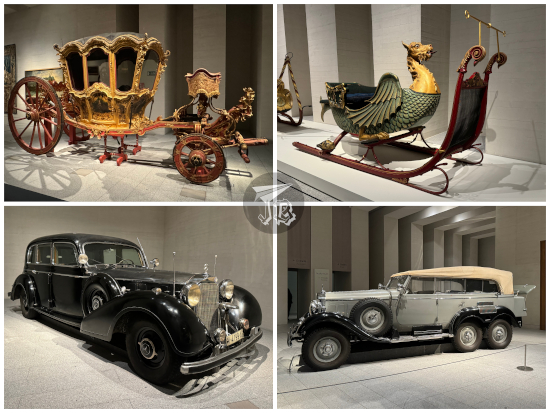
The third floor is a temporary exhibition of royal chariots and cars, including a Rolls Royce, a couple of sleighs, and a sedan chair. It kind of looks that it’s going to be a forever temporary exhibitions though…

Royal Collection Galleries - chariots and cars

The Galleries were rather… underwhelming. After all, there are quite a few royal palaces and sites in Spain, all lavishly decorated, and most of the paintings are in the museum Museo del Prado, one of the largest painting galleries in the world. This felt a bit of a haphazard collection of “stuff we did not know where to host”. I really struggled to find any link or logic beyond “this king bought this”. And even if it was chaotic of sorts, it felt quite short of other places like the Victoria & Albert museum in London. I am not sure they will “fill it up” eventually, or if the main items will remain in their dedicated locations.

Oh, and in case you are wondering why I did not check out St. Patrick’s parade… It was the day before…

9th March 2024: Minerals, fossils & trains (Madrid, Spain)

I might not be the most people-person ever, but if there is something that makes conventions extra fun, it is seeing attendees unapologetically geek out about what they love – in the case of Expominerales, that would be… rocks. Of course, this is an over-simplification. Expominerales is held yearly in the mine and energy engineering school Escuela Técnica Superior de Ingenieros de Minas y Energía (ETSIME) in Madrid. The year 2024 marks the 43rd edition of the event, which is considered one of the most important fairs in Spain in the topic of Earth Sciences – minerals, fossils, gems, and meteorites are widely available to the public. Aside from the small historical museum Museo Histórico-Minero Don Felipe de Borbón y Grecia, there were dozens of exhibitors with all kinds of items for sale, ranging from a few euro to several thousands. These year there were a few lectures, too, and coincidentally, the two of them I was most interested in happened on Saturday, one after the other.

I arrived at the ETSIME around 11:00, and I walked around the stands a couple of times. I have to say that I wanted everything, but I set a budget and I was able to stay around it, after shopping and lunch. At noon, I settled to listen to the lectures – one about the rehabilitation of an ancient gypsum mine in a hamlet called Hornillos de Cerrato, in the area of León. The other one versed about the uses of an already-rehabilitated one in the south of Spain, home to a huge geode. Both of them were pretty interesting, though the conference room was freezing. Someone had forgotten to turn on the heater there, it seemed…

Expominerales 2024 at ETSIME

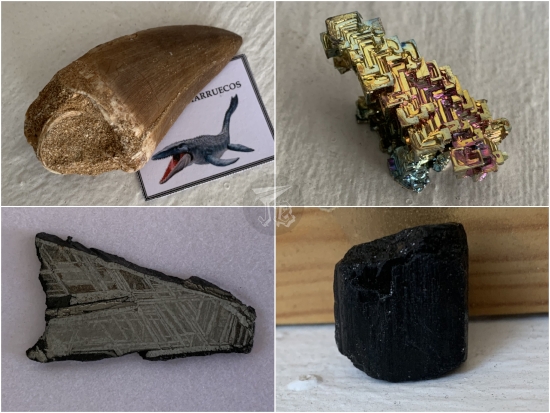
After the two conferences, I had a last round to buy a last thing, so in the end I bought an iron-meteorite pendant, a fossilised shark tooth pendant, a plesiosaur tooth, and a soil sample of the K–T boundary. A plesiosaur was a marine reptile with flippers, a short tail and a long neck. The K–T boundary (now named the Cretaceous–Palaeogene (K–Pg) boundary) is the theoretical layer of iridium-rich black sand that was formed by the meteorite that caused the extinction of non-avian dinosaurs – and basically most life at the time, in one of the great world-wide extinctions in the history of Earth.

Shopping from Expominerales

At 14:30, I had a reservation for lunch at a Japanese franchise called Ramen Shifu. While I had originally been looking forward to trying the ramen (and I got my hopes pumped up when I read that they were Hakata ramen style), the noodles were rather disappointing. Fortunately, the okonomiyaki – Japanese pizza of sorts, made with a base of cabbage and topped with sauce and bonito flakes, was all right. On top of everything, paying was stupidly difficult because they did not have change.

Shifu Ramen ponzano - okonomiyaki and ramen

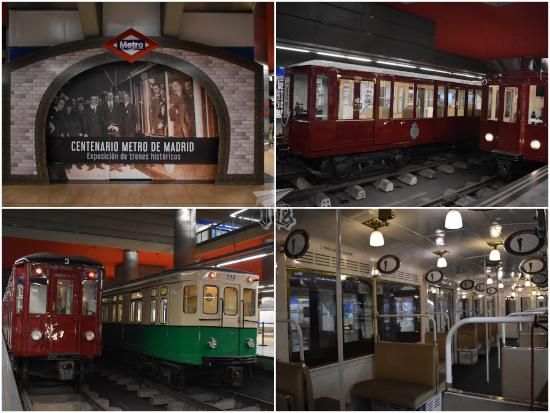
When I came out of the restaurant though, it was raining like crazy. I pulled out my umbrella and hopped towards the closest underground station, as my next destination was inside the metro system – one of the Underground’s museum network Museos de Metro de Madrid the collection of classic trains Estación de Chamartín: Exposición trenes históricos, inside the Chamartín stop. The exhibition displays four historical trains, restored from among the first ones that ran under the city, and some memorabilia. It was a bit underwhelming – more like false advertisement. I hoped I would be able to snoop inside the trains, since that was the photograph that opened the webpage, but unfortunately they were cordoned off. There was however a map with the works by Antonio Palacios in Madrid, which will become handy eventually.

Classical Train Exhibition Madrid

Afterwards, I just headed off towards the train station and got back home.

24th February 2024: Feria de las Mercaderías de San Matías 2024 (Tendilla, Spain)

Going to the Medieval Fair in Tendilla around the festivities of Saint Matthew’s Feria de las Mercaderías de San Matías seems to have become a tradition. Though they close off the village to traffic, I know the area well enough to know where to ditch the car so I can get in and out easily. Since last year, I’ve been driving in early on Saturday, before the scheduled events start so I can help out with the shopping for the day – there’s the tradition of cooking breadcrumbs, migas at my relatives’, and it’s a big meal, so we usually need to get some last-minute stuff.

The weather forecast was miserable – and there was the risk of a huge storm like the previous day, so this year there were fewer stands and visitors. That, in turn, meant I ran into many more acquaintances than usual, as it was harder to blend in…

After getting everything ready, we left the house around 11:30 to walk around the already-set stands and look at the communal migas. There was not much of interest on display. We walked into the women’s association ladies, giving out confectionery items, and we tried those. A bit after noon, the opening parade set off, with musicians, dancers and giant puppets.

Opening parade

Then we found a place at the edge of Main Square Plaza de la Constitución, to watch the equestrian show by the group Caballeros del Alarde, called Privilegio de Juan II de Castilla. It was very similar to the one they did in 2023 – they make sure that the square is covered in sand and prepare two U-shaped courses and they do different activities on the horses, trying to emulate a joust. At the end, they brought out a small hawk – which they called “fat” – so it got used to people. During the show there was a few minutes’ worth of hail, nothing serious. It was chilly all through the day, though.

Stuntment doing horseriding exercises

Afterwards, we went home to make lunch and we happily ate our migas – breadcrumbs seasoned with paprika and fried with garlic and minced chorizo, with a sunny-side-up fried egg on top. Some people like eating them with grapes or orange bits, but I just like them “plain”, so I ate the fruit later.

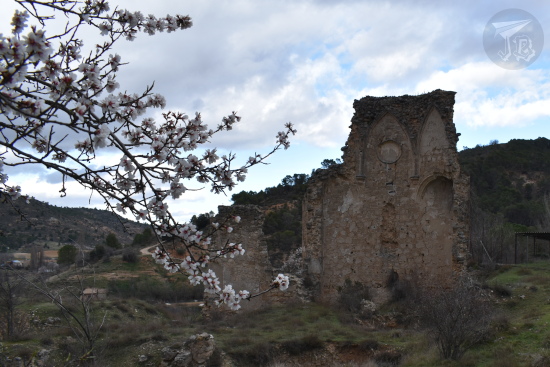
Once fed, family needed to entertain some guests and I made myself scarce. I headed out on my own, and I went to see the animals at the exhibit at Plaza de Vicente Mariño. It was still early and bright, so I decided to climb up to the ruined monastery Monasterio de Santa Ana. As spring was nearly upon the village, the almond trees were in bloom despite the cold, and it was really pretty.

Animals at the farm exhibit - A rabbit, a horse, an ox, a goat, two geese, a pig and a herd of sheep

Saint Anne's Monastery with flowers in the foreground

I went back home and we decided to show up to the “guided visit” that the town hall organised. Right now, this is the only way to see the recreation of a traditional house that has been built in the ethnography museum Museo etnográfico. It made me feel old, because there were a lot of things that I was used to seeing – and using – when I was a kid. However, the guide was… not too good. She even said things like “oh, I’m not rural, I wouldn’t know what that is” about some items.

Afterwards, we tried to find a good spot to watch the parade-show by the cultural group Asociación Gentes de Guadalajara, which started after dusk. They played the funeral parade for the Count of Tendilla Cortejo fúnebre con el catafalco de D. Íñigo López de Mendoza, I Conde de Tendilla. Born in the Mendoza family, one of the most powerful clans during the Castilian Middle Ages, he was a politician and warrior. The Count participated in the power struggle before Isabel I was proclaimed Queen of Castile. He died in 1479, and was originally buried in the monastery Monasterio de Santa Ana. Later, his tomb was relocated to Guadalajara, and eventually destroyed during the Civil War. The whole thing was very solemn, and we ended up catching the parade at three or four points. We even could catch part of it from the balcony at home as they turned to “bury” the Count in the church.

Burial of the Count of Tendilla

We went back to the square Plaza de la Constitución to watch the last show of the day – by now dark night. It was supposed to involve the Knights Templar arriving, and then dancers and jugglers, but apparently the Templars got lost. A lady danced with fire, and there was a scuffle with fire swords, but no knights. That was a bit of a bummer.

Jesters at the Medieval fair

Afterwards, I went to find my car and drive back before all the Sunday drivers finished having their dinner and left. I hoped that would mean fewer idiots on the road. Unfortunately though, I still could not avoid the stereotypical idiot using full-beam headlights behind me. It seems there is always one of those when I drive at night.

23rd February 2024: Zorita de Los Canes & Recópolis (Spain)

Zorita de los Canes is a hamlet at the bank of River Tagus, in the middle of nowhere in the Spanish Central Plateau. It was founded as an Almoravid dynasty fortress (alcazaba), however the stones that erected the castle are much, much older. The fortress was built around the 12th – 13th centuries, and although ruined, it used to be visitable – not at the moment though. The stones to build the castle were quarried from an even older settlement, which today is known as the archaeological site of Recópolis.

During the Middle Ages, Zorita was extremely disputed. After the Moors built the alcazaba, the town was taken over by the Christians, then recovered by the Almoravid dynasty, until it was conquered by Christian king Alfonso VII. The village was entrusted to the Order of Calatrava, the first military order to be founded in the Kingdom of Castile, who were to defend it against the Almohad Caliphate.

I’d been wanting to go to Recópolis for a while, and I found out that the archaeological sites in the area are free until the end of the year, so I thought it would make a nice mini-trip. I booked the ticket a few days in advance as it seemed that the weather would be cold but dry, albeit windy. I thought it could be a good chance before fuel prices go up again.

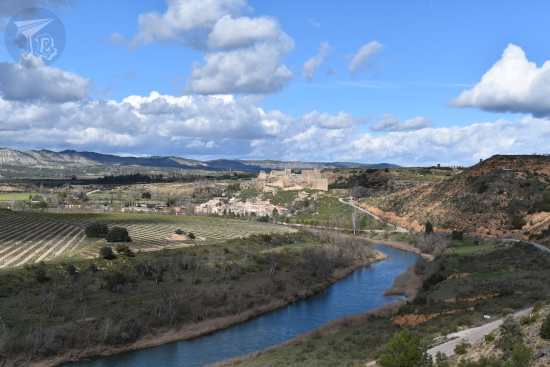
I had an early lunch and drove off with the idea to get to the archaeological site around quarter to three, as I was booked for three o’clock and the ticket said to arrive ten minutes in advance. The drive was a bit faster than I thought, but the Sat-Nav sent me on a completely different route than Google had, which made me a bit insecure about timings. That’s why, even if I saw a couple of villages that looked interesting, I decided not to stop and explore them, I could do it on my way back. Suddenly, the ruined castle came into view. I pulled over in a safe place to admire it and checked the time – I was good. Thus, I drove into Zorita de Los Canes and stopped at a small parking lot at the entrance of the village. I parked next to the river Tagus Río Tajo, which gave me a couple of nice views.

Castle in Zorita de los Canes, atop a hill

Part of the Medieval wall still stands, and access to hamlet’s core is done through an ancient gate, which I was happy to cross on foot. There was a small church, and at the summit of the peak stands the derelict castle Castillo de Zorita de los Canes. I decided not to climb as I knew it was closed, and after a few minutes, I got back into the car and drove off.

River Tagus and Castle in Zorita de los Canes

All in all, I was in town for about a quarter of an hour, and did not drive for longer than three or four minutes before I parked at the entrance of the archaeological site Parque Arqueológico de Recópolis. The interpretation centre was empty and locked, and I was the only car in the parking lot. The time was around 14:30 at that point and I decided to wander around for a bit, as there was what looked like a hiking trail amongst the fields. I found a nice lookout of the castle, but not the ruins themselves.

Zorita de los Canes from far away

The discovery of Recópolis is credited to Juan Catalina García López in 1893. Juan Cabré Aguiló started the excavation in 1945, and found a “little treasure” (tesorillo) of coins from looting (one of them fake). Of Visigoth origin, it predates the Moorish town by a few centuries. It was erected around the year 578 by king Leovigildo in honour of his son Recaredo, who would go on to become the first of the Christian kings of Spain.

The city followed the byzantine pattern. There were two perpendicular streets, one of which lead to the palatial area, with shops to the side. Recópolis became important enough to mint its own coins, but the crisis of the Visigoth state lead to it conquest by the Moors in the 8th century. The city was slowly abandoned and became a quarry for the nearby settlement of Zorita. Later, in the 11th century, Christian settlers built a church and a small village, which had been abandoned by the 15th century.

The whole archaeological area spreads 30 hectares, out of which eight have been excavated. The interpretation centre has a few replicas of artefacts that have been found – due to security concerns, no originals are kept on site. To be honest, I was not surprised – I could have walked into the site and left without anyone stopping or even seeing me. When I arrived, it was me and the vultures, and I had a bit of a flashback to that time at the cave Cueva de los Casares, and even fantasised a little about being alone to explore the site. The guide arrived on time and opened the centre, and I was still the only one there, which was weird – I know for a fact that there were a bunch of reservations for 15:00, but only I showed up. Maybe the others became discouraged because of the weather?

The nice tour guide suggested waiting for a few minutes to give time for others to arrive, and offered me the VR experience. I accepted, of course – I’m not going to turn down such a thing. It was really fun, because you could pick up objects as the local goddess and a little child showed you around a reconstruction of the town, the palace and a glass workshop.

Afterwards, we headed off towards the ruins – nobody else had shown up. The guide offered to let me stay after the tour to take all my pictures so I decided to just listen to him as he explained and pointed to some very interesting details – a bit giddy inside. Would I really be alone eventually? He showed me the church, the palace and the grain silos in the ground, where grain was stored. He also took me to the palace and pointed out the main streets, and taught me how to differentiate the Moorish construction (criss-crossed materials) from the original Visigoth one (parallel architectural stones).

We also chatted a little and I mentioned I hoped it did not rain – he said that it had been threatening rain all week, but it would be all right. I eyed the black cloud approaching and hoped he was right.

Spoiler alert: he was not.

After finishing the guided visit, I was left alone indeed. I went around the main area of the archaeological site, and when I was in the church, the storm broke out. I had an umbrella, but I still got drenched. Interestingly though, even if it was raining and windy, it was suddenly not as cold as before. However, I had to give up eventually, since taking pictures was too difficult. As I decided to return to the visitor centre, the cloud finally moved through, and rain slowed down. I was heading down the hill towards the visitors’ centre when it finally cleared completely. I stopped, wondering whether to leave or come back, and when I looked up I saw a rainbow, sprouting right out of the castle. There were even vultures flying against the retreating cloud. It was really cool.

Rainbow hitting the castle, and a vulture flying

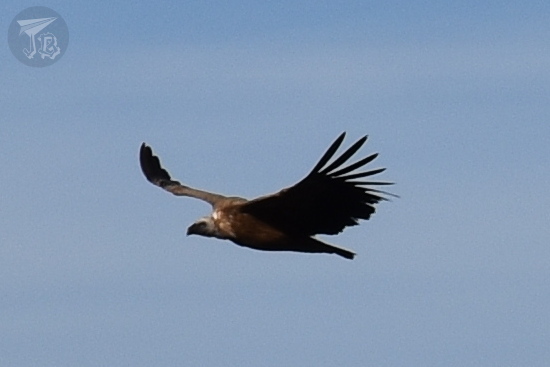
I felt motivated again, so I went back to the ruins of the city to take a few more pictures – after all, it was really cool to be all alone in the archaeological site. I wandered among the houses where it was allowed, and went to the edge of the site to take it all in, then I walked back. As I was in the middle of the street, a griffon vulture circled me a couple of times, maybe wondering if I was food – I think staying where I was taking pictures did not help? It eventually left, and I headed back to the centre, where I arrived just in time to watch the little video documentary about the Visigoth town.

Ruins of Recópolis

Recopolis ruins

Griffon vulture mid-flight

I left afterwards, and I got caught in the storm again – thus I did not stop in any village on the way. The first half of the drive was miserable in the rain, but then it cleared out, and the rest of it was all right. Fortunately, I did not run into too many other cars either. I got home around sunset and went to bed early since I had to wake up early the following day.

Nevertheless, now I’ve got a VIP (VOP? Very only person?) experience, alone in an archaeological site, which is added value to the whole thing and I loved every second of it, even with the rain.

17th February 2024: Hita, Medieval villa (Spain)

Today, Hita is barely more than a hamlet at the foot of a hill, lost in the middle of the Spanish central plateau, in the Guadalajara region. Its origins date back to pre-Roman times, and the settlement was first recorded in Roman roadmaps. The area later became part of the Caliphate until 1085, when it was conquered by king Alfonso VI and the town was incorporated to the Crown of Castile. The town flourished in the Middle Ages. In the 14th century, a then-famous poet, known as Juan Ruiz, the Archpriest of Hita (Arcipreste de Hita), wrote one of the most important literary works in Spanish-speaking history, the Libro del Buen Amor (Book of Good Love), a bit of a parody of the local society of the times in poem form.

Also in the 14th century, the lord Íñigo López de Mendoza took over the region. He rebuilt the castle from the ruined Moorish alcazaba and erected a wall around the settlement. However, the village eventually lost its importance, inhabitants, and vineyards, as the feudal system evolved. It was mostly destroyed during the Civil War in the 20th century. In 1961, historian Manuel Criado de Val wrote a play based on the Book of Good Love and it was played in the town square. People liked the idea, which eventually grew into the town’s Medieval Theatre Festival. It revitalised the village a little, and the first summer of June, the town fills up with plays, a marketplace, tournaments and jousts, and people dressing in period clothing. Today, Hita has fewer than 300 inhabitants, and it’s trying to build a reputation as a picturesque day trip “Medieval villa” – it has even built a visitors’ parking lot.

We arrived around 11:00, and left the car at the entrance of the village, in said parking lot. By 11:20 we had walked by all the whole historical centre – which, given how the town is promoted as a Medieval marvel, was a little underwhelming. We parked in front of the area named stockade or palisade, Palenque, where the medieval tournaments are carried out. Its construction is fairly recent, so it does not hold any historical importance outside the festival.

Stockade in Hita.

Next to the Palenque stands one of the remaining sections of the medieval walls Muralla Medieval that still remain around the village. There is also the sculpture of a semi-mythical figure – Álvar Fañez de Minaya. Minaya was Rodrigo Díaz de Vivar, El Cid’s, right-hand man. El Cid’s deeds are known from the Spanish epic poem Cantar de Mío Cid, which presents him as someone akin a Round Table knight. Though he probably did exist – along with his lieutenant – he was probably more of a mercenary and a warlord than the legendary hero.

Sculpture of Minaya in front of the medieval wall

The access to the historical centre is done through the stone gate Puerta de Santa María, the only one of the wall entrances that has survived – although it has been heavily restored. It was originally an arch, in civilian gothic; today the upper part is completely reconstructed, with two turrets. In front of the gate stands the pillory Picota, which signals that in medieval times there was a justice department.

St. Mary's gate into the town of Hita.

The village is small, and mostly uphill. There is a main square, some ruins, and a church. Since the church was closed and we could not snoop around, we decided to visit the local museum and sign up for the guided visit that was offered, as they would open the visitable monuments up.

The museum, Casa Museo del Arcipreste, multitasks as archaeological display, ethnographic museum, festival promotion, and recreation of the Archpriest’s writing chamber, with some facsimiles of the pages. There are masks from the festivals, and the town’s botargas.

Hita - local museum

When the guided visit started, we first overlooked the landscape. We got a commentary of the location of the village and its historical importance, and the kind of soil and crops that used to and still are grown in the area. I had chosen the weekend because the weather was going to be nice, and it was – especially no wind, which would have made things awkward.

We then visited the ruins of Saint Peter’s church Ruinas de la Iglesia de San Pedro. Originally a Romanesque temple turned mudéjar, it was blown up during the Civil War. Today, only the altar stands, and it is used as stage for cultural acts. As a memento of its original mission, the town has kept the tombstone of the last governor of the castle before it was destroyed, still on the ground.

Hita - Ruins of St Peter's church

We moved onto the church Iglesia de San Juan Bautista. The building was erected in the mudéjar style throughout the 14th and 15th century. The tower is herrerian, erected in the 16th century. Inside, the most remarkable detail are the wooden ceilings, also dating from the 16th century. The floor is sprinkled with gravestones that used to be in the other church. There are two baptism fountains, and a small statue of the Virgin Mary with the Child, carved halfway between Romanesque and Gothic styles. Then she was embellished with baroque jewellery.

Hita - Church of St John the Baptist

Thankfully, we only looked at the ruins of the castle,and did not climb up to it – today, only a wall and the base of a tower stand, high up the hill that in the Medieval Age controlled the whole plain.

Ruins of the castle in Hita

Instead, we were invited to peer into a bodego, a traditional cave-house. The one we saw was restored, but it felt pretty authentic. There was a bedroom, a kitchen, and the end of the dwelling was more cave-like, working as stable and barn. The smell was damp, and it was good that they’ve put electric lights on it, because the tiny windows would have made it a little claustrophobic.

Cave house in Hita

We then descended towards the main square Plaza Mayor, which was the old marketplace and even older synagogue. A hollow on the wall has been used to recreate a cell where the Archpriest was imprisoned. Opposite the wall, there are popular architecture houses, with typical porticos.

Main square in Hita

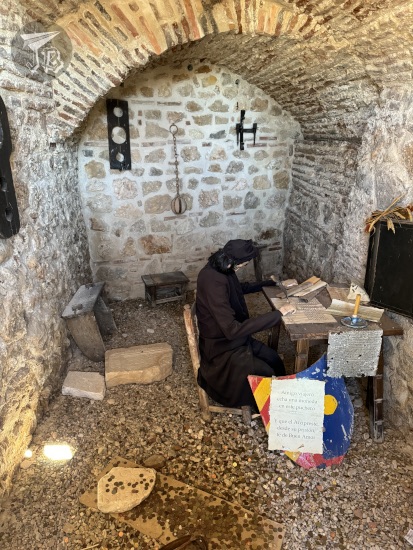
The Archpriest's cell

To end the visit, we looked at the gate Puerta de Santa María, and then were invited to see a traditional wine cellar excavated into the medieval wall. Though wine production was abandoned long ago, the cellar Bodega de Doña Bellida still exists with its traditional structure and huge clay vessels. It was excavated into the mountain, just like the bodego.

Wine cellar and jars

There was not much more to see in the village, so we just headed off afterwards. I was a bit underwhelmed about the whole thing, I am not going to lie.

13th January 2024: Commemoration of Ricardo Velázquez Bosco in Guadalajara (Spain)

In general, I’m not a fan of guided visits, but I’ve learnt to accept that they are sometimes the only way to get access to several monuments. Thus, I signed up for the free* “themed visit” about Ricardo Velázquez Bosco in Guadalajara. The route was organised by the town hall to commemorate the centennial of the architect’s death in 1923 (I know it’s 2024, the activities started in 2023, but they spread through January).

Velázquez Bosco is considered one of the most important architects in the Spanish late-1800s – early-1900s. Among his works are the Spanish Crystal Palace and the Madrid mining school. His style has been called “emphatic eclecticism” and described as eclectic historicism with academicist tendencies – which basically means that he did not like Modernism, and preferred combining historical styles instead.

In Guadalajara, he worked for the most important noblewoman of the period – the Duchess of Sevillano and Countess of La Vega del Pozo, María Diega Desmaissières y Sevillano (Duquesa de Sevillano y Condesa de la Vega del Pozo). The Duchess lived in Madrid, but was connected to Guadalajara through her aunt, Catholic Saint Maria Micaela, founder of the nun order known as Handmaids of the Blessed Sacrament. The Duchess of Sevillano (known in town as “the countess”) had a lot of buildings erected in Guadalajara and around it, most of which are now private property and have a very-limited-to-inexistent visit regime. The town loved its countess since she commissioned (also to Velázquez Bosco) the farming hamlet Poblado de Villaflores – the construction and subsequent agriculture and livestock activities created a lot of work in the area.

To honour her aunt’s charity work, the Duchess ordered Velázquez Bosco to build a school and an asylum, and though she never really lived in Guadalajara, she commissioned him to build her a palace when her Madrid home was expropriated. She never got to live there, as her heart failed in Bordeaux at the age of 64. She was buried in Guadalajara, in a pantheon that she had also ordered the architect to erect for her.

Today, both the asylum and the palace are schools, and cannot really be visited. The pantheon is privately managed by a private foundation Fundación San Diego de Alcalá, which also manages one of the schools, the adjacent gardens, and the church of the former convent.

The first stop of the visit was the pantheon Panteón de la Duquesa de Sevillano. It is a small eclectic building, the inside is a Latin cross, the outside is a homage to the First Romanesque buildings, with neo-Gothic ornamentation. The characteristic purple dome and the interior mosaics are of Byzantine influence. The crypt is a false one, as the pantheon is reached by climbing up a monumental staircase, so when you “go down” to the crypt, you are actually at ground level. The Duchess’ sepulchre, carved in marble by modernist sculpture Ángel García Díaz, represents the funeral procession. We had to pay 1 € in order to visit the pantheon, as there was no agreement between the town hall and the foundation.

Ducchess of Sevillano's pantheon

Ducchess of Sevillano's Pantheon

We then were taken to another of the foundation’s buildings, the school Colegio Niña María Adoratrices. Today is a semi-private Catholic centre run by nuns from the congregation founded by Saint Maria Micaela. The school cannot generally be visited, so I was glad this worked out. The school building was erected in red brick, with a white limestone façade echoing the Renaissance building of the University in Alcalá de Henares. The school used to be a convent, and there is a restricted cloister. Legend has it that the cloister is only open for wedding photographies to brides who studied at the school. It is square, with two stories of neo-Romanesque arches and columns with vegetal decoration. We were also shown the chapel, with neo-Mudéjar panelling on the ceiling, and the monumental staircase.

Adoratrices School Guadalajara: Façade and cloister

Adoratrices School Guadalajara

Finally, we walked to what was built as the Duchess’ palace in Guadalajara, Palacio de la Condesa de la Vega del Pozo, today another school, Colegio de los Hermanos Maristas, also Catholic and semi-private, and extremely difficult to visit. We were shown inside and got to see the actual outline of the palace. Inside, we saw the panelling and the ceramic decoration before we reached the inner patio, a mix between Castilian and Andalusian styles.

We then visited the smoking room upstairs, an astonishing ward with ceramic tiles decoration and wooden floors. As a last snoop, we could peek into the balcony, which keeps the original cement-tile (baldosa hidráulica) floor. It was extremely impressive – and one can forgive the horrible pale yellow exterior the palace has been painted. Ricardo Velázquez Bosco was one of architect Antonio Palacios’ teacher, and I had the feeling that Palacios took his ideas for the Fundación San Diego de Alcalá, Panteón de la Duquesa de Sevillano, Colegio Niña María Adoratrices, Colegio de los Hermanos Maristas, Maudes hospital from the walls and floors of this palace.

Maristas school, former Duchess of Sevillano's Palace

Maristas school, former Duchess of Sevillano's Palace inside

The visit took around two hours, and it was free except for the pantheon. Being able to see the inside of both schools was the best, because it is rare that visitors are allowed in either. Thus, I am glad I signed up for this, especially as the weather held – we had a tiny bit of drizzle, but not much, and the clouds kept the cold at bay.

16th December 2023: A day out of ExpoGema (Madrid, Spain)

Since the mineral expo ExpoMinerales back in February was all cool and fun, I decided to attend its shinier (and unbeknownst to me, way more unaffordable) sibling, the gem expo ExpoGema, and make a day out of it. Thus, I headed out for Madrid on the 9:00 train with temperatures below zero – I was not made for winter. It was not much better when I arrived, but for once the train ride was uneventful, I actually made my connection, and it seems that after a chaotic year, the underground train tunnels are finally open. Everything going smoothly gave me some unexpected 45 minutes to wander around as the square Puerta del Sol slowly became fuller and fuller with people.

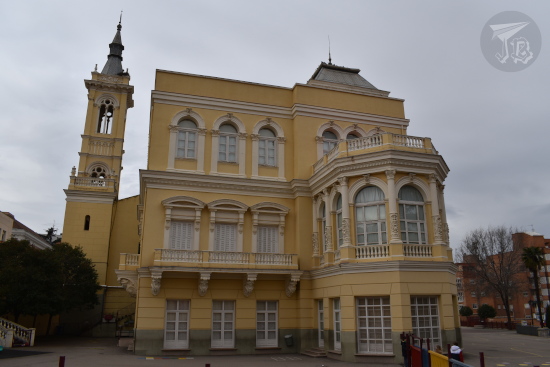
I had booked a guided visit through the company Madrid en Ruta, who has the exclusive concession to show the business centre Casa Comercial Palazuelo. Located in downtown Madrid, it was designed by architect Antonio Palacios. The promoter, Demetrio Palazuelo, bought the lot left behind by a fire, and commissioned the building with the goal of renting it out to shops and professionals – it was thus the first office building in Spain conceived as such, and not repurposed from a manor or an apartment building. Palacios drew inspiration from the Chicago School commercial architecture and used iron to stabilise the building, which allowed him for bright interiors using lots of glass. The office building was erected between 1919 and 1921, and the offices are still rented out today, with the only caveat that the beautiful interior translucent-glass doors have been painted white – to either protect privacy or hide the fact that today the house seems to be almost empty – at least according to the building’s own directory.

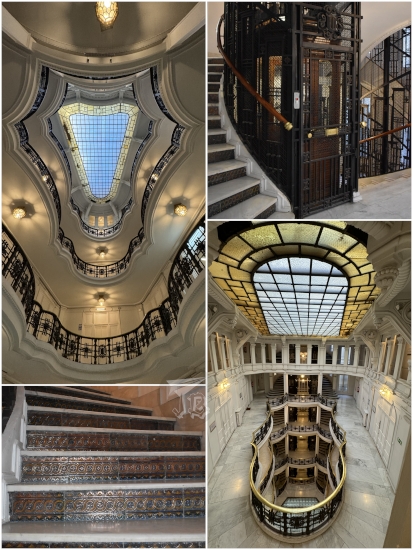
The exterior façade could be considered eclectic – the main frame tends to neoclassicism with huge glass windows framed in black iron. The interior tends towards Art Deco and modernism. The offices are distributed around a central indoor patio, with curved balconies that overlook it and lots of lights mainly due to the skylight. There are two classical lifts which are the original ones, in peartree wood. When we went up, I took the stairs, which have white treads, and the riser is made out dark green ceramics. I have seen these in other works by Antonio Palacios.. The interior, with the iron balustrades and its curvy design, was really cool, but I think it is really a pity they painted over the glass.

Interior of Casa Palazuelo

The visit started at 11:00. We spent the first fifteen minutes outside getting context, roughly half an hour inside, and the last twenty minutes on the roof of the building, waiting for the clock of the Puerta del Sol to strike 12:00, then we were ushered out. I really wish we could have wandered the house a little bit, even if we could not go into the offices. The ten euro we paid surely did not feel like we were paying customers, but more like we were sneaking around like unwanted guests – which we probably were anyway.

Puerta del Sol from the roof of Casa Palazuelo

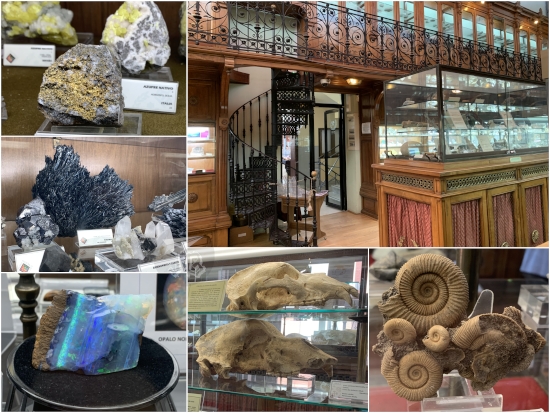
I grabbed a quick snack then and headed off towards the engineering school Escuela Técnica Superior de Ingenieros de Minas y Energía (ETSIME) for the sixth edition of the gem fair ExpoGema. The fair itself was neat, but most everything was way above my budget range. I was there at the typical Spanish lunchtime, there were few people, and most were at the stands. Thus, I had the museum Museo Histórico-Minero Don Felipe de Borbón y Grecia almost completely to myself. I really like old-style museums, and this one has a huge amount of specimens, most of them are minerals, but there are also fossils and a collection of cave bear skulls and bones. I had decided not to book any guided visit or activity as none happened within the couple of hours of lunch downtime.

Geology Museum at Etsime

I bought an ammonite pendant, a small pyrite with almost perfect right angles, and another pendant made with a small meteorite from Campo del Cielo, along with a tiny extra piece. Campo del Cielo is an area in Argentina where four or five thousand years ago an iron meteorite fell. The meteorite shattered upon entering the atmosphere and, when it impacted the surface, the different created up to 26 craters. About 100 short tonnes of a fragmented iron meteorite have been recovered to date, and I now own around four grammes of it – yay me. I did not buy any precious stone though since the pretty shiny rocks were way out of my budget.

Expogema 2023

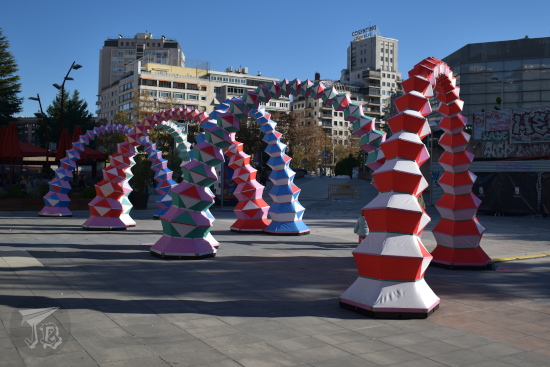
I left the ETSIME and I walked towards the square Plaza Pablo Ruiz Picasso, where there is a temporary art installation called El Regalo (The present) by Amigo&Amigo, a studio specialising in art installations. The artwork comprises a few arches that end in pads that can be stepped on – when they are, music sounds. The day was still bright, so the artwork was not shining, but a bunch of kids jumped on the pads to keep the music playing.

El Regalo artwork

Afterwards, I took a train and headed off towards central Madrid again. I had a reservation for an afternoon tea at NuBel, an “avant-garde gastronomy space” in the modern art museum Museo Reina Sofía. I had been drawn to the place due to the “freshly-baked scones” they advertised.

The experience was beyond disappointing. First, I had to wait to get seated, but then the person who checked me in forgot to notify that I was there – this is what I assume happened, I was literally told that “the kitchen had forgotten about me”. The set menu took 40 minutes to come out, and the scone was cold anyway, so not even freshly-made. I had got a decaf latte that was also cold when the food came.

The menu, 16€ as I don’t drink alcohol, consisted of: two mini-sandwiches – the two of them had been made from the same bread slice, so you can imagine the size, with some kind of mayonnaise filling which was not bad but rather unidentifiable; one shot-sized glass of (pre-made) gazpacho; one scone; a piece of red velvet cake; a piece of carrot cake; one chocolate brownie; a side of cheese cream, butter and jam; and in my case the already-stone cold decaf latte.

Nubel afternoon Tea

The scone was cold – so much for freshly-made, the only thing that had kept me waiting. Furthermore, the cheese cream, albeit nice, did not fit it like at all, so I had to use butter on it. I laughed to myself thinking about “the horror!” while I clutched my metaphorical pearls. The red velvet was probably the best, but in general the cakes were too sweet – good thing the menu included free tap water. Afterwards, I was comped another free decaf as an “apology for the delay”. However, when I tried to pay, more drama ensued. First the card-reading machine was not working, then they could not take cash because they were balancing the register, then they could bring the machine to the table. All in all, I spent almost hour and a half there – about five minutes waiting to be seated, forty minutes waiting for the tea set, and twenty minutes trying to pay. I’m sorry to say I did not tip, nor do I plan to ever come back.

I missed my train due to the paying delay, and I had to wait almost half an hour for another one. I hung out the Christmas market for a bit, and looked at the lights around Puerta de Atocha station. As it was cold, I walked in and went to check out the original train station, now turned botanical garden. I had never stopped to look at the iron ceiling, just at the plants – and the tortoises people used to dump there – but there had been an old photograph during the Casa Palazuelo visit that made me want to look at the building itself, and I recognised that old station in today’s building, with its wrung iron columns. Funny, how you can look at the same old things and recognise them.

2nd December 2023: Iron balconies and croquettes (Madrid, Spain)

I wanted to do a full day in Madrid this weekend, but ticketing did not align, thus I had to organise two half days. So on Saturday morning I set off for an 11:00 visit to Frontón Beti-Jai. A frontón is the court where games of Basque pelota (pelota vasca) are played. The term refers to a number of sports that use a small hard ball which is hit by the players so it bounces off the vertical walls of the court. Depending on the specific variety, the ball can be hit with the hand, a racket, a bat or a type of basket, and it can bounce on one or two walls of the frontón as long as they are at right angles with each other. Basque pelota is mainly played in Spain and France, and it is also popular in some Latin America countries. Though it was originally included in the 1900 Olympics, it has only been played as an exhibition sport and never in competition.

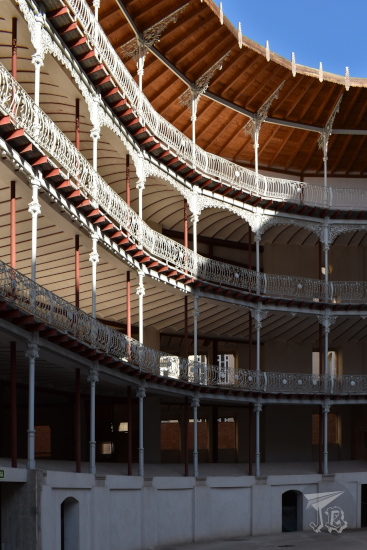
In the 19th century, Basque pelota was a popular and lucrative business in Spain, especially in Madrid. In 1891, businessman José Arana commissioned architect Joaquín Rucoba to build a frontón in Madrid, “similar to but better than” the one in San Sebastián, the original Beti-Jai. The capital’s Beti-Jai (“always party” in Basque) was placed in the district of Chamberí, witch construction starting in 1893. The architect designed a white-and-grey outer façade in an eclectic style with Neoclassical reminiscences in order to blend with the mansions in the area at the time, and a red-brick Neomudéjar secondary or side façade. The inner wall that stands behind the main entrance is also Neomudéjar. The playing court is plain concrete, and he whole area is shaped as a half-ellipse. There were long-lost stands on the ground, and three upper stories supported and adorned by cast iron balconies and columns, with a wooden roof on top. The decoration on the balconies is different for each floor.

The frontón opened in 1894 and it hosted games until 1919 – it is said that the crackdown on the betting systems and loan sharks caused Basque pelota to slowly fade out of fashion. Throughout the period and afterwards, it also had some alternative – and creative – uses, among them aeronautical experiments by renown engineer Leonardo Torres Quevedo, car workshop (a few times in different years), motorbike shop, political hotspot, even industrial bakery. The stands were eventually walled off – which protected the ironwork. Though both in the late 1970s and the early 1990s the building was “declared” as protected, the structure was eventually left to rot. The building was bought and restored by the Madrid Town Hall between 2010 and 2019, finally attaining protected status in 2011. It is the largest and oldest frontón standing.

Frontón Beti Jai inner façade and stands

I like cast iron architecture a lot, which is why I signed up for this Pasea Madrid guided visit. We did not get a nice and knowledgeable guide this time, so I mentally checked out. She was not just nervous, she read the whole visit out of a phone, gave some wrong or plain false information, and relied on people “knowing things” and “having visited places”. I wandered around taking pictures and approaching the group periodically trying to fish out any interesting bit of information, until the guide grew tired and kicked us out when most people decided to just stand in the sun, even if there was some time left. People who had been listening to her had barely any time for photographs.

Fronton Beti Jai Stands.

After the frontón, I had a reservation for lunch a restaurant part of a franchise specialising in croquettes, is called Solo de Croquetas Zurbano – a pun between “only croquettes” and “croquettes’ solo”; Zurbano is just the street. It has been a bit of a buzz lately so I was really curious about it. The place was organised in three floors – a bar on the ground floor, a loft-like seating on the first floor and a bigger restaurant-like area in the basement.

Though the Internet said the restaurant opened at 13:00, I was offered a reservation at 12:45, which I took because I did not want to be wandering around in the cold for too long. I was not extremely surprised though when I popped by at the reservation time and it was indeed crossed. I ended up wandering for a while before 13:00 came up and I could sit down. I decided to try a basic “croquette tasting”, which includes six savoury croquettes two sweet ones, and a drink. There are three lists to choose from, and I took the B-set:

  • Rulo de cabra con pimiento caramelizado, goat cheese roller with caramelised red pepper – happy to report the pepper was barely distinguishable, just added some colour to the filling. Very cheesy, cheese is always good.
  • Boletus con trufa, boletus with truffle. Lots of mushroom, little truffle, but okay. I’m not that much of a truffle fan anyway.
  • Provolone con tomate seco y orégano, provolone cheese with dry tomato and oregano. There is never such a thing as too much cheese.
  • Cachopo; a cachopo is a typical dish from the North of Spain that consists on two beef steaks with a filling between them, and everything breaded, which I ate once in Astorga. This one was weird.
  • Cecina con puerro y queso gorgonzola, beef jerky with celery and gorgonzola cheese. Probably my favourite out of the savoury ones.
  • Sobrasada de Mallorca con queso Mahón, sobrassada (cured pork sausage filling) with Mahon cheese. All right.
  • Croqueta de Oreo con chocolate blanco, Oreo and white chocolate. Rather good, which is surprising considering I don’t even like Oreos…
  • Croqueta de Cheesecake con frambuesa , Cheesecake and raspberry. Surprising, to say the least.

Solo de croquetas tasting

All in all it was good. The croquettes were decently sized and had distinctive flavours. The set felt a bit scarce though. Not that I went hungry, but I could have done with another couple of croquettes. I think it is what they are counting on – the tasting is okay, price-wise, considering the novelty (18.50 €), but if you want anything else, the meal will get very expensive very fast. I guess it is noteworthy that all croquettes are gluten-free, and the tasting has a lactose-free set and a vegan set.

I left the restaurant and walked towards the train station. On the way, I was distracted by the small Christmas market, more precisely by the a gorgeous 1900 merry-go-round that had been installed among other attractions. I had a bit of a walk around to check out the stands and then I went to wait for the train – which was, predictably, delayed.

Carousel in Colón Square

26th November 2023: A Bunker and a Greenhouse (Madrid, Spain)

I have been to the park Parque del Capricho in Madrid before, and I was not really impressed. As it is considered a “hidden gem” in town, I expected something… I don’t know… more grand? It has different “attractions” such as a bee hive, a casino, ponds, fountains, statues… quite into the Romantic spirit of the times it was built, but I really did not connect with its design. I have to admit though that when I first visited I did not register the locked-down door with the word “bunker” surrounded by a brick structure next to the palace. It turns out, there is a Civil War bomb refuge 15 metres underneath the grass (I did see a machine gun spot in the grounds of the nearby castle, which was actually installed there to protect the military position). The refuge is a place you can only visit through the town hall’s Pasea Madrid program, as it is usually closed to the public.

The park was built as a recreational garden between 1787 and 1839 at the whim of the 12th Duchess (and Countess) of Osuna, who placed a summer house Palacio de los Duques de Osuna, in the centre of it. It became wildly popular among the high classes at the time – just like walking around cemeteries had become popular in France and England. However, at the turn of the 20th century the park had dwindled in fame. It changed hands, and after the 1929 crash it became all but abandoned. With the advent of the Spanish Civil War, the palace became an orphanage first, and it was later confiscated by the Republican government to be used as military operation centre. General José Miaja was in charge of defending Republican Madrid from the military coupists and moved the emergency command centre from downtown to the so-called Posición Jaca in the outskirts. The park was chosen because it is close to the airport, and it was easy to deploy defence batteries. Some of the most important battles in central Spain were “supervised” from there.

The day started dark and gloomy, so I picked up a thick coat – the webpage also noted that the temperature in the refuge is around 15 ºC. Public transport was just not feasible – round trip would have been about four hours by train – so I took the 40-minute drive and parked in the main avenue, a few minutes away from the park entrance. I had calculated a wide berth of time because I was not sure how easy it would be to park, but I apparently got there before the family weekend-makers. I was early for the 11:00 tour, so I just hung out the park for a little. By the time I walked in, the weather was nice and sunny.

One of the buildings in the park is a miniature farming house that today has an equally-tiny orchard with cabbages, cauliflowers and… a pumpkin patch. I swear, I had never seen a pumpkin patch before, not one so… colourful. I walked around for a little, then waited for the guide to arrive.

Pumpkin patch in El Capricho

The Civil War bunker or refuge Búnker del Capricho was built next to the palace where the command was set, excavated into and down the small hill. It was designed to withstand bombings, and protect its occupants from chemical attacks – people were rightfully freaked out as World War I had yielded to the development of chemical weapons. Building the refuge was commissioned to miners-turned-soldiers, who were able to finish it within the first few months of 1937. In case of an attack, the palace would be evacuated from the doors and windows, the personnel would go down into the refuge and close and lock the doors. Once operational, the refuge could host 200 people for up to two of weeks.

The bunker is dug between 14 and 16 metres into the ground. The walls could withstand most bombs designed at the time, with some of them being over two metres thick. The thirty-metre gallery could be sealed with submarine-like doors – designed by marine engineers – and keep out any toxic gas. There is a ventilation system and different wards on the sides, one of them identifiable as an operating theatre, another as a shower room. The floors are tiled, with different patterns for different rooms – the theory is that the patterns would allow anyone to know where they were even in low visibility conditions. The gallery is tiled too, but in white, and it has round ceilings, also painted white – also in theory, this is to counteract the claustrophobia from being underground; this idea was also applied when the first underground stations were built in Madrid.

Upon entering the bunker, there are two flights of stairs at a ninety-degree angle to each other. Then, there is another right-angle turn to enter the actual refuge. There are two metal doors that could be hermetically shut, now peeled-off and rusty, but which really look like ship or submarine safety doors. This design minimises shock waves and blocks any gas that could be used against the Republican Command. The structure is bigger and wider than I thought it would be.

Underground refuge in el Capricho Park

I guess it is part of the Spanish history, so good enough to see once and then move on – know about history not to repeat it, but do not dwell in it. Which is what I did. Once the guided visit was over, I wandered the park for a little. I found the park miniature fortress, the lake with its black swans, and the small casino. I was hoping for some nice autumn colours like I saw a couple of weeks before in Retiro Park, but there was not much on that front. I however did come across a few bees hard at work.

Black swan feeding

Honey bee on purple flower

I left the El Capricho and went across the avenue to walk into the neighbouring, bigger park Parque Juan Carlos I. I wanted to see the so-called Estufa Fría – just a fancy name to call a greenhouse. The greenhouse did have some pretty autumn colours in the Japanese garden, as the small maples (Acer palmatum) had started turning gold and red. The structure hosts palm trees, ferns, a small “bamboo grove” and an autochthonous forest that was composed of mostly evergreen plants and ivy. I had no idea that the Estufa Fría even existed until a few days before, so I guess I’ll need to keep it on my radar for future springtime visits – I want to see the blooming cherry trees in that park anyway.

Estufa fría or cold greenhouse in Juan Carlos I park

It was not much of an outing, barely a few hours, and I was home for a late lunch. I did not want to stay out long, as that evening I had tickets for the opera.

12th November 2023: Trains and Parks (Madrid, Spain)

I had booked a visit for 15:30 using Madrid’s program to divulge the Heritage of the city Pasea Madrid (“Walk Madrid”), and I had planned a great day around it. Unfortunately, such plan had me on the best train to get to the demonstrations happening there at noon and therefore it would most likely be “delayed due to uncontrollable circumstances” or worse. Thus, I needed a new plan. Since there was a yellow weather-alert in effect across the parks in the area I wanted to be , I just drew a general list of places I could check out and decided to keep it flexible.

The day did not start off as I had imagined it. I slacked off a bit in the morning and by the time I was ready to leave, it was too too late to catch the original train of the second plan. There was part of me which was really not in it, and I considered just cancelling the visit and staying home. Then again – I reasoned with myself – the visit was sold out every other day, I had been lucky to secure a spot. I did not know whether I would be lucky enough to be free when the next batch of tickets were released, nor if the dates were convenient – if they ever opened again, or as the webpage said, it was a “special occasion” (honestly, I think that they just say it is to hype up the reservations). Thus I set off to catch the next train, still in good time for plan B as it was flexible and I could just kick one stop off if necessary.

Once in Madrid, I headed off to the Railway Museum Museo del Ferrocarril, technically closed that day due to the monthly flea market Mercado de Motores. It turns out that the ground floor of the museum is still open, which allows you to have a look at the main train collection (actual historical trains) and take some cool pictures. For once, I was not the only one with the camera, but one among a bunch – to the point that a few of us ended up queueing for a similar picture at some point.

The Railway Museum is located in what remains of the former terminus of Delicias, which opened in 1880. Designed by French engineer Émile Cachelièvre, it had three distinctive areas – the passenger building, the loading docks, and the customs building. The last train left the station on the 30th July 1969, at 22:15, headed for Badajoz. In 1984, the Railway Museum opened in the passenger building, which kept the former platforms.

Fleamarket at the Railway Museum

I am not sure how crowded the museum is during normal days, but for the market, it was packed. I had secured a free entry reservation, just in case. The main building hosts a number of actual trains which serviced passengers and cargo throughout Spanish history – real locomotives and cars on the tracks they used to travel. Before Covid, one of the cars was used as cafeteria, and another as an Orient-Express-inspired restaurant, neither of which are in active now. Though the side rooms of the ground floor and the upper floors were closed due to the market, I got to see the trains from the outside and admire the building structure.

Railway Museum Madrid

In the outer part of the museum, I found the food court and the former tracks which disappear into the nearby park. To the side stands the miniature train complex Ferrocarril de Las Delicias a layout of tiny trains – a 265-metre long, 127-millimetre wide track, to be exact – where you can travel on equally-scaled trains, with classical tickets and all. My original idea had been riding it, but I found a great spot for photographs and decided not to queue through all the toddlers and their parents. I thought that since I wanted to go back to the museum to see all the rooms, I could do that on a day when the tiny trains were running.

Miniature trains in Delicias

I left the station-turned-museum and walked towards the so-called Pantheon of Spain Panteón de España, a burial site for remarkable Spanish politicians, noblemen and military personalities – formerly known as the “Illustrious Men”. Before mobile phones with a camera were a thing, my school took my class to the crypt, but nowadays only the upper area and the gardens can be visited. The original plan, designed by Fernando Arbós y Tremanti in the Neobyzantine style, comprised a basilica with a bell tower and a cloister. The project began in 1891, but only the tower – now part of a school – and the cloister had been built when construction stopped in 1899 due to astronomical costs. In the cloister, there are funerary monuments to a number of important Spaniards who were exhumed and reburied there, such as Mateo Sagasta, Antonio de los Ríos y Rosas, Anonio Cánovas del Castillo or José Canalejas. Eight tombs and a central monument can be visited in the cloister and the central garden. The entrance is decorated with golden mosaics, and the interior is white calcite and grey slate, with domed rooftops. The central garden had flowering winter roses and a view of the abandoned bell tower.

Pantheon of Spain

I headed out towards Madrid’s main park Parque del Retiro, part of which had been restricted until noon due to predicted strong winds. The weather, however, was fantastic, even warm, which felt weird for such autumn-coloured day – it made the yellow alert issued a little strange. The park was gold, red and orange everywhere, a stark contrast with the green grass and bushes. I reached the crystal palace Palacio de Cristal, which looked extremely cool with the fall tones, though it was packed.

Retiro park in autumn

El Retiro crystal palace

I took a turn towards an area that I had not visited before inside the park. In the 18th century, when the now-public park was the monarch’s garden, the royal gardeners kept complaining that flowers bloomed where they had not planted them, and blamed a magical force living in the park. The Spanish word used is duende, which is a nature creature somewhere in-between a fairy, a spirit and a gnome. The sculpture Duende del Retiro was created by José Noja in 1985 to honour the legend. The duende plays a flute while sitting on a stone hut, which used to be a cage for the bears of the former zoo Casa de Fieras del Retiro, now turned into the garden Jardines de Herrero Palacios. I’m glad no animals live there any more, except some geese and ducks that can fly – or waddle – away any time they want, but considering how much they get fed by passers-by, I doubt they care about doing so.

Duende of Retiro Park

I finally made my way towards the central pond of the park Estanque Grande and the monument to King Alfonso XII Monumento a Alfonso XII, my 15:30 visit. The monument is composed by a colonnade, two lion-gates, four mermaids sitting on different marine animals, and a triumphal column with a sculpture of the king riding a horse on top. The complex measures 30 metres high, 86 metres long and 58 metres wide. The colonnade is public access, and I would not have booked a guided visit for it. However, what made the visit special is that we were granted access to inside the column to climb to the lookout that lies within the top pedestal where the horse stands (97 steps, thankfully on newish metal ones).

Alfonso XII became king of Spain in 1874. He grew up in exile in France until his mother, Queen Isabel II abdicated when he was 17 years old. He reigned for almost eleven years. His first wife, reportedly his one-and-only love, died within a few months of marriage. He married again, and had three children with his second wife, Queen María Cristina, two more with his opera singer lover. He was charismatic and the Spanish loved him, he was called “the bringer of peace”. He died while María Cristina was still pregnant with his son, king-to-be Alfonso XIII, and she became Regent. It would eventually be Alfonso XIII who inaugurated the monument to his father.

The monument was designed by architect José Grases Riera and involved as many as 20 sculptors. Probably the most important one was Mariano Benlliure, who made the horse and the king in bronze – the horse is about seven metres long, and the whole sculpture from the horse’s hooves to the King’s hat, about eight metres high. Grases Riera placed his project on the existing pier of the pond, in order not to cut down any tree from the park, as a pier could always be rebuilt somewhere else. The monument was funded by the public, so it alternates cheaper stone and more expensive bronze, according to how much money there was at nay given moment. The colonnade features shields from the different Spanish regions at the time, and the main column has scenes from the King’s life and allegories to Peace, Industriousness, the Arts… Completion took 20 years from the call for projects in 1902 to the monument inauguration in 1922.

Monument to Alfonso XII across the Great Pond

The lookout is encased in the pedestal where the horse stands. It has windows made of glass to allow a 360-degree view of the park, and I swear I had never even realised it was there. The stairs were not steep and there were cool views from the lookout, especially with the autumn colours, and the sun starting to set. The guide was good – just again impressed by the camera – and explained to us everything that could be seen from there. A relative, however, took the same visit a few days later and, when we compared notes, the information we had been told was rather… different.

Monument to King Alfonso XII - horse and king close up, plus views from the viewpoint

The whole visit took an hour, with 15 minutes at the lookout, and we were out by 16:30. It took me a bit over 25 minutes to reach the station, but the train was late – it was actually at the platform when I got there even if it should have left ten minutes beforehand. I hopped in, and I spent the ride organising the photos on the phone. I am glad I did not cancel the visit and went on with it. I shall remember that for the upcoming one.

16th September 2023: Archaeological Site of “Los Casares” (Spain)

I took an almost two-hour drive to the municipality of Riba de Saelices, which involved having to fill up the tank in the middle of nowhere – ouch. It was early in the morning, and once I got off the motorway I saw a bunch of roe deer grazing dawn away. A couple of them got spooked by the noise of the engine and jumped towards the road, and another was uncomfortably close to the asphalt, but I was careful not to run any of them over – of course!

I went past the village and took a turn at an unpaved road, and reached the parking spot of the site, 3.5 km later, around 9:10, which was great for my free 9:30 visit. . My main interest in the archaeological site Conjunto Arqueológico de Los Casares was the cave Cueva de los Casares, which can only be visited by appointment and in small groups. Post Covid recovery plans have made some archaeological sites free until the end of the year, and I wanted to visit before the end of good weather. The cave holds important carvings from the Upper or Median Palaeolithic period. However, the site also comprises the remains of a Muslim village, a defensive tower, and an ancient oven, with the latest findings dating from the 14th century.

I found the parking spot – a clearing at the foothill of the area. The whole place was empty except for a kettle of griffon vultures (Gyps fulvus) circling up above. It was a bit creepy, I’ll be honest, and I joked with myself that maybe the webpage for the archaeological site was just the way the vultures ordered food. From the parking lot I saw a small clearing with tables, and up the hill, a small tower, which I thought was the tower from an old Muslim castle. Since I had some time I decided to climb up and I found the entrance to the cave, with a notice that visits started there. By then it was already 9:30 so I thought maybe my ticket was wrong and the winter timetable had already started so the visit was at 10:00. A bit before 9:40 I saw two cars approaching – yay.

Vultures flying

Archaeological site Los Casares: cave, ruins, and tower

Finally, the guide arrived and she told me that the visitors in the other car had lost their way, so she had had to guide them down the track. We started late as the group also took a while to come up. We stayed at the entrance of the cave for a little as the guide explained about the civilisation that inhabited the area in the Palaeolithic, and a bit about the cave bears that used it as a lair before them.

The cave Cueva de los Casares was inhabited by Neanderthals some 60,000 to 40,000 years ago. The stonework and industry have been classified as the European Mousterian; among objects found inside the cave there are flint points, arrow tips, scrapers, and even pottery. Animal remains, both from predatory events and human consumption have also been recovered. The most important archaeological items found in the cave are the carvings on the walls. Though there are carvings from later periods, some experts think that the cave holds the oldest anthropomorphic carvings in the Iberian peninsula – not carved by Homo sapiens (modern humans) but the previous Homo neandertalensis.

Entrance to the cave Cueva de los Casares

Only the first third of the cave can be visited, and we got to see horses, cattle and the human-like figures. Once you know what you’re looking for, it gets easier to identify the shapes. One characteristic about the human depictions of the period is that humans are represented to have weird heads, though nobody really knows why – possibly animal attributes to represent their qualities. The humanoids are represented alone and in groups, and sometimes they are one above another. There are families, activities – such as diving – and copulation (apparently this is important because the carving in question might be the first ever recorded). It is an interesting experience, though no pictures are allowed inside, there are some on the official page – you don’t get to see half of them anyway. I’m disappointed we were not shown any mammoth carvings either, those are restricted to the expert-only area, but at least I saw something, and it was original.

After the cave, I climbed up the gully to the hilltop and the Berber tower – called Torre atalaya (“Watchtower tower”) – which hangs above the entrance to the cave to look at it. On the way up I also had a good view of the Muslim settlement underneath, Poblado Hispano-musulman. I also looked down the gorge and the valley called Valle de los Milagros, which I may or may not hike in the near future in search for fossils. However, I really did not feel like staying at that point, so I just drove back.

Watchtower Los Casares

Muslim village of Los Casares

Valley Valle de los Milagros from above

22nd July 2023: Half a morning in Naples {Southern Italy, July 2023}

For my last half-day in Naples, I had free entrance to the catacombs Catacombe di San Gaudioso, one of the monuments in the Catacombe di Napoli (Catacombs of Naples) network. These are in a really bad part of town that the cooperative is trying to revive – and they say they’re being successful. San Gaudioso – Saint Gaudiosus of Napoli – was a North African Christian bishop who fled persecution into Naples. His relics were buried in the Catacombs of San Gennaro and then transferred to his own around the 6th century. The Catacombs of San Gaudioso were “popular” at first, but they became abandoned, until eventually they were rediscovered and entrusted to the Dominicans in the 17th century. The Dominicans took over and developed a rather morbid interment tradition for the nobles and clergy. The body was drained, then buried. A wall would be built in front of the tomb, and the deceased person’s skull placed on it, with the frontal bones facing forwards. The body was fresco-painted as a skeleton underneath, with symbols and writings around it. Today you can see those frescoes, but the front part of the skull has been smashed away. There is also the actual tomb of Saint Gaudiosus and other 17th century paintings left. If you ask me, the guide went a bit into… excessive graphic detail about the body preparation.

Catacombs of San Gaudioso

The catacombs were restored and open to the public in 2017. They are accessible though Basilica di Santa Maria della Sanità (Basilica of Saint Mary of Healthcare), the Baroque church that was built by the Dominicans once they were entrusted the catacombs – with the money they had from the noble family’s interments. The church connected directly with the catacombs through a hole under the back area of the altar. There was a wedding, so we could not snoop around much. In the sacristy, there is a presepe which, aside from the standard Nativity scene, has scenes from everyday life, legends of Napoli and mythology touches.

Baroque church Santa Maria de la Sanita

I walked back towards the Historic Centre of Naples Centro storico di Napoli thinking that maybe I could get an early lunch, but the nice places were not open yet, and the smell was a bit on the overwhelming side. I went into Via San Gregorio Armeno – the Christmas alley – again. It was Saturday morning so the “good” shops had brought out what they offered and I finally got to see what makes the area famous.

Neapolitan nativiy figures

I finally decided to go towards the station, grab a bite to eat there, and head off to the airport. I had seen a huge bookshop near the food court, and I found something to entertain myself. I tried another piece of typical Italian food – a focaccia stuffed with cheese and greens. And then I realised that I had not had any real Italian ice cream! That was easily solved though…

focaccia and ice cream

The flight back was uneventful except I got emergency exit seat again, so I had to negotiate an exchange seat. The flight attendant this time was not as efficient as the one I had last time this happened. He had me wait until boarding was complete to find me another seat, which almost ended up with him having a riot in his hands. And here I had tried to board a bit earlier than usual to help the crew out… I will go back to boarding late-ish from now on.

Balance: Pompeii and Herculaneum are fantastic. Some people need to learn some respect and be civil – “no smoking” includes marijuana, don’t prance around with your shirt off in what is basically a ghost town, and for the love of that is holy, don’t poke the buildings. At least I did not run into anyone writing their name anywhere. Naples is not the best city, but it’s not as dangerous as I had worried about beforehand. However, maybe I should have done my planning a bit more carefully. Then again, not being too efficient allowed for downtime and resting, which I might have needed. I recently read that you should relax when you go on holiday?

21st July 2023: Naples, from the hills to the port {Southern Italy, July 2023}

Due to poor planning on my side – that happens sometimes – Friday was a weird day. Part of me keeps thinking that I should have taken a train or a boat somewhere, but I actually managed to do most of the key sights in Naples. Acting on a recommendation, I had booked a 10:00 visit to the Catacombs of San Gennaro Catacombe di San Gennaro, part of the Catacombe di Napoli (Catacombs of Naples) network.

I bought a multiple-trip public transit ticket and I set off around 8:00. The underground-bus commute was to take 45 minutes, but the underground alone took that long. Thus, I decided to do the second leg of the trip on foot, up the hill Collina di Capodimonte. The bus trip was to take 20 minutes, and the walk 22 – I took less than 20 and I did not even see any bus going where I wanted to be… then again I was stupidly early in the end…

The cult to San Gennaro (Saint Januarius) is deeply felt in Naples – the miracle of his blood turning liquid three times a year is just one of the signs. They buried, exhumed, and reburied the man up to seven times if I understand correctly, and he is not even in the catacombs any more, but in the cathedral. The catacombs are excavated into the volcanic tuff that conforms the hill, and they date back to the 2nd century CE. They were located outside the city walls, as were all the graveyards at the time. The original tomb was expanded to accommodate palaeo-Christian burials. The first patron of Naples, Saint Agrippinus, was buried here and a basilica was constructed in his honour. After his burial in the 4th century CE, the catacombs became… popular. Eventually, San Gennaro was buried there in the 5th century and the place became a pilgrimage site until his body was moved to Benevento.

The catacombs have two levels, and can only be visited in a guided tour. They were restored in 2006, and are currently managed, by a cooperative which tries to promote Naples heritage and improve the city, providing working opportunities for young people. They tackled the restoration of the catacombs in 2006. Our guide asked if anyone had visited any catacombs before, I said that I had visited the Catacombs of Paris, but she did not make any… further comment about anything. There are no bodies in the Catacombs of San Gennaro, which is almost weird considering how morbid Neapolitans are.

Catacombs of San Gennaro

What you can find in the catacombs is a powerful example of underground architecture. Everything is directly carved into the rock, except for a few bricks here and there (and some scaffolding). There are three types of tombs: fossa (ground burial, vaguely body-shaped), loculo (stacked tombs built against the walls) and arcosolium (a carved tomb carved into the wall and a protective arch surrounding it). Some of the walls and tombs still have frescoes, a few of them with recycled symbolism from the pagan times, such as the god of wine Bacus’ vines being reinterpreted as a Christian theme of Jesus as the ‘true vine’, God as the husbandman, and the disciples as the branches.

The visit ended at the basilica San Gennaro Extra Moenia or St Januarius Beyond the Wall – due to it being outside the city’s protective walls, even if these walls are long gone. As the reception area had a small cafeteria, I headed there for a late breakfast (second breakfast? super early lunch?). It was around 11:00 and I ordered a mini-pizza and got myself a cold coke. I felt much more alive after that.

Neapolitan mini pizza

I went uphill for Museo e Real Bosco di Capodimonte, one of the former royal palaces Reggia di Capodimonte, and the forest that surround it. The palace was built in the Italian Baroque and Neoclassical styles between 1738 and 1840. A cohort of architects worked on it, the most credited being Giovanni Antonio Medrano. Although today the palace is technically a museum, the ‘good’ paintings have been moved for restoration, so I decided not to go in. But I might have got sunburnt on the walk.

Royal Palace of Capodimonti

I went back down Capodimonte Hill towards Central Naples, and I made a stop at Galleria Principe di Napoli, a commercial gallery dating back from the 19th century. It was originally built in brick, with a cover of iron and glass. Today it is almost unused as most of the shops have closed or moved, and there have been recent mini-collapses which worry local authorities.

Commercial gallery in Naples

I walked into the underground system – which does not have air-con and was crowded. I stopped at Stazione Toledo, one of the stations belonging to the project Stazioni dell’Arte (Art Stations), a city project to beautify Naples’ transport hubs. Óscar Tusquets designed Stazione Toledo, and it has earned the reputation of being the most beautiful underground station in Europe.

Escalator in Toledo underground station Naples

Afterwards I went back to the platform to wait for a train to head to the harbour – the frequency is 15 minutes, but at least I was sitting down. I should have eaten something , but it was too hot – I bought a bottle of water and an ice cream (which was not even actual Italian ice cream) and continued off. I saw the outward of Castel Nuovo, a medieval castle dating back from 1279, commissioned by Charles I of Anjou. Had it had an open ticket office, I would have come in, but you could only book online and I really did not want to go around entering my bank data in the middle of Napoli.

Outside of Castle Nuovo, Naples

Thus I walked past the theatre Teatro di San Carlo and headed off towards the square Piazza del Plebiscito. On one side stands the church Basilica Reale Pontificia San Francesco da Paola, which was getting prepared for a wedding. On the other side, the other Naples Royal Palace Palazzo Reale di Napoli. The palace was one of the Bourbon residences during the time of the Kingdom of Naples and the Kingdom of Two Sicilies. Like the Capodimonte one, it is built in a mixture of Italian Baroque and Neoclassical styles, and it is attributed to Domenico Fontana. I snooped around the free areas of the palace.

Basilica of San Francisco de Padua, Naples

Royal Palace, Naples

There is another shopping gallery next to the palace, the Galleria Umberto I, a little more alive than the Prince of Naples if only because there were tourists groups using it as a meeting point. I crossed it on my way to the underground stop. I took the train again and alighted at the square Piazza Dante, with the monument to the famous poet Monumento a Dante Alighieri and the school Convitto Nazionale Vittorio Emanuele II, whose tower is called the Equation of Time Orologio Equazione Del Tempo, with a double clock to reflect both solar hours (apparent solar time vs mean solar time) simultaneously.

Dante Square, Naples

I headed out to the chapel-museum Museo Cappella Sansevero, which is reported to always have long lines. I wanted to check if there were advanced tickets. Upon arrival around 15:15, I managed to get a slot for 15:30, and I was admitted a bit after 15:20. Pictures are not allowed and the guards patrol like eagles, so I could not even a sneak one. The chapel is home to a number of incredible Baroque and Rococo sculptures. The most important one is the masterpiece known as the Veiled Christ Cristo velato by Neapolitan sculptor Giuseppe Sanmartino (1720 – 1793). The sculpture was commissioned by Raimondo di Sangro and completed in 1753. It is so impressive that a legend says that an alchemist transformed the veil from a real one into marble.

Other incredible sculptures are Release from Deception and the veiled Modesty. When you go out, you are forced to cross a small cabinet which holds something called Le Macchine AnatomicheAnatomical Machines” (Giuseppe Salerno) which are real-life skeletons with a reproduction of the vascular and circulatory system.

My final stop for the the day was Complesso Monumentale di Santa Chiara, a monumental complex comprising a church Chiesa di Gesù Redentore e San Ludovico d’Angiò, a cloister Chiostro maiolicato, a museum Museo Di Santa Chiara and a Roman archaeological excavation Scavi archeologici Santa Chiara.

This religious complex started off as a Clarisse monastery built between 1313 and 1340. The cloister is square, and the arcades are covered in frescoes. The cloister itself is considered unique, as in 1742, Domenico Antonio Vaccaro built two avenues of octagonal columns. These pillars, along with the benches that join them, are decorated in the Rococo style, covered with majolica tiles in floral and everyday-life themes. A bit too fancy for a Poor Clares convent… though I really liked the columns and the cloister.

20230721 Santa Chiara Cloister Naples

The library contains codexes. The Roman ruins are from a Roman bath, but with Pompeii and Herculaneum so recent in my mind, they were not that impressive, I guess. The museum holds pieces from the baths, religious artefacts from the church before it was burnt, and other religious paraphernalia.

Altar. Santa Chiara, Naples

The church was originally erected in the Angevin Gothic style, with some original Romanesque left, and it was redecorated in Baroque style in the 17th century. After being damaged during the WWII bombings, it was restored “in style” – meaning, how it was supposed to have been before the Baroque decorations.

After the church, I went back to the hotel and I decided to try one of the McDonald’s item that is typically Italian – not found anywhere else, a Tasty Basket: McNuggets (found everywhere), chicken wings (found in more places), and panzerotti con pomodoro (typical Italian, a panzerotto is a small calzone with the same dough and seasoned tomato as pizza). It was either strangely good or I was hungry.

panzerotti con pomodoro

18th July 2023: Naples from below and above {Southern Italy, July 2023}

Naples [Napoli] was waking up when I walked out into the heat. It was a bit after 8:00 because I was… not really planning, just expecting to get lost. My hotel was right next to the Porta Capuana and Castel Capuano, remains of the Medieval times and ancient walls. There is where I took my first wrong turn – the nice receptionist at the hotel had tried to explain to me how to get there, and I tried to follow his instructions – which meant I did not follow my original route and I got disoriented. Fortunately, phone GPS came to my aid and I eventually made my way to the Historic Centre of Naples Centro storico di Napoli. While on principle I understand the protection of a Unesco Heritage Site, it did not feel like one, mostly due to the smell – a mixture of human urine, cooked flour and raw fish – and the crazy traffic. I don’t think “pedestrian” means the same thing in Italian as in any language I speak.

I was around the area I wanted to be about 9:30 for my 10:00 visit, and I took the time to wander up and down Via del Tribunali. Off to one side stands the metal sculpture Busto de Pulcinella – a character of the early theatre school called Commedia dell’arte, where different characters wear masks to be identified as an archetype. Pulcinella is an opportunistic anti-hero from the lowest social strata recognised by the black mask. Italians like rubbing body parts of different statues for luck, that’s why his nose is polished off.

Napoli Storico - the centre of Naples

I had a booked guided tour at 10:00 for a place called Napoli Sotterranea – Underground Naples. It is just one of the companies that give tours through the hundred of kilometres of tunnels that cross the Historic Centre. The city of Naples was built on and out of tuff, a volcanic rock made out of compacted ash, with a yellowish colour in this area. Tuff is easy to dig and excavate, and the Greeks used it to build an aqueduct to serve the city – that later the Romans expanded – 40 metres under the ground. When I arrived at the gate, there was a crowd – and even if I had a “skip the line” reservation, my English tour did not start till 10:20. The whole thing was a bit chaotic, and I later realised that as convenient as online pre-booking is, it is not covered by the Naples Tourist Card, so a lot of people had no option but to call at the attractions to get their discounted tickets – I decided not to get the card because I had booked or planned to book most things in advance so it was not value for money for me.

Napoli Sotterranea starts off going down over 150 steps into the excavated tuff to visit the aqueduct. There are a number of galleries where the water used to run, and at some points you can even glimpse the original paint to help prevent the water filtering into the rock. Then the guide explains that during the WWII bombings, the tunnels were used as air raid shelters and you are shown the “showers” and “latrines”, followed by a morbid recall of the stench and the conditions, and some art exhibits and objects from the time. It was at this point I started thinking that the Neapolitans had a thing for the macabre.

Fortunately, we moved over soon, to a tiny garden that is not watered nor lit by sun, and yet it thrives in the tunnels due to humidity and artificial lamps. Then we went further into the earth – you have to walk along a very narrow tunnel, sometimes only practicable sideways. They used to give you a candle for it, but now they tell you to use your phone torch. It was a bit claustrophobic, but at least you did not need to crouch like in the pyramids. At the end of the tunnels there are several underwater ponds and fountains.

Napoli Sotterranea: tunnels and underground water reservoir

As you come out from the tunnels, there is a small “museum of war” with some uniforms and so on, and then they take you to see “the Roman Theatre”. Here’s the thing – the theatre is kind of there. Throughout the centuries, it has been incorporated into the rest of the architecture of the city, so only bits and pieces are visible, mostly those that remain underground, like the actors’ tunnels, and a hall which holds a collection of Neapolitan nativity scenes or presepe.

After the guide set us loose, I walked towards the Montesanto funicolare cable car station. Naples’ rope way is a tourist attraction in its on right, some people say. I’m not a fan, but I really did not want to climb up Vomero Hill Collina del Vomero in the sun and heat. The ride did not take longer than a few minutes, and after a short stroll I reached one of the city’s castles – Castel Sant’Elmo.

This fortress and former prison dates from the late 13th century. It was built in volcanic tuff, and the structure was mostly developed throughout the 14th century, though it was severely damaged in an earthquake in 1456. Construction continued, and then in 1587 lightning struck the ammunition depot and the explosion destroyed several parts of the castle, including the church. Throughout Naples’ convoluted history, Castel Sant’Elmo has been a stronghold for war, and a prison. Today, it’s a monument, a museum, and a viewpoint of the port and Mount Vesuvius Il Vesuvio in the distance.

Naples Castel San Telmo

Next to the the castle stands the monastery-museum Certosa e Museo di San Martino. It originally was a Carthusian monastery inaugurated in 1368 and dedicated to St. Martin of Tours. The monks were expelled by French soldiers in 1799, and they were never allowed back. In 1866, it was taken over by the state. The monastery has a Baroque church – Naples is after all the birthplace of the style, but in a different way from the Spanish one, so I don’t dislike it as much. The monastery also has two cloisters – one of which with a cemetery in the middle. There are also hanging gardens and orchards and the different rooms of the building host religious artefacts, items from the Bourbon times, and one of the best presepe in the world.

Naples Monastery of San Martino, showing the church, the cloisters, and the entrance to the hanging gardens

Then I went back downhill, again using the funiculare. My next spot was Naples Cathedral, dedicated to the Assumption of Mary, known as Cattedrale di Santa Maria Assunta, Cattedrale di San Gennaro in honour of Saint Januarius, the patron saint of Naples. However, the most common name it receives is simple Duomo di Napoli. The current building was built in the Angevin Gothic style (gotico angioino) back in the 13th century, over palaeo-Christian buildings. The interior is strongly Baroque, though there are still some 14th century frescoes.

Collage. Duomo the Napoli: façade and main nave

For reference, Italian churches claim that walking into them showing shoulders or knees is disrespectful – so they encourage visitors to show “decorum and modesty” because “it demonstrates respect in the house of god”. I think their obsession with joints is exaggerated (especially considering the heat), and there was a certain event that highlighted the hypocrisy of it all. I visited the palaeo-Christian baptistery, one of the parts of the cathedral that you need to pay in order to access – and all tickets in Italy have been increased 1 € as part of the recovery plan of the area of Emilia Romagna, affected by heavy floods in May 2023.

The Baptistery of San Giovanni Battistero di San Giovanni in Fonte is a basic round pool on the ground, but the mosaic above it is super-detailed. It dates back from probably the late 4th century. The centre has the Chi-Rho symbol, and it is surrounded by scenes from the Bible, animals and plants, and allegories. Well, while I was admiring the art, the guy from the ticket booth came over, pulled his zipper down and urinated into the remains of the original wall. Talk about Catholics and respect in the house of God…

Next I went to the side chapel Reale cappella del Tesoro di San Gennaro (Royal Chapel of the Treasure of St. Januarius) and the Museo del Tesoro di San Gennaro (Museum of the Treasure of St. Januarius). San Gennaro / Saint Januarius is the patron saint of Naples. He was a Catholic martyr in the 3rd century, who died during the persecution of Christians by Emperor Diocletian. After his beheading, his blood was saved and it is said that the blood liquefies three times a year. The chapel holds a reliquary, and the museum some religious artefacts, including the “treasure” – reliquaries, jewels and other religious paraphernalia in noble metals and gems.

Collage: Baptistery of San Giovanni and Royal Chapel of the Treasure of St. Januarius

After the cathedral, I found Via San Gregorio Armeno, an alley that is famous because it concentrates the sells of handmade figurines for the nativity scenes presepe. However, as I walked I could only find cheaply-made expensively-sold figures of politicians, footballers and so on. I have to say that I know or understand nothing about football, but apparently Naples’ city team has won the national championship, and that’s a big thing? Everything was full of football references, posters, banners… and the alleyway was not an exception. It felt a bit… disappointing as I had heard so much about it, and I saw very few things that were “classical” there – I would come back another day and found the real thing though.

I made a visit to a local supermarket to find something to drink, dinner, breakfast and snacking the following day – because I had packed some, but I had forgotten that I had. Italian people don’t believe in either sandwiches or refrigerated coffee, which was a bit of a bummer. They have a lot of stands to grab something on the go, and they are keen on cafés, but I really did not feel comfortable sitting around in the city.

I went back to the hotel with my “groceries” because I did not want to be walking around after sunset, and I spent the rest of the evening watching British Museum’s documentaries about Pompeii and Ercolano to get ready for the following day. One of the things that drew my attention was how the documentaries kept emphasising the “importance” of the archaeological sites, and that it was important to respect them. I did not understand why, as I felt that is quite obvious. I would later discover… yes, people need to understand their importance.

24th June 2023: Abierto por Restauración. La Puerta de Alcalá (Madrid, Spain)

There is a Spanish adage that calls King Carlos III (1716 – 1788) “the best mayor Madrid ever had”. The truth is that when Fernando VI died, his brother, King of Naples and Sicily ascended the Spanish throne. He started a number of reforms in the Spanish capital that today conform the so-called “Way of the Light” – Unesco Heritage Site Paisaje de la Luz since 2021.

Madrid had at the time a surrounding wall for administrative reasons, in order to control trade. The different gates were named according to the main city they lead to. Carlos III decided to remodel one of the gates, the one that lead north-west – first to Alcalá de Henares and then to the rest of Europe. To carry out the task he called for a contest, which was “coincidentally” won by the Court’s architect Francesco Sabatini. It took ten years (from 1769 to 1779) to be completed, in typical Neoclassical style.

Today, this gate is still known as Puerta de Alcalá, and it stands in the central district of Salamanca in Madrid. The wall, however, long gone so the structure remains as a triumph arch more than a gate, in the middle of a roundabout in the Square Plaza de la Independencia.

The gate measures almost 24 metres high, 43 metres wide and 12 metres deep. It was built in solid stone with five arches, and decorated with sculptures depicting the cardinal virtues (Prudence, Justice, Fortitude and Temperance) and allegories of war victories.

Puerta de Alcalá under the protective cover

Restoration studies started in 2022, and the works began in 2023. In March 2023, it was announced that the gate would be “open for restoration” Abierto por Restauración, and that about 6,500 tickets would be offered for guided visits to the monument throughout summer. I had a free morning when the tickets went live and I managed to secure one, despite them being “sold out” in minutes. The Abierto for Restauración project, financed by the Madrid Town Hall, aims to raise awareness of the heritage that Madrid holds.

Though I had originally planned for a day out, I was not feeling too well . Nevertheless, I really did not want to give up the chance and I decided to just head over, attend the visit. and just take the train back home, making it a half-day out.

The gate is covered with a huge billboard showing a hyper-realistic photograph, which also hides part of the scaffolding and protective messes that cover the structure. The restoration aims to repair the mistakes of previous attempts at conservation, counteract the effects of pollution and weather, and secure the sculptures at the top of the gate.

We were supposed to meet at 10:45 at the gate of the park on one side of the square, for the 11:00 visit. The guide arrived at 11:00 sharp and started “taking attendance” – since the gate is technically a “construction site” you are insured, and you have to wear a security helmet and all. Then she took us to the base of the gate and told us the history of the construction. The previous group started coming down at 11:00 and we climbed at 11:15. By noon, we were down.

We climbed the inner scaffolding to the top of the gate, where we got to see the work first-hand. Not that there was much to see, because the works cover most everything. There are giant staples that have been taken off the sculptures in order to repair the damage and secure their placement.

Scaffolding supporting the Puerta de Alcalá

The upper platform allowed for snooping along the sculptures there and the views around the gate, along with a bit of the work being done – huge metal supports for the sculptures, filling up cracks, insulation…

Sculptures at the top of Puerta de Alcalá

Views from the top of Puerta de Alcalá

Though the experience was short, and I did not see as much as I hoped, I was lucky to grab a ticket – 6,500 of them, with 13,000 in the waiting list – but it looks like the reforms won’t be over for a while, so it might still be open next summer. It might be an interesting experience to try again and compare the progress.

11th June 2023: Cuevas del Cerro del Águila {WNW Spain, with a splash of Portugal, June 2023}

We had decided to split the way back, so we booked tickets for the natural cave known as Cuevas del Cerro del Águila. They are located in the mountain range Sierra de Gredos, quite literally in the middle of nowhere. They were discovered by accident in 1963, and have been open to the public since 1964.

The geological construction dates back 500 million years, from the time when the area was a dolomite-filled marine platform. When Spain emerged as dry land, rivers started flowing, dissolving part of the rocks, and created de underground halls. Mineral-saturated water dripping creates a wide variety of speleothems – stalactites, stalagmites, columns or stalagnates, flowstones…

Caves Cueva del Águila

Caves Cueva del Águila

It was a really cool thing to see – I’ve been to caves before but this one was the most impressing I’ve visited in a while.

Afterwards we just drove off back home for a late lunch, a nap, and getting ready for the work week.

11th March 2023: Rocks from the land and fish from the sea (Madrid, Spain)

Back in 2018, when going to Madrid’s Geomineral Museum (Museo Geominero), I stumbled upon an event in the Mining Engineering University – something called Expominerales. At the time, I did not have time to explore it, and only later did I realise what I had missed – an international fair for the trade of minerals, rocks and fossils. I made a mental note to check the event out the following year, but something came up and I completely forgot about the whole thing. In 2020 the pandemic struck, and finally in 2023, almost five years to the day, I went back to this event held in Madrid.

Expominerales is held yearly at the working engineering school Escuela Técnica Superior de Ingenieros de Minas y Energía (ETSIME), which offers the bachelor’s degree in Mining Engineering, and the one in Energy Engineering (whatever this last one is). The first weekend of every month, the school organises a “mineral-world flea market”, and the second weekend of March, it hosts an international mineral, gem and fossil fair, with shopping stands and different workshops and activities. After a few cancellations due to Covid, it returned in 2022 and it’s back to its former glory in 2023 – Expominerales XLII, the 42th edition of the fair.

The ETSIME in Madrid. Pink-and-white building from the 19th century, accessible through stairs, with flags hanging over the door

Mining Engineering became a formal education path in Spain in 1777, originally in the town of Almadén, a mercury hub. The school was moved to Madrid in 1835 and a two-building campus was ordered. The historical building in the ETSIME (M1) was designed by architect Ricardo Velázquez Bosco, and decorated by ceramist Daniel Zuloaga between 1884 and 1893. The second building (M2) was damaged during the Civil War, and has suffered several modifications to accommodate classrooms and laboratories. The premises also include a reproduction of a mine, Mina Museo Marcelo Jorissen, however this one is closed for renovation – a lot of that seems to be going on around the university, since part of the decorations of the buildings are also covered.

The M1 historical building has a central cloister with an ironwork colonnade. The building is rectangular, and on the short sides there are two symmetrical wards. One holds the historical mining museum, the other one the historical library. The central cloister is the main area where Expominerales is held, on the ground and first floor. On Saturday, the exhibit opened at 10:00, and we were there a bit later in order to sign up for the first guided visit at 11:00 (3€) – we wanted to take it so we had access to several rooms that would otherwise be closed to us. The idea was being there before families with kids started arriving and the activities became overcrowded – it turned out in the end that most the activities were indeed organised for children, so it did not really make a difference. Furthermore, the visit we feared full only had 6 attendees.

We had one hour before the guided visit that we spent looking at the stands on the ground floor on the M1 building. The guide was a student who might have been partying the previous night, because he sounded a little out of it – forgetting info and words, even things related to his own degree.

First, we went to see the mineral collection, the origin of the historical museum in the M1 building, Museo Histórico-Minero Don Felipe de Borbón y Grecia. The mineral collection was started in 1831, and throughout the years it was increased with new minerals donated by different institutions. It was later expanded to cover palaeontology and historical artefacts related to mining and other earth sciences. Though a lot of the displays are scattered throughout he building, the original museum dates from the 19th century, and it has four sections: the mineral collection, the fossil collection, the cave bear collection and the mining archaeology section, totalling over 10,000 items.

The historical mining museum at ETSIME Madrid. It is a large ward with cedar wood shelves from floor to ceiling, filled with rocks and fossils. The picture also shows some close-ups of rocks, two cave bear skulls, and a cluster of fossilised snail-like animals

Today, the museum is named after King Felipe VI, who visited the museum in the late 1980s after the university reached out to him to propose the name. The then prince came to visit then, and the name “the king’s stairs” was given to the set of side stairs he used – Escaleras del Rey.

We also visited the small hall where candidates read their theses, a little hall with spectacular ceramic tiles by Zuloaga, and finally the historical library, with obsolete but cool volumes. The library also dates back from the 19th century, with the walls covered in wooden shelves, with a small metal staircase to access the upper balcony. Unfortunately both this one and the one in the museum were cordoned off.

Library in ETSIME. It is a large room with cedar wood shelves from floor to ceiling, and a spiral staircase.

The visit ended at the lecture hall on building M2, one of the few remaining areas of the original design. It is a marble room with wooden benches and decorated windows that represent the original subjects taught to Mining Engineers. After we were left off, we sat down at the cafeteria for a drink.

Lecture hall in ETSIME (Madrid). It's a marble room, rather dark, with smoked windows representing different subjects of the Mining Engineering Degree

We recharged batteries, and then we had a look at the stands on the first floor of the M1 building, alongside the collection of apparatus that they had. Afterwards, we decided to separate in order to do shopping. Expominerales hosted over 30 stands, national and international.

Expominerales. A view of the ETSIME cloister from the second floor, showing different stands and lots of people peering curiously

I, being the nerd that I am, got myself a tiny slice of iron meteorite (from Geoterra Minerals), a mosasaur fossilised tooth (from Carlos Hammann, who also had amazing megalodon teeth that I will never be able to afford), a decent-sized of recrystallised bismuth (from Rossell Minerals), and a small piece of black tourmaline (from The MineralShop) – all for 51€.

Collage: a fossilised tooth, a bit of mineral in metallic colours, a slice of meteorite with silver orthogonal markings, and a bit of shiny black rock

When we met again, it was a bit past 13:30. There were too many people by then – families had started arriving, so we decided to leave. We had booked at a nearby restaurant for lunch, and they did not mind accommodating us a little earlier. The restaurant, called DeAtún Ponzano specialises in tuna dishes – particularly Atlantic bluefin tuna (Thunnus thynnus), sustainably caught in the Straight of Gibraltar.

Before overfishing was even a thing, Phoenicians settled in the south-west of Spain somewhere between the 9th and 7th centuries BCE – the city of Cádiz, credited as being the longest-standing city in Europe, may have been the first port. The Phoenicians observed that the bluefin tuna migrated from the Atlantic to the Mediterranean every year around the same dates, and later they came back to the ocean. These guys came up with a very simple technique – that was later developed further by the Romans and perfected in the Islamic period: the almadraba.

An almadraba is a portable but complex net which is lowered for the migration period. The bigger fish are funnelled into a box-like construction, and the smaller ones swim right through it. Once the almadraba is full, a number of fishing boats lift it in a process called levantada (raising). Expert fishermen walk onto the nets, discard any small specimen that might have been trapped, and choose the tuna that will be sold, generally individuals heavier than 200 kg.

Since the fish are selected on a case by case basis, the amount of both the catch and by-catch is small in comparison to other fishing methods. Both the seasonality and craftsmanship of the whole process make it much more sustainable than others – of course, this also causes fewer pieces in the market, which in turn increases the price. Furthermore, all the fish are wild, hand-picked, and only bled out when they are loaded onto the ship. Thus, the quality is extremely high. Another factor that makes almadraba-caught tuna more expensive is the fact that walking onto the levantada is dangerous. Fishermen have been seriously hurt by struggling tuna, as some of the fish might weigh up to 500 kg.

Working almost exclusively high-quality tuna means that DeAtún is not a restaurant on the cheap side of things. I’ve actually traced down their tuna provider and the prices are rather cost-adjusted for almadraba-caught tuna. There’s another thing to consider, too, which is that the Spanish law forces restaurants to freeze fish that is going to be served either raw or quasi-raw, at least for 24 hours at a temperature under -20 ºC – this is done to destroy a fish parasite called Anisakis, which can cause stomach distress and serious allergic reactions. Apparently, the perfect temperature to keep the tuna properties is -60 ºC. So yay Anisakis-safe almadraba-caught tuna all year round (though it’s true that the freezing law makes it impossible to eat fresh tuna raw).

We got a welcome tapa of boiled potatoes with olive oil and herbs (“papas aliñás”), a favourite from southwestern of Spain, the same area where the almadraba tuna are caught. We shared some European anchovies (Engraulis encrasicolus) “anchoas del Cantábrico” with tomato and toasted bread. These anchovies are salted for at least six months, cleaned, and stored in olive oil. They have a strong flavour, and are not everyone’s cup of tea, but I adore them. We also shared a portion of “ortiguillas” (Mediterranean snakelocks sea anemone Anemonia sulcata, battered and fried), also typical of the south-west – I’ve never been much of a fan though.

Lunch at DeAtún. Collage with a potato salad, anchovies and battered seafood balls

Finally, as my tuna preference is raw, I was wondering whether I wanted sashimi or tartar. In the end, I decided to try a combo (“trio DeAtún”): tuna sashimi (slices), tuna tartar (dice) and tuna tataki (heat-sealed slices), with a side taste of different sauce emulsions – wasabi, kimchi and curry. The tuna cuts used for these preparations (descargamento and tarantelo) would be the otoro or toro Japanese cuts, which are appropriate for raw preparations – technically the best ones, fatty or very fatty meat. I don’t love tataki, thus my original reticence to try this combo, but it was good. My favourite bit was the sashimi though, the tartar was missing a bit of spice.

I was offered chopsticks to eat the dish, and I accepted – easier to handle the fish. That apparently made the maître think that I had been the one choosing the restaurant, because in his words I “seemed to be an expert, chopsticks and all”. That was hilarious – I mean, why offer chopsticks if you don’t expect them to be accepted? For the record, although I booked the table, I did not choose the restaurant – it would have been a little on the “too fancy” side for me. The truth is, there were a bunch of very-elaborated dishes that we decided to give a miss, and we went for the raw tuna.

Lunch at DeAtún. A plate with three tuna cuts. The centre is round, and rose-like, and the sides are extended on a line. The fish is uncooked and it looks dark red. There's a similar dish in the background, with more cuts

Desserts were okay, but not the reason we had chosen this place. The point was eating tuna – raw tuna in my case – and the restaurant delivered. I was however amused by tables around us refusing the raw options even when the chef himself came out to greet them and recommend the dishes (someone over there must have been an acquittance, I don’t really know). Finally, we set back home to compare treasures and plot going back to Expominerales in its 2024 edition – at a time where we can snatch some discounted rocks.